The Gay Dilemma

Vince Vaughan in The Dilemma

There has been much controversy swirling about the Ron Howard directed, Vince Vaughn starring, Universal film called The Dilemma, a rather apt title when you think about the conundrum the film presents. The kerfuffle is about a joke that Vaughn’s character utters “Electric cars are gay…”

Firstly, it must be said that this line is controversial because the word gay is being used out of context. It is not used in any of its eight assigned definitions. What this usage insinuates could be anything from stupid to effeminate (which is not synonymous with male homosexuality for the record).

This issue about the usage falls into no man’s land which is what makes it a lightning rod. On the one hand I do not and shall not be an endorser of censorship in any form. However, what has occurred with this line in the film falls just short. Universal didn’t have to agree to GLAAD’s demands of the line’s removal from the trailer but it was in their best interest after the publicity started getting negative. On the other hand, I firmly disagree with the misappropriation of the word.

GLSEN (Gay, Lesbian and Straight Education Network) is doing great work, which started well before the rash of suicides to combat slurs, like using gay as a synonym for stupid. I applaud their efforts and as you will see this kind of forum is where a real difference in attitudes and perceptions can be made.

Art imitates life, I believe, and not the other way around. Racism was much more pervasive and out in the open through much of American history than it is now. These attitudes were reflected in how minorities were portrayed by Hollywood. While racism still exists, of course, it is less socially acceptable now and its appearance in films, save for pedagogical purposes, is frowned upon. Hence, if homophobia becomes less present in society it’ll be a less functional device to implement in cinema.

There have been much, much more offensive gay jokes in the past such that what offends me most about this joke is actually the writing. Whether this version or the earlier version it’s bad writing and not terribly funny. Not to cast aspersions on the film as a whole. It may end up being funny and that joke just falls terribly flat because its unoriginal, unintelligent and unnecessary. Slurs should be viewed like profanity: what a writer must always ask him or herself is “Is the profanity/slur the most viable option?” If not substitute it.

Vaughn’s statement regarding the line where he defends the it rings hollow due to this fact. If the line was comedic genius I’d understand the need to defend it but whether or not this line ends up in the final cut will not change what the film is and what it’s about (knowing Vaughn there are likely ad-lib takes with different assessments of electric cars). This is not removing instances of “The N-Word” from Huckleberry Finn we’re talking about here.

My adolescence coincided with a world where “Politically Correct” was a buzzword and there is something to be learned from the concept. Mostly it’s this: political correctness can lead to over-zealousness and over-sensitivity but it can also create real change when applied to the right situations. Eradicating the use of the word gay as a pejorative would certainly be one of those cases.

The main factor that keeps me from lighting a torch, getting a pitchfork and charging the Universal Lot is the fact that I don’t think art will change perception of a given people in one fell swoop. Everything is cumulative.

Look at the very climate we live in now, in the 1980s and 90s there were to an extent varying degrees of apathy. Protests both for and against gay rights are much more prevalent now and the Gay Rights Movement has become a forefront issue not only in the US but worldwide. Many more people seem to be open about their sexuality now, which is great but there is a backlash, sadly. This openness has lead those who find fault with homosexuality, for whatever their prejudicial and ignorant reasons, to feel more inclined to persecute those who are, and those they deem to be, gay.

So the ebb and flow in societal assimilation is very violent at the moment, both literally and figuratively. Homosexuals are trying to refuse the counterculture label they’ve had to live with for better or worse and are standing up and seeking to be counted. Obviously, there are some who don’t want that. Things always come to a boiling point before a new sense of normalcy is reached. Hopefully, a nation repeatedly struck by the tragic losses of those whose only “sin” was knowing who they were will wake up and realize they are berating their sons and daughters into an early grave.

This drift in topic, away from the film itself, does have a purpose. For the word ‘gay’ to stop being used as a putdown the change has to come from society. It’s happened before, the mentally challenged and physically challenged weren’t always referred to as such. It wasn’t arts that lead the way to correcting the derogatory nicknames they acquired, it was people.

Timing is everything. That is why this silly little line has become such a talking point. If the political climate were calmer then GLAAD still would’ve objected but it may not have gotten this kind of attention. Oddly, the one thing we can be thankful for is that this film with its thoughtless insensitivity has created more debate. And discourse is good. Talking about this and saying its wrong repeatedly is the only way it’ll ever sink in. Eventually people will learn but movies won’t teach society but instead will follow. So let’s take the first step to making both better.

Beware of “Composite” Serials

In my previous post I asserted that, for the most part, I want this blog to be a positive place and I stand by that so please take this more as consumer advocacy than film nerd complaining, though in truth it is a little of both.

Now a little bit of background: I absolutely positively love the serial format, aka chapter plays, aka cliffhangers. Believe me when I say they are a sort of cinematic narcotic. It’s the simplest kind of story-telling done in the best possible way and more often or not they compel you to keep going and leave you wanting more. What’s not to love? I will admit that I have not seen as many as I’d like to because it is kind of a leap of faith to start one. Twelve to fifteen episodes at 20 minutes a pop is a larger commitment than you realize.

However, those I’ve seen I’ve greatly enjoyed for one reason for another. Furthermore their cinematic significance is not confined to being a footnote of a bygone era but also have left a lasting legacy. George Lucas and Steven Spielberg both admit to owing a debt to the serial format in constructing both Star Wars and Indiana Jones.

Now the point of all this backstory is so that you might better comprehend my anger when I recount the following tale as I learned of an industry practice the hard way. Whether they were created for a theatrical re-release, television or video so-called “theatrical” cuts of serials exist. Meaning, that tidy, condensed, at times confusing versions of stories intended to be much longer exist.

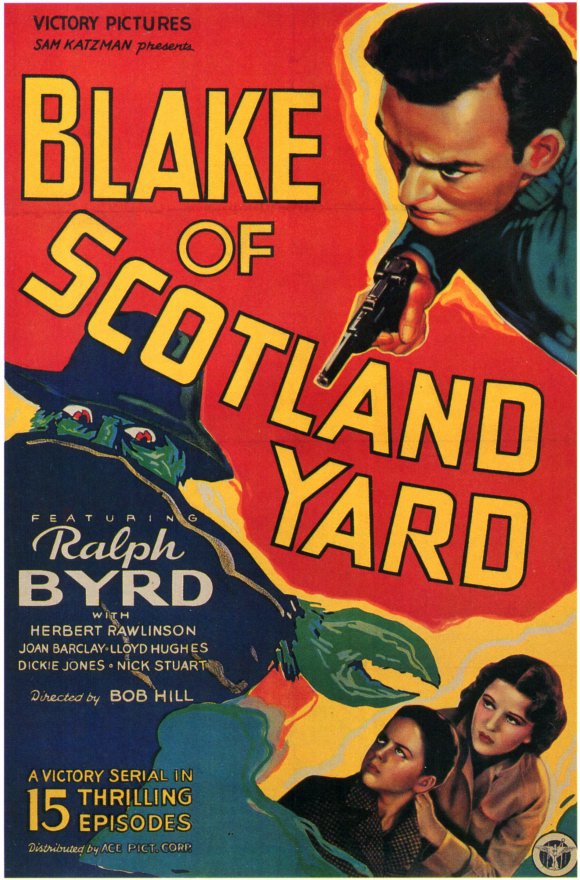
This is what I fell victim to. I had a complete version of Blake of Scotland Yard on VHS. I used a DVD/VHS deck to transfer it to a DVD. That deck broke and nothing else plays the DVDs. This is a situation I am still trying to to remedy. So cut to the present: I am hankering for serials anew, more specifically my favorites. I see Blake of Scotland Yard on Amazon and order it. Now I got two more serials there which are whole but this one is a so-called “composite.” Something I am just learning about and passing along.

So I may or may not watch this confounding version which is 73 minutes long as opposed to 303, (over four times shorter!) but I will not enjoy it.

So, buyer beware: before renting or buying a serial I implore you to check the running time they typically should run well in excess of three hours, so anything in typical feature length range is cut.

Happy viewing.

The Movie Rat’s Manifesto

Welcome to The Movie Rat. This blog’s name comes from a term I came up with for a friend of mine when we went to the movies every Saturday for a matinee and at least one other film. We were like mallrats except we went to the movies eventually he lost interest but I kept on going.

So a new blog and infinite possibilities and here there won’t be any annoying restrictions such as trying to keep one of the most universal artforms in the world “localized.”

What does one do when one sets out to start a new blog. Well, for the time being anyway, whatever one wants.

However, I am starting with this manifesto to let you know a few things I plan on doing and conversely not doing.

So here are some things you can expect and some things I will venture to avoid, five things in each category sounds like a decent start…

I will:

-Be re-posting older articles slowly but surely.

-Do daily themes such as: Monochromatic Monday, Two For Tuesday, Weird Wednesday, Theme Thursday and Film History Friday. These may change. I also Plan writing longer more theory-based papers from time to time. I have ideas for both Metropolis and Zé do Caixão (Coffin Joe).

-Will offer “seasonally appropriate” reviews: For exampled, TCM is currently doing 31 Days of Oscar. From September 1 through October 31st there will be a glut of horror titles, from November 1st through Thanksgiving; foreign films and Christmas-themed (sometimes only slightly) in December.

-Always be looking for new and unique films as well as different ways of viewing and/or acquiring them and being a consumer advocate to an extent.

-Always write personally. No matter how informed one is I will not presume that my opinion is anyone else’s. I firmly believe in the assertion that no two people ever watch the same film and can only offer my views and interpretations and if I need to use a few “Me’s” and “I’s” to convey that so be it.

I will not:

– Discuss the MPAA here. Ratings exist for a reason but I personally do not care. The MPAA, if you visit their site (www.mpaa.org), will explain its reason(s) and other reviewers will give you their slant on the rating (I suggest: www.lights-camera-jackson.com – he is a kid who is also a professional critic and always includes how kid-friendly a movie is) but it is of no concern to me. I am not a parental aid I am only interested in aesthetics. I would not deign to judge what is and is not appropriate for your children that is a decision that all parents must make on their own based solely upon their values and what they believe their children should see, hear or can handle.

– Use the phrase “well-intentioned.” Few films, if any, have bad intentions.

– Avoid, at all costs, saying “it’s the best of its kind since such and such” for I am likely to have missed films of its ilk since such and such and you may disagree with my opinion of the former film and therefore I won’t adequately express my sentiments if that’s all I say.

– Since I discussed hyperbole above I will not say I am going to post something. I mentioned on more than one occasion on Examiner that I was planning on writing something about hyperbole in film criticism. And I was, but I never did.

– Confuse the person with the artist, or allow any other bias I may have, creep in without at least addressing it and letting you know that there is a grain of salt. Unless, it’s a first run or DVD review this will be a very positive site but unfortunately some movies are bad and it needs to be said, however, I do believe that in an overwhelming majority of them there is at least some redeeming quality.

I’m sure there’s probably more I can add. Suggestions would be more than welcome, for either category. Starting tomorrow the fun really starts.

Comrade Kermit and the Myth of Childhood Indoctrination

UPDATE: After the text watch a video of a UK press conference where Kermit and Miss Piggy respond to Fox News! Kudos to Movies.com where I first saw the video linked.

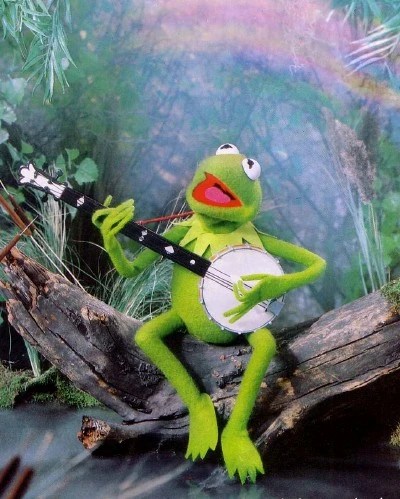
By now you all may know and are tired of hearing about the whole Fox News debate about The Muppets.

The first thing I will say is that the reason I am writing this entry and bringing it up at all is to address the larger issue of brainwashing in children’s entertainment.

To specifically address the film in question any film wherein the the antagonist, the meanie who is vilifying big oil, actually says “Maniacal laugh” repeatedly as opposed to maniacally laughing shouldn’t be taken too seriously as anything besides entertainment. Furthermore, let us also note that this is a film wherein a grown man and a felt puppet are biological siblings and believe me that is something kids get and accept as they willfully suspend disbelief a lot. The fact of the matter is kids can have deep thoughts about shallow subjects too. It is adults who in turn ascribe other or hidden meanings to things, whereas kids tend to take things at face value.

More to the point any and all these “troublesome” symbols or plot points you could point out would be a lot more influential if we all lived in a vacuum. If there’s one thing that dictatorships have proven is that brainwashing is not a myth, however, it typically also needs isolation, torture and sensory deprivation to work. Therefore just because someone sees The Muppets at six doesn’t meant they’re going to become an eco-terrorist.

It’s not that simple because people aren’t that simple. We’re not automatons (Holy subliminal Hugo reference, Batman!). Granted I’m not saying that all 7 Billion plus of us are beacons of deductive reasoning or balanced thought processes but what I am saying is that “The Muppets made me do it” is not something someone in their right mind would say.

I’ll grant you that I’m oversimplifying in the above statement, however, that’s what these allegations against children’s entertainment ultimately boil down to. Cindy saw The Muppets and bought a hybrid or Bobby watched Sesame Street an now lives with a guy named Ernie. That’s not how it works.

Anyone who has gone beyond an introductory level film course and done any work in theory knows that cinema is malleable enough such that you can impose any meaning you want on a symbol or a motif, however, that doesn’t make your argument sound. You could argue, if you were so inclined, that Thelma & Louise was really about the dangers of social drinking but it’s a lot more of a stretch than discussing it as a feminist work.

In my last post I wrote about The Sitter what I inferred but did not say in that piece was that clearly I find the inclusion of those themes important and so will audience members who identify with those sentiments, having said that the film can try as it may but it won’t dictate your reaction. An example would be what I cited as the most moving line of the film. The intent of the line is to make you feel empathy, sadness, shock or depressed upon hearing a young person say what he says. The goal is not laughter, it’s not a punchline- yet someone in the auditorium took it as such.

So there we are all watching the same thing, the writer and director have X number of desired results, but inevitably there will be audience members who are outliers. They might still like it but for different reasons but missed the intent.

We all bring our own baggage to a film, the ideal is to check it at the door but we do. Another truism is that “No two people ever watch the same film.” However, that’s true and despite all the training even if you and your friend read all the same film texts you’d still have different takes.

The notion that children, and people in general, are all mindless simpletons who can’t process information on their own and are susceptible to every form of pseudo-propaganda whether real or imagined is troubling. It gives entertainment too much credit in a negative way when most people look to it for an escape or to reinforce things they already hold near and dear to their hearts.

The reason I take such a laughable subject seriously is due in part to fact that it came over the airwaves on TV, on a supposed TV News station. Now all 24-Hour News Networks are iffy these days and with the reality ethos so prevalent on all networks whether this is a sincerely held belief or one that was exaggerated to inflate ratings it equals the same thing; perception is reality. It is said therefore it is real therefore belief is inferred both by the person hearing it at home and on the part of the speaker of said opinion. So rather than dismissing the opinion I decided to tell you why it doesn’t make sense. I think I have.

Then, of course, there’s the obvious: The Muppets are now a Disney property. Disney is a multinational, multi-billion dollar corporation. Do you really think they want to breed communists who, if they’re really communists, would have to shun their commercial empire thus not line their pockets? Disney was creating a product and in this case they did a fantastic job as they updated the characters but also pleased many long-standing fans.

In the end I think in this day and age we all have a sense of the impact of art, advertising, literature, music or anything with a message inherent or inferred can have on us. Reflexive thought is all around us. This is perhaps best exemplified by the 1800 Tequila ads with Michael Imperioli where he discusses commercials. “This is a commercial for tequila.” And that line will influence this paragraph and I am well aware of it. The bottom line is: Commercials want to sell you things, some of those things are movies. Movies want to entertain you and make you think but no matter how hard they try they can’t tell you how to think. Telling you how to think is a kind of what many politicians and pundits are doing and that’s why they really think listening to the Muppets is bad. It’s not as much about what’s being said as who is saying it.

BAM Award Winners: Best Hair and Makeup

This another recently added category. The nature of this category in both the Oscars and here is that usually there needs to be something a little beyond a good, simple makeup job being done. A good makeup job is expected. When it’s not a given, like in the first Twilight, it can be a huge distraction. What usually is above and beyond the call of duty is incorporating a prosthetic, bruising, making up for black-and-white and cuts aside from the usual makeup scheme.

In terms of crediting the award I have decided to credit the film only here. Typically I have included the key makeup artist, however, that overlooks the large crew that works in the department so I felt it more appropriate to acknowledge the film as a whole and not just the department head.

Category became Hair and Makeup in 2021.

Here are those who have gone a little beyond:

2024 The Substance

2023 Sally Alcott, Robb Crafer, David Darby, Carmel Jackson, Alex Lawton, John Nolan Wonka

keegan-michael-key-on-starring-in-wonka-with-timothee-chalamet

2022 John Russell, Natasa Krstic Hellraiser

hellraiser-2022

2021 Malignant 

what-could-malignant-2-be-about-1638224731

2020 The Wretched

2019 Joker

2018 A Wrinkle in Time

2017 Wonder

2016 Donald Trump’s The Art of the Deal: The Movie

img_3399

2015 We Are Still Here

WE-ARE-STILL-HERE_Dagmar

2014 Unbroken

Unbroken (2014, Warner Bros.)

2013 The Hobbit: The Desolation of Smaug

The Hobbit: The Desolation of Smaug (2013, New Line Cinema/Warner Bros.)

2012 Holy Motors

Holy Motors (2012, Indomina)

2011 Tucker & Dale vs. Evil

2010 The White Ribbon

The White Ribbon (2009, Sony Pictures Classics)

2009 The Unborn

The Unborn (2009, Rogue)

2008 The Chronicles of Narnia: Prince Caspian

2007 Harry Potter and the Order of the Phoenix

Harry Potter and the Order of the Phoenix (2007)

2006 Transamerica

Transamerica (2006, IFC Films)

2005 Star Wars: Episode III – Revenge of the Sith

Star Wars: Episode III - Revenge of the Sith

2004 Shaun of the Dead

Shaun of the Dead (2004, Universal/Studio Canal)