Free Movie Friday: Semper Est Sperare (Always Hope)

Similar to my last post in this category this is one where I recuse myself on commenting too much in a critical capacity, but do want to link to it, and promote it, because one of the stories within this documentary pertains to close personal friends of mine.

And, following on the heels of sharing this film from Jacks Gap on other forms of social media, I believe in both opening avenues to discussion on mental health issues, and doing what I can to try and end the stigma.

This is a topic that actually has some current traction in the States as this recent piece by John Oliver comes to mind.

The feature is little more than and hour, so if you see all three you have three strong voices; young, older, and in between trying to keep the debate going and end stigmatization. Keep the conversation going.

The Wonderful Grace Kelly Blogathon: The Swan (1956)

Introduction

This is the first of two consecutive blogathon participations where I had intended to read the original texts (the play in this case, and the novel in the next). As it stands, these grandiose plans will have to be scrapped, and I will need to include both The Swan along with the Tin Drum (should I get to the book) to the long list of titles I watched before I read. Most of the Hungarian playwright, Ferenc Molnár’s, works are available online in the public domain either on Project Gutenberg or Internet Archive.

As for the film version, which was released in 1956 (four years after Molnár’s death) was one of Grace Kelly’s final screen credits before retiring from the screen after becoming Queen of Monaco.

A renewed interest in Kelly, sparked partially by the forgettable Grace of Monaco, is what drew me to this blogathon, and Molnár and this connection to her late career drew me to The Swan.

Grace Kelly the Swan

The Swan (1956, MGM)

Firstly, yes, I believe I will be reading Molnár’s work after having seen this film. More on that later, but first the focus of the blogathon: Grace.

One thing that was interesting to see, as someone who has now seen nearly 1/3 of her scant titles, was the added range this role allows her. We all have blind spots almost everywhere, even film enthusiasts, and Grace outside Hitch’s movies was one of mine. Kelly was Hitchcock’s perfect blond not only in terms of appearance but for how he could cool down her refined class, and make her be quiet, or calculating, or a cipher as the case may be. Here she was likely drawing off real-life emotions but was allowed several facets – a few I’d not quite seen.

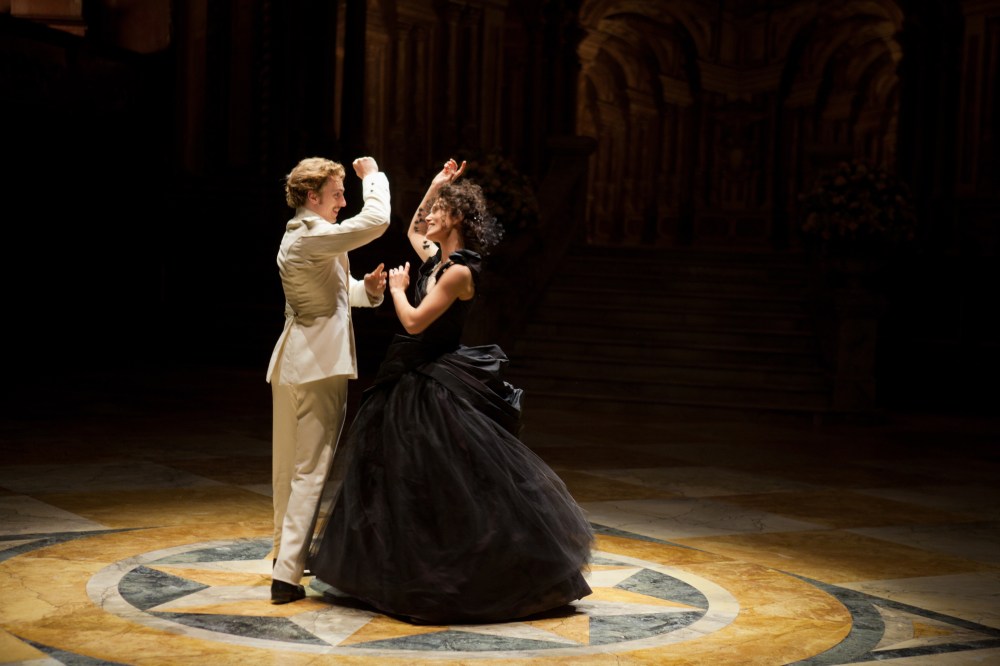
Firstly, there is the physical prowess she exudes. Now, it’s very clear from the first time you watch her that few actors’ names were ever so fitting as Grace Kelly’s. She has a regal air and gait anyway, always, did but when you add her fencing, ballroom dancing, and some of her emotional vulnerability it’s very impressive. Emotionally she’s ill-at-ease, distraught, nervous, and very noticeably listening and reacting in the most intense scenes.

The Swan (1956, MGM)

That and she’s practically a textbook example, even in Cinemascope, of the rule that actors on film must adjust to the framing; having more leeway of movement and gestures in wide shots and being more subtle the closer the camera comes. Not that it’s ever that close as there are lots of wide shots and long takes.

This and the minimal airing out of the play were used to exploit Cinemascope, which was created to offer something TV couldn’t play up some the of theatrical elements in a cinematic milieu, fitting as much early TV were playhouse shows and the lines of theatre, television, and film were blurred.

The drawing from real life experience is not me stretching that she was royalty later and plays royalty here, this film was actually released shortly after her marriage to Prince Rainier of Monaco, surely that was part of the appeal to her and to MGM’s marketing department. “I want to be a queen” she protests at one point as her becoming a princess was imminent.

Hungary

Flag_of_Hungary_(1867-1918).svg

The setting of this film is labeled as Central Europe 1910, but it’s really the Austro-Hungarian Empire right before World War One. The decadence of the Empire in its latter days has been fodder for Hungarian writers and will likely continue to be. This was a project that director Charles Vidor could relate to as he was one of many who left either Hungary or Austria-Hungary before it to Hollywood. Born Károly Vidor in Budapest, 1900; he was around the age of Alexandra’s brothers at this time.

However, some of the setting is evident even in Anglicized text like the paddle game, mentions of the great plain, the Puszta; which I never heard being referred to as a place where mirages frequently happen; Szeged and (where your paprika likely comes from). I was also glad they broke into French on occasion which was almost universally the language of European royal courts. At least this is a compromise of the convention of translating to English.

Whereas sometimes foreign comedies don’t translate this does because it’s about dry wit, impropriety in highly proper environments and some well-played, subtle physical comedy.

Themes and Motifs

The Swan (1956, MGM)

The themes and motifs in this film are quite apparent but very much appreciate nonetheless. Among them are the role of religion in politics and maintaining the status quo. Father Hyacinth, the monk and a relative, is likely an underrated character and quite shrewd. He’s nearly duplicitous in his ability to influence even though he also admonishes the royals, most of the characters are layered like this rather than being archetypes. There are also overtures of class warfare, the rights to culture and one’s “place in society.” As is not atypical with royals, and in Hollywood couples, there is an age difference of 15 years. The plot also centers on marrying for political gain versus love, there’s a refreshing spin on jealousy plots and a jilted lover.

Conclusion

Grace Kelly wedding photo

This film is also proof that older films are worth watching despite their Oscar pedigree or lack thereof. The film is an early Cinemascope title, the sets are as opulent as Golden Age mise-en-scènes, and the score by Bronislau Kaper, albeit sparsely used is mellifluous.

Despite focusing on Kelly it is an ensemble piece and aptly performed by Alec Guinness, Louis Jourdan, Jessie Royce Landis, Brian Aherne, Estelle Winwood, Agnes Moorehead, Christopher Cook and Van Dyke Parks.

Even though there is a slight bit of predictability, I appreciated the refereshing take on a manipulated love triangle and the sociopolitical themes aside from the romance.

The Swan (1956, MGM)
The Swan, a nickname and metaphor that plays early and late in the film. To not tease the end too much I was not surprised what the ending was after seeing Internet commentary like “the end didn’t work for me.” Keeping in mind the cultural relativism of Hungrian works, which I am familiar with, as well as realistic expectations in the real worls and not in Hollywood claptrap the ending makes perfect sense and it is all the more bittersweetly beautiful for it.

Review: Off White Lies

Off White Lies

I find myself commenting on a film’s subtlety quite often. Rather than sounding like a broken record I will expound on that. It’s one think to tell an intricate story without spoon-feeding an audience like say Tinker Tailor Soldier Spy, and another to tell a simple story in a straightforward way. However, to tell a simple story, subtly; jumping in medias res and making revelations indirectly rather than with overt exposition is quite a feat. As is often the case, it’s not necessarily the end destination that matters with a film, it’s the journey. With necessary information being delivered when absolutely necessary and without drawing attention to itself we are allowed instead to focus on the characters and how they interact. This is especially helpful when dealing with a father-daughter dynamic. We see how they interact and the why becomes more and more apparent as we learn more about them.

The story, such as it is, moves rather smoothly ends at an appropriate time and features good performances all around.

8/10

Rewind Review: Despicable Me

Probably the hallmark of Despicable Me is that it has great sight gags and they will hit you very frequently indeed. Whether through dialogue or by visuals this film will have you laughing one way or another and that kind of persistence is something you have to love. It is a surprisingly good film because you may have thought it revealed all the tricks up its sleeve over the year plus Universal has been promoting it but there is more in store believe me.
It is also a film that asks you to take things at face value. It will not bend over backwards to establish this is the universe in which our story exists but instead will show you it. It may be challenging for adults who have to willfully suspend disbelief while children will gladly do so. One thing to keep in mind is that the inciting incident of this film is the discovery that a pyramid has been stolen and been replaced by an inflatable. In a world where such a thing can happen nearly anything can like orphans selling cookies, same-day adoption, shrink rays, etc.

A standout feature of the film was the score and particularly the “Despicable Me” theme song sung by Pharrell Williams. Heitor Pereira has long been making valuable contributions to film scores but his work on this film might be his calling card in the future.

Despicable Me (2010, Universal)

Despite the fact that the names of the actors were heavily advertised as well, the cast does a fantastic job of becoming invisible and blending in to their characters. Examples being Russell Brand who plays the elderly assistant Dr. Nefario. Miranda Cosgrove who plays Margo the oldest girl and you do even stop thinking about Steve Carell as Gru and just see Gru.

This is a film the effectively incorporates flashbacks to illustrate who Gru is on more than one occasion so we can see what his motivation for his lunatic plan is and why he feels he must do it but we also take the journey and start to see his change of heart. It is a film that also finds an extra villain, at least a temporary one, in a somewhat unexpected place.

The film really is ingenious on a number of fronts with its gadgets and gizmos, aforementioned sight gags, with the whole plot about the moon but especially with the creation of the minions. You get here the rare thing created in animation that just you can’t quite classify, you know not what language they speak or where they’re from but they’re just there and it’s great.

Despicable Me (2010, Universal)

The creativity and the quality of this film again illustrates how the animated feature is flourishing. About the only thing you can hold against the film is that Gru doesn’t explain that he didn’t call the orphanage, you understand he is torn at the moment but considering the character he is dealing with she could’ve been even more forceful in taking them back leaving him feeling worse.

Even with that Despicable Me is a joy to watch from start to finish and one of the summer’s most pleasant surprises and was, overall, a more throughly enjoyable experience than Toy Story 3. This film will likely be the most entitled to feel robbed should the Academy’s love affair with Pixar continue.
8/10

Review: Goosebumps (2015)

Not long ago my personal history with the works of R.L. Stine was discussed here in another post:

As I’ve reference a few times, in my youth I had an aversion to horror. I didn’t relish being scared back then. As someone who gravitated to the genre later in life, I take no umbrage with the idea of juvenile horror such as the likes that R.L. Stine creates. Yes, many kids (much younger than I when I was started to read Desperation), cut their teeth on Stephen King. However, not all kids are the same (which is a small part of why I avoid giving parental guidance advice). However, I can remember instances where a certain frightening tale did intrigue me; Poe would be an example. Had I at a young age know of Stine I may have gravitated to the genre earlier.

This year, having had a number of his books come to me secondhand, I’ve read quite a few before donating them to the local library; and as evidenced by the TV shows that bear his name, they are twisted tales that don’t always work out so great for the protagonist, which can really scare kids. (I hope to prepare aa post [or a series of them] about The Haunting Hour, the series, before Halloween).

In having read some titles naturally one’s flim-inclined tendency is to mentally adapt as you go; see it as a film and think it as a film. The issue then becomes which of his myriad books to cover, which is why this film version is not only so ingenious, but also timely.

Goosebumps (2015, Columbia)

This film tells its tale from the perspective of a new kid in town, Zach (Dylan Minnette), who is intrigued by his mysterious next door neighbor, Hannah (Odeya Rush), and then threatened by her unfriendly father (Jack Black). The father is a fictionalized version of Stine whose literary monsters have become real, and must be kept bound in their manuscripts. A trio of kids along with the quirky, insistent new best friend, Champ very aptly portrayed by Ryan Lee; use their smarts on the subject, wits and bravery to battle this legion of nasties.

The angle of approach employing not only the meta aspect for additional comedy but introducing a new cinematic universe, which is clearly in vogue at the moment, is clever. Granted at times there is some of it that comes off as a very humorous, well-produced infomercial but it flows naturally. And let’s face it, name recognition comes into play in existing cinematic universes as well and Stine, despite his popularity with a certain set isn’t as renowned as say Stephen King.

The strongest segment of the film is the first act, which is in turn both a good and bad thing. It sets the film out in a strong way with a great build, the comedy clicks, the performers are in tune, the score excels and pushes the film along. Into the second and third act the innovation and freshness slow a bit apace and some steam runs out of the clever conception but it remains enjoyable throughout.

Goosebumps (2015, Columbia)

Danny Elfman’s score, one of his best in a number of years, is nearly all that remains consistently on point throughout. The Sony Animation Studios credit is noteworthy as the animation is very present effects are strong throughout – even though very much animated the blend is quite good.

Jack Black is a performer who I had not appreciated until he won me over entirely with his virtuoso performance in School of Rock. Over the past five years the only film of his that I’ve seen is another Linklater project, Bernie, which was rather a departure for him. It was good to see him again, and in great form at that. He’s restrained as Stine and cuts loose as the voice of Slappy and The Invisible Boy – a fact I didn’t know until I checked the end credits.

The other standout in the adult cast is Jillian Bell as Lorraine. Her scene with Black is comedic gold.

Goosebumps (2015, Columbia)

Whereas, Goosebumps as a show revealed many young stars, this film does a bit more of what The Haunting Hour did and use some proven younger actors Minnette, most recently seen in Alexander…, Ryan Lee, one of the revelations of Super 8 continues to cultivate his frantically nebbish cinematic persona.

Quality films that are also appropriate for kids are perhaps the most rare, even more so when they can actually scare kids also. Stine has that knack and this film that bears his most famous series’ name does too.

Swashathon: Robin Hood Daffy (1958)

Introduction

This is my contribution for the Swashathon hosted by Movies Silently.

Robin Hood Daffy (1958)

Robin Hood Daffy (1958, Warner Bros.)

This was another blogathon where I thought I would not have a title to contribute. Part of it had to do with the fact that Swashbuckling is such a niche that I didn’t think I’d have much to contribute as it’s not one I can claim any level of expertise in. I could’ve offered up for Kim but that would require a re-watch and it didn’t jibe with my schedule. That’s when on a double-check (triple-check? quadruple-check?) I noticed that Robin Hood Daffy was there and I just had to write about it. Any chance to discuss the Looney Tunes is a good one.

I know this short very well, as I know many, so it prompted me to look up the precise definition of swashbuckling as my understanding over-emphisized sword-play and I knew Daffy’s Robin Hood never had a sword.

The definition reads as follows:
—noun
1 a swaggering swordsman, soldier, or adventurer; daredevil.

Robin Hood Daffy (1958, Warner Bros.)

So there it fits.

As for the Looney rendering of the tale of Robin Hood there are some things that are worth noting without giving a blow-by-blow of a short that runs fewer than seven minutes.

Perhaps first and most importantly is the notion of cartoon casting. And by this I do not mean voice actors. For once Warner had Mel Blanc in the fold they knew they had a good thing and he was one-man show. What I mean is match the existing characters in a stable of cartoon talent as the parts in an adaptation, matching the correct types. Daffy as a hapless Robin and Porky as a jolly and sarcastic Tuck is perfect and offers a brilliant send-up of the Robin Hood tropes and story.

Another commonality this shares with other great Looney Tunes is the direction of Chuck Jones. Jones being one I so admired he was the first director whose writing I read, in Chuck Reducks.

Robin Hood Daffy (1958, Warner Bros.)

This short is also a reflection of my understanding of film progressing, or maybe it’s more proper to say it is an astute example of children’s innate ability to grasp adaptation and different renditions of similar material. What I mean is that Disney’s Robin Hood was at the time likely my favorite movie, and remains my favorite Disney film. They represent two drastically different approaches to the anthropomorphizing of the Robin Hood characters, in two different film forms, but use the same medium (animation). I loved them both growing up, much in the same way as I enjoyed the goofy 1966 Batman TV series as well as the 1989 Tim Burton film, and the new school. I later saw the Errol Flynn-starring Robin Hood in High School.

The gags are spectacular, and some are among my all time favorites such as Daffy’s minstrel song, “Ho, ho, very funny. Haha, it is to laugh”, “Yoicks! And away!”, and more.

The work is elevated to the level of genius in set-up (Tuck/Porky doesn’t believe Daffy is Hood). And then the payoff at the end. It so perfectly befits them both and should be known to children and film buffs everywhere if it isn’t already.

One Of My Favorite Cartoons Blogathon: Duck Amuck (1953)

Duck Amuck (1953) 

This is a post written as part of the One of My Favorite Cartoons Blogathon hosted by Movie Movie Blog Blog. Firstly, I must sya that I am thankful that I didn’t have to narrow it down to just one.

Next, considering the fact that I just wrote about another Looney Tunes short that’s tangentially similar to this one it was a natural choice. That superficiality is that this short starts like its going to be another swashbuckling tale not unlike the later Robin Hood Daffy but with this one being a Musketeers tale.

However, we soon see that there is something very different afoot here as this tale starts to play with the conventions of animation as the unseen animator starts to taunt Daffy having him walk off backgrounds/sets, putting him in perpetually juxtaposed situations like having him change into ski attire to match the newly alpine environs only to have him them ski onto a Hawaiian beach.

Duck Amuck (1953, Warner Bros.)

This then escalate as he is erases faced with being muted and creating incongruous sound effects. Things continue to childish backgrounds, changing his whole physiognomy, a childish background, invasion of black to the image, doubled frames, a premature end, and then finally, the coup de grâce is that the fourth wall is demolished as we leave the world of the cell to see who it was who was animating him. This short was already meta enough it just had to add the cherry on top with a hilarious, perfect cameo.

This is one I still had bits memorized from even though I’d not seen it in years. What this blogathon prompted me to do was to listen to the commentary and watch the featurette that accompany this short on the Golden Collection DVD set, which I had not yet seen.

Much of the commentary is provided by Michael Barrier, an author who wrote about the golden age of the animated short. He documented the fact that Warners were resistant to using Bugs in such a limited role (as the invisible-until-the-end animator). The animators discuss in the featurette how it had to be him based on the dynamics of their relationship.

Duck Amuck (1953, Warner Bros.)

The idea started with the germ of the concept without an end in mind, as was frequently the way Chuck Jones did things. Aside from the struggles against the studio where they had to be defiant and use Bugs anyway there was also the internal battle between Jones and animator Ed Selzer. Daffy has an abnormally long monologue in this film (800-feet of stock). Selzer wanted to run a pencil test with synchronized sound to prove the animation he had worked with the pauses built in. Jones wasn’t sure. Warners were always budget conscious (even though these tests were never deeloped), and pencil tests were scarce. Ones with sound were unheard of. Selzer was proved correct.

Duck Amuck is definitely one of the finest Looney Tunes shorts ever. Much of that is echoed in the featurette entitled “Hard Luck Duck” that features interviews with Willi Ito, Bob Melendez, Chuck Jones, Leonard Maltin, Joe Alaskey, Jerry Beck, Noel Blanc, Art Leonardi.

Disney was frequently at its best when they let their creativity cut loose like in the Pink Elephants sequence of Dumbo, the same can be said for Warners as evidenced in Duck Amuck.

Mini-Review: The Inheritance (A Partilha)

Based on a hit Brazilian play the screenplay also co-written by Miguel Falabella is wonderful. If you can get a hold of this movie it’s really worthwhile. Glória Pires, Lilia Cabral, Andrea Beltrão, and Paloma Duarte interact as real sisters do and it’s great fun watching them try to steal scenes from one another. The interesting thing about this film is that it was filmed with all master shots and it’s incredible how well it works in a comedy. The performances truly shine in this film which is funny and often touching. This is a film that is universally funny and appealing and I’m surprised it didn’t get wider exposure

10/10

Mini-Review: Shun Li and the Poet

Shun Li and the Poet

Any look at different immigration patterns worldwide will pique my interest to an extent. However, what’s most compelling here isn’t just insight into Chinese émigrés but the characters they play and the performances delivered. This is a warm, moving film that is beautifully photographed.

8/10