Commentary

Camera Movement in Fear of the Dark
Film Criticism can be applied anywhere and a salient, valid point can be found in nearly any film whatsoever. A case in point would be the film Fear of the Dark. It’s a 2002 independent Canadian production and co-stars Kevin Zegers, best known from Transamerica, and Jesse James, best known as Helen Hunt’s son in As Good As It Gets. It’s a low-budget horror film with deals with a very simple concept, which is “What if there are beings in the dark to be feared, and what if they can hurt you?”
This was a film I recently re-viewed and what struck me was the amount of movement the camera made in the course of the film. It’s all to build tension and was effective but what was striking is that since handholding wasn’t exactly as in vogue when this film was made as it is now so the movements were almost all controlled dollies, pans, pushes, and tilts.
In all, the estimate is 225 shots in the film in which there is significant movement. The film runs 86 minutes so that’s an average of 2.6 moving shots per minute. That is dedication to a stylistic decision. What’s more the shots are very creative such as:
10. Tracking shots following skateboards.
16. Vertigo shot pushing down the stairs.
66. Reflection shot in mirror pull back and create an in-mirror Two-Shot/OTS combo.
76. Swish Pan.
91. Sped up dolly shot.
93. Crane down on house.
103. Push in reverse.
123. Circle shot.
211. Tracking and Reverse Tracking.
These are just some of the examples. Kudos to Marc Charlebois the Director of Photography and Director K.C. Bascome for daring to move the camera with a purpose and with effect and not whipping it about willy-nilly.

For Dario Argento Filmmaking is A Family Business
A few years ago I was fortunate enough to attend a horror convention that Dario Argento was attending. The following is a repost based on questions that I and a friend of mine were able to ask.
A friend of mine asked Dario Argento during a Q & A session at this year’s Monster-Mania on March 13th if he found it challenging to work with family. His answer was quite insightful and rather great.
He said it’s like a “bottega nascimentale,” which is roughly translated as a family business. He said it’s easy his grandfather was a distributor his father and brother are producers. Now his daughter Asia is a actor and director. He called it the “Italian style” and it is truly the only way he knows how to work and it’s worked well for him.
The Pop of Ted
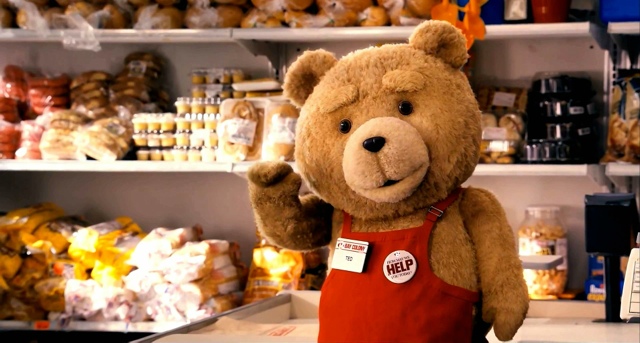
Anyone who watches Family Guy, or really any show Seth MacFarlane is involved with, knows that he and the writers have a passion not only for non-sequitor flashbacks and cutaways, but also pop culture references both ubiquitous and obscure. It’s one of the things you either love or hate about his style. I, for one, love it.
While there’s much to dislike about the now (in)famous cultural vegetables article in the New York Times, one very salient point that was made in it was in discussing Phineas and Ferb and how the writer’s niece would laugh at jokes she couldn’t understand because she had an inherent understanding of the comedic rhythm employed. I can relate to that because I used to do that. I’d laugh because something sounded funny or silly, then later when I’d learned what the reference meant or where it was drawn from that made it better.
Another thing that can be seen as useful about material so drenched in pop culture references is that it does bring things back to the fore. Every so often a movie, song or TV show will resurge in popularity. At times, it’s rather random, at others there is a catalyst-reference in another film.
Having seen a few Flash Gordon serials I was always curious to see the feature film version, but I never had until just after seeing Ted.
I was also one who either sought out older shows and music, but also had a lot of things introduced to me by my parents. If some kids are disinclined to be culturally indoctrinated in any way, shape or form a film like this; if parents approve of course, could create talking points. I know I already explained to a younger friend the significance and the funniness of the Teddy Ruxpin joke.
The more instantaneous, in many ways, the world gets the more important it can be to recall certain touchstones of the past regardless of what the subject. Whether it be something meaningful like the significance of the Berlin Wall coming down or who’s Tom Skerrit.
Time is a continuum not a vacuum, creating art in a vacuum can be a precarious, needless to say many artists do watch, read and listen to other artists in bygone eras, and whether consciously or unconsciously that exposure influences what is created now. However, literal referencing of said artistic influence, no matter how great or small, underlines a specific figure or work in the past that someone can glean something from.
Therein lies the significance of noting it. Rather than tirelessly discuss each reference I caught, I’ll list them below. A few of them added thanks to that same friend who saw it quite a few times more than me.
Pop Culture References in Ted:
Hasbro
Family Guy cast members
Bridget Jones’s Diary
Norah Jones
ALF
Johnny Carson
Belinda Carlisle video
The Notebook
Star Wars
Tintin (Destination Moon)
Saturday Night Fever flashback
Garfield
Tom Skerrit
Ryan Reynolds
E.T.
Jesus?
Peter Griffin (References as character in dialogue)
“This is art.”
Lance Armstrong’s
Veiled North by Northwest chase
Fenway Park
Scrabble
Spongebob Squarepants
Taylor Lautner
Music
Ted Is Captured / Raiders Of The Lost Ark
Flash’s Theme – Queen
Only Wanna Be With You – Hootie And The Blowfish
Come Away With Me – Norah Jones
All Time High (From The Motion Picture Octopussy) – Rita Coolidge
I Think We’re Alone Now – Tiffany
The Spirit of Little League
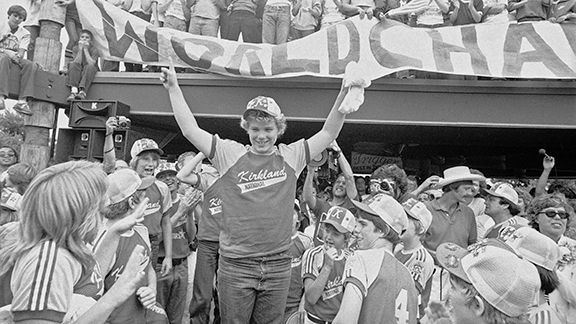
ESPN’s series of documentaries 30 for 30 tackled the 30 biggest stories in sports since ESPN’s launch in 1979, and many acclaimed filmmakers took the helm. The ESPN Films brand have since spun off to further sports docs. While I have not been able to catch all of them I have seen many and the series of films has been even more fascinating and riveting than many anticipated (Note: many of these films now stream on Netflix).
Little Big Men,the tale of the Kirkland, Washington team that captured the 1982 Little League World Series title, originally aired, interestingly enough, after this 2011 tournament’s completion; which made sense since most of the film dealt with their lives after the championship was claimed, and how the sociopolitical climate was ripe for these kids to be put on a pedestal, which made them heroes and symbols to be looked up to, and then taken down.
As is typically the case, there are mixed emotions in this film. All the players loved the experience and were still glad to have won in spite of the unforeseeable hoopla that followed them.
They also drove home the point that they played, trained and strove for the title because they wanted it and no one forced it upon them, which in this day and age is a legitimate concern.
The Little League World Series is a great event, having been there several times, it seems that all the players take it as a great experience regardless of outcome. However, the sentiments of the Washington players do bear repeating as the notion of enjoyment of the game being paramount is one that needs to be cultivated and should not be taken for granted. Just as players and parents need to learn and practice sportsmanship, so are constant reminders needed about the joys of baseball.
Here are a list of some films that vary in their quality, but all remind us why the game is great and will bide the time between now and next year’s Little League World Series:
The true story of the 1957 Monterrey team that won it all.
The Bad News Bears Go to Japan
Both versions of the tale need acknowledging, so I figured I’d highlight the end of the trilogy.
The Bad News Bears (2005)
It’s one of those remakes that make you scratch your head…until you see it. My apologies again, Billy Bob.
It’s only about baseball, and sports in a roundabout way, it’s really about nuclear disarmament and a movement; but it starts and ends on the diamond with one Little Leaguer and is one of the best examples of the power of sport.
Mickey
This is a film that was delayed and limited in many ways. Little League even assisted in the production, but I believe it began filming in an age when age fraud was largely fiction. Then the Almonte scandal broke. The film means well but is really a bad and misguided cautionary tale that does bad mentioning.
Small Ball: A Little League Story
This is a PBS documentary about a team from Aptos, CA that made the 2002 World Series that is a very balanced look at the process.
Commentary: Chris Massoglia – Sandlot to Silver Screen

It is not unusual for an athlete to either be an actor, or to become one at some point in their career. In this age of social media, and of the multi-taskers and multi-talented, it is not unusual at all. One hardly needs to list former athletes turned actors, for those who watch films frequently will likely know of at least one. However, one hardly hears of an athlete turned actor with a tale such as that of Chris Massoglia.
In the summer of 2004, Chris and the Robbinsdale Little League of Robbinsdale, MN, were one game away from a trip to Williamsport, PA and the Little League World Series. Playing the Regional final meant an appearance on ESPN for all the players. By that time Chris Massoglia had already appeared on TV. He was on an episode of Law and Order: Criminal Intent the year before and had just recently appeared in two episodes of Criminal Investigation, using the stage name Chris Kelly.
The commentators talked about Chris and his acting pursuits because on the ESPN questionnaire all the players get, so that the broadcast team can get a sense of who they are, Chris listed his nickname as “Hollywood.” He was dubbed so by his teammates due to his acting pursuits and now it seems that the moniker is quite prophetic and not the simplistic ribbing initially intended.
After a few more TV stints he appeared in the independent film A Plumm Summer, which can be viewed in its entirety on YouTube. However, his big break is still ahead with two upcoming lead roles. Now going by his given name, Massoglia has landed two huge roles.
First, he played Darren Shan in The Vampire’s Assistant. The film, was an anticipated potential franchise, featured a star-studded cast.
Chris also co-starred in Joe Dante’s Venice Film Festival Award-Winner The Hole.
One if not both of these films should be the launching pad for Massoglia’s stardom, and have him become one of the more unconventional athlete-turned actor-tales we’ve seen.
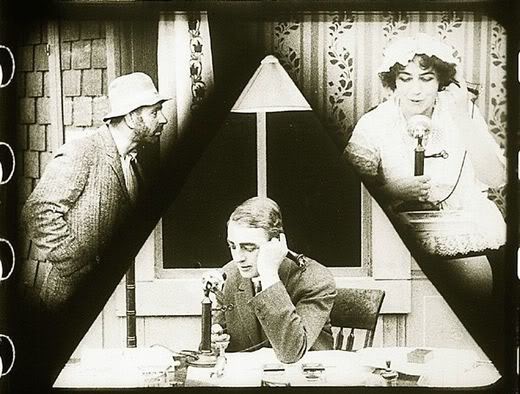
Nominate Films for the 2012 National Film Registry
Recently, while scrolling through Twitter I noticed quite a few people posting that the National Film Preservation Board is allowing the general public to suggest titles to be entered to the National Film Registry for the first time. You can read the pertinent details here. The only thing I found a bit confusing was whether an individual can select 50 titles from a calendar year (e.g. 1933) or if and individual may only suggest 50 per year. I erred toward the latter option. My choices feature many Hitchcock, Disney, horror, Looney Tunes; a few silents, docs, and the occasional footnote. What’s great is that since 575 films have been picked in 23 years they provide a list of significant films not yet selected for you to peruse. Of course, you can submit whatever you like if it fits their criteria. I made all my selections 25 years or older, however, the official cut-off is 10 years.
The National Film Registry was instituted after a bill was passed “Congress first established the National Film Registry in the 1988 National Film Preservation Act, and most recently extended the Registry with passage of the Library of Congress Sound Recording and Film Preservation Programs Reauthorization Act of 2008 (PL110-336).” So, essentially these are your tax dollars at work, America, so make some suggestions. If you’re curious you can read mine below:
1. Suspense (1913)
2. The Perils of Pauline (1914)
3. Charlie the Champion (1915)
4. Mickey’s Orphan’s (1931)
5. Skippy (1931)
6. Island of Lost Souls (1931)
7. Wild Boys of the Road (1931)
8. Babes in Toyland (1934)
9. Manhattan Melodrama (1934)
10. A Midsummer Night’s Dream (1935)
11. Son of Frankenstein (1939)
12. Rebecca (1940)
13. Dumbo (1941)
14. The Little Foxes (1941)
15. The Wolf Man (1941)
16. Gaslight (1944)
17. Mrs. Parkington (1944)
18. Three Caballeros (1945)
19. The Yearling (1946)
20. Panic in the Streets (1950)
21. Strangers on a Train (1951)
22. Limelight (1952)
23. House of Wax (1953)
24. It Came from Outer Space (1953)
25. Creature from the Black Lagoon (1954)
26. Them! (1954)
27.Lady and the Tramp (1955)
28. The Trouble with Harry (1955)
29. Forbidden Planet (1956)
30. Ali Baba Bunny (1957)
31. Witness for the Prosecution (1957)
32. The Children’s Hour (1961)
33. The Pit and the Pendulum (1961)
34. Whatever Happened to Baby Jane? (1962)
35. The Birds (1963)
36. Hush…Hush Sweet Charlotte (1964)
37. Wait Until Dark (1967)
38. Rosemary’s Baby (1968)
39. Willy Wonka and the Chocolate Factory (1971)
40. Texas Chainsaw Massacre (1974)
41. Carrie (1976)
42. Burden of Dreams (1982)
43. The Big Chill (1983)
44. A Christmas Story (1983)
45. National Lampoon’s Vacation (1983)
46. Terms of Endearment (1983)
47. Amadeus (1984)
48. The Times of Harvey Milk (1984)
49. The Breakfast Club (1985)
50. Stand by Me (1986)
Madagascar 3 & Brave: Audience Expectations and Narrative Goals
Shortly after writing about the drive-in experience I made my first trip of the season. The drive-in I frequent does double-features and usually the fit of the bill and whether or not I’ve seen the movies ends up being the deciding factor.
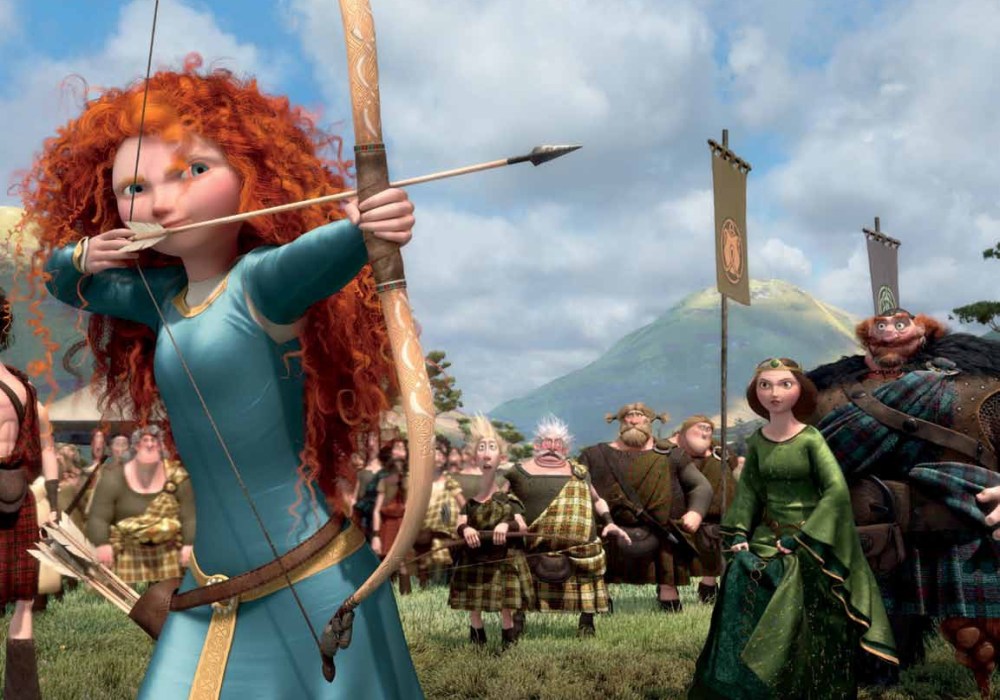
This time in the family-friendly block there were two animated films being shown Madagascar 3: Europe’s Most Wanted and Brave. The fact that I had seen neither, really wanted to see Brave and they were both in the same medium, made it an easy pick for me.
What I found to be most interesting is in comparing and contrasting the two films, which I did merely because I viewed them back-to-back and because they had any inherent narrative or thematic similarities aside from being in the same medium; is that it was a tremendous study in audience expectation and narrative goals.
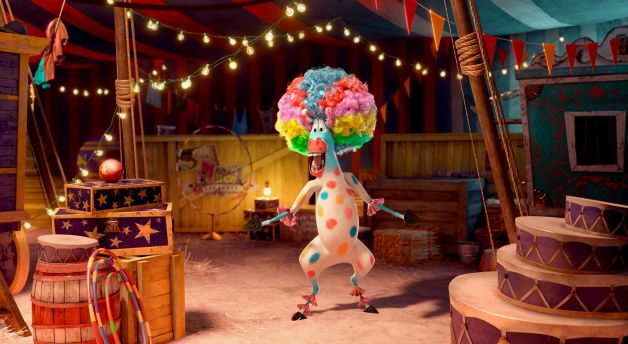
With regards to audience expectation: I expected next to nothing from Madagascar 3 except to hear the circus song again and laugh like some human version of Pavolv’s dog and I did, and I got some other chuckles out of it too, more than anticipated. Yes, there were things that were silly and overwrought but for fluff it was OK.
Whereas with Brave, just in the trappings of the story that I knew going in, the implications of those trappings and the potential it had based on that alone; set the bar was set very high.
Now, with regard to narrative goals what I mean is what the stories primary desire is. I believe, first and foremost, in judging a film on its own merits and with regard to what it is trying to accomplish. I won’t knock Austin Powers because it doesn’t stack up to Citizen Kane because it’s not trying to be that, it’s just trying to be funny. Granted with any genre film, yes, they want to successfully execute a story in the given genre and then if you get more out of it that’s icing on the cake, but the extras are not the main objective.
It’s trite but it’s probably easiest to think of it as setting a bar in the high jump, as I alluded to before. Madagascar didn’t set it so high but they cleared it, Brave set it really high and stumbled around a bit, in my estimation.

To be perfectly honest, I haven’t registered a grade on either film anywhere simply because I remember I saw them and found them both middling. Yet, as I alluded to before, that middling for Madagascar 3 is somewhat triumphant and for Brave was really disappointing based on what my perception of them was going in. In essence, I probably felt more frustrated after the better film. While there are still things that bothered me about how it was handled, Brave is still probably would be the one I’d pick if forced, and the one I’d be most likely to revisit.
I haven’t read a lot of press on Brave but I have a feeling that there were many who were talking about what they would’ve preferred happen. Without giving it away that’s not what I mean to say when I say it bothered me. I mean even with all the same givens and without reworking the circumstances there were elements there that could’ve been fine-tuned and much of what was likely to be good about it still was: the message, the struggle and the conflict.
Perhaps what’s most interesting is that I likely wouldn’t have drawn these parallels had I not seen them back-to-back but I did, and Brave was supposed to be the jewel in the crown. Yes, I hyped it a bit but having not read much in detail I did wonder what the complaints were about then the elements that didn’t connect as crisply as they could have came into the mix.
In the end, I thoughtthis a perfect opportunity to address those nuances in narrative evaluation that scores, regardless of you scale, can belie.
Why Goon Works
Not too long ago I was finally missing hockey enough that I decided I should watch Goon (For my rating, which will be omitted from this commentary, please go here). I had the conflicting emotions going in of having high hopes but also being somewhat guarded. As I have discussed with films set in Brazil, but made abroad, I have some trepidation when it comes to handling of subject matter is close to me. Hockey is one of those touchy subjects.
For example, when I was younger, I was obsessed with hockey (mostly with the New York Rangers) quite badly, such that I’ve had to temper that with conscious effort such that a win or loss doesn’t effect not only my day, but also the time that elapses in between. When I was younger I naturally would have had to rented Slapshot at some point. Now, the point of this piece is to discuss Goon, so suffice it to so say I was quite turned off, didn’t find it overly-amusing and didn’t think it got it. To paraphrase what Penelope Spheeris said about why she didn’t do This is Spinal Tap when offered “You’re making fun of these people,” and feeling a part of that scene she couldn’t see herself doing it. That’s how I feel Slapshot dealt with its subject matter, which is the polar opposite of how Goon does it.
I think Goon does understand, touch upon and convey so many nuances of the game that fans, and those involved in the game get that outsiders cannot and what it most amazing is that the film puts these notions in a great movie that’s accessible and enjoyable to the non-fan.
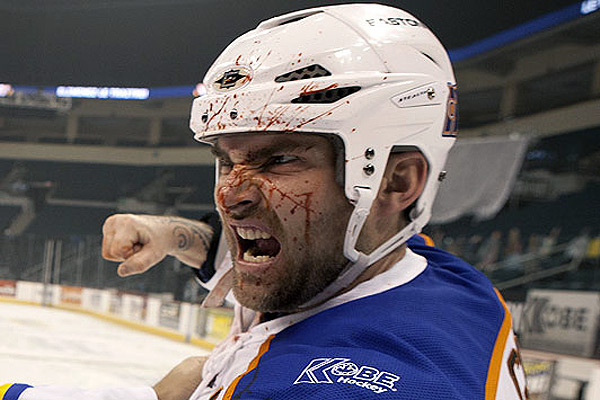
Clearly, Goon will deal mostly with fighting, as it chronicles the unlikely rise of a nobody into a minor celebrity at lower levels of the sport simply due to his prowess in fisticuffs.
While the film doesn’t get didactic about anything I feel it does thoroughly examine fighting as a part of the culture of a sport, the fabric of it really, and the mindset of said fighters. It shows the trade-offs you’re willing to make, what’s tolerated, what isn’t, momentum shifts a fight can cause; essentially the “necessity” of it.
While I, as a hockey fanatic, will grudgingly admit to the “necessity” of fighting I also cannot in good conscience leave it out of quotes and cannot just leave it at that. I think it also important to delineate that this is hockey we’re discussing and I compartmentalize. Just because I accept and understand a brutal, physical practice in a sport played by adults who agree to the risks they take on does not denote my feelings on nuclear proliferation, capital punishment or any other topic.
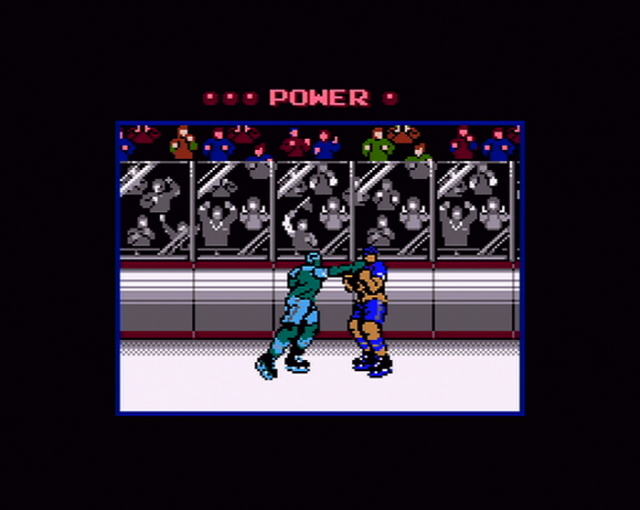
I think the film shows even while making spectacular out-of-this-world bouts that there are ramifications and consequences of many kinds in fighting. What bothers me most about the perception of fighting, which I hear all too frequently on debate shows when they deign to talk about hockey, is that it is allowed. It’s more accurate to say it’s an accepted practice, but it is not allowed. If it were allowed you’d have something akin to Blades of Steel, wherein only the loser was penalized, or what’s more no one was. If you fight you are assessed five minutes in the box. There can be a strategic purpose to it therefore it really is a more violent version of intentional fouls in basketball, or on rare occasions in soccer (aka football).
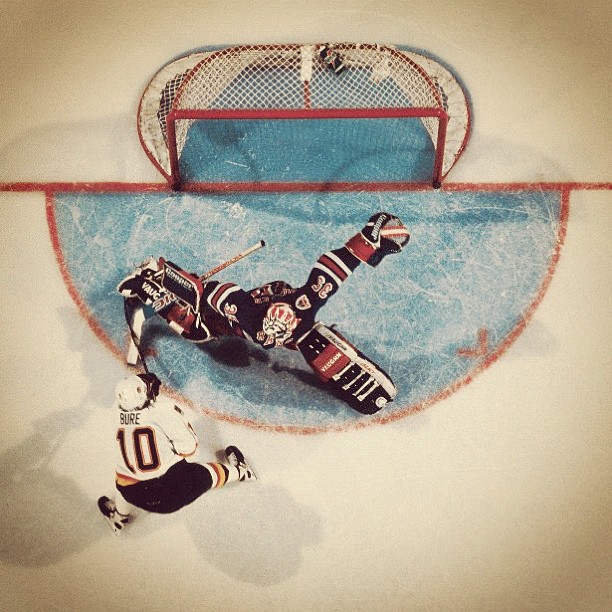
However, I can agree that hockey is likely the only sport wherein there are enforcers, whom you don’t expect goals or assists from, but whom you expect to protect said assets. The complaints are old, but some of the facts are new and Goon touches on the head injury issue.
With the growing animus in all sports to keep its participants safer never is the conversation more nebulous than around fighting in hockey. Many head injuries in hockey and football are typically the result of one player being either defenseless or unaware of the oncoming collision, in a hockey fight 99 times out 100, heck I’d wager 999 times out of 1000; you have both combatants know they’re about to deliver blows to one another’s head. It’s probably the clearest case of they know what they’re signing up for there is. Yet it’s the most vilified act in sports it seems, and I think what Goon does amazingly is humanizes these players, even ones that start out as caricatures. However, Doug Glatt, the lead played by Seann William Scott, is so well drawn. He’s a gentle giant, a consummate team player who will do whatever needs doing whether it be fighting or taking a puck to the face.
If the sport were to clamp down on fighting more would I still watch? Absolutely, and I think that those who argue attendance would drop don’t get it. It will only drop where there aren’t real fans of the game. With regard to player safety, I’m far more concerned about enforcement of blows to the head in the middle of a game at full speed than a fight, though I’m not going to act as if there are no cumulative ill effects health-wise there. It seems sports leagues are skewing towards legislating to avoid sudden cataclysmic injury rather than chronic ones.
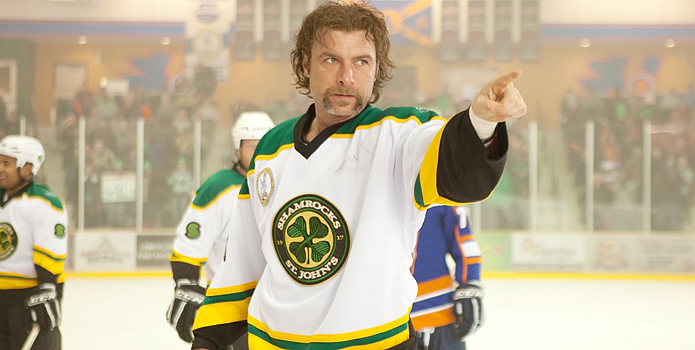
Now, while I’ve been off on a tangent, what the film does is the polar opposite of what I have, which is what makes it so good. It avoids bombast and soapboxing of any kind. For example, Glatt’s rival Ross Rhea, played by Liev Schreiber, talks to him, seems like an OK guy and steals a comment he made in his speech when having his number retired, but that’s the end of that thread. They have something to settle on the ice and won’t be distracted by off the ice stuff.
The film has pretty effective action sequences and really good looking hockey plays, which go beyond your typical insert of a puck bulging the twine. The totality of the handling of the sport in the film is amazing aside from narrative, performances, aesthetic and other production choices. However, fighting, because it is called Goon after all, is at the center of it and within the sport and without it’s a hot button type of issue and perhaps what I’ve been driving at, aside from letting some things off my chest, is that it dealt with it without pretension, condescension, excuses or even glorification, it just is. It’s in the game and that’s it.
In film one of the terms you’ll hear all the time is “raise the stakes.” Put more at risk, go bigger, bolder or higher for more dramatic impact. So, yes, Glatt is a superhuman fighter, some of the impacts and injuries in the fights are extreme and he does stop a shot with his face, and several subsequent stuff-in attempts, but when the tone, details and spirit and scenarios are all right then the occasional extravagance needed in film is far easier to accept.
If you were to cull through all the video you could find to create a montage, as long or as short as you want, to illustrate why you think a sport is great it probably won’t connect. If you put it in the context of a story then you have a chance of even getting neophytes along. For example, I know very little about cricket but I’ve really enjoyed films about it because of the common themes I could relate to the passion, strategy, desire to play, hero worship and so one (aside from the fact that it’s aesthetically great on film). Now, if you take many elements that make a game great and combine it with a great story that anybody can sit and watch then you’ve got a real winner.
Goon‘s success is attributable to the fact that it cares deeply about its story, its protagonist and the game it’s portraying and that’s all. It’s not trying to make any other statement at all, yet, paradoxically that’s just how it makes one. Hockey is a beautiful game and if those who run the sport treat it as well as this film does then it’ll be in great shape.

Film Thought: No List Is Ever Complete
I recall once that Roger Ebert tweeted a link and added to it something to the extent of “See this is why I don’t do lists.” I got his point. It was a completist’s one, meaning how can you legitimately make such and such a list claiming it’s ever or all-time when you haven’t, you couldn’t possibly, have seen every qualifying film. Fair enough.
However, it was only recently that I followed this line of thought out further when thinking of my own lists. If I say these are the 10 Best Examples of This I Ever saw, am I disingenuous? No, if I haven’t seen something or disagree, that film, performance or whatever else isn’t on the list. Surely, there are year-end best film lists made by people who saw less than every film released that year. How do those lists differ? They don’t.
Therefore, what I resolved is that if I make a list, barring year-end ones which are time sensitive, that for all intents and purposes it is perpetually a work in progress. Why should it not be? Do I anticipate never hearing another new voice actor (referring to an older not re-posted here list)? I’m preparing a Spielberg ranking, will it not automatically re-shift when Lincoln comes out? I will also no longer be married to round numbers. If something should demand 11 choices, there will be 11. Much in the way my best films of last year lists were assembled, I felt there were 25 films worthy of being cited. Clearly there were still only 10 in the top 10.
The important thing is to do these things in order to express oneself, create discussions and learn. I may be pointed towards a film I have not yet seen or heard of through a list or a post, and why shouldn’t I?
Similarly, I plan to continue to write on the new releases I see but in ways I find enriching, which will not always mean a standard review. I did as such for The Dictator and I think that Brave and Madagascar 3 should be treated in a unique fashion also.
These new precepts I feel will encourage me to re-post more, to write on films more quickly and to avoid procrastinating, and ultimately I believe they will make my content more interesting and dynamic. I hope you do too.
 The Movie Rat