Better late than never I always say.
So for Film History Friday my goal is to look back at a filmmaker, event, or whatever in the annals of the history of film that has had a profound impact on the course of the artform. Aiding me greatly in this quest will be the wonderful website known at The Internet Archive this is a fantastic site that archives all sorts of content online, from old web pages, to books, music and films in the public domain.
It’s all well and good to talk about films but the best way to learn about them is to see them so there will be some video links below. My subject for this particular installment is the magnificent Georges Méliès. He is frequently referred to as the first wizard of cinema. A magician at heart, Méliès truly was the first man that demonstrated the boundlessness that film has in its ability to enchant and amaze. The first two films below feature wonderfully blocked, I dare say choreographed, shots wherein cuts that are nearly invisible create the most wondrous illusions. Truly now the tact of cutting and making an object vanish is old hat but keep in mid the era, the lack of sophistication of audiences and also it must be said that Méliès performs these illusion with such a deft hand, with such aplomb that it brought a smile to my face. There’s such unabashed joy in many of these films that it is likely to communicate to audiences even more than a century later.
This first film shows you a very basic demonstration of what Méliès is about. It’s a short simple tale of a many being driven slowly mad by a mischievous imp playing tricks on him.
The Black Imp (1905)
Video
Here we see Méliès upping his game. While this film was made just two years later you must take into account the fact that he is credited on the IMDb with having directed 555 films between 1896 and 1913. Even dealing mostly in shorts that’s a ridiculous output. The point is the learning curve was high and he can tell a simple story in one film knowing he’d get to push the envelope in another. If you liked the first film you’ll love this one.
Satan In Prison (1907)
Video
The video posted below is a fragment. It’s a piece of an adaptation of Robinson Crusoe that he did. It seems to be all that remains. Many of his films its sad to say are lost. The fact remains that a lot of silents are gone and we only know of them because the text for titles was copyrighted. Film preservation combined with the short-shelf life and combustible nature of of silver nitrate stock made things difficult. It’s also interesting to note that the book The Invention of Hugo Cabret, and the forthcoming film, deals with Méliès in a fictional sense and his lost films also.
Robinson Crusoe -fragment- (1902)
Video
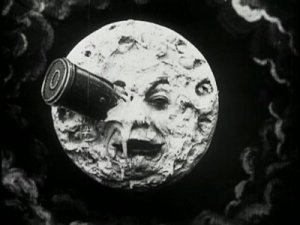
I was only going to post three but since that was a fragment I think one more is in order. This is the film that made me fall in love with him. Even 108 years later this is still amazing stuff.
A Trip to the Moon (1902)
Video

 The Movie Rat