Film Thought: The Foundation of Everything is Drama

I’ve always believed that drama is the foundation of all other genres, which could be interpreted to mean that everything is essentially a cross-genre piece, but essentially what lead me to this premise was thinking about how to to approach myriad genres as a writer, I think this can also apply to acting. There are few things that fall outside this cross-section.

Comedy is driven by obsession and as silly, or outlandish as scenarios may get the performers and the world created for them has to be one where there are stakes, consequences, needs and desires that ground these things. Even in parody comedies this should apply. Many cite The Naked Gun series as one of the best examples of this subgenre, and much credit in that case is due to Leslie Nielsen. For as preposterous as what he was saying or doing was he was committed to it, there was a dramatic intent bordering on deadpan that tethered the silliness of the situation to reality.

When applying this precept to horror it carries an additional even more significant burden. A comedy that does not make one laugh cannot really be said to be effective, but a horror film that one doesn’t find scary can be. A horror film is designed to terrify, to frighten, to scare to disquiet. Stephen King in discussing horror literature breaks down his own hierarchy wherein the gross-out is his last recourse.

The issue with the effectiveness of horror films effect on an individual in some cases can be heavily influenced by the individual. As a child I was rather sheltered, and kept to mostly age appropriate fare for quite some time. I didn’t like scary films. Gremlins scared me until, I later watched it in whole and found its dual intent. The first horror film that I really openly embraced, where I enjoyed being scared was The Shining. From there I was hooked and I sought out more.

Yet, seeking out more becomes the issue. You want to learn the genre but there are then fewer and fewer of those films with that seismic impact on you, even if it is that good. You get desensitized, to an extent to the more visceral elements of the film, which are its primary objective.

Thus, if a viewer is desensitized, or a horror film just isn’t as scary as it could be, what recourse is there for it? There is that foundation of drama. If the dramatic beats are set and strong; and I’ve said it’s not necessary before, and that’s true, but if the acting is strong, if the conflict is palpable; if the characters have some definition; if their goals, obstacles and needs are, at some point defined; then you’ve established drama in a horror film. You have there your foundation and the subjective matter of “Is this scary?” while it still matters, isn’t as as pivotal as it might’ve been.

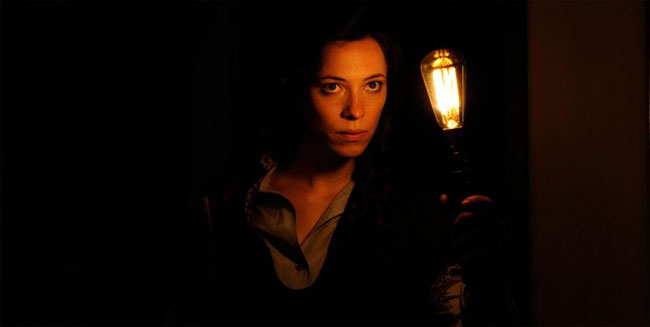
As I said, this is a notion I’ve had for a while and it recently crystallized when I viewed a ghost story entitled The Awakening. It has its creepy moments, and this is easier to do in a ghost story perhaps than in other subgenres, but I wouldn’t necessarily call it terribly frightening, but the character’s conflicts and arcs, their interaction, the human emotion and struggle of the film; in short, the drama is really what drew me to it which is what brought this thought back foremost in my mind.

This may be why some films, and I won’t name names, that insist that their knowing cheesiness and lack of production value is their strongest asset don’t work for me. Great things have been done by filmmakers with limited resources who staunchly believed in what they were trying to commit to celluloid and did their damnedest. Usually, those are the films where you can smile and love it even through the glaring faults.

To conclude, I just want to clarify, if it wasn’t clear already, that I do not mean that everything needs to be treated sternly and severely, which is part of why I made references to comedies and Gremlins. The sensibility has to work for the film in question, however, even in a light tone there’s a dramatic foundation to it, a commitment, a dedication, which does not make itself apparent in the aforementioned unnamed films. To me that is what still strikes me as one of the fascinating things about the horror genre is that there is a when-all-else-fails contingency plan. That’s not to say that all films deal with material in a way that can transcend so well, or treat their foundation with the respect it requires, but it is there and those who use it well are really worth noting.

The foundation of everything is drama. The fenestration you add to it creates genre. It’s a building block to all film narratives, but with the horror film I feel it’s a most crucial one, because the prime objective is so very hard to achieve on a mass level that there needs to be something to fall back on.
Film Thought: What’s Your Favorite Film?

After having updated this year’s 31 Days of Oscar, someone commented, after seeing my reaction to Imitation of Life “That’s my all time favorite movie.” The conversation that ensued essentially came to this conclusion: “What are the odds?”

The conclusion I drew separately was “Hmm. Well, what if I hadn’t said anything, and I never knew?” Even film buffs who watch bajillions of things have one favorite that they can point to. The difficulty usually becomes trying to pick a top 5 or 10 say – definitely in going beyond that.

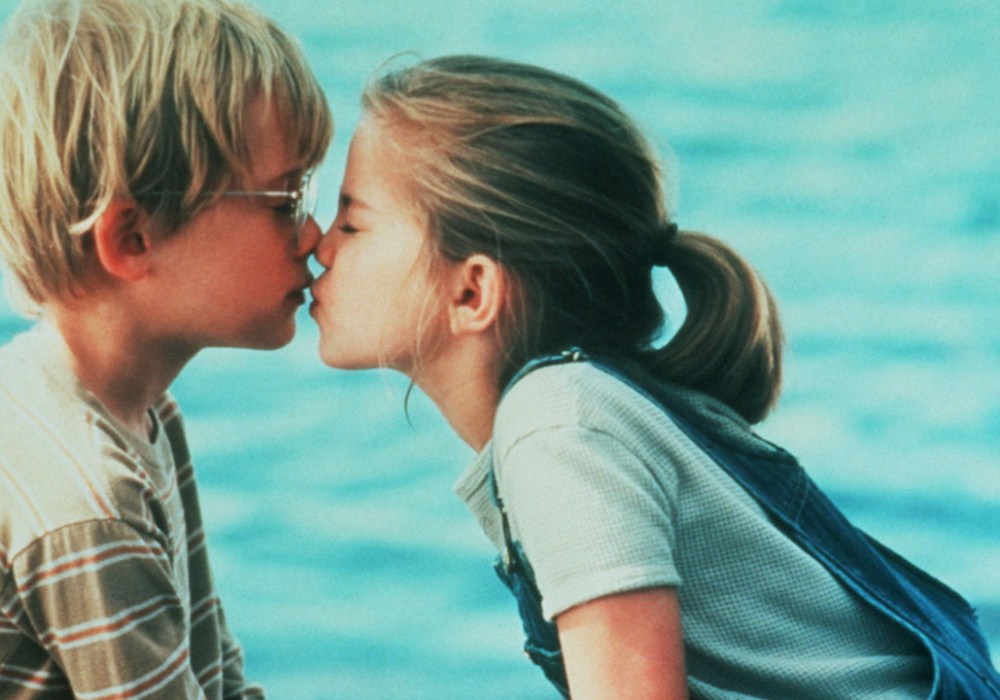
Even I, who am usually extraordinarily reticent to proclaim the best film ever made, have my answer: which would be A.I., however, every time I see Citizen Kane I think it kind of sits above being ranked. In doing my recent Spielberg list I was reminded that he supplanted himself as having made my favorite film of all-time when he made A.I. The film I’d last thought that of was Jurassic Park, and before that My Girl for very personal, and probably not so cinematic reasons. My point is a favorite film is a part of you for a number or reasons, it marks you and you it, whether for all time or at the very least in a time and place in your life.

What I came away from that conversation most curious about was “What’s your favorite film?” The general your, meaning almost anyone I talk to. I want to hear them, and see them if I haven’t. And a friendly note: if you ask someone their favorite film, and you set out to see it, do not expect it to be yours too, please just take it for what it is.

So there’s the question, I’m curious to know, if you can name just one favorite what would it be?

Film Thought: A Film For All Occasions

Not too long ago I was asked to participate in a medical study to gather information, and further knowledge, about a metabolic condition I am afflicted with. Part of the process which I was subjected to was a very long MRI. Any and all people taking this MRI were encouraged to bring in a movie to watch. This movie would be viewed in the tube through an angled mirror that would reflect the screen’s image in to you.

What this piece of information made me realize is that there really is a film for all occasions. With this situation I was thinking about what film had a hypnotic quality, that would keep me fairly still for an extended period of time. I also thought to pick a rather lengthy movie should the scan run long for whatever reason, which it did.

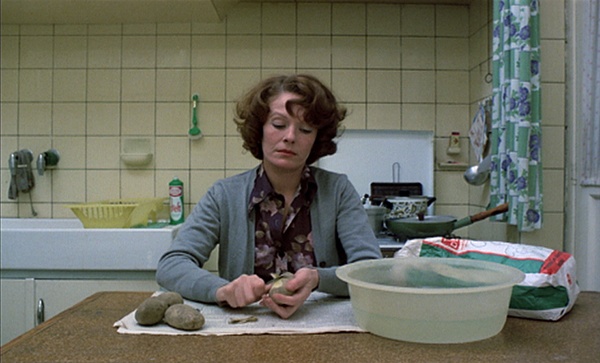
I chose Jeanne Dielman, which ended up working perfectly. I have since noted that there are films that, of course, have seasonal connotations such as Halloween and Christmas, but also those that are perfectly suited for other more idiosyncratic occasions. While I usually try to go to the movies on my birthday, those choices are particular to me and my tastes, there are even more obscure occasions that have movies that fit them. It’s all about finding the right tone and rhythm for you. What other odd occasions have movies that suit them perfectly, I now wonder, seeing as how I found the perfect MRI film?

The Dichotomous Parallel Between MP3s and Digital Copies

Recently, I drew the parallel between the digitization of music and that of cinema. Digitization in terms of the end user’s home entertainment product. I often describe myself as being caught between two times because I always like to have links to the past, while conversely staying fairly current. I remember when MP3s first came around it was amazing. It was like “Ermagerd, I can listen to music on the computer” (That is, if we talked that back then).

Maybe it had a little to do with the fact that the internet was still in its infancy and we all either turned a blind eye to, or were ignorant to, the piracy it incurred. Eventually, the free music party came to a halt. While Lars Ulrich was neither the right person, nor an un-douche, he had a point about Napster. The fact of the matter is the word monetization wasn’t even in the vernacular back then. In the end, it was Apple with the inception of iTunes and the iPod that legitimized MP3s. Now, there was and is music business tussling there too. The point of the mini-history lesson is: Music on a computer was instantly fine with the masses. I can’t say it was preferred, even I have to give it to certain formats (even the analog ones) for having un-reproduceable qualities, but it was widely and quickly accepted as a norm.

With movies that’s not really the case. I’m citing mostly myself in this instance but the shelves of a Best Buy and the warehouses of Amazon will back me up on this, films on physical media are still king even if not by much. However, having some sort of file saves room. I had a clutter of CDs that I then jammed into my iTunes and could access it at the touch of a button on my iPod. With movies I’d still rather hold the disc.

There are gray areas which I’ll come to, devices may play a large part. Apple didn’t just start iTunes, as I mentioned they added an accessory. So, yes, the new album I both wouldn’t be something I physically received, but I’d access it through a device.

This tactile obsession is a bit odd and interesting. I think the volume of streaming done on Netflix and Amazon will indicate that we’re fine with cutting the rental store out. We just want to see a movie. People have been watching movies on TV since there was TV, and even more frequently since the advent of HBO. However, that’s watching a movie. Owning a movie up until recently has meant possessing a physical copy of the film.

Even within the realm of digital film there’s a slight stigma I feel. I like having as a bonus a digital copy of a film … on a disc that I can download into my iTunes. However, Ultraviolet annoys me and is something I’ve not used and I think many others feel the same way, and I have access to digital versions of many Disney films I’ve purchase, which remain unstreamed. It still comes down to having a box with a film in it feeling more like owning it even though the issue of space is still present.

Perhaps, this is a slower evolution, or maybe physical copies of films on one media or another will never die our for home video use. Perhaps it’ll be smaller or less successful films that go digital only, while the blockbusters and new classics that can still make a killing on video will get DVDs and Blu-Rays and whatever comes next. I don’t know the answer; time will tell. I just thought it was such a jarring juxtaposition for me personally of how readily I accepted digital representations of one artform but struggle with another. Furthermore, it’s confined to a feeling of ownership, of wanting to have that film in my grasp. I can watch any old thing by any number of streaming methods even as a first viewing but ownership still equates to a holding the film, and I’m sure I’m not alone there. That may change for me and for many some day but it hasn’t yet.

Film Thought: No List Is Ever Complete

I recall once that Roger Ebert tweeted a link and added to it something to the extent of “See this is why I don’t do lists.” I got his point. It was a completist’s one, meaning how can you legitimately make such and such a list claiming it’s ever or all-time when you haven’t, you couldn’t possibly, have seen every qualifying film. Fair enough.

However, it was only recently that I followed this line of thought out further when thinking of my own lists. If I say these are the 10 Best Examples of This I Ever saw, am I disingenuous? No, if I haven’t seen something or disagree, that film, performance or whatever else isn’t on the list. Surely, there are year-end best film lists made by people who saw less than every film released that year. How do those lists differ? They don’t.

Therefore, what I resolved is that if I make a list, barring year-end ones which are time sensitive, that for all intents and purposes it is perpetually a work in progress. Why should it not be? Do I anticipate never hearing another new voice actor (referring to an older not re-posted here list)? I’m preparing a Spielberg ranking, will it not automatically re-shift when Lincoln comes out? I will also no longer be married to round numbers. If something should demand 11 choices, there will be 11. Much in the way my best films of last year lists were assembled, I felt there were 25 films worthy of being cited. Clearly there were still only 10 in the top 10.

The important thing is to do these things in order to express oneself, create discussions and learn. I may be pointed towards a film I have not yet seen or heard of through a list or a post, and why shouldn’t I?

Similarly, I plan to continue to write on the new releases I see but in ways I find enriching, which will not always mean a standard review. I did as such for The Dictator and I think that Brave and Madagascar 3 should be treated in a unique fashion also.

These new precepts I feel will encourage me to re-post more, to write on films more quickly and to avoid procrastinating, and ultimately I believe they will make my content more interesting and dynamic. I hope you do too.

Film Thought: Critical Buzzwords in Need of Banishment

A recent comment, which for the purposes of this piece will remain unnamed and unspecified, brought to my attention that when critiquing a movie whether positively or negatively there are certain buzzwords and catch phrases that are bandied about haphazardly and in essence they are meaningless. The reason the words are meaningless can be repetition or lack of serious thought about the connotations that such words carry.

I will list below some of the words and phrases I have come to loathe and will refrain from using from hereon in and I welcome suggestions of others as I’m sure I’ll forget some.

1. Manipulative

Why: When we go to see a movie we are going wanting to be moved, asking to feel. In our attendance at the auditorium or in our rental of the film is an implicit understanding that we are subjecting ourselves to a piece of fiction which will make us feel emotions we otherwise wouldn’t be feeling, therefore, any and all cinema is manipulative by nature and to call something manipulative is not only redundant but an ineffectual rebuff of the work.

2. Pretentious

Why: Very rarely is the word pretentious accompanied by a specific example of what it is that makes the work pretentious. Typically the word is assigned to a film that is intentionally cryptic. Whether or not the film in question is actually good is irrelevant because the dismissive, lazy and facile usage of a word so sloppily applied in and of itself does not condemn a film. If one one can illustrate how the film is bloated or more arcane than it needs to be or in some other way an affront is a much better critique than the flippant use of a trope statement.

3. Self-Indulgent

Why: This is really a film school/film student special for it was there that I really heard it for the first time and it was immediately rebuked by some. Any film, aside from the obvious product or franchise-extenders (though they are not all exempt), is self-indulgent by nature. A director and crew members and then actors are all in essence saying “This story is very important and I’m the one that needs telling it.” While that sounds like an over-simplification that’s some of the essence. That’s the artistic impetus that drives the creation of film. The financing of said films is driven, obviously, by other factors but everyone who wants to either direct a film or start their own production has the same core belief: “My story matters most.” While that’s sincere it is self-indulgent to an extent because what makes that true to an individual is clearly subjective, and yes, you want to entertain an audience but you also want to make your film. No escaping it logically.

4. Instant Classic/Classic

Why: The first is clearly oxy-moronic. We all know what it’s supposed to mean but it’s tired at this point. The case for classic is really one with a caveat. It should not apply to films younger than 25 years old (I’m guilty of using it as such) and, of course, does not replace actual commentary and analysis.

5. Must See

Why: Many of these do come from the realms of blurbs, however, when writing you can try your darndest to avoid writing something that’s blurbable (and occasionally fall ass-backwards into it anyway) or you can pander to it; this phrase is closer to the latter. Must see in my estimation, while a positive (I tried to find balance), is in and of itself meaningless especially depending on your level of film nerdiness.

Certain actors used to trigger a film as a must-see for me, now there are fewer of films that create a lot of chatter (good, bad or mixed) sometimes become “must-sees,” on rare occasions award and/or festival pedigree, however, regardless of what the reason is whose to say what’s a must see? Yes, no film should be dismissed out of hand, we’ve all been surprised but you can’t watch it all. Your criteria has to remain your own and this essentially boils down to the interpretation of critique as consumer advocate. True, that’s less the case than ever before (not that it ever really should’ve been for myriad reasons) but it stems from that and like any over-repeated phrase it’s started to mean nothing. Case in point is the recent The Devil Inside: it caused an internet firestorm because of the vitriolic reactions it got from crowds. I know I went full circle from liking the trailer and anticipating it, to hearing the negative reaction and doubting my interest, to hearing so many negative and angry reactions that I just had to see it for myself. The story illustrates that “must-see” was coined as a ringing endorsement of a film can apply to films that you hope you’ll like but know you likely won’t too, so it’s meaningless.

Those are the few I came up with rather quickly. What are some buzzwords and phrases you feel should be banned?

Film Thought: Sorry, No Refunds For Bad Movies

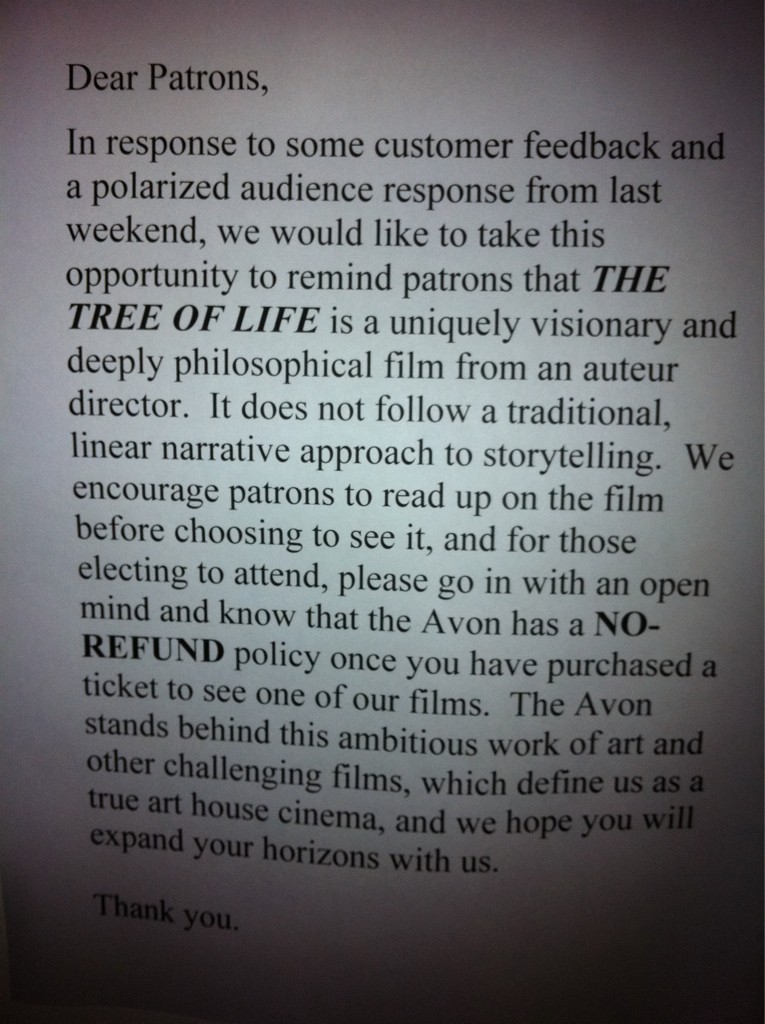
Sign at the Avon Theater Warning People about The Tree of Life and the no refund policy


Attention to All and Sundry:

After hearing about people seeking refunds for disliking The Tree of Life because it was too artsy and a woman suing the makers of Drive because it’s not an action flick and now people in the UK are unaware that The Artist is (mostly) silent.

I’ve recently had cause to go on a few Twitter rants about all too frequent substandard filmgoing experiences but this is one where I have to defend exhibitors.

Essentially we as filmgoers have to grow up and take some responsibility and think about what it means to buy a movie ticket:

1. The film you watch may, in fact, be bad and that’s OK.

To be truthful watching some movies I hated has been just as memorable as one I thought was great, maybe you really just have to love the form but the bottom line is that money you pay may be for something you dislike. It’s a mystery, that’s part of the fun. The theatre does not guarantee your enjoyment of the film, what it should guarantee is a clean, quiet auditorium, a properly projected image and crisp, clear sound. In short, they should guarantee you enjoy the experience of watching the film not the product itself.

2. Make Sure You Want to See The Film

If you are one who shows up looks at the showtimes and picks something at random, live with that. The same goes for something you think will be stupid or that you can’t wait to see. Also, if you are seeing a film because you think it will be stupid normal codes of conduct still apply to you. Your snarky disposition is not a license to speak or be otherwise disruptive.

3. Forewarned is Forearmed

This goes for things as basic as sound/silent (a rare conundrum), color/black & white (nearly as rare), synopses and parental information, some who are defending the audience members make it seem like finding out The Artist is a silent film is a chore. If all you knew is it won awards you can find out. As an experiment I just searched “The Artist Movie” on Google and results came up in the usual split-second and then it took me just a few seconds to scan down and find the Wikipedia entry that in the abstract starts by stating the film is silent. Such a chore.

4. A Movie Is Not That Different From…

Perhaps the best comparison (the most apples to apples) I can think of is books. Everyone has likely read a bad book and in all likelihood you owned it. I never once thought of reading something and then taking it back to the store. What does the store have to do with it? They only made it available to me. I chose to buy it.

Movies are similar. The difference is it’s a scheduled artistic presentation not unlike a concert. You are buying a ticket that guarantees you admission, not fulfillment. Has anyone ever seriously sought a refund because they didn’t know who the opening acts are or because Guns N’ Roses didn’t play “Pretty Tied Up”?

In both books and concerts there’s an accepted level of the unexpected and we’re fine with that. Why not films?

5. Trailers Aren’t Accurate

Things will make trailers and not the final cut, tone will be mangled and you will be manipulated. A trailer is a commercial. They are meant to make you want to see a film. Some are bad and some are good and they rarely are an accurate representation of the film’s quality.

6. Knowledgeable Complaining & Spending

If you truly dislike some film trend like remakes or a given franchise then you’d be best served by not giving those things your money. Otherwise, your complaints fall on deaf ears as the studios cash their checks. If you are curious to see those things that’s fine but know they will still exist if you contribute to their box office. If you just want to be informed as you besmirch them that’s fine but don’t delude yourself into thinking you can wish them away.

The box office is really all that decision-makers will listen to 99 times out of 100.

7. When I Should Complain/Seek a Refund

The theatre’s responsibilities are limited to presenting the films it has. Therefore, issues such as sound, projection or anything else that adversely affects your viewing are grounds to complain and/or seek a refund. I’ve read that being compelled to walk out can get you one but I wouldn’t bet on it hence the above stipulations.

I could probably get further bogged down in the minutiae but the above seems to be the minimum that needs to be stated in light of the recent silliness that seems to have occurred at the movies perpetrated by patrons.

Everybody’s Got Stories: Extremely Loud and Incredibly Close and My 9/11

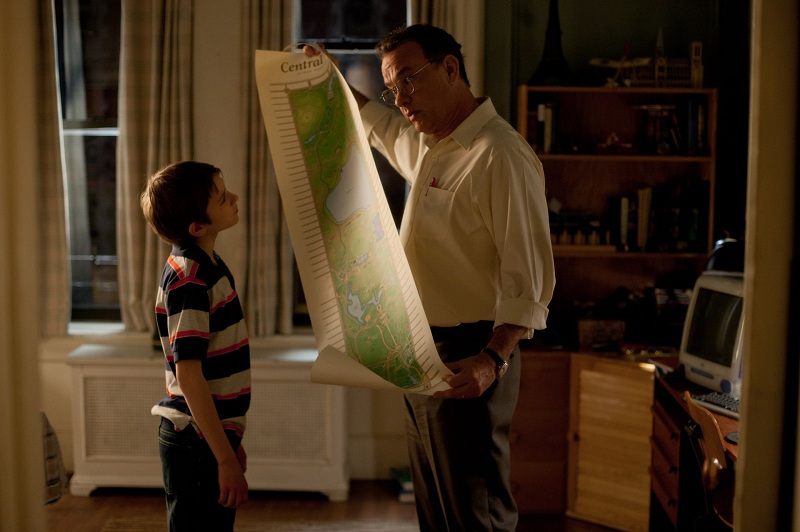
Thomas Horn and Tom Hanks in Extremely Loud and Incredibly Close (Warner Bros.)

I worked in 1 World Trade Center from 1999 to 2001- to September 11th, 2001 to be precise. My story about that day isn’t all that dramatic really. There are details I could divulge but suffice it to say I wasn’t on the schedule for Tuesday mornings that month. So I was not on either the 106th or 107th floor on that day, nowhere close, thank God. I thought about taking that shift when the proposed schedule came out but decided against picking up an occasional AM shift. I was juggling college and the job and Tuesday was an off day from classes and I decided to use that to rest.

Of course, we all know what happened that day and since then I’ve been fairly quiet about a number of topics that pertain to the day itself. I’ve also had varying reactions to works of art which have dealt with the attacks.

I am writing this, of course, because Extremely Loud and Incredibly Close is due out soon and it’s been lambasted by some as exploitative among other things. I have yet to see the film so I cannot defend its artistic merit, however, we should look at other depictions of 9/11. One other caveat: so unimaginable and unpredictable were the attacks to me that while working there I wrote a post-apocalyptic script wherein a family eventually lived in the World Trade Center.

First, there is the tandem of fairly fact-based films World Trade Center and United 93. Neither of these films interest me in the least. I have, more times than I care to, been able to imagine, only imagine but what more can one do, what those floors looked like that day. Having worked there I get a much clearer picture than I care to so I needn’t see any dramatization thereof. The films may be fine and as propaganda-free as possible but I just have no interest. To me those smack more of exploitation for it takes actual people and focuses on the event and tried to feed on rampant patriotism to generate box office. Some see it otherwise and that’s fine but as I said I have no reason to see it.

Remember Me, which I wouldn’t have seen anyway, was your standard father-son drama and decided to use 9/11 as a twist ending rather infamously and in classless fashion.

On the flip-side Stephen King in his collection of short stories Just After Sunset deals with the tragic day in New York in two different ways. In “The Things They Left Behind” he deals with the aftermath and those lost but in “Graduation Afternoon” it comes in at the end, in the distance. It does not inundate all that preceded it and change the entire story and feel like a blatant, in-your-face exploitation. It is there, it is stunning and it affects all, but it does not compromise the tonality of the entire piece.

In Brian K. Vaughn’s brilliant comics series Ex Machina the first issue concludes with a newly-minted superhero’s biggest failure, the fact that he only saved one of the two towers. Considering the tone of the series was serious, political and a very post-9/11 story it all fit.

So the last three I enjoyed so I can take in a tale of fiction which cites something that so closely affected me. Yet it seems this film gets quite a bit of vitriol just in the “How dare you?” realm. The question of “How should art deal with 9/11?” is a valid one but it seems that was never asked for the two that try to most closely replicate it. Bastardized truthiness does not a documentary make and what function is being served there? Those are movies about 9/11 but in a bright piece of marketing Extremely Loud and Incredibly Close is being labeled as being about every day after. In some ways those days were harder.

Furthermore, the word art is formed from the word artifice. It is about subterfuge. Exactitude is what a documentarian strives for but even they know there’s a gray area.

This film reminds me of some of the reading I did about Kapó before I decided to buy it. The film features perhaps the most over-analyzed shot in film history of an inmate dying in a concentration camp. It raised questions of morality in film, however, what should be moral about film? Absolute morality eliminates myriad genres. Horror is where we imagine out nightmares to try an exorcise them and horrid, immoral things are imagined and inflicted upon the people that populate those stories. What need have we of narrative morality?

Not to compare disparate tragedies but surely there was a time when the holocaust was an untouched topic. However, through the years different narrative avenues about events in and around World War II have been found, some not universally embraced, Stephen Daldry’s (the director of this very film) The Reader comes to mind.

The fact of the matter is there are events in world history that defy logical explanation and easy categorization. However, that does not stop us as human beings from exploring them and one of our biggest means of exploring is through the arts. Some say “Why make this film?” I say “Why not?”

Film Thought: Excuse Me, Did You Like The Movie?

Hayden Panettiere and Cayden Boyd in Fireflies in the Garden (Senator Entertainment Co.)

It happens far too often that I leave a movie theatre and am left shaking my head not at the film I just saw but rather at the chatter that I can overhear walking out of the auditorium. All too often I hear confusion at a rather simple film or mental constipation due to the fact that the film as somewhat more artistically rendered and opaque than the run-of-the-mill fare which makes up the bulk of our cinematic diet.

The example I’m about to cite is not meant to smack of regional elitism but rather to illustrate that all too often now little of what once drew us out to the movies is still what appeals to us about it. It seems to be more out of habit than for the aesthetic pleasure and a communal activity.

The tale is relatively simple: I was visiting an old friend in New York and amongst the activities we decided to engage in was to go to one Manhattan’s many theatres and see something we couldn’t find anywhere else.

The film in question was, the critically dismissed yet left me rather moved and affected on a few occasions, Fireflies in the Garden. As soon as the film was over someone came up to me and asked “Excuse me, did you like that movie?”

We exchanged a brief and cordial discourse about it. The gentleman asking and his screening partner differed in opinion. I allowed that I could see that specifically due to one of the casting decisions of a younger version of a character (what I didn’t mention was an unusual family structure within the narrative) but I told him I did like it.

That was all that was said. It was short and not too detailed but it’s an all too rare occurrence. This part of the communal aspect of moviegoing is virtually extinct it seems. Many will lament how etiquette, whether it be talking or being distracted by mobile devices and other faux pas are bigger problems but this is a side effect of the mentality that seems to be “This is just something to do” or put differently “I’m not here just to watch this film.”

I’m not saying that every screening should be like a post-screening bull session in film school or that all layouts be art house in nature with a cafe where you can sit down and debate the finer points of the narrative, however, a quick exchange wherein you say “Yeah, I did like it. I can see where you might have issues…” should not be so much of a shock.

I recently stated that that’s what I like about Twitter, you can go there and have a group of followers who have have seen that film and have their own insights into it. It’s a minor but not insignificant part of the moviegoing culture that ought not be ignored: there should be more stimulating conversation on the way out of an auditorium rather than inadvertent eavesdropping and muffled sighs.

I am all for taking the time to absorb a film, any film at all, however, some of them present questions and quandaries that should be discussed in a more open way and post-screening discourse should not be so endangered.

Film Thought: The Elasticity of Film

Occasionally on Twitter I’ll post a random epiphany-like encapsulation of a belief I have about film in general and hashtag it #filmthought. I have decided to write this one out here because it needs more explanation than Twitter can bear.

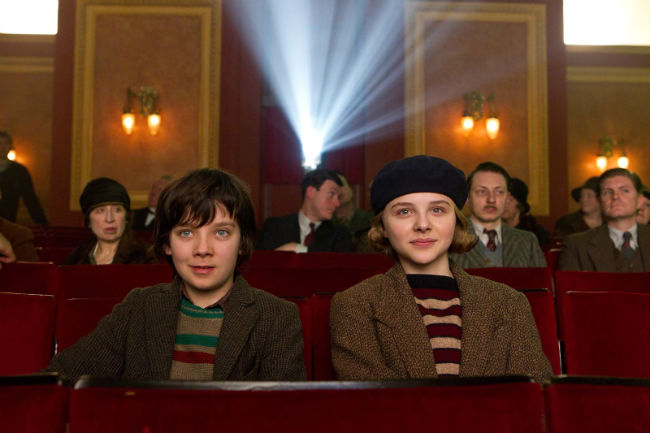
Today, I was sitting through my third screening of Hugo (Reviews of some sort on many of the films I’ve seen will come- apologies for being behind on new content) and the theatre I was at had some issues with the polarizer on the 3D projector. The polarizer is essentially what adds the additional D in layman’s terms. If you’re one who is physically or morally averse to 3D you do not want to see it with a polarizer on the fritz. Anyway, that got me thinking, once the issue was resolved, about 3D in very general terms. I will avoid a film if it’s post-converted or slam really poor 3D. However, when there’s an artfulness to it as there is in Hugo and Avatar the technical aspect can wow me personally. For the record, Hugo is an infinitely finer narrative than Avatar.

In watching this tale about the true birth of cinema, at least in part, and seeing such proficiency at the “latest and greatest” innovation I came to a realization. There have been an abundance of articles about how since film is younger than the other arts it always seems to be in peril in the eyes of those who love it most. Whereas 3D, alternate distribution paths and piracy are the big threats once upon a time sound and color threatened to end the seventh art and didn’t.

In a manner of speaking film has gotten somewhat experimental at least in terms of technique. Many techniques are being rolled out before they’re necessarily perfected but solely to innovate. I think a part of the fear of film critics, historians and enthusiasts in general is that they feel history repeats itself and have found cinematic trends to be cannibalistic rather than symbiotic.

That is to say new alternatives present themselves and become dominant rather than an additional option. In the annals of film history, taking all of it into account, it’s becoming one of the more well-rounded arts in terms of media employed. However, what I’d love is for such choices as 2D or 3D, color or black & white, sound or silent to be actual choices.

Think of all the options a filmmaker has in his arsenal if with the potential success of films like Hugo and The Artist.

There are more media than one realizes:

Short

Feature

Color

Black and White

Silent

Animation (Various techniques of animation as well)

3D is medium when there is thought given to it.

Motion capture

And there are even more rare instances for example: The French filmmaker Chris Marker took the still photograph montage, a wrinkle for an editorial change of pace brought in by the New Wave and created an entire film, La jetée, from it.

It is imperative that film keep its elasticity of form. That the evolution of the art creates more creatures with which this art can be expressed rather than killing them off entirely. Some of these creatures may become increasingly rare but survival of the fittest need not apply to an art especially when there are many artists out there who do not want to conform or be mainstream.

In summation, I will always welcome well done 3D and loathe it when it’s lazy and exploitative. There’s always room for more; in film the ways in which visual narratives can be constructed should not be limited. There are as many ways to tell stories as there are to tell them as long as there is an audience. In an ever diversifying world the artform needs to continue to push aesthetic boundaries not hide away in a CG 3D impermeable shell.