Americanization: How Le Grand Chemin Became Paradise- Le Grand Chemin (Part 3 of 3)
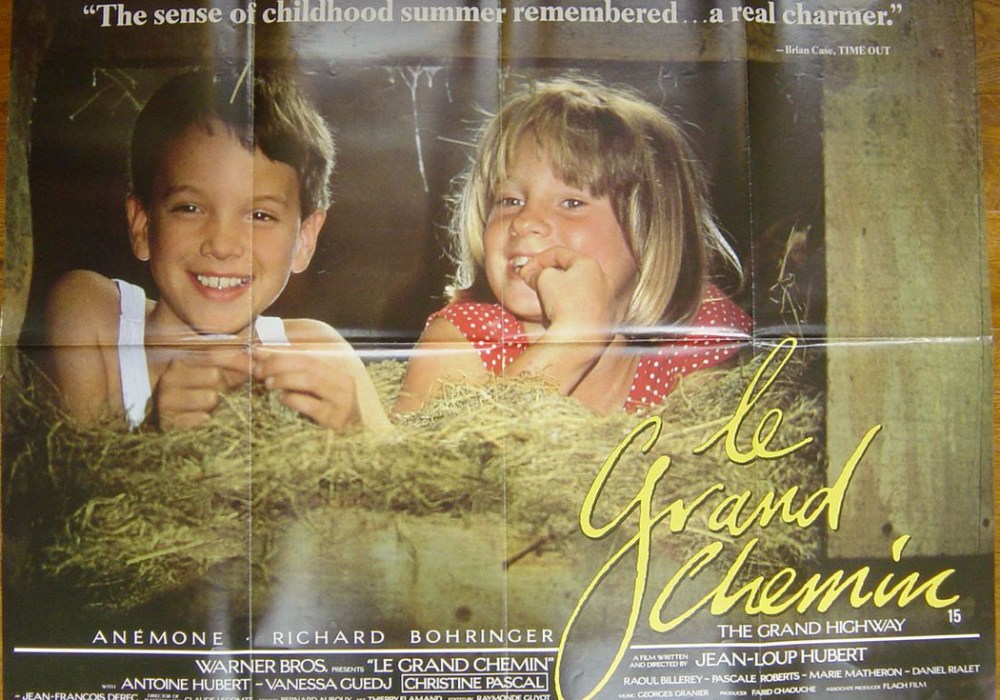
Le Grand chemin
Written and Directed by Jean-Loup Hubert
Unlike Paradise, Le Grand chemin takes place in June of 1958. The back drop of the Algerian War will play a role in this film and is a cultural detail that just doesn’t translate to an American version. We open on the much cozier confines of a bus that runs between Nantes and St. Brevin. Louis (Antoine Hubert) is to be left by his mother with her friend Marcelle (Anémone) for three weeks while she waits for her baby to be born. Being that it’s 1958 and post-maternal hospital stays were longer and that anticipated birthdates were a thing of the future this is a much more plausible scenario with which to begin the story.
Unfortunately, auteurship isn’t what makes the original better. Both films have auteurs at the helm, Hubert and Donoghue respectively. In the remake’s case the difficulty was in that she was writing an adaptation and transplanting the story from one culture to another. The true auteur of this film is Jean-Loup Hubert who originally wrote this film, spawned from his own imagination. At best Donoghue saw the film and thought it was underappreciated in the States and wanted to bring it to a wider audience. In all likelihood a studio executive bought the rights and hired her to adapt and direct.
The title of this film has been loosely translated as “The Grand Highway.” While Grand may be kept the same it can also be ‘large’ or ‘great’ but chemin was definitely mistranslated it’s either ‘path’ or ‘track.’ I had learned that chemin was a path but it was clear to me visually that the translation was wrong even if I had no knowledge of French. Hubert frames the street passing under the bus after the driver yells out ‘Le Grand chemin’ obviously making it a metaphor. This is the path that is leading Louis into this couple’s life, a convergence, and it’s also life passing us by. Pello, who was Ben in Paradise, is introduced in much the same way talking bad of the couple and then surprising Louis by being at the house.
I take issue with the Billie character in Paradise. In Le Grand chemin she is Martine (Vanessa Guedj) and her character is a lot more rounded and intelligent. She is the grounded realist for having grown up in the country. Martine never doubts that her father walked out on her mother for a younger woman and towards the end of the film her bluntness causes Louis to run away being that he’s a dreamer from the city. While we may even dislike her for some of her actions, like when she shoves civelles down Louis’s shorts as a joke, she is strong and independent and not weak like Billie.

In this film, we see Marcelle knocking a rabbit out cold and skinning it. I’ve already discussed the animal rights concerns this was likely to cause if attempted in the U.S. and the studio was probably unwilling to shoot in another country to do something that may offend the audience. However, there is a purpose to this scene. Louis witnesses it all. This serves to reinforce his bad feeling about the trip which is prevalent at the beginning of this film. While Pello did deceive him, he is the first to earn his trust when Pello winks at him so he’ll pretend it’s their first meeting. In Paradise, Willard was merely afraid to say otherwise and a bond forms later in the film amongst less natural circumstances.
The involvement of the Catholic Church also occurs earlier and more frequently in this film than it does in the American version. Actually, in the classic American tradition of watering everything down the Reeds attend a Protestant church of unknown denomination. In France, there is a greater acceptance of criticism of the Church. In the revolution the Church was under attack and to be abolished, later France was the nexus of the existentialist school of thought in the 20th Century. These interpretations of the Clergy are not necessarily as negative as we may interpret them, but rather an attempt to help humanity cope when they feel religion has failed them. In Le Grand chemin, Hubert frames the priest in a high pulpit above the parishioners. He is speaking of God and the saints and of lofty things and boring everyone to death. Later, when Louis is walking around on the roof and Martine is seeking help he makes jokes about them. All this is saying is that the Church and its clergy have begun to lose touch with the reality of worshippers’ lives. It’s not done in poor taste and it does in the end serve the story. The challenge Martine placed to Louis is that he couldn’t urinate down the gutter which leads out of a gargoyle statue’s mouth. When Louis is missing at the end he is found when a nun gets a “shower.” Now a nun is a human being just like you and me, thus, imperfect and not a religious icon and it escapes the dangerous realm of blasphemy. In Paradise, the preacher is merely a talkative dolt and the challenge is merely a high wire act because I guess Americans don’t urinate until they’re of age.
Another aspect in which the French film excels is in the score. The French score is evocative of childhood whimsy and wonderment as need be. It is touching and extremely moving towards the end and put a great emphasis on the ending. And it highlights the moments of high drama perfectly without overshadowing the action.
In contrasting the actors ‘The Bedroom Scene’ is where we can most easily draw comparison between how each version of the story was handled. Jean-Loup Hubert frames his actors together with minimal cutting and the tension is so thick it hits home. You hear it almost as if you’re there. Richard Bohringer’s performance as Pello in this scene is absolutely raw, you can see there’s no stopping him, there’s nothing contrived here, no acting – that we can see. Hubert also excels here at writing putting this in a more emotionally vulnerable point in the film.
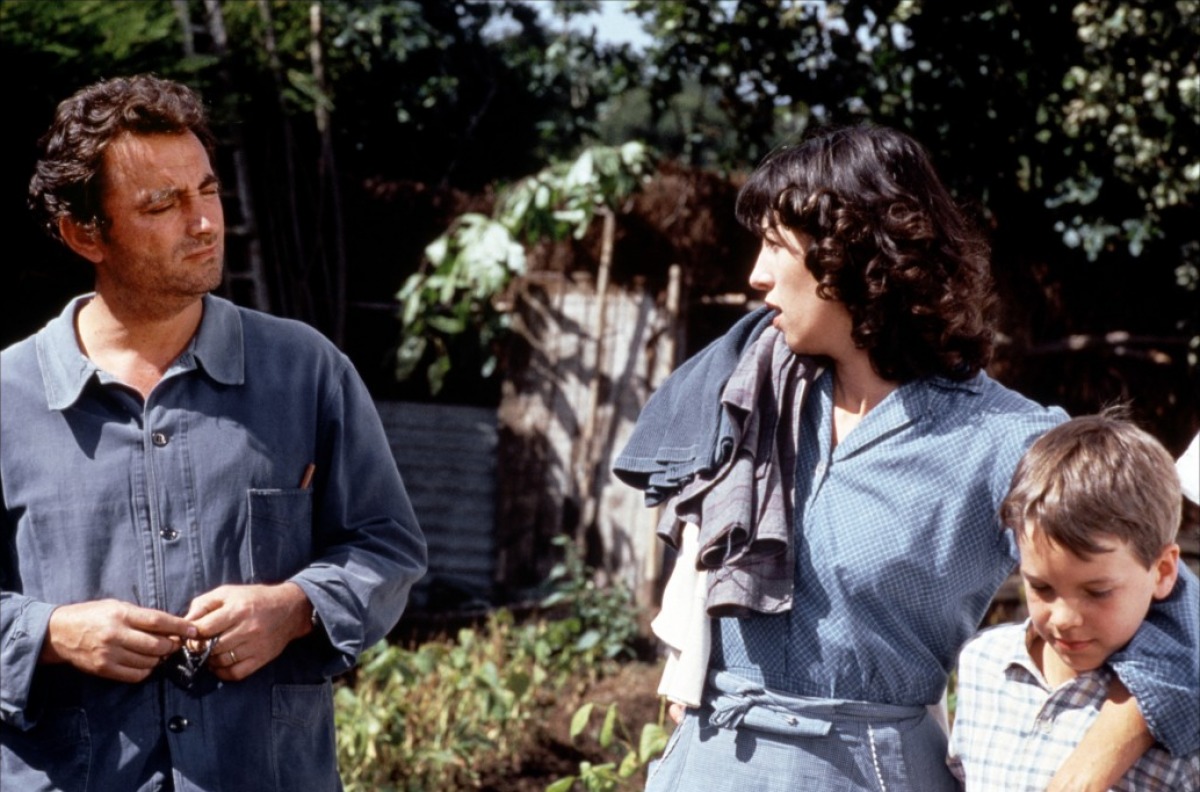
In Le Grand chemin, we see the following scene unfold: Pello and Louis have just spent a day together. In a very warm and touching shot Louis reaches out and takes Pello’s hand. Shortly after Marcelle arrives worried about whether or not he has eaten. Later she has to go pick Pello up because he’s drunk. Here we see them really butt heads. Because Pello has made a connection with Louis and he’s always been the more forward looking of the two he pushes the issue of Jean-Pierre, their dead child. He misses her as a wife and feels she’s playing the martyr and tries to take her physically. “God won’t help you, let’s do it in the wheelbarrow,” he says. He then chases her into the house and she locks him out of their room. Upon falling to the ground drunk he finds the key to Jean-Pierre’s room. He goes in and starts demolishing it, as he expected Marcelle comes out to stop him and again he attempts to rape her. This is high drama and great conflict. Pello is living in the moment and Marcelle in the past; we see the metaphorical struggle enacted physically.
Even if the American film had reached the same amount of drama that the French film was able to they still undercut the tension. In the French film we discovered the room in that scene. In the American we had a sentimental and non-essential wandering into the room by Lily. The woman’s role in this scene is the same in both films; she must be resistant, in fear, fighting back and in hysterical shock at her husband’s actions. Melanie Griffith holds her own but is unable to live up to Anémone’s example. Don Johnson, on the other hand, fails miserably in this scene giving her nothing to work off of. His diction is poor, his tonality is all off and he is scarcely believable. He comes off as a man who may be a jerk but would never be thought of as being that passionate.
The French film also makes the connection between Pello and Louis and it’s made in not a more subtle but a better way. In Paradise, all the bonding occurs during a fishing trip both the forming of the friendship and the big question about the dead child. In Le Grand chemin, first Pello shows Louis how to sand by letting him watch how it’s done. Here we also see Pello give Louis a makeshift wagon where he carries around the scrap pieces of wood. This allows a visual representation of the bond they had. When he gets upset near the end we see Louis leave the wagon behind in the shed. Later, we have the fishing trip where they are already friendly and he asks about the baby after a long talk.
What really works well in Le Grand chemin is the story arc. He may not be the most involved character but Louis is the catalyst of this film. In one scene Pello refuses Marcelle’s idea of a bedpan and takes Louis outside to urinate against the wall. He says to him “If you can hit the wall you’re ready for girls,” and in a very humorous turn Louis leans forward trying to hit the wall. The scene begins with Pello arguing with Martine and ends with his getting closer to Louis. He sharpens the conflict between the couple and then ultimately brings them closer together at the end. In the closing scenes, he climbs into bed with them because he had a bad dream and ultimately for the context of the film he sees them as his parents. He also affects Martine while they are quite different as Louis is timid and Martine is outgoing to the point of being brash she is very saddened by his leaving. When Louis is saying his goodbyes she is squeezing grapes and mixing them with rum to drink away her depression. This is another scene American audiences would have trouble with. We’d be willing to accept underage drinking in a movie, but only at a certain age even though much the same thing must happen here. The ultimate visual representation of how he affected everyone was when he was standing atop the church and the whole town is watching him.

In what is a very affective sequence, Louis’s character is pushed too harshly to the truth and lashes out. First, he is listening to a letter his father wrote him, a father he always believed was a head waiter in Nice. He asks Marcelle to see the postcard he sent and sees it’s blank. Marcelle was instructed to make up a message for him to hear. He recognizes the postcard from the year before. Marcelle tries to play it cool but Louis isn’t going to believe the story anymore, he calls her a liar and then he gets slapped. He runs off and consequently meets Martine who speculates that he must have met a younger woman. While Louis is ready to accept his father is gone he doesn’t want to hear anything negative either. He calls her a liar as well and then disappears to the church. What I like about this film is that it’s one without a ‘hyperplot’ but it does move and it is very well told. The characters come together bit by bit, and you get to slowly find out what they’re all about. If this film where made in the US it would be independently produced and most likely fall through the cracks, but in France it won many awards.
Of course, the way in which this film handles both sensuality and sexuality, while also dealing with death is very adept. Love and death are dramatic foils that writers have been toying with since time out of mind. In Le Grand chemin, the theme of death is more readily handled. Pello is not only a carpenter but he makes all the caskets in the town and he is best friends with the gravedigger, Hippolyte. Combine this with the fact that they had lost a child some years ago you get quite an odd little circle. It’s psychologically subtle. When you think about it Pello in all likelihood fitted his own son for a casket, he literally buried his own son. While his best friend, who may have been the godfather for all we know, buried him in the ground. So the impact on them must have been twice as hard in this film. As for Marcelle, no one can say how hard it is for a mother to lose a child unless they’ve ever been in that situation. So the film opens with characters that are deeply bruised. The connection between life and death is blood. In Pello’s shop we see Marcelle’s ‘monthly rag’ here blood is signifying the inability to create life. And it also ties in with sex. When dealing with a scene of attempted rape it’s hard to keep sympathy for a character but Pello never really loses our respect because once we realize he’s drunk and not his usual self (not that his usual self has been that nice) we almost understand his actions. We also know that all he wants of his wife is some affection. He feels that she died with their child and he hates it. Between the children the scenes of discovery are obviously better handled than in the American version. The scene where they discuss the clap in the French film isn’t as shy or prudish as the American. Martine is a tomboy and Billie is not. She doesn’t sit like a girl or talk like a girl. She offers Louis a look up her skirt which is something which is only clumsily suggested in the American version; Martine says it with bravado and pride. Billie only wears a dress when looking for her derelict father while Martine flashes a priest. The scene when they spy on Martine’s older sister is also quite differently handled in the American version.
While the American version starts off imitating the French version with identical framing of the kids on the upper level of the barn how the coital relationship is filmed is quite different. Why it is so I have no idea? In both cases, there are shots where the children would have to be there, unless there was some sort of processing. In the French film, the boyfriend moves up from performing cunnilingus and we see him on top of his girlfriend. In the American version, they are already engaged in intercourse and we see the couple sideways. Even when depicting sexuality we must be the example of prudery and puritanical ethics.
Simon, Solange’s (Martine’s sister) boyfriend, is about to go off to Algeria. This was a war that was a backdrop to many French films. It was a war that eventually ended French colonialism in the nation. Many films, including Godard’s Le Petit soldat, have used this war as central themes yet in this film it’s more a background issue but I don’t believe it represents any larger symbol here but is merely a plot element. If the American version had some kind of backdrop it may have been better but it doesn’t; it’s flat and it’s all surface.

Le Grand chemin is triumphant filmmaking in which all the elements work together smoothly. Jean-Loup Hubert gets a wonderful performance out of his son that ranks amongst the great performances by child actors alongside Christian Bale in Empire of the Sun and Haley Joel Osment in The Sixth Sense to name a few. For the adult roles, Hubert had actors who were confident enough to be able to take a scene of such intensity and absolutely live it, the chemistry was there and it was shot to perfection. The story is well-written and simply done. The music and cinematography in Le Grand chemin are far superior. If we learn anything in comparing these two films is that the original work, especially if foreign, loses a lot of it’s spirit in switching countries its culture and in many cases its talent.
Le Grand chemin is a beautiful film that should’ve been left alone. Some stories are only meant to be told once. And many must stay where they are born and are never meant to be imitated overseas.
Works Cited
Chemin Grand, Le. Dir. Jean-Loup Hubert, 1987. Perf. Anemone, Richard Bohringer, Antoine Hubert
Éloge de l’amour Dir. Jean-Luc Godard, 2001. Atkins, Beverly T, Alain Duval, Rosemary C. Milne et al.,
Le Robert & Collins Poche Dictionnaire Français-Anglais Anglais-Français. 2nd ed. Dictionnaries Le Robert: Paris, 1996.
Paradise Dir. Mary Agnes Donoghue, 1991. Perf. Melanie Griffith, Don Johnson, Elijah Wood and Thora Birch.