Review- Zookeeper

Kevin James in Zookeeper (Columbia Pictures)

Upon hearing about the film Zookeeper one would think and hope that there’s got to be more to it than just talking animals. The good news is that there is. The bad news is that there really isn’t that much more to it. Sadly, the film aside from not being that funny gets bogged down in a transparent and overly predictable love plot that makes the entire thing seem like an exercise rather than an attempt to create.

While the film starts well enough with a humorous and slightly heartbreaking inciting incident of a failed proposal attempt there comes a point where all the cards are laid out on the table and you start to see where it’s heading. Now I harp on this because this isn’t your usual amount of predictability, I’m talking about an experience wherein you can predict how and when all the dominoes of the story will fall with a great amount of accuracy, this lack of the unexpected leads to a lack of joy and a lack of real comedic impact despite the occasional half-hearted chuckle.

When there is a twist, and I use that term lightly here, it’s like a breath of fresh air and what you’re witnessing becomes exponentially more enjoyable than it should be. When you combine two old hat concepts like talking animals and chasing after a dream girl that doesn’t make the story different or unique by default there needs to be a bit more to it than that but the film never quite gets there.

Typically, with material of this ilk the performances can raise it to a level where it ought not be able to reach but that sadly doesn’t happen here. Rosario Dawson, who let me state for the record is a great actress, can’t really elevate the film at all. A majority of the laughs that this film can muster are thanks to Joe Rogan, as our lead’s rival for the affections of his beloved. He is a crazy, over-the-top type of character but at least he’s well-defined and there’s an energy to his scenes. Kevin James’ scenes with him are the best he has really, as a romantic lead and a no-nonsense-business-man he connects less and isn’t as convincing.

The casting of the voices was a bit odd. Cher and Sylvester Stallone are always very obviously themselves and never really become their characters or invisible as I like to call it in voice work. Adam Sandler does well by seemingly impersonating Gilbert Gottfried as the monkey but of course Nick Nolte is the stand out of the voice cast not because he has the most versatile voice but because he’s the strongest actor of the bunch by far.

Of course, in comedies it all comes down to “How funny is it?” If it can hold water as a compelling narrative it can almost be looked at as a bonus. Clearly as a story the film has its failings but it’s really not terribly funny either. It’s the kind of movie that you might see on cable (a lot) and if you had nothing better to do you’d still likely change the channel.

The ultimate failing of this film is that it tried to get a little too cute by creating an excessive amount of symmetry in the story. This symmetry makes the design of the film apparent and instead of being engaged the film just hits you and you just take it. Sadly, there are very few redeeming qualities about this one.


3/10

Review- The Art of Getting By

Freddie Highmore and Emma Roberts in The Art of Getting By (Fox Searchlight)

When I first saw a trailer for The Art of Getting By my initial reaction was that Freddie Highmore is back with a vengeance. This film, and the previously reviewed Toast, definitely bear that out. Highmore does some pretty difficult work in this film as he’s asked to make a character likable who is not very likable at a distance and who a lesser actor may make detestable.

However, the film establishes his philosophy on life and why he approaches it the way he does right off the bat through voice-over. The voice-over is used sparingly afterward but the “We’re going to die, so what’s the point?” attitude is not hard to wrap one’s head around it’s just that he takes it to an extreme level. However, I have no qualms with it because part of cinema is about living vicariously through others.

Of course, what does snap him out of that in part is a girl played by Emma Roberts. Hers is a task that’s also not very easy because in this film she plays perhaps the most enigmatic female lead I’ve seen since Emily Blunt in Wild Target. I believe I have cracked her as her behavior does seem strange and I think a lot of her subconscious motivation is that she really is a carbon copy of her mother but she fears admitting it and thus a lot of the irrational behavior you’ll see form her is explained.

While George (Highmore) is getting to know and like Sally (Roberts) the tension at home starts to bubble to the surface and he also is forced to come to grips with his slacking off at school and either make his work up or he’ll be expelled. Slowly and perceptibly he starts to change and the straw breaks the camel’s back you know he’ll make it up. A lot of the unexpected comes in his relationship.

What this film does well is that it manages intertwine several uncertain outcomes towards the end such that your focus isn’t entirely on one so even though things, to an extent, work out as expected there’s still that tension about which will be resolved when and how. One thing it keeps you waiting on is to see his one art project. It should also be noted that due to Sally’s enigmatic nature what she does at the end is by no means a sure thing.

While much of what you need resolved to have what can typically be considered a full filmic experience does get resolved there are a few things that are left open to interpretation. This openness was something I realized afterward where some events were viewed differently by myself and a friend.

For the most part this film does a fine job of carving out its universe and establishing who these people are and how their world functions. What never did jibe was the drinking. The leads are portraying high school seniors, eighteen-year-olds, yet they seem to be able to get alcohol by simply buying it (18 obviously being underage in New York City). This isn’t a prudish complaint, kids drink, if that factors in the story; fine. However, something as incongruous as getting served in a bar is something that cannot go unmentioned in the dialogue.

Despite a few unfortunate enigmas in the storytelling I believe that this film effectively created a narrative of the modern slacker and how he is snapped out of it and finds things to live for. The larger (or smaller) the world grows the more we can feel isolated at times so an occasional reminder about what makes it worth it is welcome.

7/10

Review- The Tree of Life

Brad Pitt and Laramie Eppler in The Tree of Life (Fox Searchlight Pictures)

In a recent review, I forget which, I was tempted to discuss the importance a title can play in a film but I didn’t because I thought in that case it’d be a bit too trite. Specifically mentioning how a title can pull everything together and put it all in focus when things seem a bit disparate. This is quite true of The Tree of Life. Before having seen this film I actually hadn’t heard (or recorded to memory) that this was a notion in many philosophies and religions and about the interconnection of all living things. However, even if you walk in without that knowledge, as I did, the film makes that very clear in its shots and edits.

Which leads to the editing of this film, I believe that aesthetically and technologically we’re approaching an edited film that can more accurately reflect the inner-workings of the mind than ever before. In some cases better than novels if you think about it because novels capture inner-monologue and describe in an abundance of words what a quick series of images can convey. This is brought up because this film is essentially a mindplay and it’s the closest to seeing thoughts projected on a screen as I’ve seen. You really go on a journey through these disjointed images and while it does take a while to get into it there will come a point when it clicks.

You can truly experience this film and more so in the front row. Yes, it’s where I normally sit and many have an aversion to it but this is where the images are bigger and the film really does feel like it’s thoughts happening in front of your eyes at times.

The reason it takes a little time to get into is that in the beginning of the film no scene starts in a conventional way and dialogue is chasing imagery left, right and center. This is the scatter-brained portion of the film once the protagonist starts to ruminate on the film’s central question: “What’s my place in this world?” it gets less scattered.

There are two extended sequences that break out of the box and go through time and space from The Big Bang to evolution to vistas of the world as it is today, along with a frame of the very Beginning I believe. These sequences are what draw this film comparisons to 2001, which aren’t unwarranted but aside from these episodes it’s a much more grounded, soul-searching and personal tale than Kubrick weaved.

After the first such episode the flashbacks get less choppy and more contiguous and aside from the editing style the narrative gets rather straight forward and very interesting. As is true with memory this film calls up things that are highlights but not all of them and leaves room to speculate and reflect on what we didn’t focus on the first time, which makes this film a prime candidate to be re-viewed.

It’s this personal approach throughout that connects you to the film. Even with the unusual structure and editing and amazingly ambitious scope it’s still about one man, and thus all men and we learn about him and his upbringing and see what torments him and what he’s seeking to reconcile.

There has been an awful lot written about the fact that this film uses religion as a story element like that’s akin to having plot holes or no conflict, in other words, it was reported as a negative coming out of Cannes. Don’t worry I’m not about to soapbox my religious views on anyone; people doing that is one of my pet peeves. What I am going to say that it’s a bit ridiculous that it’s practically verboten for a character in a piece of fiction to have religious views according to some. This is a story about a man who is having an existential crisis and is trying to figure out what his role is and his mind wanders from the dawn of creation to everywhere in between. It’s perfectly natural for him or his mother to be asking God “Why this or that?” Furthermore, if you still need a little more justification I’ve got it: not only is our protagonist a child of the 50s but this is a person who has found no answers yet, no peace at some point, no matter how devout he is or isn’t he might’ve turned to faith.

The bottom line is artists do put their views and ideas into their films but they’re not always literal. So just because a film mentions God or invokes religion in anyway does not make it preachy. This is ultimately a film about coming to terms with your past and those you’ve lost. I’d almost go so far as to say this movie is as much about preaching Christianity as The Exorcist is. So enough.

As is to be expected the cinematography in this film is absolutely breathtaking. So many of the shots look like paintings almost and all are beautifully composed. This is a must-see for students of the craft.

The acting in this film is also very strong. As an audience member it takes a while for you to feel it but as more pieces of the narrative fall into place you really start to see how wonderfully everyone did. Jessica Chastain and Brad Pitt’s characters are as different as night and day but they play them equally well. Hopefully, Fox/Fox Searchlight push for Brad Pitt come awards season. He’s one of Hollywood’s biggest names and he’s proven he’ll take a risk and go out on a limb and this might get him his statue. Equally compelling but more surprising are the performances of the three newcomers as the kids particularly Hunter McCracken who plays our protagonist Jack as a boy. His burn is the slowest and most explosive in the bunch and his performance rivals that of Pitt.

It’s hard to sum up or rate a film like this. One thing I will say for sure is that while I despise the notion of “important” films in theory but I cannot deny them when I see them regardless of proclivities. Having gotten that out of the way I do like this film and I do consider it important. Would the flow of it work better for me if I saw it again? Perhaps. Would the story hit home harder with all the puzzles solved? Maybe. It’s hard to gauge a film when you’re in awe of so many achievements on a technical and structural level but in a narrative are left to ponder where it falls on the scale. So I will caveat this, pending re-view I rate this film:

9/10

However, please note that even without being re-seen time is the ultimate judge and I have had films rated 9 slide up before.

Review- In a Better World

Markus Rygaard and William Jøhnk Nielsen in In A Better World (Sony Pictures Classics)

In a Better World is a Danish film which won Best Foreign Language Film at the most recent Academy Awards and that is a moniker which can carry a stigma for many. The two that come foremost to mind are that either it’s an inaccessible by the masses art film or that it’s essentially an American film transplanted and taking place overseas. None of these notions apply to this film at all.

However, this film did vaguely bring to mind the Best Picture winner The King’s Speech in as much as its accessibility and relatability are part of its appeal. However, there is still an artistry and at times poetry in the way the simple subject of this film is handled that makes it excel just beyond being something passable and there’s still that European sensibility to it that’s just a little more deft even when handling things in a very straightforward manner.

This film is really telling two stories most of the time: it tells of Elias’s struggle to deal with bullying (which is quite relevant to the current climate) and his father Anton’s struggle as a doctor working in Africa who has to treat a malicious man who has sent many women to his hospital tent clinging to life and the locals beg him not to. These narratives only truly intersect once, otherwise the film shifts, as Anton does, from location to location.

The third factor, one who starts on his own but becomes involved in Elias’s story and dominates that, is Christian. After the initial images of Africa grace the screen, Christian is heard reciting a poem in English (this is one of the longest L-Cuts I’ve ever seen). As the film frequently does it conveys information visually showing us he is at his mother’s funeral. Following her death he moves from London back to Denmark and meets Elias. He has a very different, more confrontational way of dealing with bullies and sticks up for Elias who gets picked on about his teeth and anything else they can think of. Eventually Christian’s way of seeing the world catches on with Elias and his father Anton struggles to show both of them otherwise.

This is the kind of narrative that could get quite preachy and pedantic but it doesn’t do so. It does take the opportunity and has the narrative to serve as a teachable moment but the characters never talk at us but to each other and each of them throughout prove themselves to be far too imperfect to be self-righteous. In the past employing children in meaty dramatic roles had been the sole purview of the foreign film, specifically those from Europe, while there are are now more opportunities here there’s still something a bit more genuine in the portrayal of the positive and negative aspects of youths overseas.

With the themes and plots that this film has it makes doubly sure to make all of its characters engaging, interesting and human and yet also makes most of them likable as well. In doing so these simple struggles which balloon to massive issues with each decision carry more and more weight due to the investment we’ve made in each of them and their well-being. While dealing in the philosophical it still has that emotional pull we need.

This identification made all the more easy by the cast which is nothing short of superb. The kids, of course, deserve first mention. Between the two of them they shoulder a lot of the burden of bringing this tale to life and each one of them has their own journey, and aside from one hiccup which I’ll attribute to willful misdirection, they make nary a misstep. What that misstep is doesn’t bear mentioning beyond the above. The bottom line is both Markus Rygaard as Elias and William Jøhnk Nielsen as Christian are fabulous in it and I was not surprised to learn that the latter was nominated as Best Actor in Denmark’s national film award (Zulu) and may factor greatly in mine (BAMs).

Furthermore, you have supporting them the very talented actors who play Elias’ parents: Mikael Persbrandt, whose own moral dilemma occupies much of our time and he shows the great range to be both tremendously sensitive and caring and extremely enraged and Trine Dyrholm whose despair drives this movie into your core and makes you feel it if you haven’t already.

The only thing I thought was consistently off was one theme from the score, which played quite frequently and seemed the most discordant of all the pieces. This is a shame because many sections were quite effective but are rendered less memorable by the repetition of the most unpleasant section.

In a Better World is certainly the kind of film which could improve with a second viewing and was most definitely worth not only of its awards but of your viewership.

9/10

Review- Toast

Victoria Hamilton and Oliver Kennedy in Toast (W2 Media)

In seeing Toast a very fundamental question occurred to me because this film gave me the answer more purely than most do. The question being: “Why do we go to the movies?” The answer: “For the unexpected.” I never expected from Toast one of the most surpassingly beautiful scenes I’ve seen in a while.

This is just one of the many surprises this film has in store. Granted I knew next to nothing about this film going in but even taking that into account there are some wonderful surprises in store. This film is about the upbringing of famed British chef/personality Nigel Slater. What you get, however, is something more intimate and vibrant than appearances would have you believe.

Aside from a scene of surpassing beauty which is one of the great instant tear-jerkers ever, which features a wonderful selection of source music there is also within this film a great montage and a creative display of the passage of time. Throughout there are some wonderfully lit shots and creative camera angles which are used to great effect.

To not give too much away I will not describe the above scene in too much detail to keep the surprise fresh. It is the kind of scene, however, that many can make effective but few can make that effective. Moreover, it is followed up by a scene rendered emotional that few can make work. This film manages to make the simple act of eating toast an emotional experience.

Of course, a lot of this should not be considered a surprise when you note it’s Lee Hall, writer of Billy Elliot (stage and screen), who brought Nigel Slater’s story from memoir to script. Not only do you have in Hall a man who can depict children truthfully (or their perspective on things) but also one who has rendered dramas in this socio-economic milieu before and can weave a character discovering one’s sexuality into a plot without making it the film’s sole focus.

While being tremendously moving at times this film also balances itself with a good dose of comedy. Comedy is also inherent to a narrative wherein a protagonist develops a love for food and cooking despite frequently having an abnormal relationship with it, whether eating bad canned food or using it to seek attention or affection. Yet even the comedy is always met with high stakes. As funny as it can be at times you realize things are serious because of who his competition is.

This film is made even stronger by having a small but incredibly able cast. First and foremost is Oliver Kennedy who plays Young Nigel and carries the film for two acts before being aged. He was found through a long and slightly unorthodox search, which tested personality and instinct more than honed acting chops and it truly paid off. A natural, diamond in the rough was found. Typically when you have a character portrayed at two different ages you see him younger for less screen time. That is not the case here, however, Freddie Highmore’s section, where Nigel is 16 and has been in his current living situation for some time is no less compelling. Furthermore, it’s where he gets to follow through on his lifelong interest. Highmore was, of course, one of the biggest child actors of his time and is yet another one making a wonderful transition to more adult roles.

If you’ve not yet gotten an indication of how good this film is take this as a hint: I am only now mentioning Helena Bonham Carter’s involvement as Mrs. Potter, the cleaning woman who sidles into the home. She is both funny and dastardly and at times a sympathetic figure but always a bit immature and misguided, even while being so complex she manages to be an effective antagonist. Then you have the curmudgeonly father Ken Stott who is equal parts hilarious and infuriating.

This film was presented at my local theatre through the From Britain With Love series which is showcasing six British independent films in art houses across the US. This particular screening was accompanied by a post-screening Q & A where director S.J. Clarkson took questions not only from audience-members at Lincoln Center in New York but had some relayed to her from the web. My question, whether by relay or repetition, did make it through to her. It was this: Did Freddie Highmore and Oliver Kennedy compare notes on playing the same character at different ages? The answer was a similar one to Tom Hanks’ approach to playing Forrest Gump in as much as Highmore merely imitated Kennedy’s accent.

Amongst many other things this film made me rethink my aversion, in certain instances, to lens-spiking. Towards the end of each section the actor playing Nigel knowingly spikes the lens. However, on further thought considering it’s narrated by a disembodied older version of Nigel, it’s his perception and he knows he’s talking to us, it doesn’t bother me as much. We as an audience through the voice-over acknowledge that the story is being told to us in hindsight and that there’s some filtering and artifice involved.

Toast is a moving film in every sense of the word and one that I’d gladly see again. I’ve said it a lot recently but it’s not less true here, that it’s one the best films I’ve seen this year thus far and I can see it standing tall at the end of the year.

10/10

Review- Super 8

Gabriel Basso, Ryan Lee, Joel Courtney and Riley Griffiths in Super 8 (Paramount)

What I really want to know is what kind of alchemy is this? What sort of magic have Spielberg and Abrams been able to muster? A magic so mind-boggling that I’ve hardly been able to make sense of it until now. What I speak of is the fact that in Super 8 they’ve managed a seemingly innumerable amount of tricks that are baffling.

Firstly, watching this film is almost like being in a dreamlike state, the truest definition of mesmerizing because it’s as if it plays in a seemingly endless and consistent flow that’s always operating at the right speed. It’s the rare period film that actually feels like a film from the period it’s representing and it also so seamlessly and with no fuss whatsoever incorporates us in the world of the narrative such that it almost feels like a film you’ve seen before. Rest assured I’m not describing something that can be construed as being derivative (I’ll address that) it feels like an old favorite just minutes in.

There are few ideas that can be described as startlingly original, so everything boils down to execution and choices. In short, you can compare almost any film to a handful of others and this film will conjure the images of others, however, there is something to be said for what films you’re being compared to. Super 8 is garnering comparisons to The Goonies, The Monster Squad and Stand by Me and it’s better than the first two and as for the last one, there’s such a genre difference it’s really all about what’s your cup of tea.

One startling similarity it does share with Stand by Me is a bit more intangible in nature and it’s this: rarely do you see kids portrayed on screen not only so well as characters but also as friends to the extent that you forget they’re actors at points and you see them as people. There’s a level of ease, naturalness and comfort this core have with one another that jumps off the screen and brings you into the story such that even though some may be recognizable you think of them as real kids. The easiest way to engage an audience of all ages to a story driven by kids is to get them to identify and think “Yeah, I would’ve been like that kid in this situation” and this film nails that.

Just the fact that this foursome, the main one as Preston (Zach Mills) is funny, well-portrayed and has his own quirks but doesn’t join the “adventure” portion, (Joel Courtney, Riley Griffiths, Ryan Lee and Gabriel Basso) can call to mind Stand by Me when they have two actors (Courtney and Griffiths) amongst them earning his first credit is darn impressive (as opposed to one for Stand by Me [Jerry O’Connell]). The wealth being pretty evenly distributed for moments: Lee easily has the most laughs with his pyromaniac slant but one of Basso’s lines got spontaneous applause at my screening. Griffiths and Courtney both had their types to play and played them very well well and with dimension; both being rather expressive and showing a good range of emotion.

Not to mention this film has an additional facet which is that of Alice played by Elle Fanning. So it is a boys’ club to an extent and an adventurous film with wise-cracking and ribbing but there’s some romance and additional drama thrown into the mix when Alice is cast in their Super 8 film and she in essence becomes one of the gang after the train derailment. Fanning is one of the aforementioned familiar faces and she does much more than hold her own in this film but rather shines.

While I give J.J. Abrams all the credit he’s due for doing such an outstanding job on this film it does also have Spielberg’s indelible fingerprints all over it also and I think they found a story they were quite simpatico on and connected to make something outstanding. There were Spielbergian visual signatures throughout making it feel every bit as much his film as Abrams’.

One such Spielbergian trait at play was similar to Jaws in as much as the creature remained unseen or seen only in part for much of the film and the tension, drama and fright caused by an attack doesn’t dissipate due to this fact but rather is heightened. While the mystery of its intent is shrouded so is the creature itself.

The additional benefit that comes from hiding the creature is that it didn’t create a lot of additional animation for CG artists. When the creature does finally reveal itself in full I didn’t think of the CG work for a second. First, because it was so well done and second because I was so enraptured.

This enrapturing made possible more easily by the fact that the film, as mentioned before, is mesmerizing but what people fail to note when using that term is that when literally mesmerized, hypnotized, all sense of time escapes you and this film felt like it was done nearly in the blink of an eye. It’s not that the pace is breakneck, as I indicated earlier it’s always correct, but it’s enveloping.

Since I heard of this film, and with each subsequent ad (minus the viral video I heard about today), I’ve reiterated that I think all films should be advertised as this one is: Give me images, just enough to get me intrigued and have me say “Ooh, What’s that about? I want to see that!” Almost any film can be marketed that way such that you’re left thinking “Wow, that’s going to be so awesome!” but few and far between are those that really are that awesome, but Super 8 is.

10/10

Review- Prom

Aimee Teegarden and Thomas McDonell in Prom (Disney)

This isn’t a review that’s easy to write and I’ll tell you why straight off the bat. It’s due to the duality of my feelings about the film in question. As I plotted it in my head it seemed appropriate that it be somewhat similar to the Win Win review, in as much as it would focus heavily on performance. The reason for that in this film is that I’m sad to say I didn’t walk away from this film liking it but in watching it and re-watching it I really did love the cast that was assembled for it and what they did with the material with which they were asked to work.

To get the negative out of the way first a lot of my dissatisfaction in the film can be attributed mainly to narrative and script. It’s a difficult task to juggle multiple storylines, especially in a romantic comedy. You’ll find varying degrees of success in this kind of film because it’s hard to balance the stories, tell enough of them, keep them fresh and make them equally compelling. A lot of the strands while they are engaging enough are all too easily predictable.

The film also struggles with believability as it does have a tendency to transpose Nova’s (Aimee Teegarden) pie-in-the-sky feelings about the prom to a few characters. In the beginning it’s contained just to her but it spreads. Aside from the strands being predictable none of them are really stories we haven’t seen: there’s the Triangle, the Jilted Girlfriend, The Presumably Imaginary Girlfriend, The College Split-Up, The Honor Student and the Bad Boy and so on. Again no inherently bad templates but there’s not enough of a twist to freshen these up and of course all these tales each have their own arc and thus we have to wait as each starts a little awkwardly and ends nicely in due course. The only truly refreshing end of any strand was Corey’s. Corey (Cameron Monaghan) being the friend who feels left behind when his friend Lucas (Nolan Sotillo) falls for Simone (Danielle Campbell).

In spite of all of this the cast does wonders with the material. The main thrust of the film is, of course, The Nova and Jesse (Thomas McDonnell) tale. It starts as love-hate as they are forced to work together to rebuild the ruined prom decorations. There is real chemistry in this pairing. Months ago I had read that McDonnell’s performance had created some pre-release buzz in the industry and it’s easy to see why. There’s a potential star in the making there. Teegarden overcomes some very clunky and awkward dialogue at times to deliver a very good performance that is a step above what she showed on Friday Night Lights and the flip-side of her Scream 4 turn.

The Triangle of the film is actually two, which is not an easy trick to pull off so the film does deserve credit for that. Tyler (DeVaughn Nixon) is dating Jordan (Kylie Bunbury) but he’s cheating on her and wants to be with Simone. Simone also gains the interest of Lucas and Lucas likes her. It’s this dynamic where you’ll find some of the better dramatic moments of the story. Nixon, while getting his comeuppance, does give a good portrayal of the guy who will never really get it and is just out for himself. Bunbury of the four probably has the least amount of screen time but she always exudes a nobody’s fool air and she’s waiting to catch Tyler in flagrante to unleash her claws. Danielle Campbell shines as she is consistently torn throughout the film once you see the crack in her facade she is a confused character pained by the situation she’s been placed in.

Nolan Sotillo and his frequent scene partner Cameron Monaghan frequently steal the show in this film. Their chemistry is great and they work really well off one another. They also bring some of the most genuine comedy to the film and genuine emotion in general. It’s that very word that popped into my head as Lucas was fighting for Simone’s affections and was getting swatted away, he and she are quite genuine in their emotion in those scenes. Furthermore, Sotillo adds a song to the soundtrack of the film which is fantastic, it’s just a shame that it’s buried as the second song in the end credits it really could’ve been a boon to the climactic moments of the film.

The next major pairing is that of Mae (Yin Chang) and Justin (Jared Kusnitz). It was in watching these scenes that I really realized the arduous task these actors were given, few if any of them deal with scenes that allowed their to be a rhythmic ebb and flow to their performance, they were either dealing in just one note or they were constantly at high tension. Yin Chang is constantly at high tension it’s just a matter of how much she shows it that changes and her performance is very good. It’s a shame, however, that the talents of these two are utilized in one of the least compelling narrative strands.

The loners of note are: Rolo (Joe Adler) who offers a necessary and perfectly offbeat dose of comic relief and Lloyd (Nicholas Braun) who is the nice guy desperately trying to find just one girl who can or wants to go out with him. As if that wasn’t enough story Lloyd also has a constant companion, his stepsister played wonderfully by Raini Rodriguez.

In the adults of this tale a few more issues are brought to the fore. Yes, of course, there has to be an obstacle to Nova and Jesse going to the prom but the machinations by which her awkwardly played father (Dean Norris) goes through to prevent it are hard to swallow. Not neglecting to mention that somehow this high school is big enough such that people can go there for four years and not speak to one another but Nova’s dad instantly knows who Jesse Richter is at the mention of his name.

Ultimately, I’d say if you want to see a group of young actors you’re likely going to want to see again in something else go out and see this film. If you’re all about narrative and don’t care about the acting, sadly I can’t recommend it and as much as I do like this cast and what they did with what they were given, sadly I can’t give this film a passing grade.

5/10

Review- Fast Five

Vin Diesel and Paul Walker in Fast Five (Universal)

As I first discussed in my review of Rio I bring quite a bit of baggage to any American-made film dealing with Brazil and I will be analyzing certain aspects that escape the notice of the common viewer. Obviously, some of these things also come into play when discussing Fast Five and I will attempt to address those as swiftly as possible and address the film as a whole.

However, with this particular film the Brazilian-ness of it and how accurately that is portrayed is a more pervasive concern as it touches many aspects of the film from dialogue, plot, believability, characters, plot points, acting and the like more so than in the aforementioned film.

Some examples: Firstly, I applaud this film for its attempt to be sneaky foreign (like Hanna) and actually include a bit of dialogue in Portuguese and even subtitling certain scenes. Most of the acting in the film as a whole is just fine, however, the noticeable sore spots are created by those portraying Brazilians who are clearly not. Joaquim de Almeida plays a drug kingpin and the mark of the major heist in this film, he does a fine job but as I suspected when I looked up the cast he’s Portuguese not Brazilian. Very noticeably a fish out of water is American Michael Irby as his second hand man. Spaniard Elsa Pataky and Israeli Elsa Godot are quite convincing, the latter not so much in one particular scene due to her look more so than her interpretation. The best Portuguese is spoken by Jordana Brewster who speaks it rarely and I wasn’t even sure she knew any despite being born in Brazil.

Issues with the story with regards to it being set in Brazil are most prevalent in two incidents that I take issue with. So far as having a druglord who has the Military Police in his pocket and corruption, I can take that. It’s an acknowledged issue that’s been long combated, however, if you want to see a film about the PM and how a good man can go bad and see a rather realistic rendition thereof watch Elite Squad (Tropa de Elite). The issues are the first scene where the American forces lead by Dwayne Johnson go up into a favela, in very cinamtically clichéd fashion all the runners and criminals brandish their guns like a territorial pissing then Johnson shows his gun and they all back away. The problem there is that that would either lead to a standoff or a firefight, which is not infrequent. It’s a movie device that really doesn’t apply here. There’s a more realistic scene where he’s baited out into the open and surrounded.

The worst scene of the film is the apparent defeat. Here for some reason the American forces decide they should drive, seemingly unnecessarily, through the elevated and undulating streets of a favela and it sets up a ridiculous confrontation.

There is enough action to carry this film along and make it a decent ride. The villain although broadly drawn does have some decent moments. The characters in the film are many so not many are developed in all that much detail but you do get a sense of them and there is a good amount of comedy mixed in which keeps things light in spite of the bickering minorities device that is employed twice.

To give this film its just desserts there is a hand-to-hand combat scene between Dwayne Johnson and Vin Diesel that trumps anything that occurred in The Expendables and no uncomfortable undertones to boot.

Despite being incredibly outlandish in terms of what the heist is, how it’s pulled off and what the reactions of law enforcement are to it at several stages of the film it’s still an enjoyable enough flick. It’s a decent popcorn flick that actually got me in the theatre by adding the heist element to a franchise that had never interested me before. Also, plan your health break carefully and stay through the end credits for a tag teases a sequel.

As a coda, bear in mind that with the financial success of Rio and Fast Five, Brazil will likely be the go to international transplant destination for franchises everywhere. I think James Bond needs a vacation, don’t you?

6/10

Review- The Chronicles of Narnia: The Voyage of the Dawn Treader

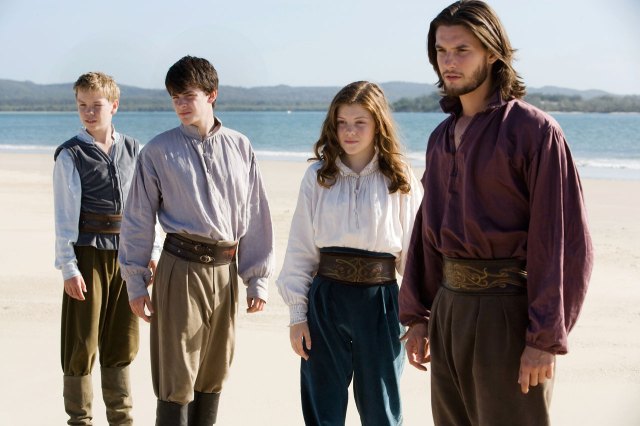
Will Poulter, Skandar Keynes, Ben Barnes and Georgie Henley in The Chronicles of Narnia: The Voyage of the Dawn Treader (20th Century Fox)

The Chronicles of Narnia: The Voyage of the Dawn Treader is in a word, though there could be many, many more; glorious. Absolutely glorious in every single, solitary respect. Not only does it work brilliantly as a standalone tale but it also closes a chapter in a series with great effect. How it functions within the series will be detailed later.

The first thing that should be commented upon is the virtuosity of the players involved. Now this tale does have a rather big obstacle to overcome as in this tale the Pevensie quartet becomes a duo, as Peter (William Moseley) and Susan (Anna Popplewell) are scarcely seen but worry not Georgie Henley and Skandar Keynes are very strong and prodigious leads in the film. They each face their own trials and tribulations in their journey and support the film equally. Will Poulter, who broke out with his earth-shatterlingly good performance in Son of Rambow, is flawless in the part of Eustace Scrubb. He applies the affectations of an uptight, snobbish brat with great aplomb from a pitchy voice to flared nostrils and as his character mellows those layers peel back. Truly, Son of Rambow was most fortunate to have both he and the incomparable Bill Milner in the fold and The Dawn Treader would be so much less than it is without Poulter.

Lastly, and here is where we discuss this film in the context of the series, there is Ben Barnes. Ben Barnes, as Caspian, who is now a King; reprises his role but not identically to the last installment. In Prince Caspian a decision was made that the Talmarines, to differentiate themselves as men of a different nation, should be Spanish or speaking in a brogue thereof. Barnes did what he could to work with this impediment but that decision along with some in structuring made that installment a little less than it could’ve been. Therefore kudos are in store for the production team, principally the late great director Michael Apted, for deciding to rescind said decision. Ben Barnes speaking in his true voice is another actor entirely and he is a credit to this film.

This film, unlike many fantastic voyages, actually allows you to get into the character’s head a bit. In fact, that’s really what the enemy is all about: exploiting fears that each of the characters have. The characters are seen alone, the characters dream and they do battle with an enemy that knows how to defeat them. Mist or fog can be a very effective cinematic motif, as evidenced by eponymous films but you add a sentient nature to said mist and a whole other level is reached. Especially with the way it is framed and how the characters very infrequently sense its presence. I wrote recently of the jolting scares to be found in the most recent Harry Potter, well that is trumped by the ominous looming and chasing of the mist in this tale which gave me goosebumps on more than one occasion, as did some other events, CG or not.

Speaking of CG this may be an aspect of this film, which is almost taken for granted. To go through a laundry list of awe-inspiring visual achievements that the effects artists conjure up in this film would be tedious. However, it does need to be said that the work in this film is so accurate and precise that it likely goes overlooked by many. It has been short-listed for an Academy Award nomination and if it does not receive said nomination it will be one of the greatest injustices they’ve ever perpetuated [It didn’t get it, surprise, surprise].

This film is expertly edited and flows like a dream and treats time like a tinker toy. It makes the film move very briskly throughout but grinds the action nearly to a halt when things need observing in the minutest detail. If you had no notion of the time you’d swear the film is at least 20 minutes shorter than it really is, which is a testament to the pace of the tale.

You can’t have a sweeping epic story line without a sweeping epic score and this film most certainly has that as well, as there’s not much it doesn’t have. The score always matches but doesn’t overpower or over-accentuate the film and is dazzling.

The superlatives could continue to flow but I saw this film twice on the weekend so that should say something. I may see it anew to gauge the 3D quality, for the time being bear in mind that it is post-converted so buyer beware [I did end up seeing it in 3D later on and the conversion was pretty good] .

You have in this tale characters who are human therefore flawed and must struggle mightily against the darker parts of their nature to achieve their goal. You also have here in a series an ending as should the films continue different characters coming to the fore, even if this wasn’t the case the ending is quite the effective tear-jerker. This is without a doubt one of the most complete cinematic experiences I’ve had in a while, one of the best films of the year and a no questions asked must see.

10/10

The Chronicles of Narnia: The Voyage of the Dawn Treader is available on DVD and Blu-Ray today.

Review- Diary of a Wimpy Kid: Rodrick Rules

Zachary Gordon and Devon Bostick in Diary of a Wimpy Kid: Rodrick Rules (20th Century Fox)

Diary of a Wimpy Kid: Rodrick Rules is a better film than its predecessor. This was something I rather anticipated, however, I don’t believe its to the detriment of this installment that it is second. There is not too much shorthand used and the narrative is accessible enough that that much enjoyment will not be stripped away if you are walking into this one cold.

This film benefits from a more unified and less episodic plot than did its predecessor as well. Not that it still doesn’t reap the benefit of humorous and well thought out subplots but they weave their way into the larger narrative with more finesse than before. These tales like Chirag’s invisibility, the new girl, the teacher with a vendetta are all well-handled and add to the film but do not ever threaten to overtake the film from what the central conflict is.

The conflict being that of sibling rivalry, which is handled very well because you see a relationship in stasis go from just about as bad as it can possibly get to become rather functional. It also contains the peaks and valleys that are requisite for such a struggle and even more of a credit to the film it goes from being borderline cartoonish in its animosity to being rather real and honest in the handling of the themes of both resentment and insurmountable hatred that sometimes accompany such relationship especially when the age difference is large.

These discussion points come first to illustrate that despite its varying brands of humor, there is a point to be made in the film and its not just silly comedy. As for the styles comedy it does do a wonderful balancing act again. As this is a homey tale there is more parent-child and husband-wife comedy than before.

Again Steve Zahn brilliantly plays a dad who wants to be as hands off in parenting as he can and also is a typical guy in some regards and not just your typical distant patriarchal archetype. He is countered wonderfully by Rachael Harris. They are funny enough, however, the comedic quotient in this film is amplified greatly when you consider that the talented and previously under-ultilized Devon Bostick gets to step to the fore in this film. He is astonishingly good in this film and rarely delivers a line that doesn’t elicit some sort of response whether it be a laugh or one that connects dramatically.

Zachary Gordon’s character Greg is somewhat mellowed this time around not as hellbent on achieving popularity and other superficial means of acceptance but glimmers of that self appear even in a more rounded character that he creates just as easily, if not easier than he did before. His honesty in situations that in tandem can be seen as absurd are what carry the film and make it something you can connect to sympathetically rather than watch as a disinterested observer.

This film moves along at a very healthy clip, not only are there some fun and creative editing choices like “Disappointed” montage for Mom but things cut swiftly within scenes such that the whole things seems like its done in a blink and not in a disappointed I-Can’t-Believe-They-Call-That-A-Feature kind of way but in a fun and escapist, easily re-watchable way.

Diary of a Wimpy Kid: Rodrick Rules allows the narrative, characters and young performers to grow and evolve from where we left them and you can call it an experiment if you like but if you do it is surely a success. Those who were there are better, more confident and comfortable in their roles and those who are new like Peyton List, who carries off the important role of Greg’s love interest with uncanny ease, blend in perfectly.

It’s funny, fun, must-see.

10/10