Thankful for World Cinema- Son Frère

When looking for a theme in which to select films from the start of November until Thanksgiving being literal is not the best option. Films centered around Thanksgiving tend to be overly obsessed with dysfunctional families. So in thinking about the nature of the day which was initially a celebration of survival in the New World, I thought why not focus on foreign films.

Son Frère

Bruno Todeschini and Eric Caravaca in Son Frère

This is quite an interesting French drama about the difficult relationship that two brothers have. One of whom is gay and receives his brother one night as learns he is fighting a mysterious and seemingly incurable disease.

One thing that is interesting about this film is that while it does deal a lot with treatment of this illness it goes out of its way to say that the disease even has a name but never says what it is. It insists on being about the patient and the care-taking brother and not the disease itself.

Aside from being a relationship film that doesn’t take the traditional route of dealing incessantly with whatever relationship it addresses. It also deals with death obviously, but moreover with being a patient. In examining those with chronic illnesses it casts an eye on the hopelessness of it all and the fear of surgery.

In that vain there is an amazing one-scene performance by Robinson Stévenin in which the brother witnesses the fear very sharply by seeing someone else in pain.

The film works very sure-handedly and keeps its pace steady but don’t let it fool you in that regard because there is a climax coming and it might even fool you in that regard. You may miss it or its impact immediately but it is one that leaves you thinking.

It is a very intimate and taut drama that is worth looking up.

8/10

Thankful for World Cinema- The Sea

When looking for a theme in which to select films from the start of November until Thanksgiving being literal is not the best option. Films centered around Thanksgiving tend to be overly obsessed with dysfunctional families. So in thinking about the nature of the day which was initially a celebration of survival in the New World, I thought why not focus on foreign films.

The Sea

The Sea (Palm Pictures)

It’s great to go into a film knowing nothing about it before hand. This was the case when I saw The Sea. While you can easily see it was adapted from a play the themes are consistent and handled cinematically for the most part.

The first thing that is apparent is that the casting in this film is ridiculously perfect. No actor feels out of place. Speaking of which neither are any of the scenes. It is rare to watch such a multi-character film and never be left confused about who’s who. All the characters are sharply defined and they all illustrate the struggle amongst family, between the generations and the joining or avoidance of a globalized world.

The scenes in the pool and the scenes with the black sheep are accessible symbolism that serve comedic or story functions such that the audience is never lost. Another amazing thing is that even though all the characters have undesirable traits they’re all funny and identifiable. The only place the film falters in anyway is that the father has a speech that’s a little too long at the end. With the way the film cuts the framing of the story is very surprising.

The acting all around is great but those who stand out are Gunnar Eyjólfsson, Hilmir Snær Guðnason, Hélène de Fougerolles, Guðrún Gísladóttir and Elva Ósk Ólafsdóttir.

Whenever watching a foreign film, especially one from a culture I’m not that familiar with, I always look for two things: One, does it seem indigenous and not overly influenced by Hollywood?  Two, While being indigenous does it communicate a universal message and/or theme. The Sea succeeds in both cases.

10/10

61 Days of Halloween- Introduction and A Blade in the Dark

Most holidays worth their while encompass entire seasons, such as Christmas, for example. However, as you may have noticed there is a corporate push every year for us to think about the next holiday even sooner. While this has many negative side effects I figure I may as well embrace it.

Since Labor Day is really only good for college football and movie marathons cinematically it is as significant as Arbor Day, which means the next big day on the calendar is Halloween and we can start looking toward it starting now.

Daily I will be viewing films in the horror genre between now and then and sharing the wealth. Many, as is usually the case, will not be worth it so for every disappointment so I will try and suggest something worth while as well.

A Blade in the Dark

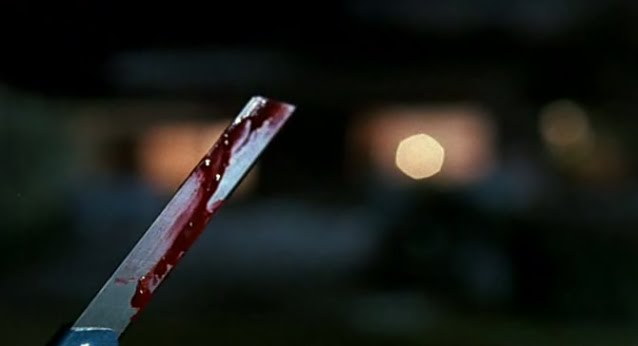
A Blade in the Dark is a film by Lamberto Bava (Demons, son of Mario Bava) which fits in perfectly in the Giallo tradition of filmmaking. You have all the necessary components: an unknown killer, a series of unexplained deaths, a theme song anchoring the film and a twist as to who is the culprit. What is most clever is that Bava here makes his protagonist a musician working on a film score so the repetition of the theme is naturalistic most of the time and can’t get annoying.

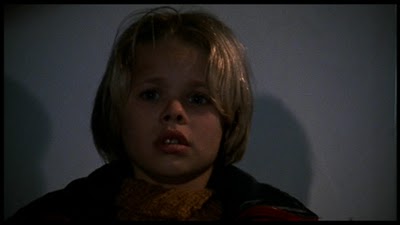
You may notice a slight similarity to Four Flies on Grey Velvet but there is a decided difference here. In this film you also have a film-within-a-film which doesn’t take up a lot of screen time but plays a significant role. You see one of the pivotal scenes full-frame before the credits roll and only later realize it’s a film-within-a-film. This little vignette also features Giovanni Frezza who was the poster child of the genre in the 1980s appearing in the works of Fulci and the elder Bava as well.

Giovanni Frezza in A Blade in the Dark (Blue Underground)

The twist in this film is one you think you see coming but you truly don’t. The film does a great job of dividing your suspicions in this whodunit and thus misdirecting you completely. While there is one scene in particular, the first kill, that stands out as being awkwardly staged the rest of it is handled masterfully. There are some tooth-clenching sequences and great gore work.

8/10

Mini-Review Round-Up #4

This is something I’m going to do periodically. Basically, I will employ many means to qualify films for the BAM Awards be it either seeing the film theatrically acquiring a DVD either through purchase or on Netflix. This could lead to an influx of several new titles being seen in a short span of time which would be difficult to write full reviews for. At least this way the film gets some of its deserved attention and you get some notion of my thoughts on them.

If you have questions or comments feel free to respond. I always get back.

As always please refer to My Rating Scale for an indication of what the scores mean and if you’re curious where these films might make a dent in my personal awards please check my BAM Considerations.

The Inheritance

Rochelle Aytes in The Inheritance (Duly Noted)

A family reunion in the country quickly becomes something more insidious.

I use the word quickly above almost for the lack of a better word. There’s nothing quick about The Inheritance, it all takes far too long to unravel, too many things are played close to the vest and by the time secrets are spilled and the true intention starts to come out it’s too late to salvage it. The idea is interesting: it’s a generational tale going back to slavery and mixing in voodoo aspects, however, all the information finally flows in a barrage and then you get bad effects towards the end and truly anticlimactic escape. It all could’ve gone somewhere very interesting but never gets its momentum going.

3/10

Stake Land

Connor Paolo in Stake Land (IFC Films)

A post-apocalyptic world wherein vampires rule and it’s kill or be killed.

There is a lot going for this film from cinematography to score to a well-delivered, at times poetic, at times humorous narration by the lead Connor Paolo. Where Stake Land struggles some is in its pace. There are some potentially rather huge situations glossed over and a lot of time is dedicated to roaming the abandoned countryside. There is also a lot of great acting in this film. While it is recommended viewing it’s also nowhere near as good as it could’ve been.

7/10

Dream Home

Josie Ho in Dream Home (IFC Films)

A woman will do anything to get her dream home.

This is almost like two different movies entirely. I get how they connect but while I appreciate the bit of time traveling done by the narrative in the beginning, and the subtext at the end in the nice simple button, but I really just could not get into this one. The film goes out of its way to explain why this means so much to her and thus we identify but it all seems so superficial. It is rather suspenseful, the kills are great but it ends up feeling a bit vacuous. It almost would’ve been better if the film tried its hand at subtext more and didn’t get so cutesy with the whodunit. Instead, we eventually get all the pieces, put them in place and say “So what?” Sometimes I’d rather be confused and intrigued at times than lucid and unimpressed.

5/10

The Reef

Adrienne Pickering in The Reef (Image Entertainment)

It’s a shark attack movie.

Not to disparage it in the synopsis section but that’s what it is. It’s one in the Open Water mold and while the performances are good a very believable the film takes the concept of slow burn a bit too far such that it burns out. It becomes completely and totally uninteresting and after a while downright boring. There’s only so much of people treading water, or even swimming, that you can take before it becomes mind-numbing shark or no shark. The score does nothing to heighten the tension and there’s really no drama to the whole affair. I will grant that it’s more realistic than most of the goofy shark movies as of late and more interesting but it still doesn’t make it good.

4/10

Fright Flick

Allyn Carrell in Fright Flick (Breaking Glass Pictures)

The story is that of a series of murders on a film set.

One of the first problem this film runs into is that it’s about a cheesy low budget horror movie. It starts with a film-within-a-film and you’re thinking “Wow, is it going to be this terrible throughout?” The good news is no it’s not; the bad news is it doesn’t get much better. The gore effects are really strong, when the chips are down some of the performances are decent but the characters are pathetic and so are some of the performances at times, only some are consistently annoying throughout. A lot of the inconsistency stems from the direction just upload it on instant and watch the in-credits scene and you’ll see the confusion that plagues this film. The standout performances are those of Chad Allen and Allyn Carrell.

3/10

Make Your Own Film Festival- Pick a Country (Part 6 of 7)

Windows doesn’t discriminate between regions any longer, and neither does Macintosh. Even if they do you should get a warning when inserting a Non-Region 1 DVD (meaning one made for distribution outside the US, Canada and Mexico) saying what region it is and asking if you want to change your computer’s region. Typically, there has been a set limit on how many times you could change regions before it became a permanent switch. Even if your computer is more finicky you still have an opportunity to watch many more DVDs, many of which you can only find online, that you never thought you could before.

Some foreign films have limited appeal and distribution internationally. You should take that into account when traveling overseas and pick up some movies you won’t find in the US. Taking that in to consideration this critic made a number of purchases when in Brazil in 2008 to set up a mini-festival.

Se Eu Fosse Voce (If I Were You)


If I Were You (20th Century Fox Brazil)

This is a genre film. It’s a trading places story which is funny and elevated due to the tremendous performances of the ensemble specifically Tony Ramos and Gloria Pires. While very few of these films go out of their way to try and explain the catalyst of the switch this one does. While in other films most notably Freaky Friday the switch is caused by a minimal twist of fate like a fortune cookie. This film operates on a much more cosmic level with planets aligning, which makes you wonder why they’re the only ones, especially considering the jokey ending which, seemed to imply another switch which would’ve been impossible by the rules established at that point.

Another thing that absolutely undoes all the good work of the cast is the fact that the cat should be let out of the bag about their trading places when Ramos’s character, now a woman trying to pass herself as a man, receives a phone call from her husband trying to live as a woman; at that time of the month and in need of guidance. Unfortunately, the secretary announces it’s his wife so the staff overhears part of the conversation chuckles, this is not something that can be forgiven. He should’ve tried to cover by saying it was a mistake and it was his daughter calling. Worst still this occurrence was about where Act II was turning to Act III so it lightened the climax and rendered it an anti-climax because there was no longer the risk of being found out. We know they will understand one another and the opposite sex better. That’s a given of this subgenre what we need for entertainment purposes is some suspense.

It’s a harmless film in the end. It’s not the kind of bad film that gets you angry but just upset that great performances and talents were wasted in a simplistic tale with obvious flaws that could’ve been easily corrected.

Make Your Own Film Festival- Pick A Country (Part 5 of 7)

Windows doesn’t discriminate between regions any longer, and neither does Macintosh. Even if they do you should get a warning when inserting a Non-Region 1 DVD (meaning one made for distribution outside the US, Canada and Mexico) saying what region it is and asking if you want to change your computer’s region. Typically, there has been a set limit on how many times you could change regions before it became a permanent switch. Even if your computer is more finicky you still have an opportunity to watch many more DVDs, many of which you can only find online, that you never thought you could before.

Some foreign films have limited appeal and distribution internationally. With that in mind you should take that into account when traveling overseas and pick up some movies you won’t find in the US. Taking that in to consideration this critic made a number of purchases when in Brazil in 2008 to set up a mini-festival.

Avassaladoras (Overwhelming Women)

Overwhelming Women (Fox Filmes do Brasil)

This is the kind of film that would be described in Brazil as “sugarwater,” sweet, simple and ultimately disposable lacking any depth or substance. Granted it does try and in the end it is an anti-romantic comedy in as much as our protagonist gets no one in the end. It is so singularly focused on her finding someone that it barely builds her or any other semblance of a subplot. It is very narrow-minded throughout.

The cast is decent. Caco Ciocler appears here as well and is hardly recognizable and extremely funny. It goes a little over the top at times but at least it is generally light but the resolution in the end is facile and its oncoming was buried. Though they were fine Giovanna Antonelli and Reynaldo Giannechini were underutilized here and their relationship, though understandable, was quite odd until they finally speak to one another.

It is likely this kind of film and the next that give Brazilian films a bad name in Brazil. It’s a genre film, the likes of which we’ve seen thousands of come out of the US so why bother when they can be just as bad coming from the States? Also the idea could likely be better executed on television and at least would be more acceptable light fare in that medium.

Make Your Own Film Festival- Pick a Country (Part 4 of 7)

Windows doesn’t discriminate between regions any longer, and neither does Macintosh. Even if they do you should get a warning when inserting a Non-Region 1 DVD (meaning one made for distribution outside the US, Canada and Mexico) saying what region it is and asking if you want to change your computer’s region. Typically, there has been a set limit on how many times you could change regions before it became a permanent switch. Even if your computer is more finicky you still have an opportunity to watch many more DVDs, many of which you can only find online, that you never thought you could before.

Some foreign films have limited appeal and distribution internationally. With that in mind you should take that into account when traveling overseas and pick up some movies you won’t find in the US. Taking that into consideration this critic made a number of purchases when in Brazil in 2008 to set up a mini-festival.

Olga


Olga (Lumière)

The packaging of this film tells quite a tale. First, this is the only DVD of the batch which has the logos of all the corporate sponsors, production companies, studios and governmental agencies affiliated with the production of the film on the disc itself, which total 19. Another view into the Brazilian film industry is the stat on the back which hypes the film as a box-office smash having over 3 million viewers. Firstly, we obviously don’t measure films on individual ticket sales in the US but even if you translate that to an American audience you can see how modest audiences for domestic product in Brazil are. In America that would equal something just over a $30M gross, even with a modest budget that wouldn’t raise eyebrows.

Olga is a rather interesting tale of a woman Olga (Camila Morgado) who was a communist revolutionary in Germany and who travels to Brazil to ensure the safe transit of a famous Brazilian revolutionary, Prestes, and gets involved in a failed plot to overthrow the military dictatorship. It’s a long film because it tells three tales really – her love story with Prestes (Caco Ciocler) then her attempt to flee and then her deportation to Nazi Germany and incarceration in a concentration camp.

It was an epic challenge for a first time motion picture director Jayme Monjardim, who had quite a bit of experience on TV in mini-series and telenovela form. For the most part it’s quite effective. Morgado’s performance is great in arc and quality. At times the score is a bit overwrought as if asking you to feel seeming not to trust the material. There are also a lot of silent pensive scenes that could’ve been excised with more judicious editing. The film is already very visual, so we don’t need these silences inflating the run time.

Overall, it is a rather interesting tale and one which is likely unknown to most with good performances throughout including the supporting cast like Osmar Prado playing Getulio Vargas and Fernanda Montenegro, Brazil’s best actress as Prestes’ mother.

Make Your Own Film Festival- Pick A Country (3 of 7)

Zuzu Angel


Windows doesn’t discriminate between regions any longer, and neither does Macintosh. Even if they do you should get a warning when inserting a Non-Region 1 DVD (meaning one made for distribution outside the US, Canada and Mexico) saying what region it is and asking if you want to change your computer’s region. Typically, there has been a set limit on how many times you could change regions before it became a permanent switch. Even if your computer is more finicky you still have an opportunity to watch many more DVDs, many of which you can only find online, that you never thought you could before.

Some foreign films have limited appeal and distribution internationally. With that in mind you should take that into account when traveling overseas and pick up some movies you won’t find in the US. Taking that in to consideration this critic made a number of purchases when in Brazil in 2008 to set up a mini-festival.

Patricia Pilar and Daniel de Oliveira in Zuzu Angel (Warner Bros.)

Another interesting piece of history examined through the lens of fiction – the historical drama. The reason this form is likely so dominant in Brazilian art is because a documentary though more true to fact will be harder to piece together after the fact. The other key factor is the audience for fiction will always be bigger, like it or not.
So much of the material that is relevant is dramatized history that is being re-earthed for dramatic purposes and to avoid history repeating itself. It is interesting in that it tells the tale of Brazilian woman who meets an American, marries, becomes a famous fashion designer and her son becomes a radical opposed to the military regime. In trying to unravel the mystery surrounding his disappearance she becomes a radical herself.

It starts out on a very high note in medias res emotionally speaking and gives us a slightly telenovela moment (this kind of moment in Brazilian terms is much more naturalistic than its Mexican cousin). Patricia Pillar is spectacular in this role not only working bilingually but in terms of her arc and range she goes from uncaring and aloof to angry, embittered, passionate, sad and plays the lady when she has to.

Like many of the new era of Brazilian films it refuses to go in chronological order and yet becomes more engaging because of it and tells cumbersome tales that encompass years deftly. This proclivity for temporal distortion could be one of the reason many in Brazil do not like domestic films because they are not the simplistic Hollywood product they are used to seeing. The stories aren’t easy and to tell them in perfect order would be rote and trite and in these films would be all history lesson and no story, no emotional involvement whatsoever. This was without a doubt one of the most powerful entries in this festival.

Review- In a Better World

Markus Rygaard and William Jøhnk Nielsen in In A Better World (Sony Pictures Classics)

In a Better World is a Danish film which won Best Foreign Language Film at the most recent Academy Awards and that is a moniker which can carry a stigma for many. The two that come foremost to mind are that either it’s an inaccessible by the masses art film or that it’s essentially an American film transplanted and taking place overseas. None of these notions apply to this film at all.

However, this film did vaguely bring to mind the Best Picture winner The King’s Speech in as much as its accessibility and relatability are part of its appeal. However, there is still an artistry and at times poetry in the way the simple subject of this film is handled that makes it excel just beyond being something passable and there’s still that European sensibility to it that’s just a little more deft even when handling things in a very straightforward manner.

This film is really telling two stories most of the time: it tells of Elias’s struggle to deal with bullying (which is quite relevant to the current climate) and his father Anton’s struggle as a doctor working in Africa who has to treat a malicious man who has sent many women to his hospital tent clinging to life and the locals beg him not to. These narratives only truly intersect once, otherwise the film shifts, as Anton does, from location to location.

The third factor, one who starts on his own but becomes involved in Elias’s story and dominates that, is Christian. After the initial images of Africa grace the screen, Christian is heard reciting a poem in English (this is one of the longest L-Cuts I’ve ever seen). As the film frequently does it conveys information visually showing us he is at his mother’s funeral. Following her death he moves from London back to Denmark and meets Elias. He has a very different, more confrontational way of dealing with bullies and sticks up for Elias who gets picked on about his teeth and anything else they can think of. Eventually Christian’s way of seeing the world catches on with Elias and his father Anton struggles to show both of them otherwise.

This is the kind of narrative that could get quite preachy and pedantic but it doesn’t do so. It does take the opportunity and has the narrative to serve as a teachable moment but the characters never talk at us but to each other and each of them throughout prove themselves to be far too imperfect to be self-righteous. In the past employing children in meaty dramatic roles had been the sole purview of the foreign film, specifically those from Europe, while there are are now more opportunities here there’s still something a bit more genuine in the portrayal of the positive and negative aspects of youths overseas.

With the themes and plots that this film has it makes doubly sure to make all of its characters engaging, interesting and human and yet also makes most of them likable as well. In doing so these simple struggles which balloon to massive issues with each decision carry more and more weight due to the investment we’ve made in each of them and their well-being. While dealing in the philosophical it still has that emotional pull we need.

This identification made all the more easy by the cast which is nothing short of superb. The kids, of course, deserve first mention. Between the two of them they shoulder a lot of the burden of bringing this tale to life and each one of them has their own journey, and aside from one hiccup which I’ll attribute to willful misdirection, they make nary a misstep. What that misstep is doesn’t bear mentioning beyond the above. The bottom line is both Markus Rygaard as Elias and William Jøhnk Nielsen as Christian are fabulous in it and I was not surprised to learn that the latter was nominated as Best Actor in Denmark’s national film award (Zulu) and may factor greatly in mine (BAMs).

Furthermore, you have supporting them the very talented actors who play Elias’ parents: Mikael Persbrandt, whose own moral dilemma occupies much of our time and he shows the great range to be both tremendously sensitive and caring and extremely enraged and Trine Dyrholm whose despair drives this movie into your core and makes you feel it if you haven’t already.

The only thing I thought was consistently off was one theme from the score, which played quite frequently and seemed the most discordant of all the pieces. This is a shame because many sections were quite effective but are rendered less memorable by the repetition of the most unpleasant section.

In a Better World is certainly the kind of film which could improve with a second viewing and was most definitely worth not only of its awards but of your viewership.

9/10

Review- The First Beautiful Thing

Aurora Frasca, Micaela Ramazzotti and Giacomo Bibbiani in The First Beautiful Thing (Palisades Tartan)

The First Beautiful Thing is an Italian film which can be characterized in a few different ways but it’s mainly a biopic without the celebrity and a character study without the self-indulgence. It concerns Bruno (Valerio Mastrandrea) who returns home to see his estranged family as his mother is terminally ill in the hospital.

The first interesting thing about this film is that it tells simultaneous tales in a fractured narrative, which unapologetically, artistically flows back and froth in time unannounced. Thus, we first meet Bruno and his sister Valeria when they are quite young and their mother is being awarded “Prettiest Mom” at a beauty pageant at random. This scene is mirrored beautifully at the climax and we truly see why it was so crucial to have that scene be first. Bruno and his mother saw that event in very different ways; Bruno’s view being similar to his father and to an extent it shaped both him and his relationship with his mother.

This film doesn’t put on any airs when dealing with intra-familial relationships and shows them for what they are. Cultural attitudes, the estrangement and the scenario allow them to be more open than they might be otherwise but there’s still a lot of imperfection, unconditional love and silent forgiveness shown throughout. This is a film that could very easily go into over-the-top melodrama but it is beautifully restrained throughout and slowly lets go of the reins allowing for a catharsis only at the end of the film.

This film is littered with very good performances. Ultimately, it’s the kind of film wherein it would get tedious to cite them all when there are many other facets of them film also worthy of attention. However, consider this each of the three main characters have more than one actor playing them. The children have 3 stages: child, teen and adult and there’s a young version of the mother and an elderly one. All of of them are quite strong an each is playing one character in such a way that we can see the trajectory of their life. Bruno, for example, is now professor, afraid of committing, hooked on drugs, stone-faced and wary of seeing his family anew. The actors playing Bruno in earlier moments chronologically have to make this interpretation acceptable and possible and they do.

The film plays out as a tragicomic one as there are certainly moments of genuine laughter and joy and moments that can and likely will bring tears to your eyes. It strikes a delicate balance of poking fun at truths we know about family life and also knowing what draws us in and brings us back home no matter how prodigal we may be.

Similarly coming off an absolutely absorbing and wrenching climax you get a quietly resolute denouement that ends the film on just the perfect uplifting note after the expected occurred.

The First Beautiful Thing, as intimated above, is accomplished technical film. The edit works quite well aesthetically and technically to blend time. The cinematography is often lush and places us in the right perspective to properly absorb the emotion of a scene (whether in overhead, creative over-the-shoulder or wide). The score and occasional use of source music, especially the songs the kids sing with their mother, is spot on.

This is one of the best films I’ve seen to date this year. It’s the kind of film you feel as if you experience not merely watched. It’s engaging on all levels.

10/10