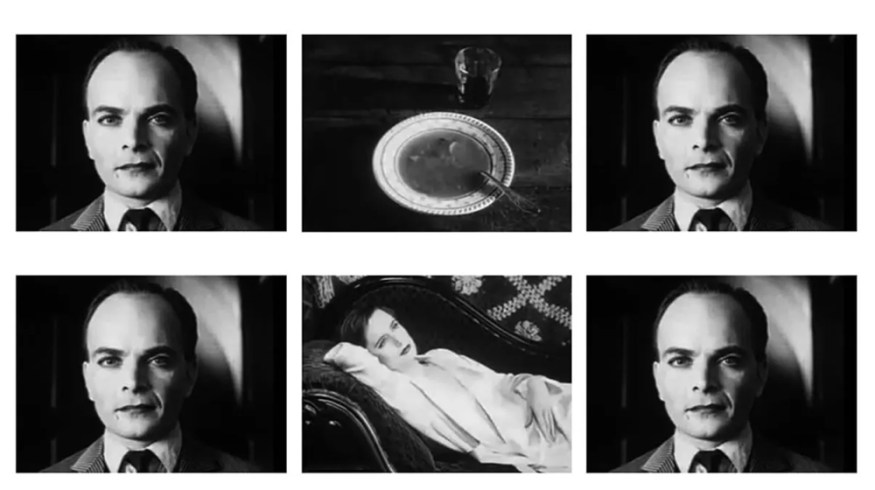
Film History Friday: The Kuleshov Effect
Following the end credits of the recent film Good Boy a mininature behind-the-scenes featurette serves as the film’s stinger. In it the director, Ben Leonberg, mentioned that the reason Indy’s (the dog’s) performance seems so emotive is due to the Kuleshov effect.
Here’s Hitchcock synopsizing it in one of his interviews with Truffaut:
“Yes, in one of his (Pudvokin’s) books on the art of montage he describes an experiment by his teacher, Kuleshov. You see a close up of the Russian actor Ivan Mosjoukine. This is immediately followed by a shot of a dead baby. Back to Mosjoukine again and you read compassion on his face. Then you take away the dead baby and you show a plate of soup, and now, when you go back to Mosjoukine, he looks hungry. Yet, in both cases they used the same shot of the actor; his face was exactly the same.”
There is also a shot of a woman in which Mosjoukine was interpreted as being in love. Like Hitchcock I’d only read of the experiment that cemented a piece of film theory. But in Good Boy the footage was shown. After having seen it, I looked it up to share here. Enjoy!
 The Movie Rat