61 Days of Halloween: The Mist

Most holidays worth their while encompass entire seasons, such as Christmas, for example. However, as you may have noticed there is a corporate push every year for us to think about the next holiday even sooner. While this has many negative side effects I figure I may as well embrace it.

Since Labor Day is really only good for college football and movie marathons cinematically it is as significant as Arbor Day, which means the next big day on the calendar is Halloween and we can start looking toward it starting now.

Daily I will be viewing films in the horror genre between now and then and sharing the wealth. Many, as is usually the case, will not be worth it so for every disappointment, I will try and suggest something worth while as well.

When it was released The Mist was one of those films that just fell through the cracks for many. Mixed reviews are likely the reason. It is a film that should be seen if only as a conversation piece because it does have one of “those” endings, you know the kind that will get you talking and will inflame passions. In other words, it takes a risk and that alone makes it worth watching.

However, for the two hours leading up to said ending it earns that “should be watched” distinction. The running time alone is worth noting. Few films in the horror genre have enough substance to add a half-hour to the usual running time to build character but if a film can it should. Knowing who these people are and whether we as an audience love them or hate them makes a huge difference. The personal dramas and threats keep us locked in when there is no threat from the creatures in the mist.

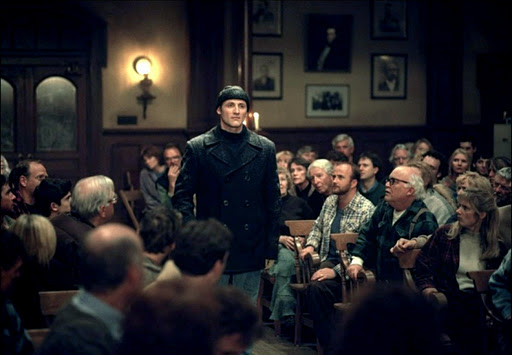
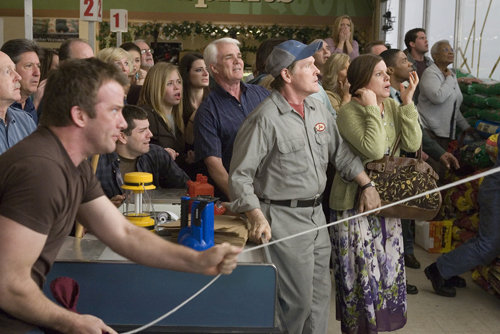
The situation in which these varied characters find themselves in is built up steadily, slowly and sinisterly; such that before any of the characters realize the peril they are in we are already feeling tense. In combining two techniques of the genre we get in this film a very compelling drama with a horrific backdrop: characters trapped in a building with assailants outside (reminiscent of Night of the Living Dead) and a multi-character yet character-driven tale, which is a forte of Stephen King’s, whose novella is the source material for this film. Darabont’s handling of King’s difficult-to-adapt material is again nearly spot-on, Darabont creates and in some ways amplifies King’s effective scenario and makes it one of the most enthralling and captivating no-win horror scenarios ever created. There just seems to be no escaping it.

In a horror film one can forgive flawed acting from a lead, Thomas Jane, but the antagonists and most of the cast, especially in a film such as this need to be solid and they are. Andre Braugher plays his character convincingly enough such that you despise him, forgetting that it’s the part and not the man annoying you. Marcia Gay Harden, as always is brilliant, and downright frightening in this role. Her ability to convince those in the supermarket, though a bit overwrought at times, is fantastically illustrated. Some of the smaller parts are also very well-played like the Woman with Children at Home (Melissa McBride), Nathan Gamble as Billy (most well known from Dolphin Tale) and the Terrified Woman (Kim Wall).

The thing which is the most inconsistent in the film is the CGI. It seems whenever there was a good to great sequence of effects they would extend it too long or cut too close to the action and the illusion would fall apart. Typically, CG looks better on DVD than in the theatre, but not here. Some elements, like the bugs, were very impressive but the CG was not judiciously used and not carefully crafted enough, which is the only major inconsistency in the film. However, there has been worse it’s just upsetting to see such a glaring problem in a film which is of a very high caliber most of the time.

The ending is a conversation piece. It is strong and unlike King’s story it’s not open. King approved of this change. Certain elements are very effective some aren’t. What you make of it is up to you. It does not detract from the whole and the film is definitely worth watching.

This review pertains to the standard edition DVD not the two-disc special edition.

8/10

Horror Films and Stephen King (Part Seven)

De Laurentiis was the sole production company involved in the making of this film. They gave this movie a budget of $10 million dollars, which may have been risky considering their spotty past varying from Conan the Destroyer to Blue Velvet. Of their 22 productions four were released in 1986. The fact that they spread themselves so thin may have lead to the variance in the quality of the films and their financial success.
    

The distribution of this film is what really sunk it, as in almost no one saw this film. DEG didn’t have the distribution power even of a New World Pictures thus not many theatres ran the film. Even if they did get a decent amount of screens there was still the problem of bad timing. 
 

Maximum Overdrive got slammed financially and here’s why: it began slowly in June, (AIP would have called it I Was an ‘86 Blockbuster) and they rolled in: Ferris Bueller’s Day Off, Back to School, The Karate Kid Part II and Ruthless People. Then on July 2nd and 4th Disney attacked with The Great Mouse Detective and Flight of the Navigator. OK, so there are a lot of comedies and family films what’s to worry … (gulp) … Aliens, the follow-up to the original blockbuster comes out and becomes the dominant film of the next few weeks beginning on July 18th. With the horror market cornered a small unassuming film directed by a writer involving trucks comes out, what do you expect to happen? Well, as that dude Murphy would say, if he had lived in the 80s, “Yo, it gets worse!” 
 

A fortnight after the truck expedition Rob Reiner released one of the finest King adaptations to ever hit the screen, Stand by Me. It was a film that caught everyone by surprise, including Stephen King, who later remarked, “It seemed to me that Stand by Me was the first really completely successful adaptation of my work.” (Stand by Me). I believe part of that comes from a true filmmaker who wasn’t afraid to involve himself in the text in handling the film. It wasn’t just a studio picking up his latest offering, or struggling writer maxing his credits cards to get a shot or a no-name director getting his one chance. 
    

Ironically, the marketing of Stephen King is only an issue when it’s a horror film. When The Green Mile came out he was the author of The Shawshank Redemption, with Hearts in Atlantis  he was the author of The Green Mile. Dolores Claiborne was probably also thrown in the mix at one point. It’s as if they think he’s only good when he writes something other than horror.

I’d seen Stand by Me as a child and had always liked it. It was one of those things I came to later rediscover in adolescence/early adulthood and when I found that King had written that tale it confirmed his genius in my mind. King and Reiner seemed to have come from similar upbringings and it lead to probably one of his most fruitful collaborations. King commented in 1990 that “Rob Reiner, who made Stand by Me, is one of the bravest, smartest filmmakers I have ever met. I am also amused to note that the company Mr. Reiner formed following the success of Stand by Me is Castle Rock Productions … a name with which many of my long time readers will be familiar.”  (Midnight, xiii). 


Often the relationship has not been as chummy. King is said to have had many a feud with Kubrick and has publicly aired his sentiments about The Shining over the years. Yet, he is quite an admirer of DePalma’s Carrie, as am I, while he finds no real amusement in his own book which he once threw out, I agree with that instinct but am so very glad his wife saved it from the wreckage. While I know it’s true that it’s usually the studio/distributor that makes the decision to plaster a movie poster with “Stephen King’s” or “From the producers of Independence Day” I sometimes hope that he stipulated that it be removed if he was unhappy with something, like Christine.
    

John Carpenter’s Christine is a galumphing piece of crap about an unsympathetic nerd that never should have been made. The book, however, is a fascinating, ominous, well-developed masterpiece told from three separate points of view and you can sympathize with all the characters. And like the master he is, you believe this scenario somehow because he makes you. 
 
   
To successfully adapt a book one must realize what makes each medium unique in order to capture the book’s essence on film without ruining it like millions of misguided dorks have done in the past. Ira Levin author of Rosemary’s Baby commented on Roman Polanski’s adaptation in a letter to King stating “There is a reason for his fidelity to the book, incidentally…His screenplay was the first adaptation he’d made of someone else’s material; his earlier films had all been originals. I think he didn’t know it was permitted – nay, almost mandatory! – to make changes.” (qtd. in King, Danse Macabre, 296). It is always wonderful when a film can be made that follows the book as faithfully as Levin feels his was followed. However, it’s not always a success like a Harry Potter or a Rosemary’s Baby the words ‘slavish,’ ‘slow,’ and ‘boring’ often come up in reviews. People who want drawn out movies that give you two to two-and-half hours to really examine the characters and the situation their in are rare, more and more studios are reverting to the 90 minute film length as opposed to the 120 and above.


The issue of time is one reason that Stephen King has found such a comfortable home on ABC writing mini-series’. In 1999 and 2002 he made two originals called Storm of the Century and Rose Red. In the latter he had the luxury of waiting 100 minutes before sending his protagonists into a haunted house whereas, in a feature film most producers would’ve already wanted the story to be over.
    

In the end, making Maximum Overdrive was a valuable experience for Stephen King. Since 1986 it seems that he’s taken a more active role in some of his productions and has ultimately learned to pick his battles. He’s since found a medium in which he can write long screenplays filled with rich, rounded characters and he has since become a producer. Thanks in part to Reiner’s success more accomplished filmmakers have since been attracted to his projects. The high-end Kingflicks are more frequent and there isn’t as much junk inbetween. He’s been involved with Frank Darabont on two occasions on The Shawshank Redemption and The Green Mile and Darabont has optioned the rights to a short story entitled “The Mist” [It has since been released], William Goldman has adapted three of his novels into films Misery and Hearts in Atlantis and the forthcoming Dreamcatcher. King wrote an episode for Chris Carter’s X-Files and is shopping an adaptation of Patrick McGrath’s novel Asylum to be directed by Jonathan Demme [This never came to fruition]. He’s also developing a television series based on Lars von Trier’s The Kingdom for which he will write pilot [This did happen].
    

Many readers who like to be scared by King, when they’re not going to court with Grisham or seeing the turbulence in Steel’s world, have fallen out of favor with King’s work. Stephen King is a writer who is constantly honing his craft. He is writing richer, more complex novels and has mastered other mediums along the way. A little over 36 years after his career in film began King’s legacy is only now beginning to show his true potency.