10 Keys to a Better Life as a Fanboy: 7. Suspend Disbelief (aka Get Into It)

This series of articles is designed to help you, the fan, try and divorce yourself from your attachment to source material and judge a film on its own merits and not in comparison to another work. These tips come from my own experience. I hope they are helpful.

Many of these topics do overlap one another but attack problems from different angles. This tip really comes into play if you’ve already managed to ignore number four. So here’s how:
You’re sitting in the dark of the matinee and you’ve got your 80 oz. soda and obese-family-size Twizzlers and you’re watching the same lame slides come across the screen repeatedly. The trailers for blockbusters-yet-to-be keep you only mildly amused. All this idle time has got you anticipating the film more than you had been before and you start thinking about how this director will handle the material? Or how such-and-such will do in this part and how the casting of character X will pan out. Boom. All the things you were supposed to ignore are back and suddenly the film starts and it’s distracting you.

This is where you have to grab the bull by the horns and just lose yourself in the story. Remember what it is that drew you to this material in the first place and look for it. If you find great, if not the film failed to an extent. Again this is not an attempt to excuse the film but just setting yourself up to try and judge the film before you and not measuring against another kind of work entirely.

10 Keys to a Better Life as a Fanboy: 6. The Perils and Merits of Series

Vista Library

This series of articles is designed to help you, the fan, try and divorce yourself from your attachment to source material and judge a film on its own merits and not in comparison to another work. These tips come from my own experience. I hope they are helpful.

The aforementioned tips are all well and good when you are the fan of a standalone piece in another medium and it is being adapted into a standalone, for the time being, film. Things get more complicated when your book or comic or what have you is part of a series. Any series will have its own arc and structure in its greater tale aside from just the structure of the single volume.

This is where you might have to breathe deep and learn some relaxation techniques. If an element, say Hermione’s quest to end the enslavement of House elves, is left out of one film it will be left out of each subsequent film until it becomes absolutely, positively crucial to the structuring of the story. So some of the subplots that enrich a book will invariably fall by the wayside, which is why comparing mediums is dangerous.

I don’t want a novel that reads like a screenplay. I want detail, inner monologue, I want it to be possible to take two pages to describe five seconds of a character’s life. Each medium has its strengths and to expect a film to be a pictographic facsimile of a book is unrealistic. Sticking to the Harry Potter theme The Deathly Hallows is 759 pages long. If those pages were screenplay pages you’d be looking at a 12 and 1/2 hour movie. So even with two films telling the tale of one book you’re looking at roughly 40% of the material in the book covered.

So it’s a fact of life that the movie by necessity can and will leave things out and change things.

Conversely, you need to look at the film within the context of the series. You can compare it to past films but also bear in mind: how did it advance the story, did it up the stakes, is it leaving the table set nicely for a subsequent edition should there be one?

10 Keys to a Better Life as a Fanboy: 5. Forewarned is Forearmed?

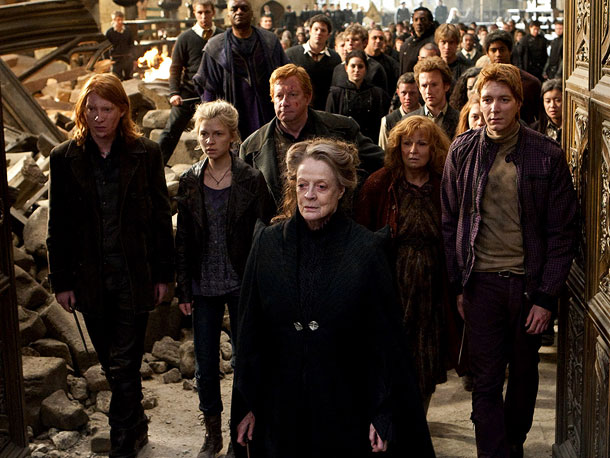
Harry Potter and the Deathly Hallows, Part 2 (Warner Bros.)

This series of articles is designed to help you, the fan, try and divorce yourself from your attachment to source material and judge a film on its own merits and not in comparison to another work. These tips come from my own experience. I hope they are helpful.

This may be the most difficult of my guidelines in which to practice what you preach but it is completely possible. Basically, what this means is that if you find yourself to forming prejudicial opinions when hearing news tidbits about an upcoming films try and avoid them. Granted this is becoming increasingly difficult in a wired world but it is possible.

For example, I wrote about the split in the Harry Potter and the Deathly Hallows films. Curiosity got the better of me and I looked into what they picked and thus opined on it. However, none of the headlines I saw gave it away had I not clicked the link I’d be none the wiser.

Now, of course, casting news is usually a giveaway. It’ll be in the headline that so-and-so was cast in a given role but what I’ve learned in those scenarios is that I have been surprised many times by such decisions so I no longer read too much into those.

This feeds into the blank slate argument but basically the less about the production you can manage to absorb and form an opinion on before you see the film the better off you will be.

10 Keys to a Better Life as a Fanboy: 4. Leave Your Expectations at the Door

newmoms.com

This series of articles is designed to help you, the fan, try and divorce yourself from your attachment to source material and judge a film on its own merits and not in comparison to another work. These tips come from my own experience. I hope they are helpful.

I have frequently started articles by saying that I went into a screening as a blank slate an that greatly enhanced the experience. Clearly this is much easier said than done and it works best when you literally don’t even know the plot details about what you are going to see. That being said you can try to apply it to an adaptation of one of your favorite works.

This selection is kind of a fail safe should number two not cut it for you. If you absolutely cannot drain yourselves of recollections of the book or other adapted materials open yourself to the experience you are about to have. Lower your expectations if you have to. Be prepared for anything and everything and don’t sit in wait of certain events. Get into full on hit me mode and let it wash over you as much as possible.

If you are typically hyper-critical take it down a notch, if you’re just critical be escapist. You can still reflect back on the film later on and make up your mind about what you thought. The key is to have those opinions be based on the movie and nothing more.

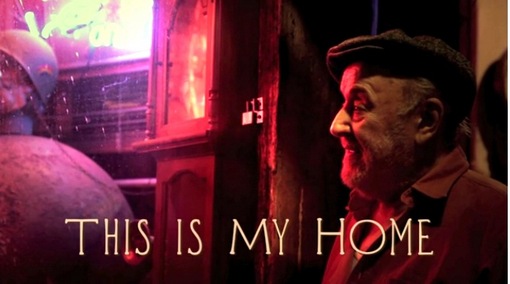
Short Film Saturday: This is My Home

(Departure|Arrival Films)

This selection is courtesy of Edmund Davis-Quinn who caught this in a post by Roger Ebert when I had missed it. The description and the film say it all. A great little doc.

The Vimeo description says: “On an unseasonably warm November night in Manhattan on our way to get ice cream, we stumbled upon what appeared to be a vintage shop, brightly lit display window and all. As we began to walk in, a man sitting out front warned us that we were welcome to explore, but nothing inside was for sale. Our interests piqued, we began to browse through the collections the man out front had built throughout his life. This is a story of a man and his home.”

This Is My Home from Mark on Vimeo.

10 Keys To A Better Life As A Fanboy- 3. You’re Not The Director, Screenwriter, Etc.

Rupert Grint in Harry Potter and the Chamber of Secrets (Warner Bros.)

This series of articles is designed to help you, the fan, try and divorce yourself from your attachment to source material and judge a film on its own merits and not in comparison to another work. These tips come from my own experience. I hope they are helpful.

While this does connect somewhat to number one, as many ultimately will, trust me this is somewhat different and is very important to remember. It is also key to keep in mind ultimately the decisions that are shaping a series based on a work you love are not yours to make. Now you may be a creative type who makes it and someday you could be in charge of a remake, as film is becoming more like theatre and remakes (read “revivals”) are becoming an accepted practice, of your pet project and if that’s the case more power to you but then you’ll be the one facing the angry postings not writing them. However, as you sit in wait for one of the year’s biggest releases you’re not going to shift opinion and if your opinion stands for several consecutive installments of a series do one of two things: one, get over it or two, stop watching them.

An example of this would be a friend of mine who told me four movies or so into the Harry Potter series that she hates how Rupert Grint plays Ron Weasley. There is obviously a difference of opinion between the makers and actor and this audience member as to who Ron is, however, the producers wanted nothing more from the early-going than to secure the young triad for the duration. If the interpretation bothers you that much stop subjecting yourself to it or knock it off and just take it with a grain of salt.

I do fully realize there are remakes or sequels that make money simply because you want to “see how stupid it is” but eventually if a series dissatisfies you for several consecutive installments you should pull the plug. Aside from that you really have no sway. Online petitions may have gotten people on SNL but they have yet to change film casting or rewrite plot points so it is an exercise in futility.

10 Keys to a Better Life as a Fanboy: 2. Have a Bad Memory

Ian McKellan in The Lord of the Rings: Return of the King (2003)

This series of articles is designed to help you, the fan, try and divorce yourself from your attachment to source material and judge a film on its own merits and not in comparison to another work. These tips come from my own experience. I hope they are helpful.

I don’t know if it’s possible to train yourself to have a bad memory but you can sure as hell give it the old college try. You may have to be born with it and in that case I have been blessed. At least in this regard, it’s not really as handy as you may think.

How this will help you, though, is that the further you remove yourself from the source material the more you will be able to enjoy the film as a separate entity. An example of my experience with this is the Harry Potter films. Now granted they have gotten better, in my opinion (exponentially so with each installment), however, when I saw The Sorcerer’s Stone my first viewing was marred because I had so recently finished reading the book.

Since then there has been a bit of a gap between my having read the book and seeing each movie. Some were larger than others but that has helped. With each successive film I have spent less and less time and mental energy thinking to myself “Oh, Such-and-Such is coming up.”

Anticipating events and then wanting to see how they are executed cinematically can diminish your enjoyment unnaturally. If you came in as a blank slate you may either be awed or disappointed but it would be all your opinion of what you saw and in no way influenced by your expectation.

An illustration I could give you would be The Lord of the Rings trilogy. I never read them. I don’t care if I ever do read them. It certainly wouldn’t make my bucket list were I to write one (Finishing War and Peace would), but I did see all three movies. Thus, I had no preset expectations and the reception it got was the reverse of what usually happens. It was hyped, fans wanted it and were typically pleased with what they saw. For the record: I thought part one was pretty good, part two was interminable and part three was brilliant until it decided it would refuse to end. In some parallel dimension of the multiverse I’m sure it never did.

10 Keys to a Better Life as a Fanboy: 1. A Book is a Book (A Question of Form)

1. A Book is a Book (A Question of Form)

Star Wars- Episode III: Revenge of the Sith (Lucasfilm)

This series of articles is designed to help you, the fan, try and divorce yourself from your attachment to source material and judge a film on its own merits and not in comparison to another work. These tips come from my own experience. I hope they are helpful.

The first and most important thing to keep in mind if you are hoping to have a happy existence as a fanboy is that medium matters. A book is a book, a comic is a comic and so on and so forth. Each medium has its own rules and limitations and conversely benefits. If something achieves perfection within its form it is therefore referred to as a masterpiece.

It is very difficult but not impossible for a story to be that well told in more than one medium. Now how to gauge whether or not a film has achieved such a lofty height cannot and should not be decided based on a comparative analysis.

There is merit to examining the decisions made in adding and omitting and transforming material from other mediums to film but such discussions are typically more adept to academic scenarios and not germane to analyzing the quality of a film.

I will even have occasion to describe a film I saw and cite that I thought it should’ve done X when it does Y, Case 39 is a prime example of that, however, that should not influence one’s overall opinion of a film. You must look at what is presented you and then decide if it works based on what is there not what you wish is there. That should apply to films as well.

Another illustration would be Star Wars: Episode III: Revenge of the Sith. I was hoping against hope that amidst the bloodshed would be the headless corpse of Jar Jar Binks, alas it was not to be. Yet that didn’t color my entire view of the film. It still would’ve been bitchin’ though.

Review- Moon Child (La Permission de Minuit)

This is another example of a film that I am fortunate to have seen thanks to a film program, in this case it’s Rendez-Vous with French Cinema, which is presented in part by the Film Society of Lincoln Center and Emerging Pictures. Much like films I saw last year in From Britain with Love this series presents new films from foreign countries that likely have little to no US distribution. It’s a great way to discover some hidden gems. If you see a new films series from a specific country playing near you I urge you to go out and see some selections.

I wanted to see many of the titles that were playing at a local art house but sadly my schedule only permitted one.

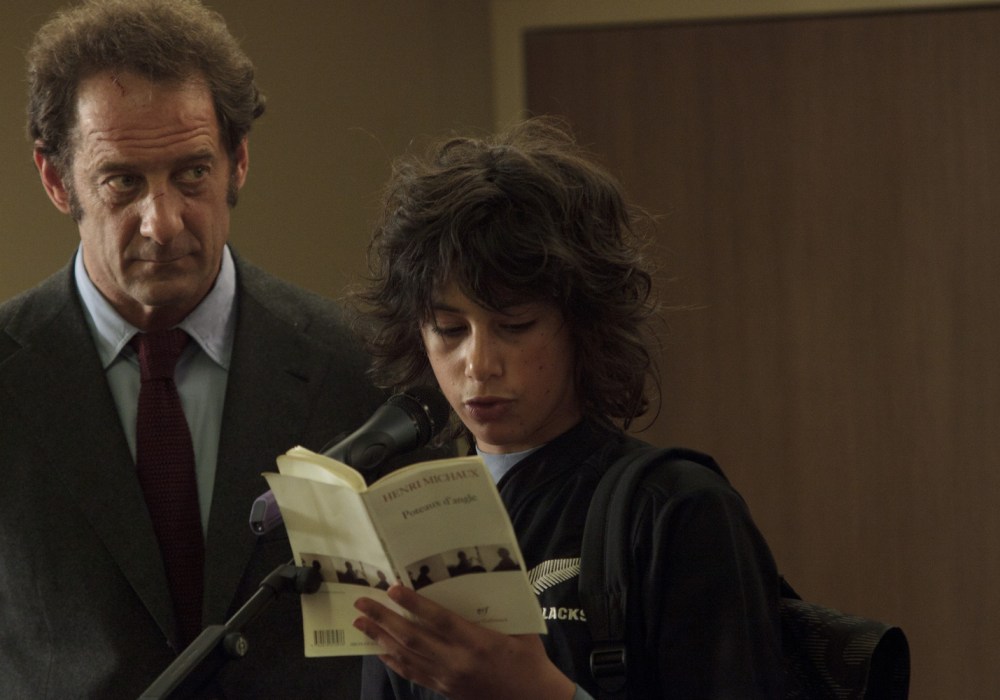
This film concerns a doctor/patient relationship between David (Vincent Lindon) and Romain (Quentin Challal). David is a dermatologist who specializes in X.D., a photosensitive skin disorder, which Romain has. Essentially he can’t be exposed to UV radiation and must cover up if out in daylight and must check lighting conditions. It’s a chronic condition which causes many growths, which may or may not be cancerous and he undergoes many procedures. The basic relationship conflict that exists in this film and a chronic illness, are things I can identify very closely with, though on a far less severe level.

However, there’s not merely a doctor patient struggle in this film. Yes, there is a the personal connection that a physician has with a patient he’s treated his whole life but they also each have their own conflicts they grapple with. David struggles with trying to transition to a position with the WHO, dealing with his successor where he is and making sure his patients are in good hands and how to break it to his current patients. While Romain struggles not only with his conditions but with adolescence and trying to find some sort of harmony between the two.

The film’s weakest point is perhaps the one it should’ve handled most easily. The rivalry that develops between David and Carlotta (Emmanuelle Devos) is a bit too infantile and trite, especially when contrasted to some of the naturalistic truths found in other aspects of the film. The arc seemingly takes a huge jump in their relationship also. Thankfully the film has so much else going for it that this is a minor complaint.

One of which is an aspect I love and that is the juxtaposition of high point and low point in the narrative. David takes Romain on a road trip as a pretext to telling him he’s leaving. There’s some great scenes, interactions and montage. It’s wonderful and you get swept away in the fun. Upon their return Romain’s mother (Caroline Proust) lets the cat out of the bag immediately. Overwhelming high to incredible low in a split-second that propels the film beautifully into its second half.

The acting in the film for the most part is very strong but it really is a two-man show both Vincent Lindon and Quentin Challal are absolutely wonderful playing their disparate characters. Moreover, they work very well and naturally with one another which really sells you on the fact that the characters have a history. It feels organic an not like an artifice created for the purposes of story-telling.

The music whether instrumental or an original song for the film is very well-spotted, always emotionally truthful and highlights the emotional resonance of all the scenes in which it’s present. It’s rare to see both incorporated in one film and even more rare still to see them both work so well.

Through all its interpersonal drama and life-and-death situations the film does find a lot of room for comedy, quite naturally too. It’s this mix that allows it to work so well. It doesn’t stay to dour and works enough ebbs and flows such that it can extend the story the necessary amount so as to tell things in their proper time without forcing things.

My one previous aversion aside this is a very strong film and I’m glad it’s getting this showcase and I’m saddened that my screening was so woefully empty. It’s rare to see a doctor’s and a patient’s tale told so well much less a man’s and a child’s but here it is and there’s a great synergy to it. It’s a film that’s grown on me since I’ve seen it and I hope more people get a chance to see it.

9/10

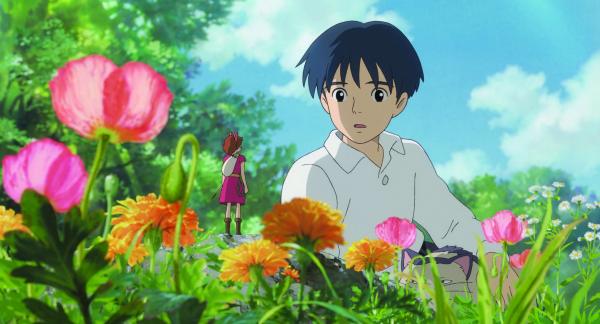
Review- The Secret World of Arrietty

The Secret World of Arrietty (Studio Ghibli/Disney)

I haven’t seen that many Miyazaki films but I must say that I’ve liked all the ones I’ve seen therefore I wish I had seen more. It’s not a wonder that these films seem to transcend the typical limits of appeal and tend to reach rather broad audiences not just niche fans. It’s similarly not surprising that Disney has partnered with Studio Ghibli as the Japanese company’s US Producer/Distributor.

The animation in this film is rather beautiful to look at and very well composed. It is great evidence of the flexibility and variety that the medium still offers despite some prevailing trends. Perhaps more so than other film media animation still has within it the most diversified and varied employment of techniques and this film is evidence of why. It looks great.

Similar to the Toy Story films this story plays much with the theory of size by portraying small characters in a world that we don’t perceive as massive. It’s a boon to imagination and engages you in a different way and it allows you to view a seemingly normal world that you see everyday but you see it in a completely different way, a way you never saw it before. It makes the story to an extent more plausible but also more engaging because it’s making the mundane magical.

Now as is the case with many animated films when they travel overseas this film is dubbed. Now, I will say the performances by the English cast are pretty good. The leads being Bridgit Medler, David Henrie and Carol Burnett the only thing I found a little off was a lot of the vocalizations (grunts, sighs, onomatopoeia), which can sound unnatural and could’ve been omitted in the US version, were kept because they’re stylistically accurate and expected. So it’s the scripting I struggled with not the actors.

The story is based on the novel The Borrowers and it seems to be a well-handled version and it’s an interesting and inventive treatment of one of life’s minor mysteries (“Where did that thing go?”).

Playing off the concept and the theory of size there are great situations and tasks set forth in the film. The narrative is a simple but enjoyable but that suffers no unnecessary complications but instead progresses with the temporal elasticity of a Disney classic.

The film does all it can to separate and reunite this newfound friendship and concludes in a very touching and proper way. It’s a great animated film that might introduce some new audiences to Miyazaki as well as Disney’s own Winnie the Pooh did.

10/10