Short Film Saturday: Ballet Mecanique (1924)

Aside form being a standout work of Dada filmmaking, Ballet Mecanique also demonstrates how silent film was always somewhat of a misnomer, which is why the addition of synchronous sound films led to the colloquial phrase “talkies” because they often had music via live accompaniment. Rescoring, or attempting to reconstruct the original score of a film, is often a task that is central to restoration as the quote below indicates.

An abstract, surreal mini-epic of kaleidoscopic images, “Ballet Mecanique” has a tangled history, marked by uncertainties about individual contributions and blurred by Leger’s re-edited versions. The music intended for the film also actually intersected with it only in intermittent fashion. Ironically, the Green Umbrella presentation matched the attempt to restore the original visual intentions with Antheil’s final revision of the score, made 28 years after the film was first shown in 1924. The union of sight and sound seemed more organic at some points than at others, but Antheil caught the manic rhythm of the film quite successfully. The combination proved surprisingly fresh and vital Monday, with Stephen Mosko conducting a tight, hard hitting performance of the brash score beneath the witty endlessly inventive images, in a remarkable triumph of imagination over the limitations of primitive technology.

John Henken, The Los Angeles Times, May 10, 1989
Mini-Review: Meeting Evil (2012)

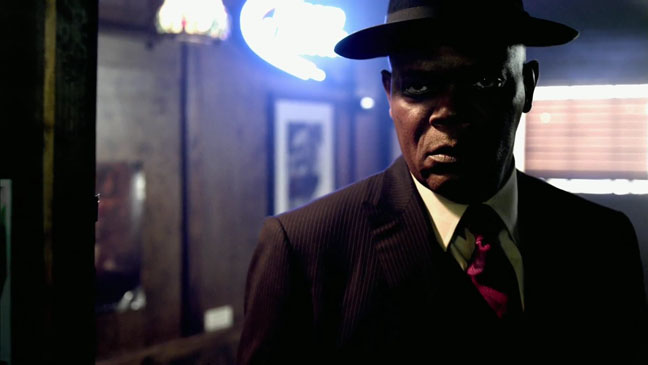
Perhaps what’s most enjoyable about Meeting Evil is that it really plays with your expectations. It’s kind of a down the rabbit hole scenario wherein the protagonist (Luke Wilson) unwittingly gets himself further and further ensnared in a web of murder, duplicity and intrigue. Where we the audience come into play is that the film never cheats but has some really great twists along the way playing into one trope or another and then pulls a switch on us. It’s great stuff because what it does is keep you engaged and stays just a step or so ahead of you but you never feel bamboozled, for better or worse. 

It’s also a film that allows its actors some room to play, Samuel L. Jackson in particular seems to truly relish this part and does great things in this film. Jackson is menacing, funny and truly a character in this tale, there’s a depth and intelligence to his madness. When all is said and done and you look back upon it you’ll see Luke Wilson does well too, faults you may find are more likely attributable to his character, but necessary for the story to function. The film also has a great sequence at a dilapidated farm house. It’s sequences like this and performances in small roles that can sometimes stick out most in a movie, granted the nature of the film makes it memorable regardless, but this sequence is where it shines. The performance in a small role of which I speak is that of Ryan Lee (Super 8) who has a brief but intense interaction with Jackson that stands out in similar fashion to Young Erik’s backstory in X-Men: First Class.

Meeting Evil
 is a film that does not stand still for long and is memorable for it, and for refusing to be run-of-the-mill. It will be in limited release on May 4th and is available via Amazon, Vudu and iTunes streaming right now.

Mini-Review: Found Memories (Historias Que Só Existem Quando Lembradas) (2011)

This film is a perfect example of a translated title that doesn’t quite do the film in question justice. If you were to translate the Brazilian title of Found Memories literally it would be Stories That Only Exist When Remembered. Granted that is more of a mouthful but it gives you a better sense of the kind of film you’re getting I feel, because as I watched the film I realized there was perhaps one of the more subtle Magical Realism tales I’d seen, one with with extreme emphasis on the the realism. Yes, there is a rather mundane, repetitious nature to certain scenes but the equation is skewed as the film progresses by a newcomer. The framing of many shots is wonderfully precise and as the story unfolds you are taken in both by the stories being told by the characters themselves as well as the ones being told about them by the film, which in many cases are parallel but not identical. Found Memoriesis a tremendously subtle, yet at times rapturous, look at small town life in a Brazilian town that should still be able to play anywhere and I highly recommend it.

Mini-Review: Beautiful Wave (2012)

This is a re-post of a review that was previously featured in a round-up. Beautiful Wave is currently included in Amazon Prime; free on Hoopla and Plex; free with ads on Tubi; and availble to rent or buy on Amazon, Apple, YouTube and Fandango at Home.

I quipped, with a lack of anything of real significance to say, after having seen Beautiful Wave that it was “neither beautiful nor a wave” in my best Linda Richman voice. However, the Mike Myers character-inspired jab may have been the most succinct way to put it. This is a film which seems like an excuse for a surfing film. I haven’t seen every surfing film, but I honestly can’t remember it being almost incidental to the story, as it is here.

Sadly, the protagonist is also rather incidental. Very little of her conflict is externalized and ultimately the film feels like it’s about everyone around her rather than her. I’d critique the pace if there was any discernible pace to criticize. The film telegraphs its climax and denouement very early on making much of the film transient. 

As you can tell the issues are mainly structural but there are a few decent to good scenes along the way. I can’t fault the performances of the three main players Aimee Teegarden, Patricia Richardson and Lance Henriksen. It’s just so inconsequential. 

Why she’s jettisoned to California just occurs as this forced inciting incident, which really has no impetus aside from the narrative necessity placed upon it by the makers. Somewhere in its running time there’s a perfectly innocuous, enjoyable albeit nebulous short film, but it really ought not be a feature. This is essentially Soul Surfer almost entirely devoid of pathos.

Mini-Review: Cold Sweat (Sudor Frío, 2010)

This is a repost of a review that was included in a round-up. Cold Sweat can currently be streamed for free with ads on Vudu, Tubi, and Plex; rented or bought on Amazon, Fandango at Home or YouTube.

One thing I thought was particularly interesting an effective about Cold Sweat was the implementation of antagonists who just could not let go of the past in a very villainous way. At the start of Cold Sweat there is archival footage that gives you a brief overview of the revolutionary and counterrevolutionary factions at play in Argentina in the 1970s, then you get a very specific incident chronicled. You know this will all come back into play, you just don’t know how. Now, using overt political symbols in horror has been done, most commonly with Nazis in all likelihood. However, the circumstances and players of each countries political past (and seedy underbelly) are all somewhat different, and the refracted ideologies, and reverberations thereof, can still be felt at current, in one way or another. So it is rather fascinating to find this angle in this film because it lends a specificity to the film and a voice; a stamp of a national cinema. Coincidentally, I saw another Argentinian (co-produced with Spain) horror film soon after this one that implemented many similar threads. The horror setpieces and manipulation of given tropes in this film is quite effective, but it its this backdrop of sociopolitical commentary, past and present, combined with the narrative that makes this such an intriguing film.

Mini-Review: The Almost Man (2012)

This a repost of a review originally included in a round up. As of now, this film is available to rent or buy on Apple or YouTube.

The man-child has been the topic of comedies, and discussed in film writing, for most of the history of cinema. The brand of childishness in these men changes as society does. The recent trend is skewing toward adolescent man-children who still have the same sense of humor, a similar outlook on the world, and terrors as children do at that formative time (where some grapple with those issues persist into adulthood). Few films have likely, and none that I’ve seen or can think of, taken this character/problem type to a seriocomic place with such commitment and results.

If I had to venture a guess I’d say it’s the inciting incident of this film where (the event that propels the story and sparks conflict) most audience members will go along with or abandon it. If you go along with it and focus on characters, especially Henrik (Henrik Rafaelson), specifically what they want and how they go about trying to get it; then you’ll get into the film. The handling of it is mature even if the act was not: it’s about “what now?” and not “why?” A crossroads has been reached, and, thus, the struggle; the delicate balance of finding true adulthood without losing oneself, begins.

Rafaelson is especially impressive because it’s one thing to play an overgrown goofball and get laughs and another to then get introspective dour and try to assume new responsibility and maturity. He achieves both and engenders empathy as well. 

This film is a briskly told tale is one that never feels insincere whether in its stasis (when the young couple enjoys one another’s company and is content to lark about), or later when there is an ebb-and-flow, an attempt to change. Likewise, the film does not end with an insincerely sudden fairy-tale ending, but rather, at a new beginning; the dawn of a new-found maturity.