Mini-Review: Space Warriors

Introduction

This is a post that is a repurposing of an old-school Mini-Review Round-Up post. As stated here I am essentially done with running multi-film review posts. Each film deserves its own review. Therefore I will repost, and at times add to, old reviews periodically. Enjoy!

Space Warriors

Director Sean McNamara, despite having mostly TV credits, has successfully brought for cinematic tales before; most recently Soul Surfer. It appears that Space Warriors with a proper theatrical premiere in Alabama and a brief limited run would be closer to film caliber than a made-for-TV project, which Walden Media and the Hallmark Channel recently repackaged it as. Especially when you include cast members such as Thomas Horn of Extremely Loud and Incredibly Close, Ryan Simpkins, Grayson Russell, Dermot Mulrooney, Mira Sorvino and Danny Glover.

Sadly the film goes from the run-of-the-mill half-developed kid-with-a-dream narrative with a standard lie to get what he wants and several conventional plot twists along the way to an absolutely outlandish finale that surely and slowly creeps up on you. That intent, however, is not always apparent and the staging, set-up and writing of that conclusion is lackluster to say the least.

It really is a shame because through all the cheese the premise had promise with more sure-handed writing and directing but the foundation that this story built itself upon was weak so it was sure to implode at some point.

3/10

O Canada Blogathon: Léolo (Part 6 – With His Family in the Common Room)

With his Family in the Common Room

WARNING: While I will do my best to avoid major spoilers this series of posts is an in depth examination of the film so it will be discussed at length. Reading about the film in distinct sections is not the same as seeing it clearly but forewarned is forearmed.

Leading to this point there have been intimations about Léolo’s state of mind and his yearning to individuate from his family. It’s a natural inclination but it is perhaps sparked earlier, and more furiously, in his life than in most. A large reason this is being that nearly all his immediate family receives at least outpatient treatment at a local mental health facility, some are committed. Part of the reason this has been danced about until this section is to be to more closely emulate the structuring of this film.

Léolo weaves this story usually tackling his interaction with each family member and later expanding the circle to see how they interacted with the family as a whole, or with him in a group. The film in some instances uses hospital visits are a trigger to introduce both the character and what placed them in the predicament.

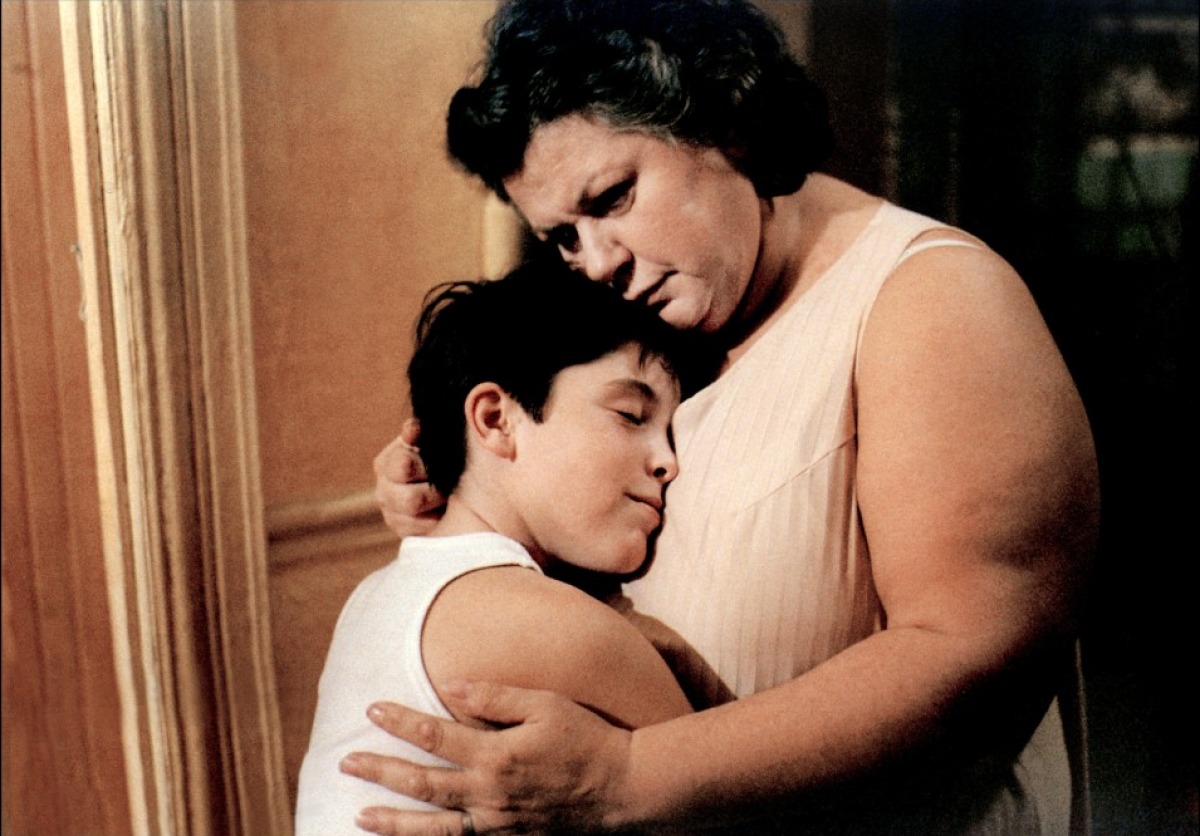
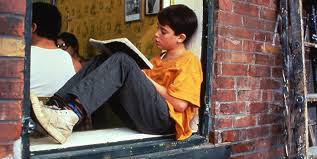
Léolo (1992, Fine Line Features)

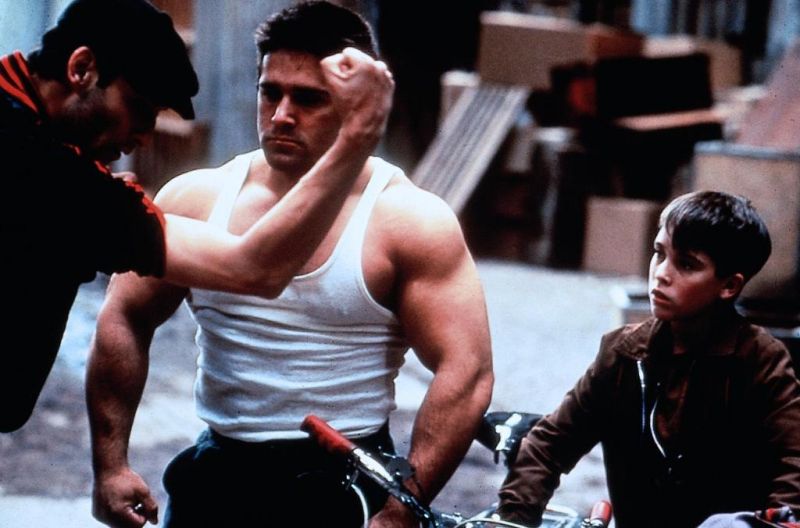
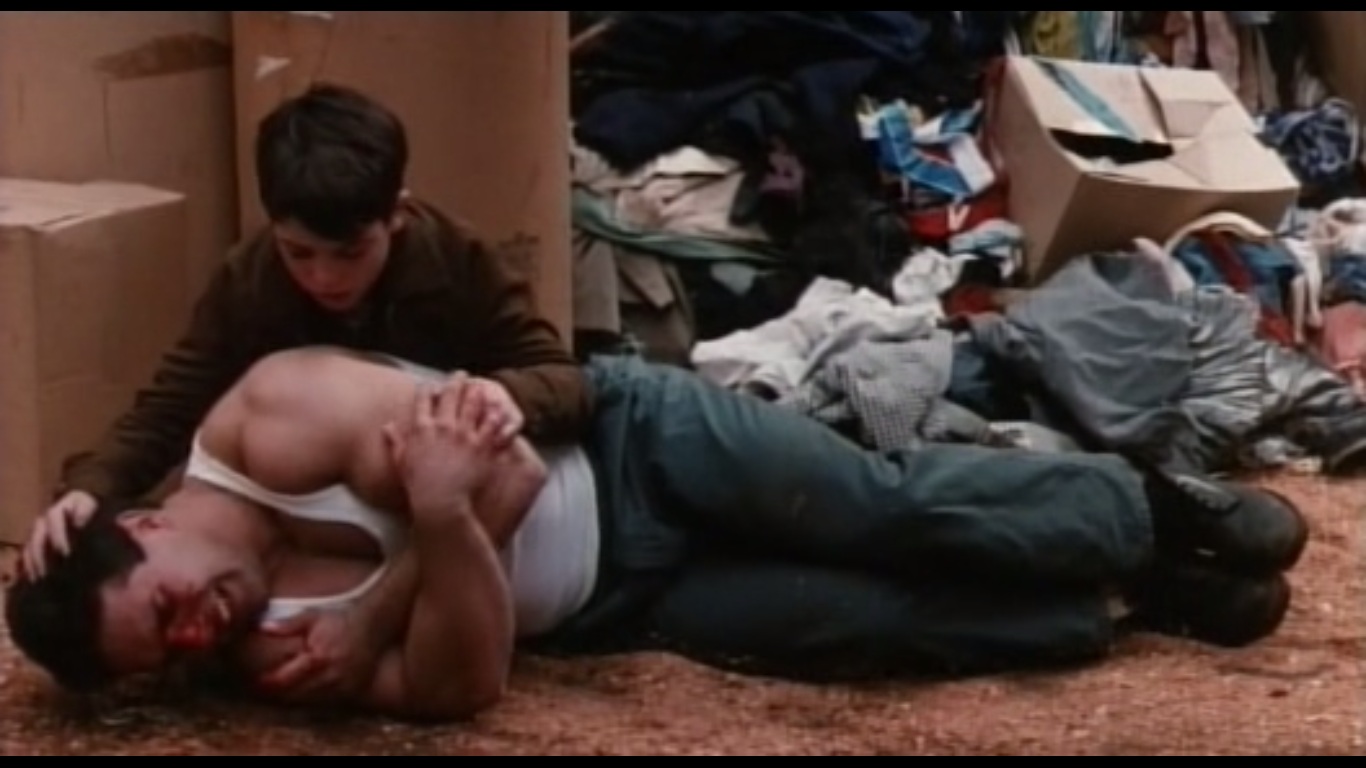
The majority of Léo’s time in the film is spent with Fernand (Yves Monmarquette). One of their money-making tasks is to collect news papers, which is how they tend to run across the Word Tamer. They get papers to sell to the local fishmonger to wrap sales in. However, when they are young (here Fernand is portrayed by Alex Nadeau and Léo is played by Francis St-Onge) they run across Fernand’s Enemy (Lorne Brass; his being bilingual adds that aspect to this portrait of Montreal, which some stories do not include) for the first time. It’s an important scene in the film because it is Fernand’s inciting incident, his motivation to bulk up. The Enemy is a local two-bit gangster who intimidates and shakes Fernand down when he sees fit. At the end of this confrontation Young Fernand is left with a bloodied nose and convinced to change something.

This aspect comes full circle the first time they run into one another since he has grown huge. It doesn’t end any differently. The scene, the insight Léolo gains and the performance by Monmarquette makes it one of the signature moments of the film and tremendously moving.

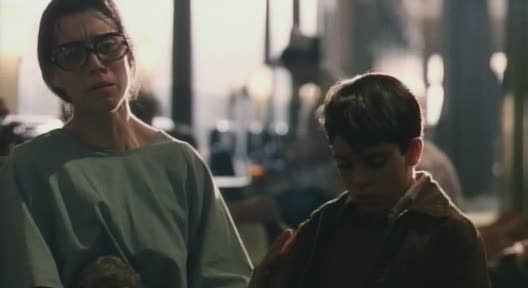
In most cases, as it is with Léolo’s eldest sister, Nanette (Marie-Hélène Montpetit), upon first seeing her we have no idea what landed her there. She pleads to her little brother “They stole my baby, Léo” and have no idea what landed her there. Whether the plea is a literal complaint or one that is more symbolic and symptomatic of her mental illness is not something that’s known right away. As is the case with all the characters we will eventually feel sympathy, and maybe even empathy for her as well. The characters, even in short strokes, round into a more real form. We see their less desirable traits but also get to step in their shoes for a brief moment. Our longest walk is in Léolo’s but nonetheless we get a sense of all their travails.

Léolo (1992, Fine Line Features)

Rita (Geneviève Samson) is the character whose backstory is circled around the most. Léo feels a special bit of kinship to her it would seem because of the little world they shared together. However, we are slow to hear why he calls her Queen Rita and catch glimpses of her not brushing her hair and sing-songing the count. It may well be an act of kindness that Léolo tries for Rita, and his mother’s reaction, that mounts pressure on him. It may not be the straw that breaks the camel’s back, but it’s on the pile for sure.

Léolo (1992, Fine Line Features)

In close competition for dancing around a backstory is Léo’s Grandfather (Julien Guoimar). This is a character that scarcely is seen before his influence on proceedings is discussed. As the problems facing individual family members and the family as a whole have been enumerated. Léo tells us of their history together and how he feels his grandfather is solely responsible for all the problems facing the family. There is a Greek tragic treatment of their tale that for varied reasons involves two scenes of attempted murder, one attempt by each party. That simple rendering of their conflicts may paint a salacious picture but there is a cause-and-effect to each.

Léolo (1992, Fine Line Features)

It is in these hospital scenes that we see that Mama is generally agreed upon as being the strongest in the family in terms of resolve. When Léolo has occasion to talk to the psychiatrist (Julien Guoimar) she agrees with his assessment. There are are group counseling sessions hinted at. However, with this being ‘70s set the state of the mental health profession was still less-than-ideal so it’s unlikely any good was being accomplished in any of these treatments which is what leads Léolo to refer to it as the “cemetery for the living dead.

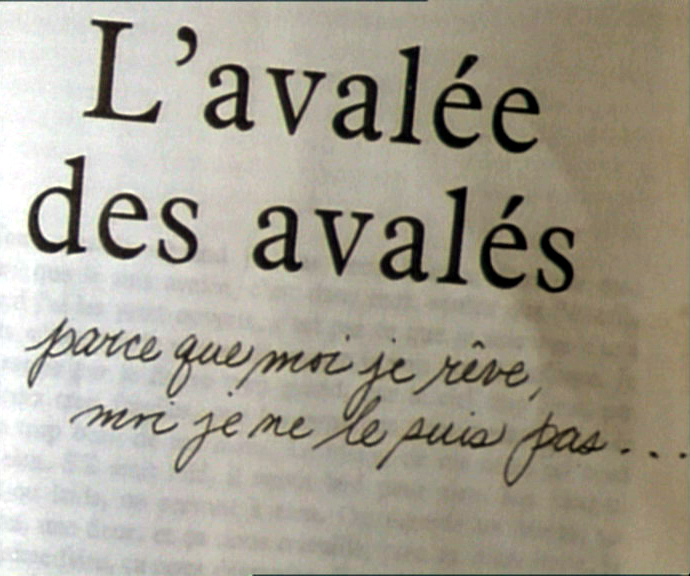
When I first had this film on VHS I remember that the closing image of the film wherein Léo co-opted the title of this favorite (only) book was subtitled with with the words “Valley of the Vanquished.” In the current region one DVD release that is the name of the chapter but the subtitle it reads: “Valley of the Swallowed.” That title truly is one of the trickier translations and it’s a shame it comes up on so crucial a line. The book when it has been translated has been referred to as “The Swallower Swallowed.” That is a fair treatment in literal terms, but I think that the bit of poetry that the titlers engage in here is justified. It is the sense that the line is driving for and thus well played in English.


This post is part six in a series. Parts one, two, three and four and five can be found here. Stay tuned for more.

O Canada Blogathon: Léolo (Part 5 – ”Parce que moi je rêve, moi je ne le suis pas.”)

“Parce que moi je rêve, moi je ne le suis pas.”

WARNING: While I will do my best to avoid major spoilers this series of posts is an in depth examination of the film so it will be discussed at length. Reading about the film in distinct sections is not the same as seeing it clearly but forewarned is forearmed.

One of the basic rules of thumb in filmmaking is the rule of three. Essentially, this is used for progressions and repetitions of key information that is needed to follow/interpret the film. However, as with any rule in art there are exceptions to this rule. Some work because they break said rule and some fail because they break said rule.

Léolo works in large part because of its insistence on breaking the rule of three when it comes to the repetition of the core philosophy of his being. In reading the only book accessible to him in the house Léo picks out a quote and believes it with every fiber of his being:

“Parce que moi je rêve, moi je ne le suis pas.”

It translates loosely to “Because I dream, I am not.” What exactly Léolo is not is open to interpretation and can change based on what he’s talking about before, but usually I take it mean “Because I dream, I am not like them.” “Them” usually means his family, but on occasion can be his classmates.

This phrase sometimes pops up being repeated three times in a row, but often when it crops back up into the narrative it is repeated with a mantra-like consistency. Sometimes in a number of voices alternating from the Narrator (Gilbert Sicotte) and the Word Tamer. It’s almost as if this chant is meant to ward off the demons that haunt and inhabit the rest of the family.

That mantra will be manipulated and toyed with as the story sees fit, and when it does it is quite a poignant comment on the turn-of-events it is underscoring.

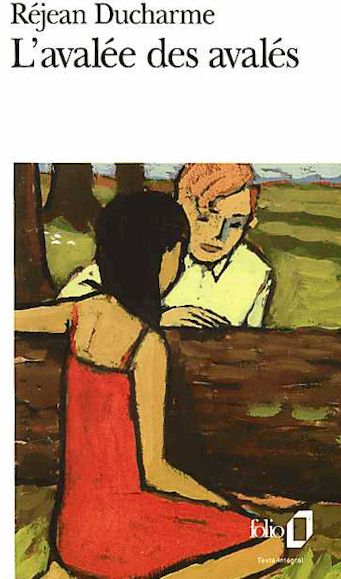
This line struck me as being so powerful, and such a brilliant encapsulation not only of this film, but of an adolescent’s (or any rebellious soul really) thought process and state of mind that it has always stayed with me. As I have revisited the film it has become inextricably linked to the film. However, I’ve also gone back enough such that I was able to remember the name of the book (L’Avalée des avalés by Réjean Ducharme), and then research it.

L'Avalée des avalés (Folio)

Its availability is grossly limited in both French and English. However, I recently saw it crop up and I decided that it was time to test myself and try to give it a read. I started taking French in sixth grade and had it through the end of my junior year of high school. I became as proficient as one could be in school without an immersive experience. I returned to it to satisfy my minimal language requirement in college. However, the French you’re learning there is the unadorned, French from France. Not the version of the language spoken in Quebec. There are differences. Despite the fact that the only sizable text I read in French was The Little Prince, and I had to hit my dictionary frequently; I made it through 26 pages with fewer issues than I expected and was enjoying it. What stopped me was really lost momentum, and it was lost in the shuffle of my book juggling. I didn’t get to the famous line even. However, I may return to it again. It may not help balance my table, or be the only book that lives in my house, but because it lives with this movie it lives with me.

“Parce que moi je rêve, moi je ne le suis pas.”

This post is part five in a series. Parts one, two, three and four can be found here. Stay tuned for more.

O Canada Blogathon: Léolo (Part 4 – Bound by Odor and Light)

WARNING: While I will do my best to avoid major spoilers this series of posts is an in depth examination of the film so it will be discussed at length. Reading about the film in distinct sections is not the same as seeing it clearly but forewarned is forearmed.

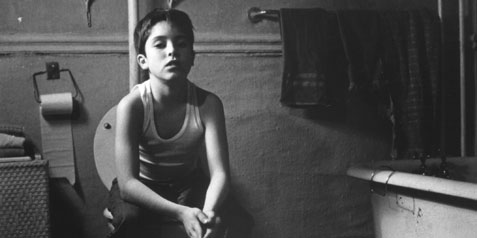
In structuring this series on Léolo I could’ve combined this section with another which would encompass this film’s dealing with all biological functions that would perhaps capitalize on the zeitgeist of commentary and thinkpieces on the subject in light of Wetlands’ limited release. However, when dealing with Léolo they should be separated for one very curious reason: Typically when films do go into the uncommonly explored arena they are in the guise of private obsession or other unshared state of privation. However, when it comes to concerns of a scatalogical nature it is very much a family concern in this film, and again, it is an aspect of his family’s life that is touched upon fairly early in the story.

Basically, Léo informs us that the battle his mother picked to fight is that they only way to be healthy was to have regular bowel movements. This is illustrated in an early flashback where she is on the toilet and a toddler Léo is on the potty-training pot wailing. Outside rain falls, thunder crashes and the lighting and poetic voice-over paints a perfect portrait of of a childhood trauma.

It establishes a template for the nature of Léolo’s home life, particularly his relationship with his mother. But even this foible of the family has its plot points. When they are younger they are forced, as is said in the voice-over they are subjected to a “Shitting laxative shock treatment.” And it’s not only mom’s obsession. Dad swells with pride when Léo shows him a “big one.” As he ages he gets craftier, and has more freedom so he can fake it if he needs to.

While in some stories there are things better left unseen, if it serves a story and rendered with artistry nearly anything goes. While focusing an entire story on such aspects can be treacherous, if it fits in there’s no reason to avoid the bathroom.

Two Stephen King-related anecdotes encapsulate my thinking on the subject: first, in his memoir cum how-to-book On Writing King discussed that he has been asked by aspiring writers “When do the characters go to the bathroom?” His advice was: you can skip it, or if it matters you can say “so and so had to push” (his favorite euphemism from his younger days). Oddly, enough I first encountered odd reactions to setting any scene in a bathroom when I was filming a short film based on King’s Suffer the Little Children. A passerby at the college we used as a location thought filming in a bathroom was the funniest thing in the world. It does happen. People use the bathroom and sometimes it matters in a film. That encounter may have been the seed that lead to my wanting to craft a whole one act play set in a bathroom.

As for Léolo, in a building, and a family such as his, quarters are fairly close so to a certain extent things are shared. It seems unlikely that he is the only one who urinates off the balcony. He’s probably just the only one who insists on being called by his Italian name when being yelled at by neighbors for it.

The bathroom escapades also play into a narrative frame wherein a sense of the family is building. Again set-ups and payoffs. In one way or another, odd or conventional, this film closes the narrative circles it opens up.

This post is part four in a series. Parts one, two and three can be found here. Stay tuned for more.

Mini-Review: The Other Woman

Introduction

This is a post that is a repurposing of an old-school Mini-Review Round-Up post. As stated here I am essentially done with running multi-film review posts. Each film deserves its own review. Therefore I will repost, and at times add to, old reviews periodically. Enjoy!

The Other Woman

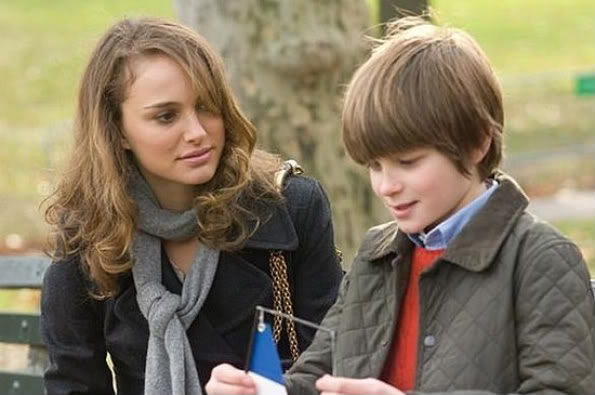
Natalie Portman and Charlie Tahan in The Other Woman (IFC Films)

A young woman deals with the difficulty of the loss of a child, a relationship with her stepson and being newly married.

This is a film which is interesting structurally and gives Portman a chance to really shine. When I saw the trailer it smacked of Stepmom but what I was hoping for was a lack schmaltzy melodrama. I got that but it was replaced by a lot of armchair psychology. There are some surprises and also good performances by Scott Cohen, Charlie Tahan and Lisa Kudrow, who for the first time made me forget about Friends entirely until it was over. It just left me wanting a little but it was enjoyable.

7/10

O Canada Blogathon: Léolo (Part 3 – The Word Tamer)

The Word Tamer

WARNING: While I will do my best to avoid major spoilers this series of posts is an in depth examination of the film so it will be discussed at length. Reading about the film in distinct sections is not the same as seeing it clearly but forewarned is forearmed.

Like many things in this film, we don’t necessarily understand the Word Tamer’s role in the proceedings the second we see him. There’s nothing wrong with that. Any required exposition within the film is handled fairly head-on, though floridly, in narration. However, there’s not a need to do so immediately. There is a great sense of pacing and where things belong in this film. Though this is a tale more of a journey than a plot, one that might seem a bit loose, it does set-up and payoff very well, and it knows when to deliver that bit of necessary news.

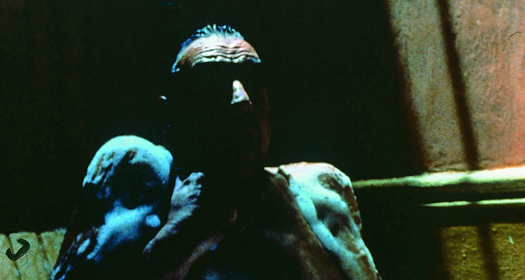
With the Word Tamer (Pierre Bourgault) our learning that he digs through trash for words and images believing that “Images and words must mix with the ashes of poetry to be born in Man’s imagination” comes early on, if not immediately. The significance of his existence to the story as a whole, and the function he serves for our lead is information that becomes clearer later on. Sure, he could be seen merely as a conduit for the audience. The angry scribblings Léolo jots down and then feels the need to not keep, lest his family should see it and his life become even more untenable perhaps, could just disappear. We could suspend disbelief and say to ourselves “we have this window to his world, what need have we for the Word Tamer?”

However, what the Tamer is partially wish-fulfillment any adolescent who has ever scribbled his angst down about his life, and the ways of the world. Any such pubescent soul would’ve loved a receptive audience that appreciates our talents and also seemed to understand us and our views as we understand them.

This guardian angel-type isn’t a secret kept from Léolo, one that we the audience and the film share. Therefore, he may very well write and dispose of his writing so that the Tamer can read it. The Tamer also does step in on Leo’s behalf once and tries to better things for him. However, I will touch upon that later.

Is this character the element that lends the film its greatest sense of artistry and fantasy, and its largest burst of magical realism in one fell swoop? It may well be. His being the reader who engages in something akin to a game of telepathic telephone is what in a sense justifies the multiple utterances of certain phrases such that they come at near matra-like intervals. He also is shown storing Léolo’s pages at the end intimating that the tale might be read again and by others at some point.

For those who have seen it previously it may seem like I’m dressing the film up to be a bizarre sort of spin on The Neverending Story, but surely this character would not be the last image of the film were his having read the story been of no significance. Endings and beginnings are perhaps the most key in a film because you’re deciding what to tell the audience first and what to leave them with as they walk out the door.

Now there may be salvation or redemption of Léolo’s tale save for the fact that we know all the pages that he spilled ink upon them saying in the omnipresent human need “I am here and this is my story.” Or in the words of Gigolo Joe as he was captured in A.I. “I am, I was.”

Unlike a great many stories wherein adolescents go through tough trials there’s a sort of difference here. It has both to do with the tonality and the structure of Léolo. At first, you’re not sure where things will go, and second, you’re not sitting there hoping against hope for an escape or endgame already in mind such as in Pelle the Conqueror.

Léolo (1992, Fine Line Pictures)

As such there is no movement towards our lead being more better understood. The Word Tamer tries to get Léolo’s teacher to talk to him about what he should read since he shows promise as a writer. One of the many quirks Léolo’s family is that there is only one book in the house (Rejean Ducharme’s L’avelee des Avales), which is used to balance out an uneven table. The teacher does not help the Word Tamer or Léo. Yet, due to this kindly altruist interested only in purity of emotion and the beauty of words he carries the tale to us. Léo lets us, the audience, into his heart, soul and mind. He examines these facets of his being, and his family as honestly as his biases allow. Due to that fact, and how he expresses himself he finds a willing reader, The Word Tamer, who passes him on to us.

This post is the third part of a series. Read part one here, part two here, and stay tuned for part four.

O Canada Blogathon: Léolo (Part 2 – Notions of Nationality)

Notions of Nationality

WARNING: While I will do my best to avoid major spoilers this series of posts is an in depth examination of the film so it will be discussed at length. Reading about the film in distinct sections is not the same as seeing it clearly but forewarned is forearmed.

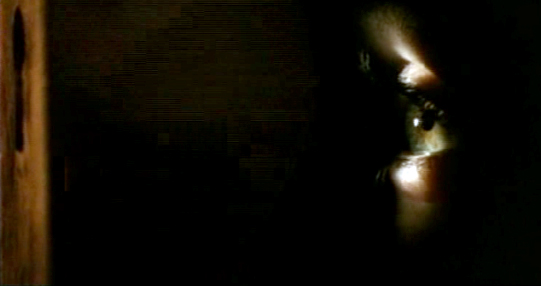
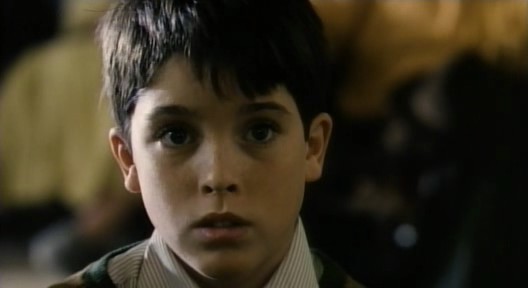
The first thing Léolo (Maxime Collin) tells you about is the story of how he believes he came to be conceived. In a way it’s his creation myth, the only explanation, however illogical, that he can come up with for why he feels so different than the rest of his family.

Naturally, with one feeling so estranged from one’s family can lead to a sense that they come from some other country. With Léolo having grown up in the midst of his family, and never having moved, the only viable option that remains in his mind is that he himself is from some other nation; somehow, some way.

This notion struck me not only because this film is French-Canadian, and the national identity of its populous has always been nebulous as a whole – as evidenced by two tight independence referenda in the ’90s and political jockeying for another. The notion was also likely to strike me personally for an obvious reason. I am neither French nor Canadian I will not get too cute about what Léolo’s desire to be Italian says about the Quebecois.

However, it’s not coincidental that that Léo’s tale of a randy Italian tomato-picker, an accident wherein his mother stumbles upon the most unlikely tomato imaginable makes him Italian in his mind, and thus, a countryman of Bianca, his great unrequited love.

Due to the fact that his belief is that an anonymous Italian is unintentionally his father and not the man he shares a house with, he also insists on being called Léolo Lozone rather than Léo Lauzon. He is rarely taken seriously in this request.

Print

“Italy is too beautiful to belong only to the Italians” he says when talking about Italy and Bianca, whom to him is the country personified. This is portion wherein I feel some more identification. I am a dual citizen of the United States and Brazil. I think being a first generation American has made me very curious about the world and made me want to experience other cultures, at least vicariously, not only as an escape (though in my younger years it definitely was) but also for my own edification.

Léo’s world is a one of very small and dark corners; it’s his apartment, his tenement building, diving in the river, collecting papers. His neighborhood, in short, to a lesser extent Montréal as a whole. He is incessantly surrounded by things he wants to be freed of it’s not a wonder that a country he has never been to, landscapes he is imagining but may have never seen represented call out to him as a safe haven. In many ways, with a much different backdrop to grow up against I had that same longing for escapism in my adolescence. Sure, most adolescents do, but it’s the manifestation of such in this particular way that makes it a parallel.

One of the great and subtle touches of this film is how it uses his preferred name to put a bittersweet closing note on the relationship arc of Léolo and his mother (Ginette Reno). There are small moments when he shows his affection towards his mother. He writes of his true feelings with greater fervor than he shows her in real life. Though at times she was unable to understand all that went through her kids’ heads, and may have passively fought him on his desired name, at the end she calls him “Léolo” seeking to bring him back to consciousness. Whatever he calls himself she just wants him to stay. Léolo may have drifted off to a purgatory – how literally one should interpret closing events in the tale is debatable – what’s inarguable its that: because he gave up on his notion of heaven and gave up the will to fight, even with the supplications of his mother beckoning him back, he was lost.

However, the way this story unravels one would hear all he thought, hoped for, and feared.

This post is the second part of a series. Read part one here, stay tuned for part three.

O Canada Blogathon: Léolo (Part 1 – Introduction)

Introduction

Since I have started participating in blogathons I have created an heretofore unwritten rule: I try to limit myself to participating in one a month. There are two main reasons for this: first, they tend to run out-of-sync with what the main theme of my regularly-scheduled programming, and second I tend to go a bit overboard with a post much larger than I normally write with several headings and topics discussed.

As someone who in commemoration of Canada Day one year created a province-by-province cinematic map of Canada of films I had seen or would like to see, I am clearly one with an appreciation for Canadian cinema. In that very post I try and get to the heart of why:

I can’t exactly pinpoint where my fascination with all things Canadian began. Yes, I’ve always been obsessed with hockey, but this burgeoning affection during my childhood also coincided with many of my entertainment staples being either vaguely or blatantly made in Canada such as You Can’t Do That on Television, The Kids in the Hall, Are You Afraid of the Dark? and to an extent SCTV. Regardless, the affinity has always been there and since thanks both to the internet and internationally distributed calendars I’ve come to learn of Canada Day, and decided to compile at least the beginnings of a list.

Strictly speaking in film terms the interest in films made north of the border this was likely the genesis. I vividly remember the inception of The Independent Film Channel as for probably a bit more than a month I saw movies that marked me and that I would never forget. Sometimes they were 8 PM showcases, other times they were just in heavy rotation. Léolo is one of those movies.

Print

All I really wrote about it in that post, for being a very significant film to me I had to mention it, was:

A completely French-Canadian film (were my revisionist BAM Awards still legitimate would’ve won many awards) called Léolo. It’s a poetic, bizarre and unique tale of a young boy’s adolescence in 1970s Montreal. Sadly, this was the last vision Jean-Claude Lauzon brought to fruition as he tragically died in a plane crash in 1997.

So I always knew that it was a huge movie to me. Which is what would make writing about it quite the difficult task. As I sat down to revisit it for this blogathon that jumped out at me as the way to structure this post: enumerating and compartmentalizing the facets of this film that not only make it work but soar above so many others for me personally.

As I began to work on this piece I started to see it was going to be huge so I have decided to split this post into multiple parts over the course of the whole blogathon.

Without any further adieu, madames et monsieurs, I present to you Léolo Lauzon, or should I say signore e signori I present to you Léolo Lozone…

Shameless Self-Promotion and Film Activism: Crossover

Hello all,

It’s been a while since I’ve done either of these posts, or a site update either for that matter. However, as things tend to do there’s a confluence right now. So let’s get to the announcements.

THE BLOODMASTER TRILOGY

Bloodmaster (David Rosenthal)

The last time I did a bit of Shameless Self-Promotion was to announce my forthcoming short stories. Well, those stories are now out and are available on Amazon for Kindle devices and the Kindle app.

This my previous novella, and any other forthcoming releases can be found on my author page as well.

RISE: COMICS AGAINST BULLYING

RISE: Comics Against Bullying (Northwest Press/Prism Comics)

The second project I’m promoting is also a bit of activism, as it is a non-profit venture in the world of comics (My journey with that medium is chronicled here).

It’s a Kickstarter campaign for RISE: Comics Against Bullying.

What this project is:

RISE, a multi-issue anthology comic book series written and drawn by a collection of established names and up-and-comers, aims to spark conversations and provide resources for at-risk youth in an accessible and engaging format.

The goal is:

To get this issues of RISE to those who need them, we’re aiming to raise enough funds to print the first two issues in large enough quantity that we can distribute them freely. Our initial plan is to provide:

Print copies of RISE for Stand for the Silent to distribute in schools

Flyers with digital download codes of the series for Stand for the Silent to distribute after their presentations

Print copies of RISE for Prism Comics to use for fundraising and distribution to those who need them

Northwest Press will make copies available for sale at low-cost to comics retailers through Diamond Comic Distributors.

Additional stock will be made available to our current and future nonprofit partners, moving forward.


My history with this project:
One my good friends Joey Esposito a while back rounded up the troops to see who’d be interested in contributing comics and some prose as well for an anti-bullying anthology. Joey through his time reviewing comics helped me get back into the artform, and more so than I ever was before. I was glad to help out in any little way I could.

While Joey’s been working tirelessly on projects he’s brought to fruition with great success like Footprints, Captain Ultimate and Pawn Shop he’s also been lining this project up and got it some great support like GLAAD, Stand for the Silent, Prism Comics and Northwest Press and now the next step is on the whole interwebs to fund at least the first two issues.

WRITTEN IMAGES

Written Images (Mike Krumlauf)

My third and final piece of film activism is another Kickstarter Campaign.

What This Project is:

An experimental coming of age film that follows two gay men in Chicago as they find themselves and each other.

Steven, an emotional introvert has recently moved to Chicago from Europe to further his education. Undecided at what his major should be, a class project helps him discover his vocation in life and make the friends he was always yearning for. Nick, a young photographer suffering addiction in multiple forms, has his morals put to the test when he meets Steven. Together they begin A journey of self discovery, love and redemption in the backdrop of modern Midwestern America.

Written Images plans to deliver an honest, heartfelt story of finding yourself, falling in love, and growing up in the likes of Mr. Hughes. Visually, the film is being shot on Mini DV, HDV, & RAW. The film is utilizing the different formats to convey the disarray both character’s lives are in.

Why This Can Work: First, it inspired the actors to create the following (at the link below) in an impromptu fashion.

Unofficial Teaser Trailer

Secondly, what Mike Krumlauf has done all leads towards using multiple video formats and telling an experimental narrative.

Here were some of the standouts on his vimeo:

A taste of his visual style:

Darkness Falls 2 from Mike Krumlauf on Vimeo.

His first feature was a doc that implemented similar techniques in a doc:

A Place to Call His Own – Amazon Release Trailer from Mike Krumlauf on Vimeo.

Some passage of time editing/visual storytelling:

A Year In Review 2013 from Mike Krumlauf on Vimeo.

Lastly, this film can work because it has the likes of Jelle Florizoone (North Sea Texas, Allez, Eddy! and Headlong) attached. And as evidenced above simply with voice over and images of Chicago, this could be a very intriguing artfully rendered feature with those involved if it only gets off the ground.

So while it can be a bit daunting to see I clumped these three together give each of these a look (especially the Kickstarters) and see if they interest you, my books are cheaper and don’t have a limited shelf-life.