My Movie Map: Traveling the World via Cinema
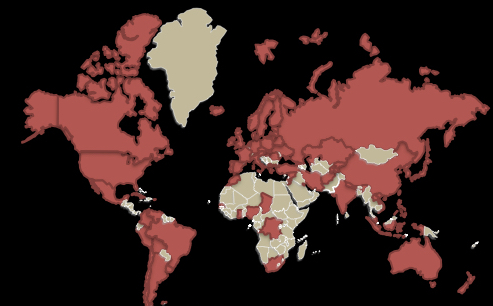
I finally did something I’ve been meaning to for some time: created my personal movie map. In short I found an interactive map and checked it off based on if I’ve seen films from each nation. Above you can see my results rendered. Less visible on the map is that there are small island nations I’m missing. Other things to consider are listed below.
—Where possible I tried to confirm that I had seen movies produced by and set in the modern-day incarnation of said country. Example: I didn’t check off Czechia and Slovakia until I found I had seen films by both since the break-up of the Eastern Bloc, or at the very least that an older film took place in that broken up region. This attempt to be accurate accounts for my spotty record in the Balkans and some former Soviet states.
—International co-productions are common. I did not double-count films. Where a country seemed to be only involved in financing, they did not get the credit for the title. Instead I tried to attribute those films to, to the best of my recollection, to the nation that influenced language, setting and was most represented on the crew. Clearly, I need to see more middle eastern cinema, but if I counted one title to multiple nationas and allowed financing to factor in, a film like Theeb would’ve counted toward three or four different nations.
—Some localities, for example Romania, Hungary, and Malta, are used by many productions in part because they can mimic other cities and because of tax incentives offered the production. Again, films not set, at least partially, in said countries do not count. This is why I didn’t check-off Malta but did check-off Hungary and Romania.
—Africa is my most sparsely viewed continent, it was made more so by strict adherence to the parameters I set. For example, Wah-Wah was my favorite film of 2006 it was set in, and a great deal of it was filmed, in Swaziland (now Eswatini). The production was British, much of the cast and crew were British also. Yes, the film is about the disparate realities of the British occupiers and natives, and the nation’s independence but it was a British production and a colonial story albeit a personal one. Therefore, Eswatini is not marked off and more than a few African nations have probably been filmed in by foreign productions and not reflected in this map. However, as my first exposure to Ousmane Sambène showed, indigenous filmmakers show you their country with an intimacy inimitable by even the most learned and well-intentioned visitors.
I created this map from Your Free Templates hopefully you’ll make your own maps and seek out more global cinema.

 The Movie Rat