Rewind Review- Is Anybody There?

I’m not one who enjoys the phrase “sleeper hit” because almost any movie is looking for some bit of success. However, it comes to mind for this movie because I hadn’t heard of it until midway through the week in which I saw it. Even on the independent film scene it seemed to have slipped under the radar.

This film is in a word: beautiful. It is funny in one moment, shocking in another and absolutely heartbreaking the next. It is a movie that searches for the meaning of life without ever being pretentious, and is always being sincere. The meaning is searched for backwards and uniquely. It tells the tale of Edward (Bill Milner), a young boy who lives with his parents in their old folks’ home, and who thus, becomes obsessed with death.

After a chance encounter with Clarence (Michael Caine) Edward finds him in the home. After some head-butting the two grow closer. The one sheet for this film is the kind that will get you nervous with anticipation for Michael Caine’s performance, one critic citing it as “the performance of his career.” Thankfully, this is no lie. We all know Caine can be funny, acerbic and occasionally charming. This performance, however, is magnificent in its arc and power and even the man himself was unable to control his emotion watching this film, and neither was I. He is fantastic.

Caine’s performance alone is not enough to propel this film to the heights it reaches. The film’s young lead Bill Milner proved that the success of last year’s Son of Rambow was most definitely no fluke and this film reveals Milner to be unquestionably the strongest actor of his generation. Here Milner carries much of the film alone, whereas in Rambow he and Poulter played off each other. We see Milner here as a much more complex character: dissatisfied with life, angry, rebellious, confused, hopeful for something better, and yet somehow innocent throughout all this. Holding the screen and making a story that could be morbid funny and sharing the screen with a living legend make his performance nothing short of astonishing.

This film was written as a period piece set in 1987. I wholeheartedly applaud this decision and I think it was made in large part to make the piece more intimate to allow Edward’s quest for answers about the afterlife to be conducted through his own ingenuity most of the time, as opposed to the cold and distant research that the Internet Age would provide.

Many of the frames in this film are absolutely beautiful in terms of depth (looking down hallways, corridors, on a rooftop), the use of obstruction in the foreground (occasionally out of focus) and just the overall mise-en-scène is typically interesting. For example, in a scene where Edward and Clarence are walking and talking – the shot starts on the back of Clarence’s truck with the words “It’s Magic!” dominating the scene and then pans over to find them. Everything is well thought out from lights through the back window of Edward’s mother’s car to the reflections on the windshield.

It is a tender, funny, wonderful film which will likely be branded as coming-of-age which I think would not do it justice. This film can be seen and appreciated by all as it examines the human condition more so than anything else and says some wonderful things about it.

10/10

2012 Holiday Viewing Log

The end of the year for any movie watcher typically puts you in scramble mode. Regardless of what kind of movies your trying to watch: new releases, classic cinema or Holiday-themed films.

Therefore, rather than have both this month’s mini-review round-up run overly-long as well as next months capsule review log, I figured it’d be good to siphon off the holiday-themed offerings, as not only will I try and do more of these this year, but there are enough special reviews coming next month and one post should suffice for them. If any films are new and holiday they will link from the other posts to text here.

For a reference to what my ratings mean, go here.

A Chrismoose Carol
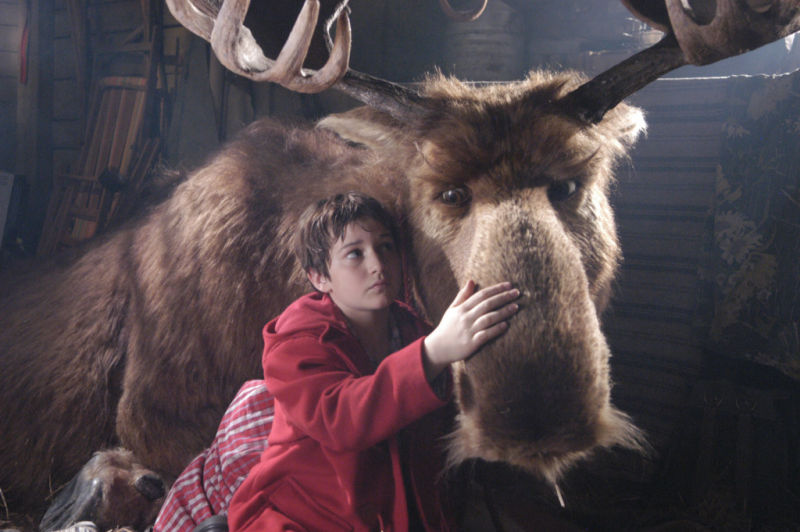
This is one of the films I picked up after getting a region-free player. I saw a trailer for it and it just seemed like the kind of thing too silly not to give a shot. What’s refreshing is that the film is playing comedy throughout. Yes, there are overtures of schmaltz and warm-fuzziness, it is a Christmas film after all, but it’s eminently more watchable and enjoyable than I ever thought it would be – and really should have any right to be. Part of this has to do with just a different perspective. Heaven forbid an American film try and get away with a Santa getting drunk and distracted, yet still trying to make a positive film, much less having it actually be Santa and not a mall employee or a psychopath. What the film deals mostly with is a thankfully practical and rather well-crafted Moose character (It seemed rather Falkor-like, I wonder if there is any connection to NES) and adds its own spin, and a rather cloistered tale that is neither a retread or earth-shattering in its repercussions as “disaster” is being avoided. A funny anecdote is that when I was younger I’d always insist on writing the original title of the film. However, seeing Es ist ein Elch entsprungen plastered on the box and being unable to record it to memory made me learn the English title, as silly and punny as it is.

6/10

Home Alone: Holiday Heist
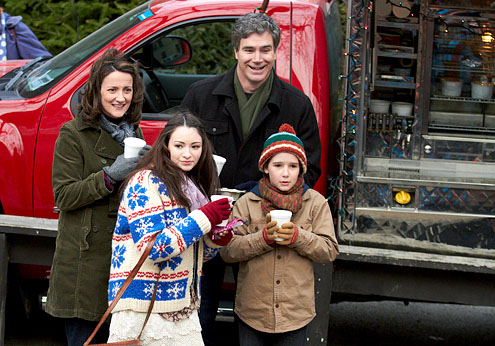
Now, I for one have written on this franchise on this site on a few occasions, once in theory and once when news broke. Similar to the way in which some can engage in auteur criticism, I feel that series and/or franchises can burrow out their own niche and create their own sort of scale. After all, when judging a film for what it’s trying to be the fact that it’s an installment in, or a continuation of, a series factors in.

When I wrote on Home Alone continuing and/or rebooting the idea I was leveraging was the fact that this is now a conceptual series. The series of films is predicated on a kid or kids being caught at home, without their parents, having to defend their house, and ultimately themselves. It almost always had to be that way. Disregarding the fact that in part two Kevin is not home, the fact that he is separated from his family anew is a major challenge to suspension of disbelief. So it was always likely to, and thankfully has, become a series wherein its concept-driven. Thus, whatever the other challenges brought up to each installment how Kevin gets lost again, is no longer a concern. Horror franchises with iconic killers have that issue of trying to bring back their seemingly dead, yet ultimately immortal lead – this is a major encumbrance lifted.

When I wrote about it as a news item it was to confirm that one of my wild postulations was really coming to fruition. I do have a tendency to err on the side of positivity over cynicism more often than not, but I had a few reasons to be optimistic. Based on the casting and story news that came out it seemed like the upcoming film would return closer to the core of what these films are. The series went out on a limb in part three and broke said limb off in part four. This looked like a very promising restart based on early indicators.

So? Now, it’s aired, and I’ve seen it, what did I make of it? The short version of it is that there was room for this film to be much more than a decent, enjoyable restart had there been some shifts in focus, both story and production-wise. Having said that after the precipitous slope the franchise was on, this is welcome and refreshing course correction for the most part. It’s just that the potential existed for it to surpass even my modestly lofty expectations.

The best elements of the film are: the booby-trapping motif is introduced prior to the reality of burglary dawning on the characters, the in-jokes regarding the series are plenty good, the performances of Christian Martyn (whose turn in this archetype I’d rank as best barring Culkin) and Jodelle Ferland (whose inclusion and progression adds an interesting dynamic to the film), the dichotomy of Finn’s character and its slight, steady arching; and the presence of the seemingly random neighbor-kid (Peter DaCunha) who does occasionally add humor and plot functionality.

Where the film misses opportunities in narrative is that it tries too hard to shoehorn what it feels are mandatory elements of a Home Alone film such as a misunderstood stranger who befriends the lead and doesn’t have a place to go for Christmas. Yes, there are anticipated elements, but each narrative has its own set of dynamics and fitting molds or formulas at times restricts the tale at hand.

An example of not wanting to fit a mold is giving the crooks a lot more backstory and justification than is really necessary. The emphasis on name recognition for the triad of crooks (Malcolm McDowell, Debi Mazar and Eddie Steeples) I feel is detrimental to the film because they get over-exposed and over-wrought and the parents are under-written and under-represented.

The dialogue misfires quite a few times which is a shame when there are some good situations introduced, but there are the occasional good cinematic touches, which goes beyond the production design, there is the rotoscopic montage of the booby trap prep and some of the set-ups for the crooks are visually intriguing.

I enjoyed this film but what wass perhaps most surprising is that there were opportunities for it to be more than just a pleasant pastime and be a legitimately, unassailably solid upgrade to the sequels that had come to this series that could even serve as a springboard. Shortcomings are almost inevitable in any film, it just seems that they came in unexpected areas here and some harder elements were well-executed and some given less priority. However, it ultimately serves its purpose as a redemptive feature for the series, but could’ve been much more.

6/10

The Little Drummer Boy Book II
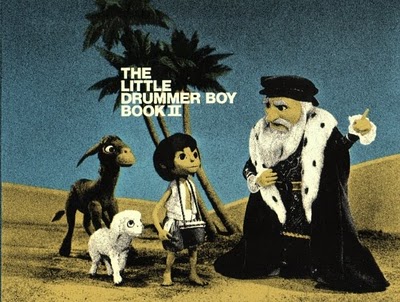
The Little Drummer Boy Book II (1976, Rankin/Bass)

This is the first of four Rankin/Bass specials that are included in a new release from Warner Archive, which collects four lesser-known Christmas-themed releases from the most famous, prolific producers in this niche. Firstly, in terms of restoration this film is in much better shape than the version of the original that I have. What is fairly refreshing story-wise is that it literally picks up immediately following the first special, and tells the tale of how the news of the fulfilled prophecy is to be spread, and what obstacles must be overcome. The music (the choir-work in this one uncredited) is chillingly good. The narrative is a bit thinner, the songs a bit more filler than the original, but it is a worthy follow-up with some surprises in store. It’s also fantastic that Greer Garson is once again the storyteller.

8/10

The Leprechauns’ Christmas Gold
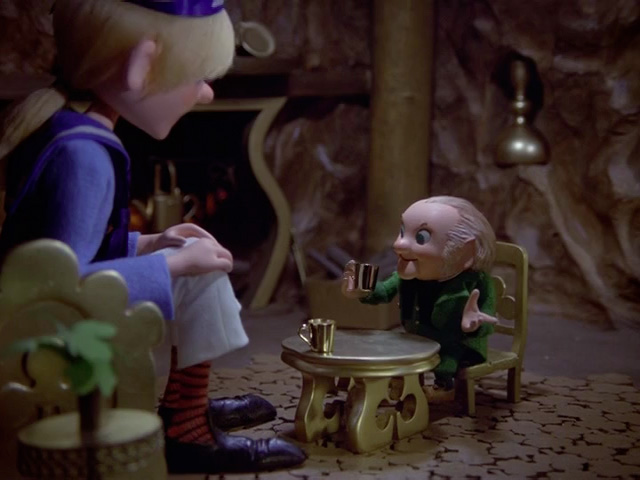
The Leprechauns' Christmas Gold (1981, Rankin/Bass)

This film continues my going through Warner Archive’s great new Christmas special set by the masters of the subgenre. Here again they have Romeo Muller back to script the tale, and it’s a good thing they do because his acumen is about all that makes this tale float. What’s good about it is that it gives me a little more banshee-related info than I had prior, but it is a most odd tale indeed. The elements mixed in of leprechauns, banshees and wayward sailors are those or darker tales and mystical tomes, but the tone is the same as their other works, yet the Christmas element is more secular than ever, if not downright pagan. This is not a moral judgment, it just makes the balancing of tone harder but the tale manages. It’s an enjoyable, odd little entry in their canon.

6/10

The Stingiest Man in Town
Teh Stingiest Man in Town (1978, Rankin/Bass)

This is yet another rendition of Charles Dickens’ eternal classic A Christmas Carol. Not only is it another adaptation, but it’s also another musical version. Even removing non-diegetic elements that bother me like comparing it to other adaptations or how the characters are really caricatures of the actors playing them, there are many things just off about this version. The songs are inconsistent at best both in lyrical and vocal quality, as is, surprisingly enough, the voice acting; though that could have something to do with direction. The story is also oddly structured inasmuch as there is a lot of denouement. Scrooge has seen the error of his ways and the tale just lingers; removing the impact of the change in his heart. I could go on, but these are the main objections I have.

5/10

Pinocchio’s Christmas
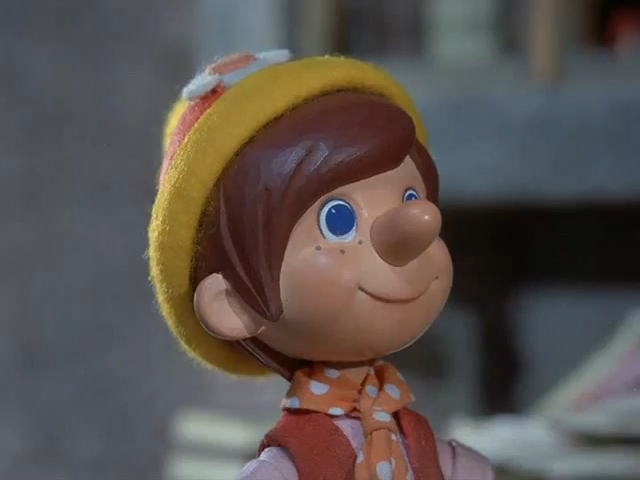
Pinocchio's Christmas (1980, Rankin/Bass)

Part of the appeal of this Warner Archive set was that I had never, or thought I had never, seen all the specials on this disc. No other film in this set gave me the feeling of déjà vu as this one. However, I cannot say of that is for real, and even if it is, I cannot guarantee I saw the whole film even if I did see it before. Out of all of these, this is the best example of the Rankin/Bass style the songs and lyrics, and vocal stylings are all top notch. It takes the Pinocchio lore and not only tells a Christmas tale with it but tells only part of the story. It’s an hour-long special that not only fits the allotted running time, but thrives because of it. There is also plenty of humor and wonderful sets. This may not be a household name special but it it on par with the best.

10/10

Help for the Holidays
Help for the Holidays (2012, Hallmark)

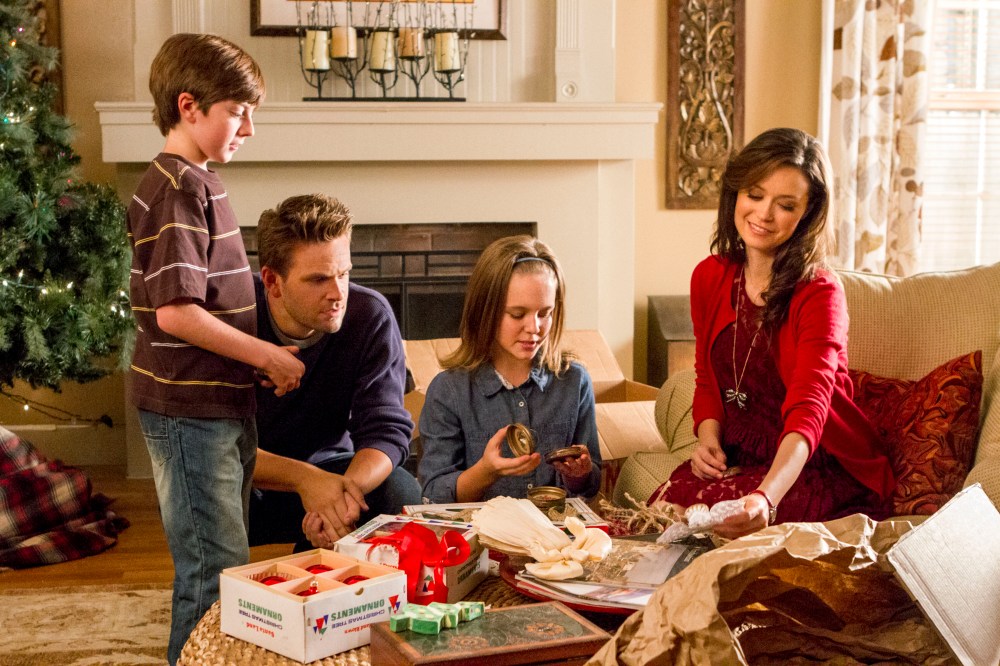
Here’s another holiday-themed film not only with an Elf element, but also with the now ubiquitous conquering-the-loss-of-Christmas-spirit problem. While the end result is predictable enough, as is some of the early path, there are enough wrinkles and well-timed moves to keep it rather enjoyable in the middle. The issues, and ultimately downfall are due to a few narrative inconsistencies, the unintentional casting of a creepy Santa and the redundant uninspired score which assails your ear throughout the entirety of the film.

5/10
Thankful for World Cinema: The Complete Metropolis (2010)

The first thing that needs saying is that there are conventions that need to be acknowledged if you are going to venture out and watch this or any silent film. Silent film acting, for example, is by its very nature more demonstrative and over-the-top than even the presentational style that dominated after the advent of sound, and most definitely can cause culture shock to those who are used to film actors of the Post-Brando world. It has to be taken as a given.

Some silent actors are clearly better than others but the style can’t be held against the film, it is what it is. While saying that Brigitte Helm is quite good in this film, she may go a little too far when she’s playing the evil robotic alter ego of her character but she is clearly two different people in those scenes. Gustav Fröhlich is an effective lead who portrays the audience’s POV aptly.

The image quality is superb for a bulk of the film, meaning the portions we already knew existed. They look as crisp and clear as they likely did in 1927, perhaps even better. While the transferred 16mm footage doesn’t look quite that good with many lines, which have been dulled and are nearly translucent running through it, they are without question an invaluable addition to the narrative.

Not only did the restorers fully explain the story of the footage’s discovery and how it was added back to the cut they also noted that the image size would change to keep less than knowledgeable patrons from complaining. Better yet they had some fun with the titles. Not only did they digitally create newer, more accurate ones, they added motion to those which referred to the workers underground and the elite up above the city.

The restoration of the original score, as best as it could be replicated, is also a welcome and brilliant touch. The end credits acknowledge the fact that some pieces of the music had to be created by educated guess and rarely could you tell. It was pretty seamless, and, moreover, the impact of the film is enhanced twenty-fold. Typically on DVD releases, especially the cheaper ones, which is how I was accustomed to seeing Metropolis; you get stock, canned, jazzy nonsense that rarely if ever really syncs. You can almost imagine the producers of said DVD sitting around picking a track because it synced in one spot. The score is breathtaking and absolutely draws you into the tale, if all else should fail.

While you should be forewarned that all we know should be in this film isn’t, as there are titles describing the rare scene that could not be saved or found. You will witness here, in greater fullness than ever before, the enormity and vastness of Lang’s vision. His vistas come through and the added running time gives this seemingly simple through-line the time to make the impact it seeks to make. It is, if you dig deep enough, a more complex and involved visual narrative than many may give it credit for. While we today will not be jarred by the seemingly contrasting styles of the sub-plots; there is a grab bag of visual elements worth exploring.

For a modern audience the message of the film, which is repeated on quite a few occasions, may seem a little heavy-handed, again I warn you that it must be taken with a grain of salt. Think of other silents you know and enjoy and consider if they too aren’t very on the head. You know exactly what the message of The Immigrant and The Kid are but they work anyway. Typically, you are told someone’s profession or that they are the hero before you see them, which is also less cinematic than desirable but the language of film was new and it was important to be simple and direct. It bears noting that Metropolis is not overly-laden with titles and it just works.

Seeing this new cut of Metropolis will not be like watching a regurgitated version of something you’ve seen before. It will be like a whole new experience. Not only do you see it on the big screen but you see it sharper and more clearly than you’ve likely ever seen it before. It really is like the saying goes; see it again for the first time.

10/10

Thankful for World Cinema: Summer Hours

Summer Hours is the latest film from acclaimed French filmmaker Olivier Assayas, probably most well-known for his film Irma Vep. This film examines a family dealing with the death of its matriarch. While this is a film that does have its occasional moments of clarity and near-brilliance, it is usually too distracted by its own subterfuge to make any real emotional impact on the audience.

The film opens up well enough with the matriarch Hélène’s 75th birthday party. Here we meet the rest of the family who have been scattered about the world. There is Adrienne, played admirably by Juliette Binoche, who is a designer in New York and Jérémie Renier, who works for Puma in China. Lastly, there is Frédéric (Charles Berling) an economist and family man who lives closest. In the beginning, we see each of the characters get sketched and it is intriguing. There are wonderful scenes both between Berling and Hélène (Edith Scob), when she first mentions the need for him to manage her estate when the time comes which he doesn’t want to hear, and Binoche and Scob when they talk about the tea service is even better and is played with great nuance and subdued emotion and longing by both.

After each Berling and Binoche have their breakdowns, one total and one restrained, the building of character comes to a near stand-still in some ways the narrative comes to a near stop as well. While there were the occasional discussions of an object to mask meaning and emotion in the beginning the dropping of names of painters, china makers, furniture artisans and the like becomes so incessant the people nearly get lost and it ends up feeling almost like an episode of Cash in the Attic.

There is one very heated exchange and then all the characters retreat into their own corner and go about doing their own thing and finding their own way to cope. Which would not be a negative if not for two things: the film was sold as a highly combustible drama in the trailer not a subdued one but more importantly, again the nuance would be more pronounced, more delicate and easier to appreciate if not for all the name-dropping. The scenes where the maid Éloïse (Isabelle Sadoyan) come back to get her item and leave her missus flowers are rather moving.

Ultimately, it is a film worth watching. The façade of objects and materialism is quite a subjective thing. Some enjoy it for just that reason. See for yourself and decide what you think. Those who appreciate good acting will definitely enjoy the film for that time alone.

6/10

Thankful for World Cinema: The Girl on the Train

The Girl on the Train, the latest film from French auteur André Téchiné perhaps most well known for his film Wild Reeds, examines the ramifications of the allegations by a girl who claims she was the victim of an anti-Semitic attack. Note: this review may contain spoilers.

The film is interesting in how it structures itself. It sets itself up in two parts. Part one is called “Circumstances” and part two is called “Consequences.” As expected, they each examine both what lead to the attack and what happened afterwards as a result of it. Sectioned films are not uncommon and it would be an interesting case study for film students to show that you can build your story in a very rococo fashion, as Rohmer did at times did, and still make it intriguing.

The Consequences section is very focused and really only shows the impact on Jeanne (Émilie Dequenne) and her mother (Catherine Deneuve). There is an overheard media report and they receive a letter from the president, and an interview. However, you don’t really feel the frenzy as much as you might think because they go into hiding and then to an acquaintance’s country house. So there are both positives and negatives to the singular focus.

Unfortunately, this is one of those films whose logline tells you the midpoint of the story, as does the synopsis. So if you go in as a blank slate you’re fine, otherwise you’ll wait a bit.

A shortcoming of this film is that once the twist is unveiled it truly doesn’t attempt to examine Jeanne’s psyche and see why and for what cause she did what she did. It’s kind of like burying the lead, or as Ebert wrote in his opinion of Artificial Intelligence: A.I. (which I disagree with) that it missed the story. We see someone who did what they did, show no real remorse and then eventually confess, apologize and it’s over. What have we really learned? Not enough, if anything.

While the film struggles a bit with pace and scenes where our lead was just skating about could have been truncated if not excised completely there were some good things in the edit. Specifically, the film frequently fades to black putting a cap on a certain portion of the story and allowing you to reflect on it these were rather good more often than not. Towards the end it is not serving the story more often than not.

In the two young leads you get characters you just watch and don’t necessarily identify with that greatly, which is not necessarily a bad thing but it magnifies shortcomings in the execution of the tale. First, there is Franck (Nicolas Duvauchelle) who makes a nuisance of himself until he wins over Jeanne, then falls into very shady business dealings and doesn’t inform her though he makes her an accomplice, then the character we have somewhat followed changes completely and in this regard the film leaves us as spectators and not participants, as opposed to the fades which do the opposite. This is a confused vision in this regard. It should be one or the other.

Catherine Deneuve in this film is just there again. It seems as if it’s been quite some time say since 8 Femmes since she’s been outstanding and not just part of the cast, however, hers, like many foreign filmographies is incomplete stateside.

The Girl on the Train is an interesting albeit flawed film that just missed the mark but still ultimately worth viewing and judging for yourself.

5/10

Thankful for World Cinema: The White Ribbon

The White Ribbon is an incredible film that, if you have read reviews, is most definitely deserving of the resoundingly positive reviews its gotten. It is a film that knows there are never easy answers and trusts its audience to fill in blanks. Of course, this happens more often than not with foreign films but when one is so accustomed to being spoon-fed it is always refreshing when you are invited to engage in the story and try to piece things together and aren’t handed everything.

The cinematography in this film is absolutely stunning. It is in what can only be referred to as glorious black and white, and shows you all the flexibility and the marvels that monochrome can bring to a film whether it be blinding snow, sharp silhouette, haunting chiaroscuro, high contrast and perfect underexposure. The thought of color in this film is quite literally repulsive. It’s the kind of feat that causes the American Society of Cinematographers to essentially say “Union allegiance be damned this is the best work of the year” by awarding it top prize. It informs the film and enhances it and never makes itself the center of attention.

It’s hard to discuss a film of this caliber without lauding a cast whose depth of talent is beyond reproach and whose ability runs so far down the supporting scale that it’s mind-boggling. As the scenes unravel themselves, and you meet the characters, you are consistently left wondering “Who is that?” after particularly well-played scenes. Especially Berghart Klaussner, The Pastor, who is chilling in a Bergmanesque fashion; Leone Benesch who in one scene perfectly plays the impossibly contradictory actions and emotions as indicated by the voice-over narration; Janina Fautz as Erna, the Steward’s daughter, who in the end is the overlooked and in a certain regard the reviled hero; Susanne Lothar as the dependent and taken-advantage-of midwife, and the entire young cast, including Maria-Victoria Dragus and Leonard Proxauf; believe it or not this list could go on.

It is a narrative tapestry that pulls together five narrative strands and slowly but surely you start to see how they all intertwine and how the fates of each family unit affect the other. You ultimately get what director Michael Haneke was in search of which is an examination of the psychological landscape that existed in the children of Germany on the eve of The Great War, the same children who would grow up and bring war to the world again.

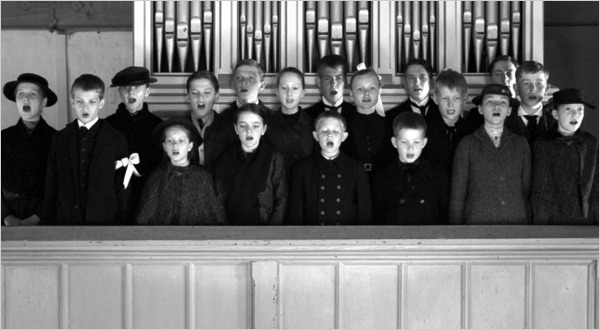
It is a film which seeks to leave its impact through certain minimal elements. For example, there is no score the only music we have are the Baroness and the Tutor rehearsing, and more lastingly there is the once repeated haunting hymn of the children’s choir in the church. The minimal visual treatment exemplifies itself when there is a beating we hear it and sit watching the door. Instead of seeing what goes on behind the closed door, we are haunted by only the sound.

This film is immensely watchable and the kind of tale you can watch unwind for much longer than it does run, which is impressive as it already runs a hefty 144 minutes. Needless to say this film is expertly paced and keeps each strand of the story equally compelling such that you want to keep going to see what happens in one or the other.

The edit both visually and in terms of sound is fantastic. Narratives are juggled deftly and kept in order and there is one audio cut from a piece of farm equipment droning to a pig mid-squeak; the cut is also visual but is especially inspired in terms of sound.

Not only is this a film whose writer, also the director Michael Haneke, juggles many storylines but he does something which seems so much easier for the foreign filmmaker which is to make a film heavily featuring kids which isn’t a kid’s movie but a serious drama. It is also an interesting piece because it sets you up to not get all the answers because you see early on that the narrator doesn’t have many, if any at all, as he has limited omniscience and when he does have an idea he doesn’t push hard enough.

The White Ribbon is not only a great film but an important one. It is one that will cause you to discuss it for quite a bit afterwards and is the latest great work in a very accomplished career for director Michael Haneke. It’s the kind of foreign film that should most definitely be making more of a dent as its appeal is universal and should not be kept to the arthouse set.

10/10

Thankful for World Cinema: Sin Nombre

The film Sin Nombre opens up seeming promising enough. It tells the bound to collide tales of Casper (Edgar Flores) and new La Mara recruit Smiley (Kristian Ferrer) and a group of Honduran refugees featuring Sayra (Paulina Gaitan). With these two seemingly unrelated situations colliding and heading on a race for the American-Mexican border you’d expect a compelling, intelligent and exciting film.

Instead what you end up getting is a transplanted American action film without the pace. All the characters are archetypes and sorely underdeveloped, which is truly sad because Casper and Sayra are aptly played, and the latter is once referred to by a gang member as a young Salma Hayek – a line which could very well turn out to be prophetic. The problem with having only archetypes is that you never get beneath the surface and what you get ends up being superficial. While I could identify with the plight I couldn’t identify with those in the plight. Whereas in City of God, because of how intricately it was told, and how shocking it is, given the circumstances; I could see myself ending up like those characters – a criminal with no other choice. The gang mentality exists and I know that but for compelling drama we need to see why the characters buy into it, only the moment of doubt is clear here. A truly effective film places you in the other situation and doesn’t leave you as a spectator.

The superficiality of character would be forgivable with more pace. However, the film is so languidly told it feels as though it runs three hours, which is nearly twice as long as its actual running time. Going on an epic journey is a major investment on the audience’s part and it would be easier to take if I knew better with whom I was going.

Backstory is sadly lacking as we never quite understand why Sayra is on this pilgrammage and what exactly separated her from her family. There is discussion of deportation and a death but we never learn who she is as a person. Her attraction to Casper also seems to come quite easily. He slays her attacker and she seems to say “My hero,” but it just seems too facile. Almost instantly she says she trusts him and “as long as I’m with you I’m fine.” Why him, and not your uncle and father you ditched?

There is just too much that we are left to accept, which is different than being spoon-fed. An audience will figure things out but some things require exposition as little as a filmmaker may like to admit the fact.

When there is not enough development of character there is only so far a story can go. There is laughter without joy, shock but no loss, suspense but no fear, and worse – a film without engagement.

4/10

Thankful for World Cinema: Les Vampires

Louis Feuillade’s classic six hour plus serial Les Vampires had disappeared from DVD for a while, before it recently resurfaced. I was lucky to have purchased this title at Christmas when it was still readily available – it’s now back in full force.

Unfortunately, Feuillade’s films seem to have disappeared from public consciousness long ago and hence the demand for his titles is less, which is why a company like Criterion would be ideal to shed light upon his lost gems. However, in discussing Les Vampires I would like to illustrate his greatness. First, I do not tout the greatness of this film simply because it is aged enough to be a classic. I like neither old things because they’re old nor new things because they’re new.

The timelessness of this tale of Feuillade’s storytelling is in how captivating his plots tend to be. In both Les Vampires and Fantomas you will see some effects that for the time are very impressive but always keep in mind the era in which he worked. Narrative cinema was still in its infancy and audiences were not yet fluent in the language of film so things are overshot: shots are very wide and there are few close-ups. Very few menial movements are cut. For example, if someone enters a building today we would cut right to them arriving at the location in the building where they needed to be, without giving it a second thought. In the oughts and teens, however, audiences needed to see the protagonist in the lobby, getting on the elevator, and reaching his floor or they would be confused. Today such moments are only shot to build tension if needed.

Having said all that, Les Vampires has everything you could possibly want in a narrative sense. The aim is to always leaving you wanting more at the end of each episode and I always did. What was a little unusual in this one is that the cliffhanger wasn’t the end as it was in Fantomas but there was usually a little denouement just before the chapter closed.

However, the elements that kept me riveted and watching two and three installments at a time and the whole thing in less than two days were all there. The story concerns a journalist Philippe Guérande and his sidekick Oscar Mazamette. They are engaged in an epic battle against an organized crime unit of Vampires known simply as Les Vampires.

This story is full of twists, mistaken identity, seemingly unbeatable villains, chases, hiding places, surprises (seriously I was taken aback by the ingenuity of some), it will always leave you guessing; after a while as it seems the kingpin on Les Vampires is a mist that can never be caught.

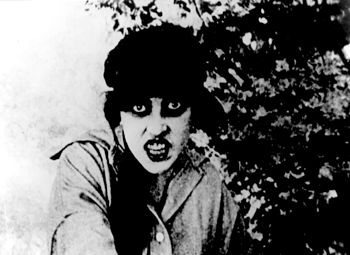
The acting is superb and seldom, if ever, are you left wondering what a conversation is about for lack of a title. Few things if any are ever introduced solely by titles. The film tells its tale visually. Musidora, who plays Irma Vep, which is now an immortal anagram because she became a worldwide star after this serial, and you can easily see why.

This serial is the definition of classic storytelling, good versus evil battling it out with drama, suspense and excitement building throughout each episode. Each episode does have its own arc, and its own characters on occasion. You can watch them separately and it almost becomes a TV show you just need back-story and you’re good to go to the next episode, except this is so much better. On the version I watched I don’t believe the score is original, packaging usually isn’t good about removing those doubts, but the score does fit most of the time and it’s very good. If you have a chance check out this excellent film. If you haven’t seen Feuilllade’s work be sure to suggest it to Criterion. There is too little of this filmmaking legend’s work available to modern audiences.

Thankful for World Cinema: Before Tomorrow

Before Tomorrow is the conclusion of a trilogy of films about the Inuit people being shot in Canada. The first being Fast Runner, which I saw and loved, and The Diary of Knud Rasmussen, which somehow was missed. It is a thematic trilogy, and not a sequential trilogy, following more in the European tradition where it’s variations on a theme and not necessary a contiguous storyline.

The film is both sparse in dialogue and replete with visual wonders. It might seem like a simple task to go up north near the Arctic Circle and get wondrous images and let the vistas do the work but there are frames, compositions and exposures that truly make these shots what they are. The edit also plays into the visual beauty of this film. There are at least three dissolves which are executed with such grace and beauty on both ends it brought to mind a quote by Truffaut where he says “So few directors can gracefully dissolve one shot into another.” This most certainly is not the case here.

There are also two different kinds of shooting here. There are more narrative-based landscape shots as the story gets more and more focused on the Grandmother (Madeline Ivalu) and her grandson (Paul-Dylan Ivalu), yet at the beginning there is quite a bit of handheld documentary-style shooting which is very well-done.

What you get in this film and its predecessors is truly a modern interpretation of Neo-Realism. Non-professional but engaging actors playing parts they understand in minimalist storylines. To relate the entirety of the tale would be entirely too easy within this space and would leave you with no surprises. There are surprises to be had and there are many emotions to be experienced within.

What will be said can be true of all simplistic storytelling, it’s the execution that elevates it, and that’s definitely the case here, yet as stripped-down as the on-screen action is there manage to be stories within the story. The film examines the oral traditions of the tribe and there are frequently stories being asked for and told that either inform or contrast the action we have been witness to.

The film ends as a close to the trilogy because after the tale of this particular installment is told then there is a slow-motion montage of the tribe living. Barring seeing the middle installment this could very well be the most overlooked, under-appreciated and impressive trilogies of the decade.

This is a film that will not cut quickly, that will take its time to develop. Allow it to. There is more than one way to make a film and to make a hyper-kinetic film with a people who are concerned with months and seasons and not so much with minutes and hours would seem wrong.

What you find here is a tidy, simple tale which is well told and as the best cinema does it shows you a world you would otherwise have no access to. It’s a tender and tenderly told tale which has humor, humanity and surprises. It’s a film that truly transports and even only having seen the bookends this was the perfect capper to the trilogy.

10/10

Thankful for World Cinema: North Sea Texas

This past weekend the Belgian Film North Sea Texas opened in New York and Los Angeles. I was fortunate enough to watch this film in July when it screened at Q Fest in Philadelphia. Based on the plot synopsis I had hopes that it would be a good film, what I didn’t expect was for the film to be somewhat groundbreaking in the annals of gay cinema, and, yes, I feel that the way in which the film handles its subject can render it universal. However, the fact remains that it will be pigeonholed as such due to what it’s about. The way in which it’s groundbreaking is startlingly simple: it’s a positive, affirmative film that essentially says love conquers all. Now, on the surface you might think you’ve seen that done a thousand times, and you have for a film about heterosexual romance. It happens less often in gay-themed films, and is even more infrequent in gay-themed films about first love.

Now, cinema, for the most part, has evolved past the point that is excruciatingly illustrated in the documentary The Celluloid Closet, which deals with the depiction of LGBT characters in Hollywood films up to that point. However, film in general, even when titles mean well, are beautifully, sensitively crafted and acted; still gravitate towards the quasi- and flat-out tragic tales when it comes to gay or lesbian protagonists.

This is not being judgmental, these are facts, and it’s a case wherein films are attempting to reflect realities. The examples are plentiful such as: This Special Friendship (Les Amitiés particulières) even being French, and dealing with the specifically named and ridiculed boarding-school romance, this is tragedy. Then you have films that deal with repression like Brokeback Mountain, Far From Heaven or even The Hours.

Then there is the kind of film that I expected this one to end up being like: Wild Reeds (Les Roseaux Sauvages), which is a tale of first romance that is all too typical: best friends one fall for another, there is experimentation but only one feels an emotional attachment because only one of the two is actually gay. It’s a first love deception that is commonplace and fair game for dramas.

However, what North Sea Texas strikes upon, and what makes it work so well and so important is that it’s an idealistic tale. It reminds me of a debate I and a professor had about the Indian film Fire in college. His criticism of the film was that the revelation of, and the familial objection to, a sexual abuse situation was unrealistic. My assertion was “Why should it be?” If you’re trying to make a point be it societal, political or otherwise, there are times when the best way to make it is to seek out an ideal and illustrate it, rather than just illustrating that the problem exists.

Not to say there isn’t drama, conflicts or struggles in North Sea Texas but the resolution to the the dramatic question the film poses is an overwhelmingly positive and beautiful one, made even more powerful because of how rarely it is seen.

It is also an extraordinarily timely one. With equality issues coming to the fore in many countries around the world, principally the United States, it is extremely useful and reassuring to see an illustration of it “getting better” and not merely being told that. Furthermore, this is not merely an assertion I’m making based on my read of the film, but it is also included in the credits where the film is dedicated to the kids whose parents refused to allow them to participate in the making of the film.

North Sea Texas is a wonderfully rendered artistic film that should win over any and all open-minded fans of film, but any film has its target audience and for the audience targeted here there are few films that ever so firmly, staunchly and beautifully espoused its over- and underlying messages. Few films can really said to be of social significance beyond just being a film. This, I believe, is definitely one of them. It may take time, but this film is one that I believe will stand the test of time and become quite a milestone. You may even try to dismiss it as a fairy tale if you want, but that could well be the point. For who doesn’t deserve their happily ever after?