61 Days of Halloween: Case 39

Case 39 is a film with tons of squandered potential that earns the rare distinction of Film Most Deserving of a Remake Due to Lack of Execution. Unlike others in the past like Captivity it does not, however, come even close to being good for a number of reasons. It should also be noted that this film was in the can for two years and likely to remain undistributed- not that something like that always matters (Blue Sky) but it should be taken into consideration.

To borrow a journalism term this film buries the lead, which is to say that it does not tell the most compelling story it has to offer. It decides to tell the tale of a well-meaning social worker who thinks she is doing this child a favor and saving her from abuse. As time goes by it turns out the girl is demonic. The more compelling tale would be to follow this girl’s life with her “parents” then the scene in which she is taken away has an added layer of emotion and becomes even more poignant, frightening and impactful. However, you cannot punish a film for what it should’ve done. What it did do wasn’t that great either.

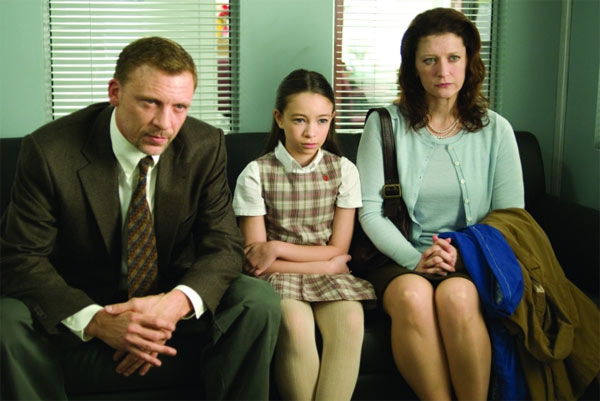
It gets off on the wrong foot right away by trying to introduce too many things in the early going. There is Emily (Renée Zellweger) and her work, then we see a little about her personal life and meet Doug (Bradley Cooper); we see her working one of her other cases which comes into the mix later, Diego (Alexander Conti) and there are a few meetings with Lilith’s (Jodelle Ferland, who is rather good in this part) family when there could be fewer. Edward’s, Lilith’s father, tight-lipped attitude prompts Emily to contact Detective Barron (Ian McShane) to try and look into their history. All this before Lilith is taken out of their custody, which would not be an issue if the film had measured its pace.

Instead once Emily has custody of Lilith she starts to jump to the supernatural conclusion far too soon and the only reason that would happen is because there is a concern about running time. While strange things had occurred things hadn’t gotten to a supernatural state just yet. Either the build had to be more consistent while bringing these people in or there needs to be a slower escalation of the Emily-Lilith conflict.

So it all becomes a question of reaction, or rather overreaction. A similar thing happens when Doug, a psychologist, has a session with Lilith. It is a disconcerting and somewhat cloying standard horror scene. As an audience, we can read between the lines and see she’s messing with him but Doug walks out of the encounter saying he feels “shaken” but he looks like he saw her head spin around the reaction is far too big for the scene we just witnessed. The only function it serves is to fuel Emily’s fears.

Then Emily’s approach to the final confrontation is all wrong. She is told that Lilith can only be killed in her sleep, which she hardly does at all. What that factoid is based on is beyond me. Her first approach is very hands-off and then although we get some very good intercut flashbacks what finally does it ends up being too easy a solution especially after having seen examples of her strength not moments before.

The concept this film tries to prey upon is that you are never safe from this demon if you are on her radar as she doesn’t actually kill you but rather makes circumstances more conducive to your death. It doesn’t quite succeed in that regard either. There is the aftermath of a gruesome scene which isn’t shot to its potential. The most effective onscreen kill is likely the hornets, however, their CG-ness is rather apparent throughout.

Inconsistency abounds in this film from pace to logic to effectiveness and even the performances aren’t immune, most of the times they are victimized by the script though. Case 39 has promise in many areas but never comes close to realizing it in anyway shape or form and ends up being a wasteful disappointment.

4/10
 

61 Days of Halloween: A Nightmare on Elm Street (2010)

Most holidays worth their while encompass entire seasons, such as Christmas, for example. However, as you may have noticed there is a corporate push every year for us to think about the next holiday even sooner. While this has many negative side effects I figure I may as well embrace it.

Since Labor Day is really only good for college football and movie marathons cinematically it is as significant as Arbor Day, which means the next big day on the calendar is Halloween and we can start looking toward it starting now.

Daily I will be viewing films in the horror genre between now and then and sharing the wealth. Many, as is usually the case, will not be worth it so for every disappointment, I will try and suggest something worth while as well.

A Nightmare on Elm Street shares one, and likely only one, distinction with the film The Perfect Game. That distinction is that it excelled, for the most part, in elements that were new and unique to it and botched what it attempted to recreate. In the latter the recreations were from other sports films, in the former the recreations were from the original version of the film.

Perhaps the best thing this film has to offer is that it seemingly breaks new ground in belief in the horror film. One of the most tired clichés in the horror film is the fact that in the face of overwhelming evidence some characters just flat out refuse to believe that there’s something out of the ordinary happening, or as Buffalo Springfield would say “There’s something happening here, what it is ain’t exactly clear.” Very quickly someone does believe the theory that it’s a nightmare come true. The majority do not believe right away but at least someone does, laying the foundation for the rest of the dominoes to fall.

What this film does casting-wise is unusual, it seems to subscribe to the theory of “Put your worst foot forward and kill it,” meaning that the first two characters focused on and killed (Kellen Lutz as Dean and Katie Fowles as Kris) are the worst actors in the film and thankfully those who receive the majority of the focus are progressively better.

Another positive is Kyle Gallner who carries this film in similar fashion to how he carried The Haunting in Connecticut. His sidekick Rooney Mara is also quite capable and a good sidekick in the film.

So, here comes a mandatory talking point: the CG. Most of the time it’s not great, not great at all. One of the things this film tried to recreate digitally was Freddy stretching through the wall. However, who would possibly want to get that in the can on set by using latex like they did in the 80s? Let’s spend money and use CG so Freddy can squirm all serpentine behind the wall and have it look totally bogus. Yes, bogus. I had to revert to 80s slang to communicate the ineffectiveness of the non-practical technique. Even when the CG was good, like when Kris could no longer fight that she was dreaming and the classroom around her exploded into ash, it only aided the film in going more over-the-top than it needed too.

The major knocks against this film will follow, and again, it’s a shame that they are big and many because it wastes a new interpretation of a now classic character. By having a new actor fill the role of Krueger in such a different way it proves that the character does have as much elasticity and room for creativity as the Joker in Batman. Jackie Earle Haley plays Freddy in a much more straightforward manner and less comedically than Robert Englund, making him more effective in this viewer’s opinion. His performance aside there were sadly some character issues with Krueger.

This film, while it does try to make Freddy a more straightforward and scary version than in the past – most noticeably by giving him a more realistically burned appearance than his prior incarnation, managed to both soften and coarsen him simultaneously. The coarsening was in his dialogue and mainly his diction. It’s a more foul-mouthed, blunt and disgusting Freddy. Apparently, his being a child molester isn’t enough anymore and to push the envelope he has to talk about it some. The way in which he was softened, however, is that he is only now, in death, a killer. His victims were all allowed to live. What was wrong with having him be a ghost-like entity who was still seeking to wreak havoc because he’d been killed by a mob is beyond me. The fact that while alive he didn’t kill one of the children he harmed does give Freddy more motivation, but we’re not dealing with the most plausible concept to begin with so that justification hardly needs addressing and does create a logic flaw in the past, mainly being why would a psychopath think the kids wouldn’t talk?

While there is more to Freddy’s back-story, which is new and good to see because it was a compelling and chilling part of the tale, it created and contributed to the number of issues with logic this film has. Examples of logic flaws include: Nancy at one point sings the “Freddy Song” yet never really follows it up or wonders why she knows it, yet she has repressed other kinds of memories, so what purpose does it serve? Jesse, aptly played by Thomas Dekker, is arrested way too quickly it’s almost like a Reichstag fire situation and aside from lacking credibility it hurts the story. The line “Who can remember being five?” stands out as being quite lazy on a few accounts, firstly, it’s clear Dr. Holbrook (Connie Britton) is hiding something and is not pressed about it and, second, even if I buy that these kids all repressed memories of what happened to them (which is easy to believe), the film also wants me to believe they all stayed in the same town and now almost all go to the same high school and don’t remember having known each other? Also, while the factoid about insomniacs experiencing micro-naps is a good touch and an added suspense element, as then one won’t realize they’re dreaming, it’s repeated ad nauseum in dialogue to make sure we remember the fact. Similarly, the allusion to the Pied Piper of Hamelin is duly noted but has no effect whatsoever on the story and is clumsily done. If the reference was to be fit in why not have Krueger read it to the kids?

Perhaps the biggest logic flaw, which is also the biggest argument for the fact that for some reason they also sought to soften Krueger, is the fact that at one point Quentin (Gallner) doubts Krueger’s guilt. Quentin’s contention is that it’s mass hysteria and they all made it up and were instantly believed, which in a post-McMartin Trial world is a legitimate enough point to address as it wouldn’t be the first false accusation of its kind. The problem is that there is no moment of decision for the character and it’s not even debated it shifts immediately from “this happened” to “we lied” with nothing in between. And only their continued investigation into how to rid themselves of Krueger proves otherwise.

So, here you have a film in which not only is Krueger not a murderer until after his death but you also have his victims believing that he may not have been guilty in the first place. It is not something that increases his villainy. What then is the point of having his absolute evil doubted? Is it armchair psychological reassurance to those who identify, however loosely, with Krueger that it’s OK because he’s not that bad? It seems unlikely but whether people want to admit it or not there is some level of identification felt with an antagonist. As Hitchcock and Truffaut discuss in an interview talking about Psycho there is a degree of that identification in that film and hence a slasher film such that the longer a franchise goes the more the villain is the star and the less you want to see him toppled. Ultimately, it just seems like another unusual decision which muddles the film.

Putting a more human face on Fred Krueger does not make him scarier. Having Jackie Earle Haley play him and not Robert Englund does but all of that is rendered nearly pointless by the rewrite of the character.

An examination of the back-story of A Nightmare on Elm Street was something I wanted to see. What it had the potential of is to intensify the fear because you more readily understand the evil. What should be sought from a more intimate portrait of the cinematic psychopath is not a softer, cuddlier interpretation of what it is he did, by having it be doubted and thus stripping it of its visceral impact, but a closer examination of it.

This very type of close examination was exactly what the Halloween remake did succeed in. It may or may not have crossed every T and dotted every I with regards to why Michael Myers became the way he was but it gave you a true, no-holds-barred glimpse of who he was before he was legend. It didn’t rewrite a history it enhanced a history, and that is what this film had the opportunity to do but it failed.


3/10
61 Days of Halloween: The Mist

Most holidays worth their while encompass entire seasons, such as Christmas, for example. However, as you may have noticed there is a corporate push every year for us to think about the next holiday even sooner. While this has many negative side effects I figure I may as well embrace it.

Since Labor Day is really only good for college football and movie marathons cinematically it is as significant as Arbor Day, which means the next big day on the calendar is Halloween and we can start looking toward it starting now.

Daily I will be viewing films in the horror genre between now and then and sharing the wealth. Many, as is usually the case, will not be worth it so for every disappointment, I will try and suggest something worth while as well.

When it was released The Mist was one of those films that just fell through the cracks for many. Mixed reviews are likely the reason. It is a film that should be seen if only as a conversation piece because it does have one of “those” endings, you know the kind that will get you talking and will inflame passions. In other words, it takes a risk and that alone makes it worth watching.

However, for the two hours leading up to said ending it earns that “should be watched” distinction. The running time alone is worth noting. Few films in the horror genre have enough substance to add a half-hour to the usual running time to build character but if a film can it should. Knowing who these people are and whether we as an audience love them or hate them makes a huge difference. The personal dramas and threats keep us locked in when there is no threat from the creatures in the mist.

The situation in which these varied characters find themselves in is built up steadily, slowly and sinisterly; such that before any of the characters realize the peril they are in we are already feeling tense. In combining two techniques of the genre we get in this film a very compelling drama with a horrific backdrop: characters trapped in a building with assailants outside (reminiscent of Night of the Living Dead) and a multi-character yet character-driven tale, which is a forte of Stephen King’s, whose novella is the source material for this film. Darabont’s handling of King’s difficult-to-adapt material is again nearly spot-on, Darabont creates and in some ways amplifies King’s effective scenario and makes it one of the most enthralling and captivating no-win horror scenarios ever created. There just seems to be no escaping it.

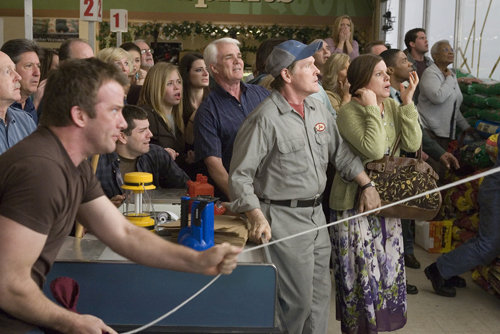
In a horror film one can forgive flawed acting from a lead, Thomas Jane, but the antagonists and most of the cast, especially in a film such as this need to be solid and they are. Andre Braugher plays his character convincingly enough such that you despise him, forgetting that it’s the part and not the man annoying you. Marcia Gay Harden, as always is brilliant, and downright frightening in this role. Her ability to convince those in the supermarket, though a bit overwrought at times, is fantastically illustrated. Some of the smaller parts are also very well-played like the Woman with Children at Home (Melissa McBride), Nathan Gamble as Billy (most well known from Dolphin Tale) and the Terrified Woman (Kim Wall).

The thing which is the most inconsistent in the film is the CGI. It seems whenever there was a good to great sequence of effects they would extend it too long or cut too close to the action and the illusion would fall apart. Typically, CG looks better on DVD than in the theatre, but not here. Some elements, like the bugs, were very impressive but the CG was not judiciously used and not carefully crafted enough, which is the only major inconsistency in the film. However, there has been worse it’s just upsetting to see such a glaring problem in a film which is of a very high caliber most of the time.

The ending is a conversation piece. It is strong and unlike King’s story it’s not open. King approved of this change. Certain elements are very effective some aren’t. What you make of it is up to you. It does not detract from the whole and the film is definitely worth watching.

This review pertains to the standard edition DVD not the two-disc special edition.

8/10

61 Days of Halloween: The Children (1980)

Most holidays worth their while encompass entire seasons, such as Christmas, for example. However, as you may have noticed there is a corporate push every year for us to think about the next holiday even sooner. While this has many negative side effects I figure I may as well embrace it.

Since Labor Day is really only good for college football and movie marathons cinematically it is as significant as Arbor Day, which means the next big day on the calendar is Halloween and we can start looking toward it starting now.

Daily I will be viewing films in the horror genre between now and then and sharing the wealth. Many, as is usually the case, will not be worth it so for every disappointment, I will try and suggest something worth while as well.

The Children may be the best way to introduce oneself to Troma Entertainment, this is a film that I first came upon at Monster-Mania Con and chose it as my first full-fledged introduction to the indie film giant. One could hardly hope for a better introduction to their work than this film, having seen The Toxic Avenger since and Tromeo and Juliet previously this is the truth: this film is basically funny only when it intends to be and can be very effective.

This is a film whose print was lost for all intents and purposes for about two decades. Even the remastered version presented on this DVD is missing a second or two from one scene creating a grindhouse-like artificial jump cut. However, this Cameron J. Albright scripted and produced project does have its redeeming qualities not belying the tongue-in-cheek intro to the film hosted by Troma president Lloyd Kaufman.

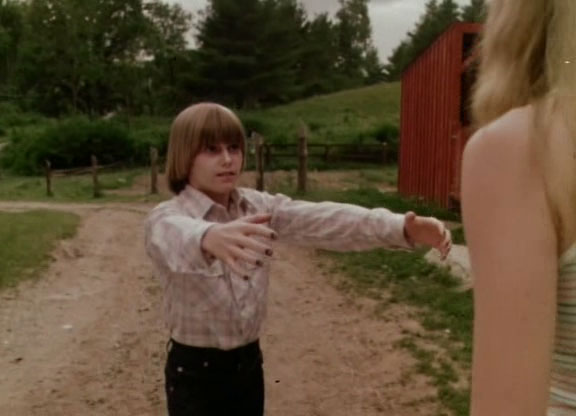
The film takes a very typical 1980s model for a terror tale, a disaster at a nuclear power plant, and makes it simple and accessible. This very time-specific fear is counterbalanced by the exploitation of a parent’s worst nightmare: finding their children are missing. Even though the parental figures displayed in this film are typically aloof and unaffected it does feed on the audience’s fear. The sum of fears is simple and the concept is simple: once exposed to the radiation they become mindless destroyers seeking to burn all they touch. Having children, the epitome of innocence to most, turn bad is of course commonplace in horror, but this film turns the simple gesture of a hug into something that should be feared and loathed. One of the most effective moments in the film is a very quickly taken hug by an unaffected child. It is one of the most frightening moments of the film because we already expect the worst.

The make-up effects, which are crucial to this particular tale, are quite good and likely were an influence on the later films cited in the introduction. Even with the phases of burning being introduced with dissolves most of the times and not cuts the shock of the first incident is still rather good and it is another case of how going into a film as a virtually blank slate can be a very good thing indeed.

What’s also refreshing, in essentially what ends up being a zombie film, is that our heroes aren’t too slow on the uptake and only waste a few rounds of ammo before figuring out how to best dispose of these creatures.

There is some very good POV camerawork building the suspense in the first inspection of the empty bus. The acting is not nearly as forced and as hackneyed as one might expect from a Troma picture and some performances and scenes even stand out as being decent and well-done, the bottom line is it’s never painful which even some good horror films are guilty of.

The first impression this film leaves is much stronger than it leaves after a second viewing so Netflix might be the best option for those uninitiated to the Troma style. Fans will certainly want to purchase it. However, it is still well worth your time and I most definitely wanted to and did see it twice. It comes recommended so a score is practically irrelevant, but if pressed it’s an 8/10.

61 Days of Halloween: The Crazies (2010)

Most holidays worth their while encompass entire seasons, such as Christmas, for example. However, as you may have noticed there is a corporate push every year for us to think about the next holiday even sooner. While this has many negative side effects I figure I may as well embrace it.

Since Labor Day is really only good for college football and movie marathons cinematically it is as significant as Arbor Day, which means the next big day on the calendar is Halloween and we can start looking toward it starting now.

Daily I will be viewing films in the horror genre between now and then and sharing the wealth. Many, as is usually the case, will not be worth it so for every disappointment, I will try and suggest something worth while as well.

First, a comment on The Crazies’ status as yet another film in a long line of remakes: after having recently seen George A. Romero’s original film The Crazies (1973) I no longer opposed this remake. Typically they should be looked at on a film-by-film basis and the original could be improved on, so this was fine in theory if not in fact.

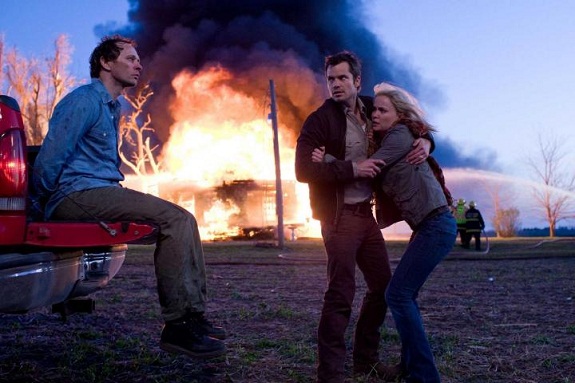
This film starts very strongly with some very notable scoring and some chilling scenes starting with the inciting incident on the baseball field. Most of the action in the beginning flows through Sheriff David Dutton (Timothy Olyphant) and it makes the mystery and horror very tight and close to the vest. The myopic view of the film allows for a very successful build in the horror as many of the characters we meet early fall prey to the disease.

The missteps begin kind of like an avalanche, one little rock rolls out of place and several other things follow. The first of these is that the jump to the assumption of contaminated drinking water is made very quickly, too quickly; it’s debated before they put a finger on anything else. Also, a touch at the beginning with the military satellite views and read outs in are a strength of the film and later they are a detriment because the military is too anonymous in this case.

Around the time when the city becomes occupied by the military, which sets up its perimeter to contain the infection, the film starts to suffer. Those we assume to be uninfected are trying to escape but they take unnecessary detours and the pace starts to suffer with many drawn out skirmishes with small victorious moments of brilliance interspersed among the trite stock episodes.

It is ultimately cannot avoid the trappings of a virus film, which is essentially a zombie movie with a different enemy. There are suspicions of who is infected, killing first and asking questions later, and unease in the survivors and aside from trying to offer unique kills nothing exciting is added to the equation. As is the case with all of these films nothing is ever over, which means we could get more Crazies which would be unfortunate indeed.

Even with the military moving in and posing a threat they are like rats in a maze just trying to avoid dead ends where they can be caught and killed, and there is no light shone upon the townspeople’s situation for far too long. While it can be to a film’s advantage to have the audience know things characters don’t, this takes far too long and slows the film down because the characters do need to find out in order to act at some point. So if we’re ahead of the tale and have to wait for the characters to catch up that’s not good.

There was, however, a goodly amount of intended humor and good acting, especially for the horror genre, in this film. It’s just a shame the material doesn’t quite live up to their capabilities and the early promise the film showed, it truly was a textbook first act but unfortunately for The Crazies films have three.

5/10

Welcome to 61 Days of Halloween 2012 and The Call of Cthulhu

Alas, the time of year I long for most has come. There will be a heavy focus on horror from here through October 31st, but rest assured that pieces discussing current/recent theatrical releases are still being worked on, Short Film Saturday will continue to be full of variety and the Mini-Review Round-Ups will also offer films outside the genre if it happens not to be your cup of tea. Enjoy the standard intro and this piece!

Most holidays worth their while encompass entire seasons, such as Christmas, for example. However, as you may have noticed there is a corporate push every year for us to think about the next holiday even sooner. While this has many negative side effects I figure I may as well embrace it.

Since Labor Day is really only good for college football and movie marathons cinematically it is as significant as Arbor Day, which means the next big day on the calendar is Halloween and we can start looking toward it starting now.

Daily I will be viewing films in the horror genre between now and then and sharing the wealth. Many, as is usually the case, will not be worth it so for every disappointment, I will try and suggest something worth while as well.

Every once in a while there is a film that just stands out so far it not only deserves to be noticed it practically demands it, it screams to be noticed. Such is the case with The Call of Cthulhu.

This is a film that screamed from the shelves of a Best Buy at me. It is produced by the HP Lovecraft Historical Society, also known as the HPLHS. The cover art was so convincing – once I had discovered it was actually “a new silent film” I nearly gave up on it. However, I decided to give it a chance, first for their dedication to the idea and second, because how often do you get to watch a new silent film?

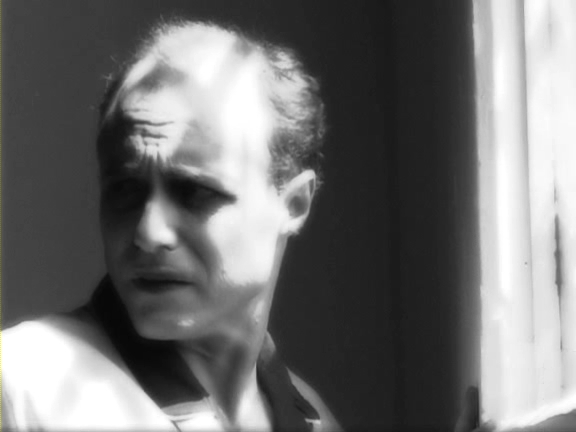
The film is short, under an hour, and highly decorated but having seen it this is the absolutely perfect treatment of the Lovecraftian mythos and a true delight for any fan of the author or the genre to behold. It takes his most difficult and ‘unshootable’ film and aside from one shot which I imagined when reading the tale handles it deftly, in fact, far better than I thought possible. All the conventions of the silent film are present and amplified. The end with close on text in journal could not be more perfect.

Throughout the use of forced perspective, miniatures and compositing is accurate to style and also rather effective. The film is also framed perfectly going through several locales with ease and not dependent on titles, in fact, not once is a title unnecessary or left wanting. It is truly a well-crafted film.

It is likely Lovecraft’s most globetrotting tale and it is certainly aired out well. The execution of the narrative is so accurate you are sure to forget about its being silent after a time if it does bother you.

The HPLHS is working on a new project Whisperer in Darkness. Their site features many links to their and other companies’ wonderful adaptations of the master’s work, available radio broadcasts and even a musical adaptation called Shoggoth on the Roof, both as a play and documentary about the play. One can only hope this group continues to bring HP Lovecraft the kind of appreciation and representation he deserves.

10/10

Rewind Review- Cirque du Freak: The Vampire’s Assistant

As those who know me, and if such a person exists, cyberstalk me, know I created this blog after writing on another site, which shall remain nameless, for a while. The point is, I have material sitting around waiting to be re-used on occasion I will re-post them here. Some of those articles or reviews may have been extemporaneous at the time, but are slightly random now, hence the new title and little intro, regardless enjoy!

Cirque du Freak: The Vampire’s Assistant is in large part a victim of a poorly thought out unoriginal marketing scheme as much as Paranormal Activity is the product of brilliant marketing. Having said that we will discuss that later and deal first with the film at hand.

The Vampire’s Assistant is by no means a perfect film, however, I did enjoy it quite a bit and it did leave me wanting more if perhaps a bit too much. The major flaws are the quickly drawn and superficially defined characters. We get enough on each to start such that the story is able to function and begin, yet the information disseminated is given to us clumsily and easily through dialogue. We instantly find out that Darren (Chris Massoglia) is a good kid and Steve (Josh Hutcherson) is a tough guy with a chip on his shoulder and all the reasons therefor.

The things conveyed through voice-over, like their individual obsessions, would have been much better conveyed with more visual information. An example, Steve’s dad left and his mom is an alcoholic so he feels he has nothing to live for when a crucial decision comes about. We learn all this through his dialogue, and have seen neither hide nor hair of his father or mother throughout. Even a flashback quick would’ve enhanced that emotion a bit which was very effectively conveyed by Hutcherson. Both young leads, in fact, elevated the story through their convincing portrayals of their sketched characters. Again each has an obsession that sets them on their path that sets them down their course but we learn this mostly through voice over.

The last issue was that of the character of Mr. Tiny. He’s an enigmatic villain and an interesting one, and his words and the opening title sequence make it clear he is only interested in being a puppet master in the battle between two rival factions of vampires. However, why he is only interested in that, what his timetable is, what his real motivation is, and why he chose Darren and Steve is nebulous at best. There is a mention of a prophecy but it is ill-defined.

Now having said all that the film does have quite a bit going for it, and knowing that Universal was hoping to launch a franchise does explain some of the lack of detail. The first part is that it does not take itself too seriously. There is a quite a bit of good humor had with the vampire genre as it turns some of the vampire clichés on their ear.

Aside from supporting turns by John C. Reilly, Salma Hayek, Ken Watanabe and more the film does have an essential conflict at its core that is quite interesting. You have in this story two best friends who become enemies and a rivalry that could’ve been avoided. You also have hilarious cartoonish portrayals of the adult characters at the beginning, which are deftly altered by Weitz when they re-emerge later on and the tone of the tale has changed. The parents reappearing looking concerned and real the teacher seeming confused and frightened, both merely shells of their formerly goofy selves.

The effects were quite good, which is more than can be said for most films, and this one based on reports didn’t cost an arm and a leg. The cinematography was composed and contained even in heavy action sequences which also can’t be said of a lot of films.

To return to the marketing, this is a film that was pushed into October and then had its title altered to include The Vampire’s Assistant, which is the title of the second book in the series. The use of the word vampire a calculated attempt to try and capitalize on Twilight‘s popularity. These are mistakes because this movie is nothing like, and never tries to be, Twilight. The target audience is different, the conflict at the center of it is completely different, and none of these ploys yielded box office results with the film finishing 8th with just $6.35M in gross. This is a shame because all these questions that came to mind wouldn’t have held any water had it not been interesting, and so now it seems they will be unanswered in celluloid and left only within the pages of Darren Shan’s novels.

6/10

Rewind Review- The Perfect Game (2009)

The first thing that likely needs saying about a film like The Perfect Game is that it’s the kind of film that you absolutely want to like but the execution of this tale made it difficult if not impossible. There are myriad reasons you want to like it: the based-on-a-true-story aspect, the fact that it covers a simple sport in a simpler time, the fact that this film (like many about the Little League game) wallowed in undistributed obscurity and the fact that the success of certain cast members after the fact and the power of social networking helped it to be released, at least in part. However, all of that is peripheral to the film and can’t really factor in, which is unfortunate because it is a great story.

One of the major stumbling blocks this film faces is a problem of accents and language. The film is a tale of the ragtag team from Monterrey, Mexico that was the first to capture the Little League World Series crown. It would’ve been best if the film had been shot in Spanish, instead we get stereotypical accents which waver despite the arduous efforts of some cast members and the young core of the film is quite talented and likely able to handle it. To compound this problem the one kid they did have deliver an entire line in Spanish couldn’t deliver it so it was poorly-dubbed. Which brings to mind the other issue in films where accented English substitutes for a foreign language and that’s the quandary of when to venture into that foreign tongue. It’s usually best to never do so for a whole line especially if the actor being asked to deliver it can’t speak fluently.

There was, however, also inconsistency in the the casting of some pivotal roles. The first being Clifton Collins, Jr. as Cesar. Not only does his accent waver, as should be considered a given of almost anyone in the cast, but his delivery is frequently off. The prime example of this is when first addressing the media in Williamsport, PA he is concerned about the start time of their first game because that’s when the players have their siesta. Not only have we not seen a siesta in the film but the delivery is so poor you think he’s joking and poking fun at stereotypes about Mexicans. When immediately in the next scene you find out it’s true and is a legitimate complaint. Similarly when he’s being the tough coach you rarely get a glimpse of why the kids would like him regardless; it’s not a layered enough performance.

The second casting issue is more one of perception but in film in many cases perception is reality. Probably the most important person to this team is the town priest who travels with them most of the way to the series. This character is played by Cheech Marin. There’s nothing greatly wrong with Marin’s performance, as there is with many of the smaller supporting players who are unknowns, but he’s just not credible in this part as some other lesser known actor might’ve been. Lastly, there is Frances Fisher as Betty a beat reporter who is following the team, at first reluctantly and then willingly, who cannot decide what decade she was from or where she is from and ends up being a character without time or place.

The young cast aside from the accent issues, which was an affectation placed upon them, do deserve special mention and accolades for bringing forth most of the positive moments in this film. Namely they are: Jake T. Austin, who plays Angel Macías, the star pitcher of the team, who features in the film’s greatest moment when their coach reminds him that he’s Sandy Koufax (as the team was inspired to greatness by comparing themselves to the Brooklyn Dodgers) and he says “No, I’m Angel Macías,” which is followed by a triple-cut on his delivery of his last pitch which was awesome. Ryan Ochoa, the team’s wise-cracking catcher, Norberto, who in the narrative makes one of the great plays in the championship in what is one of the film’s special moments. Moises Arias, who is best known as Rico on the Disney Channel’s Hannah Montana, should tap into this kind of character more, he’s a bit a pest but well-intentioned and not completely obnoxious. Lastly, there is Jansen Panetierre, who plays the amicable Enrique, who is one of the two star pitchers on the team who absolutely owns his moment when he was told he’d be starting the semi-final game when he thought he’d be passed over for Angel.

What is perhaps most maddening about this film is that it botched the simple and cliché and excelled in what was unique. What makes that even more frustrating is that a lot of what is cliché could’ve been removed from the film and and not hurt it any since it runs about two hours. There is much of the time where you feel like you could be watching The Mighty Ducks or any other sports or Disney project. There’s all the standard scenes which detract from the different tale this film is trying to tell. Which is not to detract from the aforementioned projects or company since this film didn’t handle the scenes nearly as well.

The first act of the film drags painfully and the pace never recovers. The film insists on setting things up slowly even though nothing terribly complicated or suspenseful is happening. For example, Cesar meets his love interest, Maria, for the first time and you know there will be flirtation and what this scene leads to is establishing a turbulent relationship but the pace of dialogue combined with the Bill Conti score, which in this project is always cheesy, make the scene seem interminable.

The film starts, like many do, with the “based on a true story” title card and that should be enough but it throws in archival footage as well and black & white traveling shots. This is rarely, if ever, effective and only really makes a difference at the end when you see real photos of scenes we saw re-enacted.

The bad start that this movie gets off to is almost overcome with wrinkles unique to this tale: the kids having never played on grass, the meeting with Cool Papa Bell, the trip through the segregated South, the relationship of Cesar and Maria, the preoccupation with the games that takes over Monterrey and the games themselves.

While I am sure there are likely a few liberties with history taken I won’t get too bogged down in the minutiae there, but rest assured if you survive the first act you will sit through the movie because it does indeed get better. Where it does suffer again later on is in a typically poor handling of sports on film. Yes, the story is about the characters, their relationship, their camaraderie and coming together for a common purpose but in a sports film you will inevitably have game scenes and we the audience need to know the stakes of each game and that wasn’t always the case. Similarly, as per usual, you got “Film Baseball,” which can apply to any sport and most movies, where editing made it easy to accomplish the desired result of a play. For once I’d just like to see a camera set up behind a pitcher, or the catcher, and see the whole play from windup to contact with no cuts.

If you are heading out to the movies as a fan of Little League Baseball, as I am, and want to see depicted on screen all that is good about the game, both past and present, you likely will not be disappointed. If you head out to see The Perfect Game as a fan of film you will likely be disappointed and will witnessed something far less than perfect.

4/10

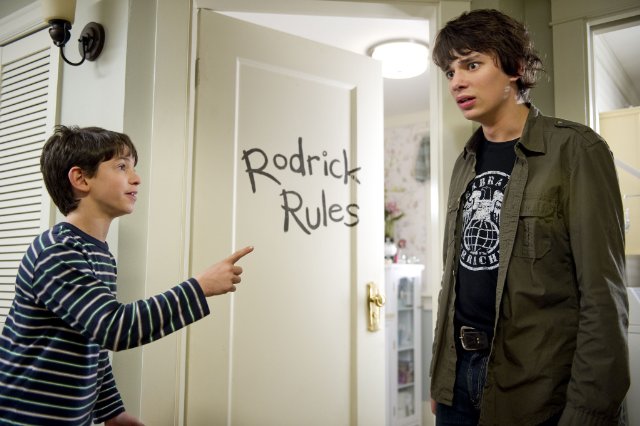
Diary of a Wimpy Kid: Rodrick Rules

Diary of a Wimpy Kid: Rodrick Rules is a better film than its predecessor. This was something I rather anticipated, however, I don’t believe its to the detriment of this installment that it is second. There is not too much shorthand used and the narrative is accessible enough that that much enjoyment will not be stripped away if you are walking into this one cold.

This film benefits from a more unified and less episodic plot than did its predecessor as well. Not that it still doesn’t reap the benefit of humorous and well thought out subplots but they weave their way into the larger narrative with more finesse than prior. These tales like Chirag’s invisibility, the new girl, the teacher with a vendetta, are all well-handled and add to the film but do not ever threaten to overtake the film from what the central conflict is.

The conflict being that of sibling rivalry, which is handled very well because you see a relationship in stasis go from just about as bad as it can possibly get to become rather functional. It also contains the peaks and valleys that are requisite for such a struggle, and even more of a credit to the film it goes from being borderline cartoonish in its animosity to being rather real and honest in the handling of the themes of both resentment and insurmountable hatred that sometimes accompany such relationship, especially when the age difference is large.

These discussion points come first to illustrate that despite its varying brands of humor, there is a point to be made in the film and its not just mindless and “low-brow” comedy. As for the comedy, it does do a wonderful balancing act again. As this is a home-based tale, there is more parent-child and husband-wife comedy than before.

Again the Steve Zahn brilliantly plays a dad who wants to be as hands off in parenting as he can and also is a typical guy in some regards and not just your typical distant patriarchal archetype. He is countered wonderfully by Rachael Harris. They are funny enough, however, the comedic quotient in this film is amplified greatly when you consider that the talented and previously under-ultilized Devon Bostick gets to step to the fore in this film. He is astonishingly good in this film and rarely delivers a line that doesn’t elicit some sort of response whether it be a laugh or one that connects dramatically.

Zachary Gordon’s character Greg is somewhat mellowed this time around not as hellbent on achieving popularity and other superficial means of acceptance but glimmers of that self appear even in a more rounded character that he creates just as easily, if not easier than he did before. His honesty in situations that in tandem can be seen as absurd are what carry the film and make it something you can connect to sympathetically rather than watch as a disinterested observer.

This film moves along at a very healthy clip, not only are there some fun and creative editing choices like “Disappointed” montage for Mom but things cut swiftly within scenes such that the whole things seems like its done in a blink and not in a disappointed I-Can’t-Believe-They-Call-That-A-Feature kind of way but in a fun and escapist, easily re-watchable way.

Diary of a Wimpy Kid: Rodrick Rules
allows the narrative, characters and young performers to grow and evolve from where we left them and you can call it an experiment if you like, but if you do it is surely a success. Those who were there are better, more confident and comfortable in their roles and those who are new like Peyton List, who carries off the important role of Greg’s love interest with uncanny ease, blend in perfectly.

It’s a funny, fun, must-see.

10/10

Rewind Review- Diary of a Wimpy Kid (2010)

As those who know me, and if such a person exists, cyberstalk me, know I created this blog after writing on another site, which shall remain nameless, for a while. The point is, I have material sitting around waiting to be re-used, on occasion I will re-post them here. Some of those articles or reviews may have been extemporaneous at the time but are slightly random now, hence the new title and little intro, regardless enjoy!

With reports already abound that the writers are and have been crafting a sequel since before the premiere the makers of Diary of a Wimpy Kid seemed like they would be getting off on the wrong foot by immediately violating one of my recommended cinematic resolutions (A piece I wrote at the start of that year urged studios to wait on sequel announcements). This is not the case, however, as for the most part there are few missteps and many, many positives in this funny family film that really is likely to please the whole family.

The first thing this film does right was to not fall into the in-and-out no one gets hurt motto of family-friendly filmmaking, which means they were unafraid of a slower pace which feels longer than it is and tells a lot of story. Even better is that you don’t really feel it at all because there’s plenty story there and no filler.

What allows this film to so easily tackle the extra running time is not only the fact that it takes a diary approach, starting just before the first day of school in September and going until the end of the year but also that employs a narrator, the protagonist Greg Heffley (Zachary Gordon), that not only moves the story along but at times talks to the camera directly, which is to this day a hard feat to pull of but it’s well done here.

This is the kind of film that doesn’t work at all unless its young lead is spot on in such a way that you not only identify with his situation but at times feel for it and this accomplished with deft and ease by Zachary Gordon. If Greg Heffly is misplayed at all, considering the story elements, he is not a sympathetic character but he adds to it a naive sure-headedness that make him readily identifiable to most audience members. Similarly, Robert Capron as Rowley easily becomes either like we were at that age, unwilling to grow up and unashamedly himself, or just like someone we knew- together they make this movie happen.

Kudos are also in store to director Thor Freudenthal not only for a second consecutive well-handled and non-condescending family film (Hotel for Dogs) but also for allowing some reality into the equation when dealing with Junior High School. Few films ever, whether through storyline or casting extras older, realistically depict the chasm in maturity that exists not just amongst kids at the same grade-level but between the 6th and 8th grade- you may never feel that extraordinarily short again as you do that year and this film finally addresses that other realities that are typically glossed over by other projects.

Another positive is the realism of the cheese metaphor. In the tale there is a piece of cheese stuck to the blacktop of the playground and it mysteriously never gets moved and it develops this aura. Stories develop and those who touch it are cursed. The flashback sequence describing the history of the cheese is a great subplot and also when it becomes crucial at the end as it is a great metaphor for the triviality and randomness about what is perceived as good and bad by peers in school. It is truly a wonderful touch.

The only slight issues this film suffers from is in the two-pronged rift that occurs between the two friends, it’s not so much that the rift happens because you kind of see it coming but it’s how they happen. First, there is a disagreement when Greg and Rowley are trying to collaborate on a comic strip for a school competition the reason it’s sort of an issue is a matter of personal preference. Basically, it’s an argument between Greg and Rowley where the film seems to want you to take Rowley’s side but in this viewer’s opinion Greg was right on that one- Rowley’s strip is funny in context of the film but taken out of the film Greg’s is better (Note: on re-views Rowley’s has become funnier in its un-funniness and the sequel deals with the joke better). Where Greg isn’t right is when he betrays his friend, of course, and here is where the moral of the film will come in. However, their rift gets prolonged because of how Greg handles his mistake after the fact, lesson learned ultimately but movie slightly lessened due to it- not to say that Rowley should’ve immediately forgiven it, but it was a sorry apology attempt.

Another way in which this film excels, however, is that the secondary characters do show some reality even if they are not as well-sketched as the leads. There is the Gym teacher showing favoritism in a not over-the-top way to his better athletes. Then there’s Angie (Chloe Moretz) who sits on the sidelines most of the time because she realizes how futile being popular and accepted at this level is if you’re not you. Even Greg’s parents just in how they react to one situation, Greg’s fight with a girl during The Wizard of Oz, is real and happens. Mom is disappointed and can’t even talk to him and dad says to Greg “I thought she deserved it.” Then there’s Greg’s older brother Roderick who never changes and always treats Greg poorly but is a proponent of a theory many know well “Just blend in.”

Ultimately, Diary of a Wimpy Kid is a very enjoyable, insightful, thoughtful and funny film about an under-represted (in a realistic fashion) subset of the population on film.

8/10