Short Film Saturday: If and Nuts & Robbers

As you may have noticed, I missed two short film Saturday posts so far this year, which is not cool. In an attempt to make up for this, whenever it should happen, I will try to include multiple videos in those I do get up rather than double posting.

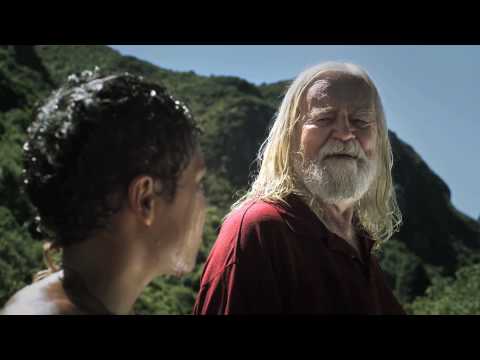
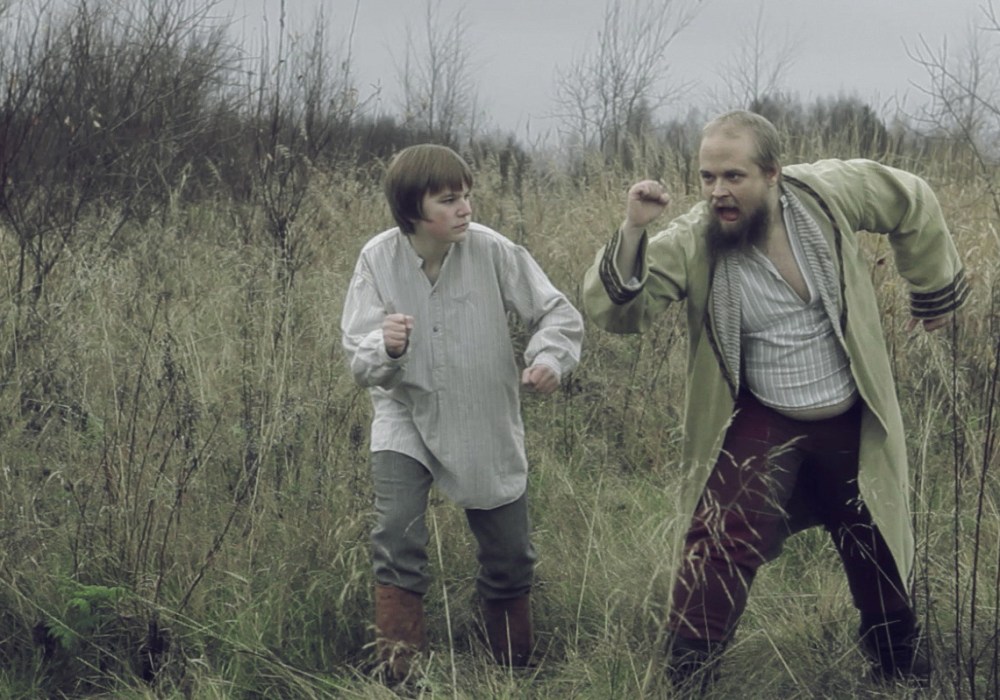
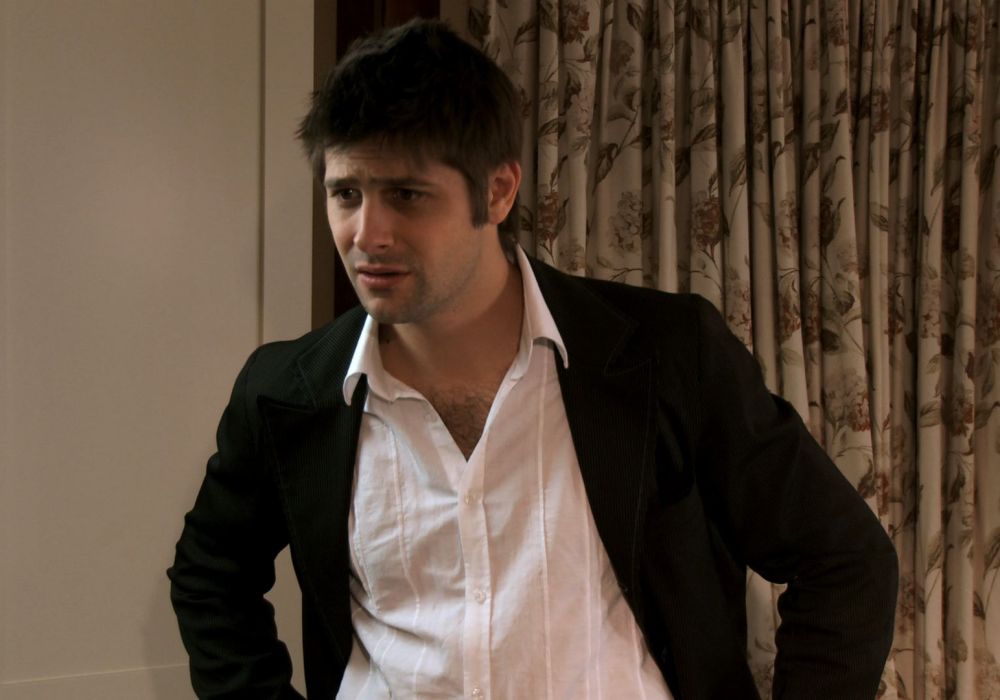
These selections were submitted to me on Twitter by Chris Heath. The only commonalities they have are his involvement and being shot in Belfast, Northern Ireland, but they are really intriguing foils. On the dramatic end there’s a rendition of Kipling’s iconic poem “If” which one could be interpreted as being read to the city, which makes it ever more poignant.

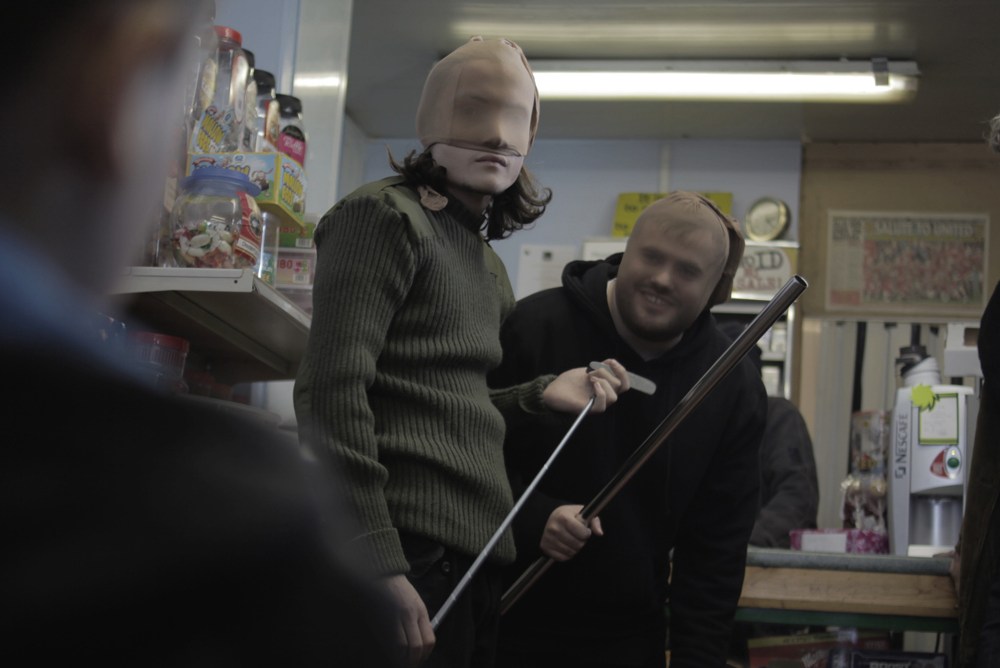
Then you have Nuts & Robbers, which is plays like a modernized, amped up Take the Money and Run.

If

Nuts & Robbers

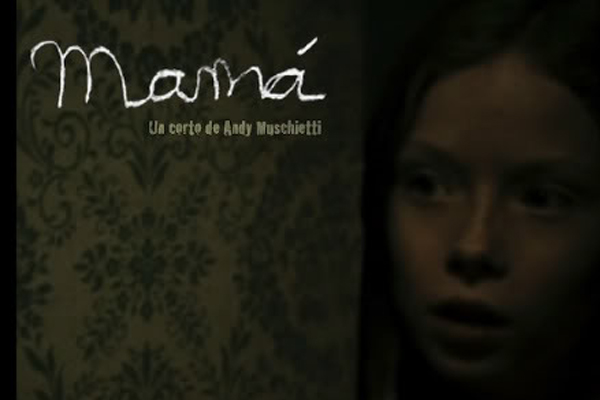
Short Film Saturday: Mamá

I can’t say it comes up too often, however, whenever a short that has been turned into a feature does come around and you can find it online, I’d like to put it up here. Out now is Mama, which drew its inspiration from this short, which does live up to the introduction that Guillermo Del Toro gives it. It’s highly effective for as short as quick as it is. The scene keeps rolling and the music is fantastic.

Short Film Saturday: Frosty Man and the BMX Kid

Firstly, welcome to the first short film Saturday of the new year. I wanted to have a new one up last weekend, but amongst other things having all my BAM posts needing to go up, and my Best of the Year in general and horror took out much of my screening time.

However, I do want to try and make up for the loss and will try and get two films up today. The first of which will leverage of the BAM Awards some and features a 2012, James Rolleston (Best Performance by a Young Actor in a Leading Role for Boy).

Frosty Man and the BMX Kid is a very quick, quirky, funny tale featuring some heavy Kiwi accents (so listen close) and a mysterious stranger. This was a finalist in the Your Big Break Competitions run by New Zealand Tourism.

Short Film Saturday: Limbo, the Organized Mind

This is a short film by Jim Henson as orginally presented on The Tonight Show with Johnny Carson.

Here’s some insight from Open Culture:

Not having grown up during the Muppets’ first and highest wave of popularity, I’ve always wondered how something like The Muppet Show could possibly have attained such mainstream cultural primacy. A friend of mine who did spend his childhood watching puppeteer Jim Henson’s array of creatures do their thing on national television offers a simple explanation: “It was the seventies.” Though Henson began his puppetry career twenty years before The Muppet Show’s 1974 pilot episode, his distinctively earnest yet presciently post-psychedelic vision seemed made for that decade. America responded by elevating his work into the zeitgeist, and not just the stuff properly involving Muppets. Above, you can watch a 1974 clip from The Tonight Show featuring a short performance from Henson and fellow Muppeteer Dave Goelz called Limbo, the Organized Mind.

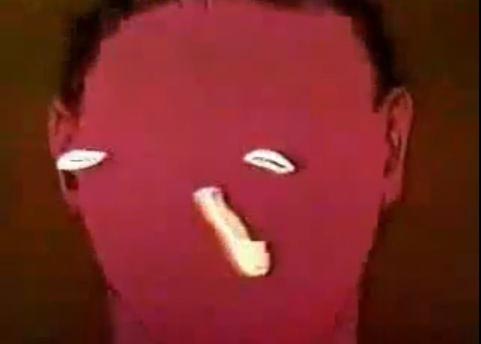
Henson and Goelz treat Johnny Carson and the Tonight Show audience to a journey through the brain, as an abstracted, hand-operated face narrates the passage through organic structures like his medulla oblongata, and cerebrum, and the seats of things less definable, like thoughts of his family, thoughts of his enemies, his “extra-special section of good thoughts,” his evil thoughts, and his fears. The score comes from electronic composition pioneer Raymond Scott, whose 1964 album Soothing Sounds for Baby has won great respect among enthusiasts of ambient music. Watching Limbo, the Organized Mind in 2012 brings one obvious lament to mind: why don’t they make such delightfully eccentric and artistic television anymore? But of course they do make it, in stranger and less predictable ways than even Henson did, but mainly in the countless fragmented, comparatively marginal venues of modern media. Limbo aired on a show that half the people you knew would have seen. It was the seventies.

Limbo can be found in the Animation section of our ever-growing list of Free Online Movies.

Short Film Saturday: Rabbit of Seville

I could very easily always pick a Looney Tunes short. I love Rabbit of Seville but saw a link wherein True Classics offers some brilliant insight:

Rabbit of Seville is the brainchild of director Chuck Jones, writer Michael Maltese, and frequent Warner Bros. composer Carl Stalling. Stalling was, on occasion, criticized by some (including Jones) for his habit of quoting modern or popular melodies in his scores, and it is true that his scores featured repeated use of certain musical cues for similar situations from cartoon to cartoon–for instance, the recurrence of Rossini’s William Tell overture in chase scenes (particularly those in Western-themed cartoons), or the use of “We’re in the Money” (from Gold Diggers of 1933) in scenes featuring the sudden acquirement of wealth. Stalling’s penchant for musical puns aside, he was nonetheless an incredibly talented musician, and the Stalling scores are among the most memorable in the Warner Bros. animated canon (for a pitch-perfect example of Stalling’s unparalleled talent, see 1943′s A Corny Concerto, directed by Bob Clampett, which Stalling completed with his eventual successor, Milt Franklyn).

In Seville, Jones takes full advantage of Stalling’s musical abilities, as the composer manages to incorporate a slightly abridged version of the overture to Rossini’s opera The Barber of Seville at an accelerated tempo that still manages to capture the essence of the original tune. Additionally, he works in a bit of the “Wedding March” from German composer Mendelssohn. Maltese composed new lyrics to accompany the sped-up tune, and aside from Bugs’ final line, the song lyrics are the only dialogue to accompany the cartoon–and really, no dialogue is needed when the lyrics include such brilliant lines as, “There, you’re nice and clean … although your face looks like it might have gone through a machine!”

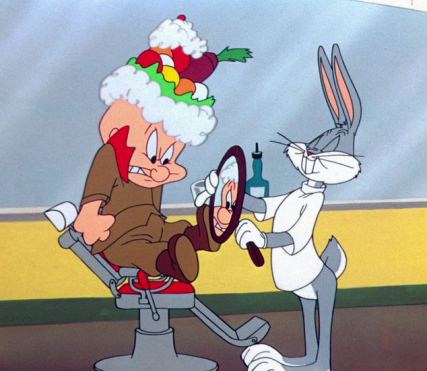
There are little touches throughout this cartoon that heighten the humor: a sign in the opening scene advertises a “Summer Opera” performance of The Barber of Seville starring “Eduardo Selzeri” (producer Eddie Selzer), “Michele Maltese” (writer Maltese), and “Carlo Jonzi” (director Jones); the stage is set for a scene at a barber’s shop, yet in Rossini’s opera, there is no such scene (despite the character Figaro’s titular position); Bugs (naturally) gets the chance to don drag, as Elmer’s alluring “little senorit-er”; Elmer deals with multiple indignities in Bugs’ Sweeney Todd-esque barber chair o’ horrors, not the least of which is having a hair tonic treatment that results in a patch of red flowers sprouting on his otherwise bald noggin; to bring an end to the madness, Bugs proposes marriage, and Elmer zips offstage briefly and reemerges in a white wedding gown; Bugs’ final, mischievous nod to the audience. The result is a sort of insane mash-up of so-called high and low culture, audaciously combining cartoonish antics and high-brow musical accompaniment in a way that, by all logic, should not work … and yet totally and completely does.

Is Rabbit of Seville as effective a cartoony operetta as What’s Opera, Doc? In truth, not quite–though both cartoons have their strengths, the more satirical bent of the latter cartoon trumps the relentlessly slapsticky nature of Seville. Opera functions as both a parody of its musical source material and an incisive comedic homage to it, while Seville concentrates more on just generally garnering laughs. Not to say that there’s anything wrong with that, for Rabbit of Seville is truly hilarious, and undoubtedly its success enabled Jones, Maltese, and crew to embark on the much more ambitious (and much more expensive) Opera in later years. And its influence has not gone unnoticed; Rabbit of Seville is, like its operatic cartoon brother, on the list of the 50 best cartoons of all time, placing at number twelve, and it remains one of the most popular ‘toons to emerge from the Golden Age of animation. Perhaps most importantly, this cartoon is among a number of memorable Warner Bros. shorts that helped introduce new generations to classical music in a fun, engaging way that, if it didn’t exactly foster new fans of the genre, at least created a lingering awareness of the great compositions of those grand old masters.
Enjoy!

Short Film Saturday: The Sorcerer’s Apprentice

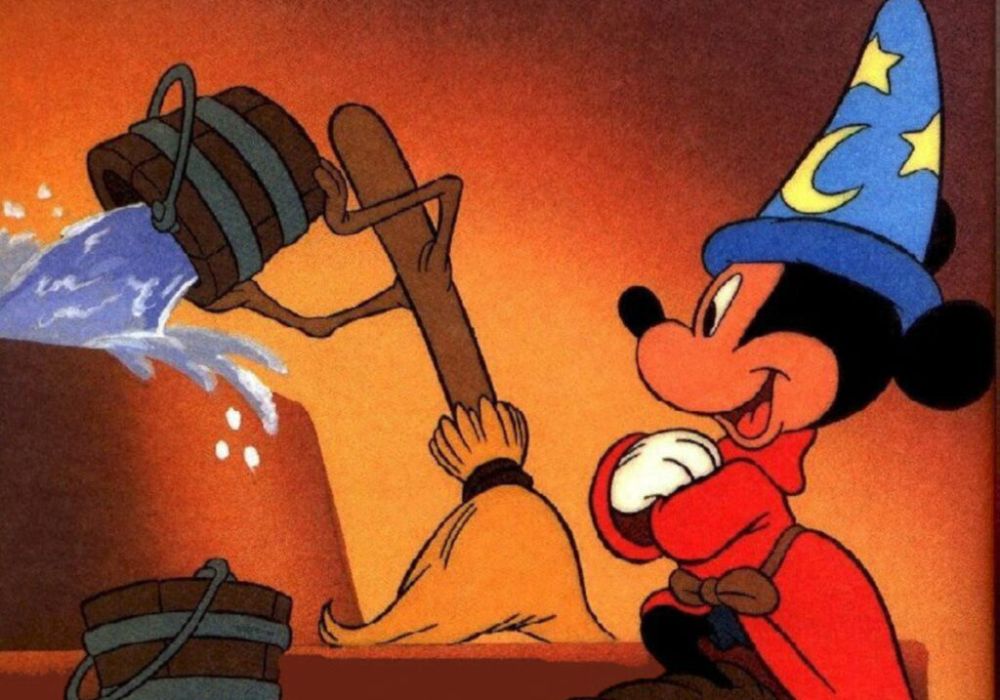
If you’re like me and you absolutely couldn’t stand the new version of The Sorcerer’s Apprentice that was foisted upon us than have a gander below at the original intent. Minus the introduction which I believe is from the rehash Fantasia 2000, it is without dialogue. It is wordless and symphonic leaving you to marvel at good old cel animation and simple well-executed story.


It’s surprising that Disney has done nothing to commemorate the 70th anniversary of the film perhaps that is waiting five years for the 75th- so be on the lookout in 2015. I was never a huge fan of the film as a whole but this was always my favorite segment and perhaps that realization brings a new axiom into the mix: “you don’t know what you got ’til it’s remade.”

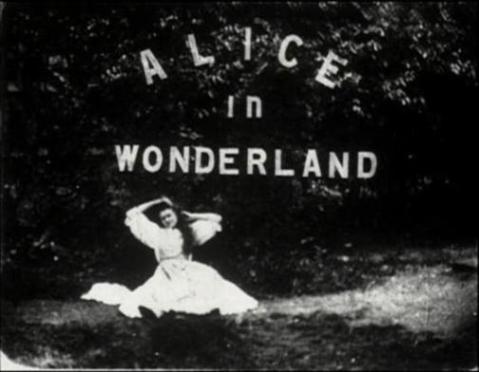
Short Film Saturday: Alice in Wonderland

If you saw the new Alice in Wonderland and absolutely could not stand it then this may be the antidote:

The first adaptation of the story on film in the world has recently been restored by the British Film Institute, BFI. It was recently posted on their YouTube page.

This is just some of the amazing and important work that film institutes do and this short encapsulates the magic of cinema. These images shot nearly 109 years ago can still be seen today in a world, especially the film world, these makers could never have imagined.

Here is more information about this particular version of the film from the YouTube description:

“The first-ever film version of Lewis Carroll’s tale has recently been restored by the BFI National Archive from severely damaged materials. Made just 37 years after Lewis Carroll wrote his novel and eight years after the birth of cinema, the adaptation was directed by Cecil Hepworth and Percy Stow, and was based on Sir John Tenniel’s original illustrations. In an act that was to echo more than 100 years later, Hepworth cast his wife as the Red Queen, and he himself appears as the Frog Footman. Even the Cheshire cat is played by a family pet. With a running time of just 12 minutes (8 of which survive), Alice in Wonderland was the longest film produced in England at that time. Film archivists have been able to restore the film’s original colors for the first time in over 100 years.”