The Problems of Limiting Foreign Film Submissions (Part 1 of 2)

In my previous post, I wrote about how I would propose to alter the Foreign Language Film submission process. I am working backwards as now, in this post, I will address, with a little more support to back up my own hypotheses the issues that would be addressed if you were to allow select countries multiple submissions.

Essentially, the goal is as follows:

If you are a nation like France or Italy with a long and rich cinematic tradition, the selection process can prove volatile and complex. France, for example, submitted Of Gods and Men a few years ago. Its being snubbed, while an Algerian film with a similar subject, Outside the Law, making the shortlist caused quite a furor. Now, this is not to say that France being given more submissions would’ve gotten it to the shortlist, but being limited to one film invariably creates questions and doubts. Both nations made films about the colonial era, one was chosen and one wasn’t. Aside from the complaints about which nation a production really pertains to, it’s messy. Just search debates about selections and you will find trades reporting on them annually.

Now, I will grant that a multiple submission policy is altruism, and being realistic these things would likely still have happened but if France were afforded a handful of submissions, these incidents would likely have been lessened.
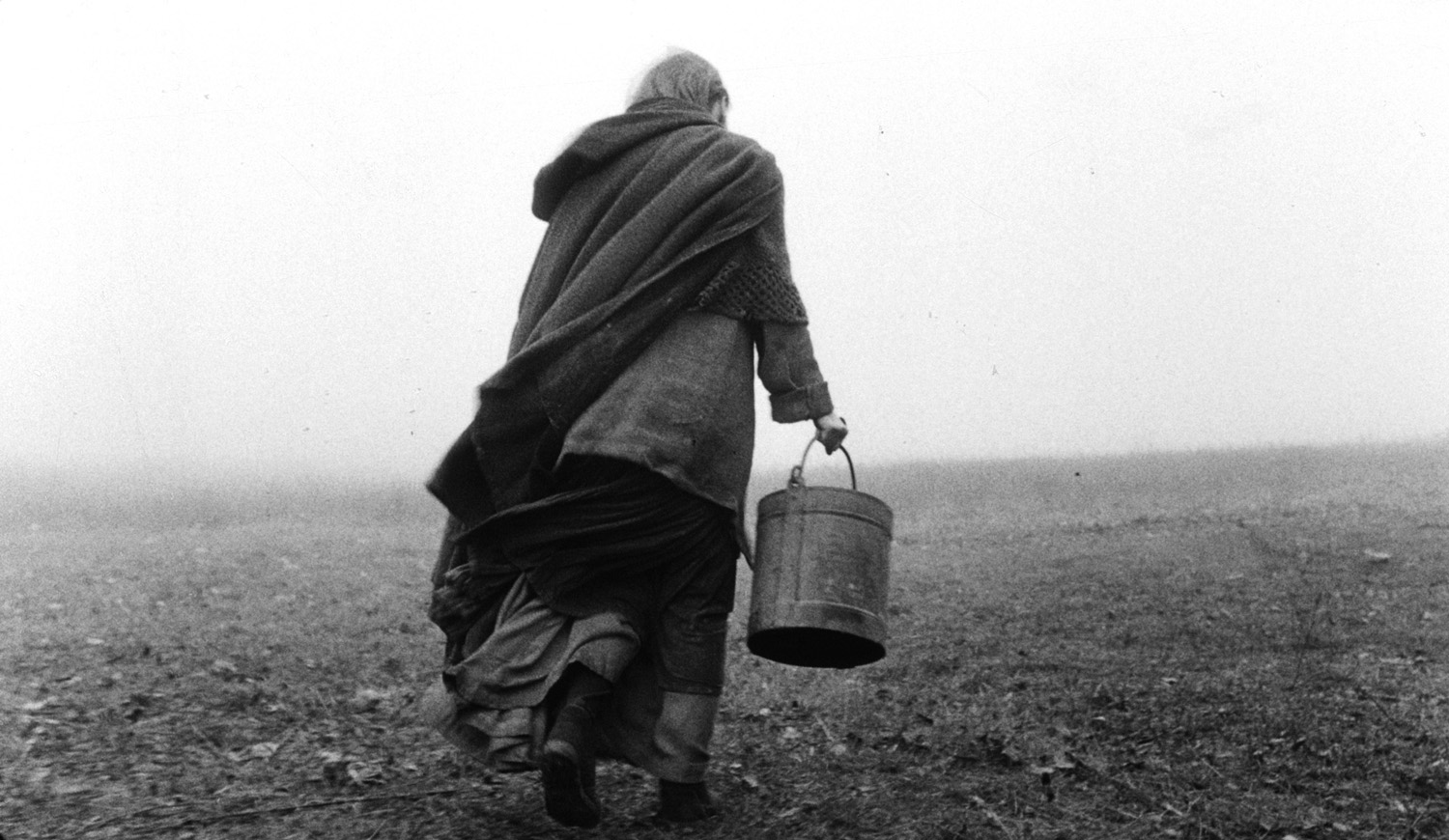
Erika Bók in The Turin Horse (Cinema Guild)

Taking any political extremism out of the equation, multiple nominees for some countries would also make some nations more inclined to take a chance. When Hungary submitted The Turin Horse last year, it was speculated in trades to have a slim chance due to the composition of the viewership and the nature of the film, and sure enough it wasn’t shortlisted. Not that Hungary has been especially prolific lately, and their last nomination was in 1988, but it’s a good example of a country that could’ve used an extra spot to pick what it thought was the best artistic choice and then gamble on a popular pick and/or one likely to find favor with American viewers.

Greece’s selection of Dogtooth a few years ago was seen as some as being silly, almost frivolous. Just it being described as gutsy made me want to see it. They were lucky in actually earning a nomination. I enjoyed it, but was equally surprised by its selection once I saw it.

With just one film allotted per country, as fair as that may seem, too many ulterior factors come into play besides is this really the best film, and some of the factors I suspected were echoed by others I asked. Other factors I hadn’t considered, that can be found mirrored in American films jockeying for Oscar nominations, also came to the fore.

The questions I typically asked were as follows:

At times, does the reputation, or lack thereof, of a director influence the selection?

At times, does politics, whether real or film, play a part?

At times, do films more likely to impress Oscar voters get selected over more artistic films?

Did you see (Title of film submitted by your country)?

If you saw it, did you like it?

Why do you think (Name of country) selected (Title of Film) Deserved it? Oscar-Friendliness? Both? Neither?

Here are some of the findings from Brazilians I asked, more nations will follow in the next part.

Brazil

With regards to Brazil, this is the nation where I will have the widest range of opinions. Aside from being a dual citizen, a majority of my family lives in Brazil so I was able to receive the highest number of responses here also.

When The Hollywood Reporter wrote-up the announcement they correctly cited O Palhaço (The Clown) as a domestic box-office success. Over 1.4 million tickets sold. That’s accurate, as ticket sales are the measure (especially for domestic films) and in Brazil that’s a fairly high total. I take no issue at face value with sending the domestic box office champion as your nominee. There are stories like wins for domestic films in Spain and Norway that are most definitely positives. Hollywood proliferates globally and for indigenous cinemas to be successful at home is very important.
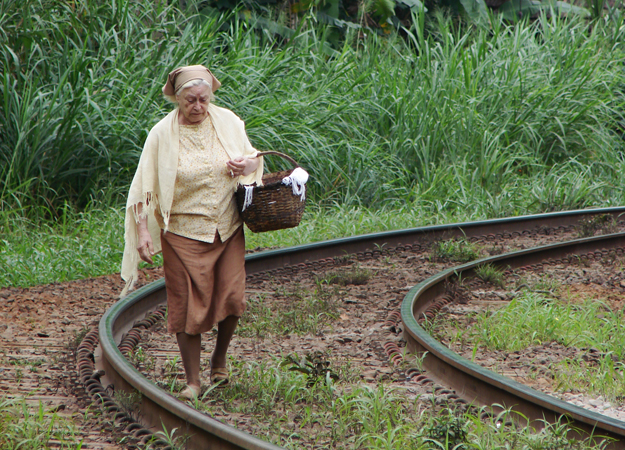
The complications of selecting the box-office champion of the year arise when you have mixed reactions to the film in general. First, I will recuse myself from weighing in on the film itself (O Palhaço) as I have yet to see it. However, I admit I was a bit surprised by this choice as I had yet to hear of it. I saw one Brazilian title this year, which I thought was great, and heard of another one. Both made a decent splash either on the festival circuit or in the international market. With regards to the plot when I read of it, it seemed like a less actually political selection, but did entertainment politics factor? What besides the box office could’ve influenced this selection?
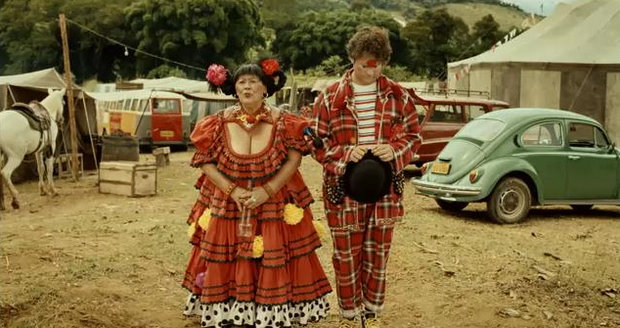
So what did my family and friends say in response to my inquiries regarding O Palhaço? They start off about as negative as a film receiving such an honor can get: “My husband saw it and thought it was horrible! According to him the movie must’ve been picked for a lack of options!” The lack of options isn’t something that’s necessarily supportable by empirical evidence. In 2012 two films either solely produced or co-produced by Brazil appeared in Berlin, 5 films either solely produced or co-produced appeared in the Cannes programs and 2 either solely or co-produced appeared at Sundance, so there were other Brazilian films with festival pedigree. Not to mention the fact, that having eligible films doesn’t always lead to a submission, as was evidenced by Luxembourg passing.

As I got more and more comments, the initial reaction that people were “Sharply divided” proved true. However, in Brazil’s case one of my suppositions seems to have played out, and that’s the reputation of the director. With O Palhaço the director is lead actor Selton Melo. It’s a passion project, those with negative views of the film argue it’s a “commercial for him.” So box office appeal and the fact that a respected actor took on a project does buoy the Oscar hopes of this film, and even those who like Melo fell on the side of those less than enthused by the film, and some even underwhelmed by this particular turn. However, Melo’s status only seems to be growing in Brazil, as he is also taking on a Brazilian-produced HBO series.

The clout, or lack thereof, of some distributors within Brazil was also reported to me as a factor that could keep more deserving films from being considered. This seems not too foreign when anyone who pays attention to Oscar races here knows how much money is involved in campaigning, and how certain directors, producers, and studio heads become favorites. It was also indicated to me that candidacy for the Brazilian submission may not be a cheap thing to make yourself eligible for, which wouldn’t surprise me either, but that is an issue that filters down to the national level and is beyond the purview of the Academy or any foreign body. However, the fact remains that many would attribute most submissions as being decisions that disregard aesthetics and if the film also happens to be good it’s a bonus, but it’s a powerplay. One response pronounced all that quite explicitly and even concluded in English stating “It’s all about business!”

Perhaps the most intriguing response I got was the one that indicated it’d be impossible to remove politics entirely since you’re asking countries to submit films, and I will grant that. It’s practically impossible to expunge when other productions and/or world events will cause protests. The nation submitting likely consciously or unconsciously affects voters, even if its just that a certain viewer has more of an affinity with one national cinema or another. What the ultimate goal of this plan, that I admit will likely never, ever occur, is to encourage more risk from national film governing bodies. Perhaps that encouragement would lead to more aesthetically forward choices that will get rewarded by the votership, or better yet bring the film to new audiences.

Now, according to my idealistic designs, Brazil as a prior multiple-nominee would receive three submissions. If that were the case, perhaps they’d be so inspired to take a chance on one of the remaining selections on something a little more free of influence. To paraphrase John Lennon, I may be dreaming but I know I’m not alone in hoping something like that would occur.


How The Foreign Language Film Submission Process Could Change

Earlier this year, but before the Academy Award cermonies, I wrote about how the Best Foreign Language Film submission process works and how I think it should change. Now, in proposing changes I was vague but made the point that the system is kind of broke and needs fixing.

To further examine this hypothesis this Oscar year, I will write two pieces. In this one, I’ll propose specifics and examine logistics of the proposed changes. Now, the main tenet of my argument is that some countries should be afforded additional submissions. Those additional submissions I believe should be awarded on a merit-based system. Again, this goes back vaguely to a FIFA-inspired system. The allocation of spots for each continent in the World Cup is partially influenced by size of the continent, but is more influenced by past results.

So with each echelon achieved more submissions will be afforded. The system will explain itself as it goes.

Here is a breakdown of the Oscar histories of the nations who have submitted a film for consideration in this year’s awards:

0 Nominations (32 Nations)

Aghanistan
Albania
Armenia
Azerbaijan
Bangladesh
Bulgaria
Chile
Colombia
Croatia
Dominican Republic
Estonia
Greenland
Iceland
Indonesia
Kenya
Kygyrzstan
Latvia
Lithuania
Malaysia
Morocco
Phillipines
Portugal
Romania
Serbia
Singaporean
Slovak Republic
Slovenia
South Korea
Thailand
Turkey
Ukraine
Uruguay
Venezuela

Nominated (7 Nations)

Finland
Georgia
Kazakhstan
Macedonia
Palestine
Peru
Vietnam

Multiple Nominations (8 Nations)

Israel (10 Nominations)
Poland (9 Nominations)
Mexico (9 Nominations)
Belgium (6 Nominations)
Greece (5 Nominations)
Brazil (4 Nominations)
Norway (4 Nominations)
India (3 Nominations)
China (2 Nominations)
Hong Kong (2 Nominations)

1 Win (9 Nations)

Algeria (Z)
Austria (38 – Vienna Before the Fall; One Additional Nomination)
Bosnia (No Man’s Land)
Canada (The Barbarian Invasions; 5 Additional Nominations)
Czech Republic (Kolya – 2 wins and 3 nominations as Czechoslovakia)
Hungary (Mephisto; 7 Additional Nominations)
Germany (The Tin Drum; 7 Additional Nominations)
Japan (Departures; 11 Additional Nominations; 3 Honorary Awards Prior to Inception of Category)
South Africa (Tsotsi; 1 Additional Nomination)
Taiwan (Crouching Tiger, Hidden Dragon; 2 Additional Nominations)

2 Wins (2 Nations)

Argentina (The Secret in their Eyes, The Official Story; 2 Additional Nominations)
Switzerland (Journey of Hope, First Love; 3 Additional Nominations)

3 Wins (4 Nations)

Denmark (Babette’s Feast, Pelle the Conqueror, In a Better World; 5 Additional Nominations)
Netherlands (Assault, Character, Antonia’s Line; 4 Additional Nominations)
Spain (The Sea Inside, All About My Mother, La Belle Epoque; 15 Additional Nominations)
Sweden (Fanny & Alexander, Through a Glass Darkly, The Virgin Spring, 10 Additional Nominations)

9 Wins

France (My Uncle, Black Orpheus [Brazilian story/Portuguese dialogue, French production], Sundays at Cybele, A Man and a Woman, The Discreet Charm of the Bourgeouisie, Day For Night, Madame Rosa, Get Out Your Handekerchiefs, Indochine, 25 Additional Nominations, Three Honorary Awards Prior to Inception of Category)

10 Wins

Italy

La Stada, Nights of Cabiria, 8 1/2, Yesterday, Today and Tomorrow; Investigation of a Citizen Above Suspicion; The Garden of Finzi Continis; Amarcord; The Legend of the Holy Drinker; Mediterraneo; Life is Beautiful; 19 Additional Nominations; 3 Honorary Awards Before the Inception of the Category)

Russia (Since fall of Communism)

4 Nominations; 1 Win

USSR

6 Nominations; 3 Wins

Totals: 4 wins, 10 Nominations

Quotas

With all that information, here is the breakdown of how I would award submissions.

Nation with No Nominations– 1 Film
Nation with a Nomination– 2 Films
Nation with Multiple Nominations– 3 Films
Nation with a Win– 4 Films
Nation with Multiple Wins– 5 Films

Now, history provides a few quirks, and being fundamentally a progressive, I will choose not to carry over wins and nominations from prior nations to current ones. Therefore, Russia is awarded their quota of films based on Russia’s submission history and is not buoyed by the USSR’s wins. The same goes for The Czech Republic and Slovakia.

The Continental Divide

With those statistics in mind, and keeping in mind my proposal that more viewers be brought into the selection process and be divvied up by region, here is an example of the viewing load that each section would have to take on. Now, I have also sub-divided Europe owing to the fact that there are many nominated and winning countries in the continent. This was also done to try to equalize the viewings among groups.

North America (4 Submitting Nations)

Canada
Greenland
Mexico
Dominican Republic

The screening load based on Canada winning and Mexico having multiple nominations with this group would be 9 films.

South America (7 submitting nations)

Chile
Colombia
Brazil
Argentina
Uruguay
Peru
Venezuela

If Brazil as a multiple nominee was allowed 3 films, Argentina as a multiple-winner was allowed 5, and Peru as a past nominee was allowed 2; the South American viewing group would still only be seeing 12 total films.

Africa

Algeria (4)
South Africa (4)
Kenya

Africa’s viewing group would screen 9 films.

Oceania

Austalia
Indonesia
Philippines
Taiwan
Hong Kong
Malaysia
Singapore

This viewing group would have 7 films.

Asia

Afghanistan
Armenia
Azerbaijan
Bangladesh
India (3)
Cambodia
Japan (3)
Georgia (2)
Israel (3)
Palestine
Kazakstan
Kyrgyzstan
Thailand
Turkey
Vietnam (2)

This group would view 23 films.

Europe

Albania
Austria (4)
Belgium (3)
Bosnia & Herzegovina (4)
Croatia
Czech Republic (4)
Denmark (5)
Estonia
Finland (2)
France (5)
Germany (4)
Greece (4)
Hungary (3)
Iceland
Italy (5)
Latvia
Lithuania
Macedonia (3)
Netherlands (5)
Norway (3)
Poland (3)
Portugal
Romania
Russia (4)
Serbia
Slovak Republic
Slovenia
Spain (5)
Sweden (5)
Switzerland (4)
Ukraine

75 Films maximum from Europe.

To alleviate viewer load geographical subdivisions would be necessary.

Scandanavia & Benelux (Sweden, Norway, Norway, Denmark, Belgium, Netherlands, Luxembourg)- 19 Films

Eastern Europe (Poland, Hungary, Serbia, Macedonia, Albania, Greece, Croatia, Romania, Ukraine, Lithuania, Latvia, Estonia, Bosnia & Herzogovina, Slovenia)- 21 films

Western Europe (France, Spain, Portugal, Switzerland, Iceland)- 16 Films

Central Europe (Germany, Austria, Italy, Czech Republic, Slovak Republic)- 19 films

Closing Findings

In spite of giving many nations additional submissions, the increase of films is not quite as drastic as expected. The 2012 submissions, if countries maximized their quotas, would be 125 as opposed 71. I fully expected to double the field.

I’d revamp the initial and final round scoring system. Films scoring above a 7.5 would be eligible for the next phase, and I’d also increase the scoring scale from 7 to 10 to 1 to 10. Only the highest scoring film from each nation with multiple submissions would be eligible for the next phase.

Let’s assume 2/3 of the field beats the score threshold, meaning about 83 films. Then assume that half those films are eliminated as multiples, you’re at 41 or 42 after the first phase.

At this point, I’d carry over the scores and have the remaining films screened for those who had not yet seen them. Scores could then be tabulated for the remaining candidates, and the shortlist would be determined.

Once the shortlist is determined, screeners go out the membership votes, and the nominees are decided based on that.

Conclusion

Is this system perfect? No, and there could be tweaks to the quotas and viewership logistics I’m sure I’m not considering. However, increasing the number for some countries above one can alleviate many issues in the selection process within those individual nations. What problems are those? I’ll get some support for my hypotheses regarding that in tomorrow’s post.

Thankful For World Cinema: Simon and the Oaks

The Foreign Award Struggle

I touched upon this a while back when writing about Spud, and that is the marketing of films from around the world hits a pothole when trying to cite foreign film awards that American viewers as a whole are not familiar with. Invariably a national film award, whether it be from South Africa, Denmark, Belgium, Sweden, or almost anywhere else (Those are just the nations I recall seeing with this distinction), will have their award name cited and then in parenthesis it will say “The Swedish Oscar,” or whatever the country it would happen to be.

I’ve been in theaters where this connotation has gotten a chuckle and I find that to be a very narrow-minded thing to do. I will grant that some national cinemas are just more prolific than others so some of these national awards may have more clout than others, but the fact remains that when I see films that have virtual sweeps in terms of nominations, and then you pair that with the fact that it wasn’t even the film submitted to the Oscars from a given country, that will make me take notice.

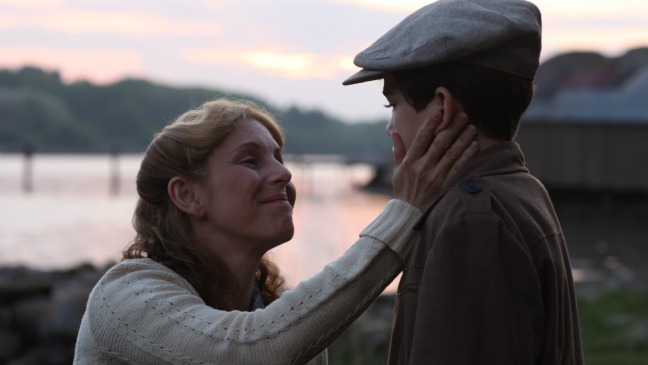
Which brings me to Simon and the Oaks. When I was last in New York, I was about to see Robot & Frank at the Paris Theater and I saw a synopsis. It seemed quite intriguing. The Paris being an independent theater usually only screens trailers for what they’ll soon be showing, and, sure enough, a trailer for Simon and the Oaks came on. The trailer made the film seem even more interesting than the synopsis did and what really stuck with me was that it was nominated for 13 Guldbagge Awards, the Swedish national film award (let’s avoid the O-word for propriety’s sake).

As I alluded to earlier, that’s nothing to sneeze at especially coming out of Sweden. Now, I won’t completely play the naive neophyte, I’m sure if you were to talk to connoisseurs of specific national cinemas they’d tell you that their awards have their tendencies and trends just like ours, but as I said I had already been sold on the film the awards were an additional curiosity. Then add the fact that it had been passed over as Sweden’s Official selection in favor of Lasse Hallström’s latest and I was further intrigued. Adding to the equation was the fact that it was picked up by the Film Arcade. I always am supportive of new players entering the distribution game, and their other acquisition thus far is The Other Dream Team, a doc about the 1992 Lithuanian Olympic Basketball Team, which also seems interesting.

Simon and the Oaks

So, external factors aside, how is Simon and the Oaks? It is very good and engaging indeed. Perhaps the most fascinating thing about the film is the changes to the expected path it gives you. It sets itself up as an outsider’s, observer’s tale that as its child protagonist grows becomes more the focus and more central to the thematic conflicts than we were led to believe at the beginning of the film.

It further surprises by setting up well-crafted, well-written situations about World War II that while not all that unique are captivating. Then about midway through there’s a crucial revelation that really sends the structure of the film for a loop in a good way and subjugates the external struggles and factors, and makes the tale a far more internal one than was ever expected. The performances are strong through the whole cast.

Not only that but there are very interesting mirrored family dynamics that intertwine. The only real uneasy patch is right after the temporal shift, but things still sort themselves out. The film moves well enough such that it could’ve taken a bit more time to transition, but this is truly a minor quibble.

I’m a big stickler for the moment in which a film decides to end its narrative, and this film selects the perfect moment and does so with perfect symmetry and poetry. It’s a film that does well to underscore the fact that there are many films out in the global market that can find an audience in the states, and I’m glad to have gotten to see this one.

The Evolution of War of the Buttons

Typically, when preparing a new version of a work the first thing that needs to be addressed is what will be different from the last time this film, play or whatever the case may be. This is not dissimilar from the approach one must take when transferring a book to film. In remaking a film, whether the changes be large or small, there should be a goal in mind.

I have not seen the 1961 version of War of the Buttons, but barring few exceptions, it’s safe to assume that the first adaptation of a tale is usually the closest to the original. The first, and only, English-language version came in 1994. The obvious changes, of course, being not only of language but of locale. The tale moves from France to Ireland.

In the third rendition of the tale, released in France last year and the United States this year, the change is a temporal one, which also greatly affects the allegorical potency of the tale.

The tale of two clans of kids in rival towns is transplanted to the south of France during the second World War. As much as possible, and as kids tend to do, they take things in stride and adapt to their reality such that this war of buttons becomes extremely important, as futile as it seems. I can see the ease of criticizing this move, but to me framing this condemnation of warfare, and the nature thereof, amidst the biggest battle ever fought is perfect. It facilitates, and minimizes, the machinations and melodramatic over-elaboration of the shift from enemy to ally among the kids because they all realize much more important things are afoot.

Taking the narrow view you can find it insulting or minimizing to compare the two in any way, but I see that as the narrow view, because the point really is that there’s no reason for the fight. At their core, the children in the neighboring town are the same as those we meet first. The same assertion can be made of any war. We’re all human underneath it all, so why fight?

This may also seem like an easy shortcut to pathos, but it’s not really. Stories about the war abound, and situational empathy will only get you so far, there has to be investment in the antagonists and protagonists and their battle for it to matter. Not only that but this film builds in the first love plot, as well as a rekindled adult romance. Due to the fact that there are many well-developed threads, I should’ve expected all the compulsory elements of the story having already seen a rendition of it prior, but it seems more fresh and not only that they literally were more organic.

In miniscule points, are there imperfections to the film, as well as areas where it could be better? Of course, but in narrative functionality and effectiveness, the areas where it matters the most; it excels greatly.

Thankful for World Cinema: Bergman Island

This Criterion collection offering pieces together three Swedish television interviews with internationally renowned writer/director Ingmar Bergman that originally hit their airwaves in 2004. This re-edited version, with cutaways and a feature structure, premiered in 2006.

The interview flows naturally with rarely a question heard. It starts with Bergman recapping his childhood and then goes through his career, spending much time on his early days breaking in, and then the rest of it is told chronologically. Then towards the end we hear his thoughts on life and death.

The discussion on the films is enhanced greatly by cutting in clips from some of his most famous films, or other dialogue to support what he is saying. What you get in this film is a rare look at a filmmaker who didn’t interview much, and this was the last one, but it was also not overly-manipulated. He stops, restarts, stumbles, rubs his eyes in discomfort; the master filmmaker, always in control, is very human here.

You learn quite a bit in this film both about Bergman as a man, and about life in general, but not necessarily anything new on film, which is fine. Like all of Bergman’s tales, this too is personal.

To delve too far into the details divulged in this film would be to do it a disservice. It is the perfect companion piece to your library and a wonderful coda to a life and a career, even more so when you take into consideration the titles at the end of the film. It adds a certainty, sadness, finality and a feeling of bittersweet farewell to the proceedings, and gives you the sense that the director who spent a career and lifetime trying to sort his beliefs was at peace in the end.

For any fan of Bergman or of film, this is a must have it can be purchased either as a single disc edition or as a supplementary bonus feature on the new edition of The Seventh Seal.

10/10

Thankful for World Cinema: The Complete Metropolis (2010)

The first thing that needs saying is that there are conventions that need to be acknowledged if you are going to venture out and watch this or any silent film. Silent film acting, for example, is by its very nature more demonstrative and over-the-top than even the presentational style that dominated after the advent of sound, and most definitely can cause culture shock to those who are used to film actors of the Post-Brando world. It has to be taken as a given.

Some silent actors are clearly better than others but the style can’t be held against the film, it is what it is. While saying that Brigitte Helm is quite good in this film, she may go a little too far when she’s playing the evil robotic alter ego of her character but she is clearly two different people in those scenes. Gustav Fröhlich is an effective lead who portrays the audience’s POV aptly.

The image quality is superb for a bulk of the film, meaning the portions we already knew existed. They look as crisp and clear as they likely did in 1927, perhaps even better. While the transferred 16mm footage doesn’t look quite that good with many lines, which have been dulled and are nearly translucent running through it, they are without question an invaluable addition to the narrative.

Not only did the restorers fully explain the story of the footage’s discovery and how it was added back to the cut they also noted that the image size would change to keep less than knowledgeable patrons from complaining. Better yet they had some fun with the titles. Not only did they digitally create newer, more accurate ones, they added motion to those which referred to the workers underground and the elite up above the city.

The restoration of the original score, as best as it could be replicated, is also a welcome and brilliant touch. The end credits acknowledge the fact that some pieces of the music had to be created by educated guess and rarely could you tell. It was pretty seamless, and, moreover, the impact of the film is enhanced twenty-fold. Typically on DVD releases, especially the cheaper ones, which is how I was accustomed to seeing Metropolis; you get stock, canned, jazzy nonsense that rarely if ever really syncs. You can almost imagine the producers of said DVD sitting around picking a track because it synced in one spot. The score is breathtaking and absolutely draws you into the tale, if all else should fail.

While you should be forewarned that all we know should be in this film isn’t, as there are titles describing the rare scene that could not be saved or found. You will witness here, in greater fullness than ever before, the enormity and vastness of Lang’s vision. His vistas come through and the added running time gives this seemingly simple through-line the time to make the impact it seeks to make. It is, if you dig deep enough, a more complex and involved visual narrative than many may give it credit for. While we today will not be jarred by the seemingly contrasting styles of the sub-plots; there is a grab bag of visual elements worth exploring.

For a modern audience the message of the film, which is repeated on quite a few occasions, may seem a little heavy-handed, again I warn you that it must be taken with a grain of salt. Think of other silents you know and enjoy and consider if they too aren’t very on the head. You know exactly what the message of The Immigrant and The Kid are but they work anyway. Typically, you are told someone’s profession or that they are the hero before you see them, which is also less cinematic than desirable but the language of film was new and it was important to be simple and direct. It bears noting that Metropolis is not overly-laden with titles and it just works.

Seeing this new cut of Metropolis will not be like watching a regurgitated version of something you’ve seen before. It will be like a whole new experience. Not only do you see it on the big screen but you see it sharper and more clearly than you’ve likely ever seen it before. It really is like the saying goes; see it again for the first time.

10/10

Thankful for World Cinema: Summer Hours

Summer Hours is the latest film from acclaimed French filmmaker Olivier Assayas, probably most well-known for his film Irma Vep. This film examines a family dealing with the death of its matriarch. While this is a film that does have its occasional moments of clarity and near-brilliance, it is usually too distracted by its own subterfuge to make any real emotional impact on the audience.

The film opens up well enough with the matriarch Hélène’s 75th birthday party. Here we meet the rest of the family who have been scattered about the world. There is Adrienne, played admirably by Juliette Binoche, who is a designer in New York and Jérémie Renier, who works for Puma in China. Lastly, there is Frédéric (Charles Berling) an economist and family man who lives closest. In the beginning, we see each of the characters get sketched and it is intriguing. There are wonderful scenes both between Berling and Hélène (Edith Scob), when she first mentions the need for him to manage her estate when the time comes which he doesn’t want to hear, and Binoche and Scob when they talk about the tea service is even better and is played with great nuance and subdued emotion and longing by both.

After each Berling and Binoche have their breakdowns, one total and one restrained, the building of character comes to a near stand-still in some ways the narrative comes to a near stop as well. While there were the occasional discussions of an object to mask meaning and emotion in the beginning the dropping of names of painters, china makers, furniture artisans and the like becomes so incessant the people nearly get lost and it ends up feeling almost like an episode of Cash in the Attic.

There is one very heated exchange and then all the characters retreat into their own corner and go about doing their own thing and finding their own way to cope. Which would not be a negative if not for two things: the film was sold as a highly combustible drama in the trailer not a subdued one but more importantly, again the nuance would be more pronounced, more delicate and easier to appreciate if not for all the name-dropping. The scenes where the maid Éloïse (Isabelle Sadoyan) come back to get her item and leave her missus flowers are rather moving.

Ultimately, it is a film worth watching. The façade of objects and materialism is quite a subjective thing. Some enjoy it for just that reason. See for yourself and decide what you think. Those who appreciate good acting will definitely enjoy the film for that time alone.

6/10

Thankful for World Cinema: The Girl on the Train

The Girl on the Train, the latest film from French auteur André Téchiné perhaps most well known for his film Wild Reeds, examines the ramifications of the allegations by a girl who claims she was the victim of an anti-Semitic attack. Note: this review may contain spoilers.

The film is interesting in how it structures itself. It sets itself up in two parts. Part one is called “Circumstances” and part two is called “Consequences.” As expected, they each examine both what lead to the attack and what happened afterwards as a result of it. Sectioned films are not uncommon and it would be an interesting case study for film students to show that you can build your story in a very rococo fashion, as Rohmer did at times did, and still make it intriguing.

The Consequences section is very focused and really only shows the impact on Jeanne (Émilie Dequenne) and her mother (Catherine Deneuve). There is an overheard media report and they receive a letter from the president, and an interview. However, you don’t really feel the frenzy as much as you might think because they go into hiding and then to an acquaintance’s country house. So there are both positives and negatives to the singular focus.

Unfortunately, this is one of those films whose logline tells you the midpoint of the story, as does the synopsis. So if you go in as a blank slate you’re fine, otherwise you’ll wait a bit.

A shortcoming of this film is that once the twist is unveiled it truly doesn’t attempt to examine Jeanne’s psyche and see why and for what cause she did what she did. It’s kind of like burying the lead, or as Ebert wrote in his opinion of Artificial Intelligence: A.I. (which I disagree with) that it missed the story. We see someone who did what they did, show no real remorse and then eventually confess, apologize and it’s over. What have we really learned? Not enough, if anything.

While the film struggles a bit with pace and scenes where our lead was just skating about could have been truncated if not excised completely there were some good things in the edit. Specifically, the film frequently fades to black putting a cap on a certain portion of the story and allowing you to reflect on it these were rather good more often than not. Towards the end it is not serving the story more often than not.

In the two young leads you get characters you just watch and don’t necessarily identify with that greatly, which is not necessarily a bad thing but it magnifies shortcomings in the execution of the tale. First, there is Franck (Nicolas Duvauchelle) who makes a nuisance of himself until he wins over Jeanne, then falls into very shady business dealings and doesn’t inform her though he makes her an accomplice, then the character we have somewhat followed changes completely and in this regard the film leaves us as spectators and not participants, as opposed to the fades which do the opposite. This is a confused vision in this regard. It should be one or the other.

Catherine Deneuve in this film is just there again. It seems as if it’s been quite some time say since 8 Femmes since she’s been outstanding and not just part of the cast, however, hers, like many foreign filmographies is incomplete stateside.

The Girl on the Train is an interesting albeit flawed film that just missed the mark but still ultimately worth viewing and judging for yourself.

5/10

Thankful for World Cinema: The White Ribbon

The White Ribbon is an incredible film that, if you have read reviews, is most definitely deserving of the resoundingly positive reviews its gotten. It is a film that knows there are never easy answers and trusts its audience to fill in blanks. Of course, this happens more often than not with foreign films but when one is so accustomed to being spoon-fed it is always refreshing when you are invited to engage in the story and try to piece things together and aren’t handed everything.

The cinematography in this film is absolutely stunning. It is in what can only be referred to as glorious black and white, and shows you all the flexibility and the marvels that monochrome can bring to a film whether it be blinding snow, sharp silhouette, haunting chiaroscuro, high contrast and perfect underexposure. The thought of color in this film is quite literally repulsive. It’s the kind of feat that causes the American Society of Cinematographers to essentially say “Union allegiance be damned this is the best work of the year” by awarding it top prize. It informs the film and enhances it and never makes itself the center of attention.

It’s hard to discuss a film of this caliber without lauding a cast whose depth of talent is beyond reproach and whose ability runs so far down the supporting scale that it’s mind-boggling. As the scenes unravel themselves, and you meet the characters, you are consistently left wondering “Who is that?” after particularly well-played scenes. Especially Berghart Klaussner, The Pastor, who is chilling in a Bergmanesque fashion; Leone Benesch who in one scene perfectly plays the impossibly contradictory actions and emotions as indicated by the voice-over narration; Janina Fautz as Erna, the Steward’s daughter, who in the end is the overlooked and in a certain regard the reviled hero; Susanne Lothar as the dependent and taken-advantage-of midwife, and the entire young cast, including Maria-Victoria Dragus and Leonard Proxauf; believe it or not this list could go on.

It is a narrative tapestry that pulls together five narrative strands and slowly but surely you start to see how they all intertwine and how the fates of each family unit affect the other. You ultimately get what director Michael Haneke was in search of which is an examination of the psychological landscape that existed in the children of Germany on the eve of The Great War, the same children who would grow up and bring war to the world again.

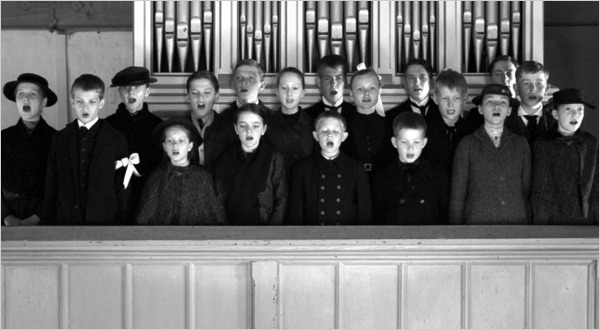
It is a film which seeks to leave its impact through certain minimal elements. For example, there is no score the only music we have are the Baroness and the Tutor rehearsing, and more lastingly there is the once repeated haunting hymn of the children’s choir in the church. The minimal visual treatment exemplifies itself when there is a beating we hear it and sit watching the door. Instead of seeing what goes on behind the closed door, we are haunted by only the sound.

This film is immensely watchable and the kind of tale you can watch unwind for much longer than it does run, which is impressive as it already runs a hefty 144 minutes. Needless to say this film is expertly paced and keeps each strand of the story equally compelling such that you want to keep going to see what happens in one or the other.

The edit both visually and in terms of sound is fantastic. Narratives are juggled deftly and kept in order and there is one audio cut from a piece of farm equipment droning to a pig mid-squeak; the cut is also visual but is especially inspired in terms of sound.

Not only is this a film whose writer, also the director Michael Haneke, juggles many storylines but he does something which seems so much easier for the foreign filmmaker which is to make a film heavily featuring kids which isn’t a kid’s movie but a serious drama. It is also an interesting piece because it sets you up to not get all the answers because you see early on that the narrator doesn’t have many, if any at all, as he has limited omniscience and when he does have an idea he doesn’t push hard enough.

The White Ribbon is not only a great film but an important one. It is one that will cause you to discuss it for quite a bit afterwards and is the latest great work in a very accomplished career for director Michael Haneke. It’s the kind of foreign film that should most definitely be making more of a dent as its appeal is universal and should not be kept to the arthouse set.

10/10

Thankful for World Cinema: Sin Nombre

The film Sin Nombre opens up seeming promising enough. It tells the bound to collide tales of Casper (Edgar Flores) and new La Mara recruit Smiley (Kristian Ferrer) and a group of Honduran refugees featuring Sayra (Paulina Gaitan). With these two seemingly unrelated situations colliding and heading on a race for the American-Mexican border you’d expect a compelling, intelligent and exciting film.

Instead what you end up getting is a transplanted American action film without the pace. All the characters are archetypes and sorely underdeveloped, which is truly sad because Casper and Sayra are aptly played, and the latter is once referred to by a gang member as a young Salma Hayek – a line which could very well turn out to be prophetic. The problem with having only archetypes is that you never get beneath the surface and what you get ends up being superficial. While I could identify with the plight I couldn’t identify with those in the plight. Whereas in City of God, because of how intricately it was told, and how shocking it is, given the circumstances; I could see myself ending up like those characters – a criminal with no other choice. The gang mentality exists and I know that but for compelling drama we need to see why the characters buy into it, only the moment of doubt is clear here. A truly effective film places you in the other situation and doesn’t leave you as a spectator.

The superficiality of character would be forgivable with more pace. However, the film is so languidly told it feels as though it runs three hours, which is nearly twice as long as its actual running time. Going on an epic journey is a major investment on the audience’s part and it would be easier to take if I knew better with whom I was going.

Backstory is sadly lacking as we never quite understand why Sayra is on this pilgrammage and what exactly separated her from her family. There is discussion of deportation and a death but we never learn who she is as a person. Her attraction to Casper also seems to come quite easily. He slays her attacker and she seems to say “My hero,” but it just seems too facile. Almost instantly she says she trusts him and “as long as I’m with you I’m fine.” Why him, and not your uncle and father you ditched?

There is just too much that we are left to accept, which is different than being spoon-fed. An audience will figure things out but some things require exposition as little as a filmmaker may like to admit the fact.

When there is not enough development of character there is only so far a story can go. There is laughter without joy, shock but no loss, suspense but no fear, and worse – a film without engagement.

4/10