Thankful for World Cinema: Summer Hours

Summer Hours is the latest film from acclaimed French filmmaker Olivier Assayas, probably most well-known for his film Irma Vep. This film examines a family dealing with the death of its matriarch. While this is a film that does have its occasional moments of clarity and near-brilliance, it is usually too distracted by its own subterfuge to make any real emotional impact on the audience.

The film opens up well enough with the matriarch Hélène’s 75th birthday party. Here we meet the rest of the family who have been scattered about the world. There is Adrienne, played admirably by Juliette Binoche, who is a designer in New York and Jérémie Renier, who works for Puma in China. Lastly, there is Frédéric (Charles Berling) an economist and family man who lives closest. In the beginning, we see each of the characters get sketched and it is intriguing. There are wonderful scenes both between Berling and Hélène (Edith Scob), when she first mentions the need for him to manage her estate when the time comes which he doesn’t want to hear, and Binoche and Scob when they talk about the tea service is even better and is played with great nuance and subdued emotion and longing by both.

After each Berling and Binoche have their breakdowns, one total and one restrained, the building of character comes to a near stand-still in some ways the narrative comes to a near stop as well. While there were the occasional discussions of an object to mask meaning and emotion in the beginning the dropping of names of painters, china makers, furniture artisans and the like becomes so incessant the people nearly get lost and it ends up feeling almost like an episode of Cash in the Attic.

There is one very heated exchange and then all the characters retreat into their own corner and go about doing their own thing and finding their own way to cope. Which would not be a negative if not for two things: the film was sold as a highly combustible drama in the trailer not a subdued one but more importantly, again the nuance would be more pronounced, more delicate and easier to appreciate if not for all the name-dropping. The scenes where the maid Éloïse (Isabelle Sadoyan) come back to get her item and leave her missus flowers are rather moving.

Ultimately, it is a film worth watching. The façade of objects and materialism is quite a subjective thing. Some enjoy it for just that reason. See for yourself and decide what you think. Those who appreciate good acting will definitely enjoy the film for that time alone.

6/10

Thankful for World Cinema: The Girl on the Train

The Girl on the Train, the latest film from French auteur André Téchiné perhaps most well known for his film Wild Reeds, examines the ramifications of the allegations by a girl who claims she was the victim of an anti-Semitic attack. Note: this review may contain spoilers.

The film is interesting in how it structures itself. It sets itself up in two parts. Part one is called “Circumstances” and part two is called “Consequences.” As expected, they each examine both what lead to the attack and what happened afterwards as a result of it. Sectioned films are not uncommon and it would be an interesting case study for film students to show that you can build your story in a very rococo fashion, as Rohmer did at times did, and still make it intriguing.

The Consequences section is very focused and really only shows the impact on Jeanne (Émilie Dequenne) and her mother (Catherine Deneuve). There is an overheard media report and they receive a letter from the president, and an interview. However, you don’t really feel the frenzy as much as you might think because they go into hiding and then to an acquaintance’s country house. So there are both positives and negatives to the singular focus.

Unfortunately, this is one of those films whose logline tells you the midpoint of the story, as does the synopsis. So if you go in as a blank slate you’re fine, otherwise you’ll wait a bit.

A shortcoming of this film is that once the twist is unveiled it truly doesn’t attempt to examine Jeanne’s psyche and see why and for what cause she did what she did. It’s kind of like burying the lead, or as Ebert wrote in his opinion of Artificial Intelligence: A.I. (which I disagree with) that it missed the story. We see someone who did what they did, show no real remorse and then eventually confess, apologize and it’s over. What have we really learned? Not enough, if anything.

While the film struggles a bit with pace and scenes where our lead was just skating about could have been truncated if not excised completely there were some good things in the edit. Specifically, the film frequently fades to black putting a cap on a certain portion of the story and allowing you to reflect on it these were rather good more often than not. Towards the end it is not serving the story more often than not.

In the two young leads you get characters you just watch and don’t necessarily identify with that greatly, which is not necessarily a bad thing but it magnifies shortcomings in the execution of the tale. First, there is Franck (Nicolas Duvauchelle) who makes a nuisance of himself until he wins over Jeanne, then falls into very shady business dealings and doesn’t inform her though he makes her an accomplice, then the character we have somewhat followed changes completely and in this regard the film leaves us as spectators and not participants, as opposed to the fades which do the opposite. This is a confused vision in this regard. It should be one or the other.

Catherine Deneuve in this film is just there again. It seems as if it’s been quite some time say since 8 Femmes since she’s been outstanding and not just part of the cast, however, hers, like many foreign filmographies is incomplete stateside.

The Girl on the Train is an interesting albeit flawed film that just missed the mark but still ultimately worth viewing and judging for yourself.

5/10

Thankful for World Cinema: The White Ribbon

The White Ribbon is an incredible film that, if you have read reviews, is most definitely deserving of the resoundingly positive reviews its gotten. It is a film that knows there are never easy answers and trusts its audience to fill in blanks. Of course, this happens more often than not with foreign films but when one is so accustomed to being spoon-fed it is always refreshing when you are invited to engage in the story and try to piece things together and aren’t handed everything.

The cinematography in this film is absolutely stunning. It is in what can only be referred to as glorious black and white, and shows you all the flexibility and the marvels that monochrome can bring to a film whether it be blinding snow, sharp silhouette, haunting chiaroscuro, high contrast and perfect underexposure. The thought of color in this film is quite literally repulsive. It’s the kind of feat that causes the American Society of Cinematographers to essentially say “Union allegiance be damned this is the best work of the year” by awarding it top prize. It informs the film and enhances it and never makes itself the center of attention.

It’s hard to discuss a film of this caliber without lauding a cast whose depth of talent is beyond reproach and whose ability runs so far down the supporting scale that it’s mind-boggling. As the scenes unravel themselves, and you meet the characters, you are consistently left wondering “Who is that?” after particularly well-played scenes. Especially Berghart Klaussner, The Pastor, who is chilling in a Bergmanesque fashion; Leone Benesch who in one scene perfectly plays the impossibly contradictory actions and emotions as indicated by the voice-over narration; Janina Fautz as Erna, the Steward’s daughter, who in the end is the overlooked and in a certain regard the reviled hero; Susanne Lothar as the dependent and taken-advantage-of midwife, and the entire young cast, including Maria-Victoria Dragus and Leonard Proxauf; believe it or not this list could go on.

It is a narrative tapestry that pulls together five narrative strands and slowly but surely you start to see how they all intertwine and how the fates of each family unit affect the other. You ultimately get what director Michael Haneke was in search of which is an examination of the psychological landscape that existed in the children of Germany on the eve of The Great War, the same children who would grow up and bring war to the world again.

It is a film which seeks to leave its impact through certain minimal elements. For example, there is no score the only music we have are the Baroness and the Tutor rehearsing, and more lastingly there is the once repeated haunting hymn of the children’s choir in the church. The minimal visual treatment exemplifies itself when there is a beating we hear it and sit watching the door. Instead of seeing what goes on behind the closed door, we are haunted by only the sound.

This film is immensely watchable and the kind of tale you can watch unwind for much longer than it does run, which is impressive as it already runs a hefty 144 minutes. Needless to say this film is expertly paced and keeps each strand of the story equally compelling such that you want to keep going to see what happens in one or the other.

The edit both visually and in terms of sound is fantastic. Narratives are juggled deftly and kept in order and there is one audio cut from a piece of farm equipment droning to a pig mid-squeak; the cut is also visual but is especially inspired in terms of sound.

Not only is this a film whose writer, also the director Michael Haneke, juggles many storylines but he does something which seems so much easier for the foreign filmmaker which is to make a film heavily featuring kids which isn’t a kid’s movie but a serious drama. It is also an interesting piece because it sets you up to not get all the answers because you see early on that the narrator doesn’t have many, if any at all, as he has limited omniscience and when he does have an idea he doesn’t push hard enough.

The White Ribbon is not only a great film but an important one. It is one that will cause you to discuss it for quite a bit afterwards and is the latest great work in a very accomplished career for director Michael Haneke. It’s the kind of foreign film that should most definitely be making more of a dent as its appeal is universal and should not be kept to the arthouse set.

10/10

Thankful for World Cinema: Sin Nombre

The film Sin Nombre opens up seeming promising enough. It tells the bound to collide tales of Casper (Edgar Flores) and new La Mara recruit Smiley (Kristian Ferrer) and a group of Honduran refugees featuring Sayra (Paulina Gaitan). With these two seemingly unrelated situations colliding and heading on a race for the American-Mexican border you’d expect a compelling, intelligent and exciting film.

Instead what you end up getting is a transplanted American action film without the pace. All the characters are archetypes and sorely underdeveloped, which is truly sad because Casper and Sayra are aptly played, and the latter is once referred to by a gang member as a young Salma Hayek – a line which could very well turn out to be prophetic. The problem with having only archetypes is that you never get beneath the surface and what you get ends up being superficial. While I could identify with the plight I couldn’t identify with those in the plight. Whereas in City of God, because of how intricately it was told, and how shocking it is, given the circumstances; I could see myself ending up like those characters – a criminal with no other choice. The gang mentality exists and I know that but for compelling drama we need to see why the characters buy into it, only the moment of doubt is clear here. A truly effective film places you in the other situation and doesn’t leave you as a spectator.

The superficiality of character would be forgivable with more pace. However, the film is so languidly told it feels as though it runs three hours, which is nearly twice as long as its actual running time. Going on an epic journey is a major investment on the audience’s part and it would be easier to take if I knew better with whom I was going.

Backstory is sadly lacking as we never quite understand why Sayra is on this pilgrammage and what exactly separated her from her family. There is discussion of deportation and a death but we never learn who she is as a person. Her attraction to Casper also seems to come quite easily. He slays her attacker and she seems to say “My hero,” but it just seems too facile. Almost instantly she says she trusts him and “as long as I’m with you I’m fine.” Why him, and not your uncle and father you ditched?

There is just too much that we are left to accept, which is different than being spoon-fed. An audience will figure things out but some things require exposition as little as a filmmaker may like to admit the fact.

When there is not enough development of character there is only so far a story can go. There is laughter without joy, shock but no loss, suspense but no fear, and worse – a film without engagement.

4/10

Thankful for World Cinema: Les Vampires

Louis Feuillade’s classic six hour plus serial Les Vampires had disappeared from DVD for a while, before it recently resurfaced. I was lucky to have purchased this title at Christmas when it was still readily available – it’s now back in full force.

Unfortunately, Feuillade’s films seem to have disappeared from public consciousness long ago and hence the demand for his titles is less, which is why a company like Criterion would be ideal to shed light upon his lost gems. However, in discussing Les Vampires I would like to illustrate his greatness. First, I do not tout the greatness of this film simply because it is aged enough to be a classic. I like neither old things because they’re old nor new things because they’re new.

The timelessness of this tale of Feuillade’s storytelling is in how captivating his plots tend to be. In both Les Vampires and Fantomas you will see some effects that for the time are very impressive but always keep in mind the era in which he worked. Narrative cinema was still in its infancy and audiences were not yet fluent in the language of film so things are overshot: shots are very wide and there are few close-ups. Very few menial movements are cut. For example, if someone enters a building today we would cut right to them arriving at the location in the building where they needed to be, without giving it a second thought. In the oughts and teens, however, audiences needed to see the protagonist in the lobby, getting on the elevator, and reaching his floor or they would be confused. Today such moments are only shot to build tension if needed.

Having said all that, Les Vampires has everything you could possibly want in a narrative sense. The aim is to always leaving you wanting more at the end of each episode and I always did. What was a little unusual in this one is that the cliffhanger wasn’t the end as it was in Fantomas but there was usually a little denouement just before the chapter closed.

However, the elements that kept me riveted and watching two and three installments at a time and the whole thing in less than two days were all there. The story concerns a journalist Philippe Guérande and his sidekick Oscar Mazamette. They are engaged in an epic battle against an organized crime unit of Vampires known simply as Les Vampires.

This story is full of twists, mistaken identity, seemingly unbeatable villains, chases, hiding places, surprises (seriously I was taken aback by the ingenuity of some), it will always leave you guessing; after a while as it seems the kingpin on Les Vampires is a mist that can never be caught.

The acting is superb and seldom, if ever, are you left wondering what a conversation is about for lack of a title. Few things if any are ever introduced solely by titles. The film tells its tale visually. Musidora, who plays Irma Vep, which is now an immortal anagram because she became a worldwide star after this serial, and you can easily see why.

This serial is the definition of classic storytelling, good versus evil battling it out with drama, suspense and excitement building throughout each episode. Each episode does have its own arc, and its own characters on occasion. You can watch them separately and it almost becomes a TV show you just need back-story and you’re good to go to the next episode, except this is so much better. On the version I watched I don’t believe the score is original, packaging usually isn’t good about removing those doubts, but the score does fit most of the time and it’s very good. If you have a chance check out this excellent film. If you haven’t seen Feuilllade’s work be sure to suggest it to Criterion. There is too little of this filmmaking legend’s work available to modern audiences.

Short Film Saturday: Motherland

What’s curious is that both this week’s and next week’s selection are films I encountered when seeking out different films entirely. In the case of this film, I was seeking a comedy called Motherland instead came across this stark, artistic, wide open to interpretation film produced by British fashion designer Ozwald Boateng that I found to be very intriguing.

Thankful for World Cinema: Before Tomorrow

Before Tomorrow is the conclusion of a trilogy of films about the Inuit people being shot in Canada. The first being Fast Runner, which I saw and loved, and The Diary of Knud Rasmussen, which somehow was missed. It is a thematic trilogy, and not a sequential trilogy, following more in the European tradition where it’s variations on a theme and not necessary a contiguous storyline.

The film is both sparse in dialogue and replete with visual wonders. It might seem like a simple task to go up north near the Arctic Circle and get wondrous images and let the vistas do the work but there are frames, compositions and exposures that truly make these shots what they are. The edit also plays into the visual beauty of this film. There are at least three dissolves which are executed with such grace and beauty on both ends it brought to mind a quote by Truffaut where he says “So few directors can gracefully dissolve one shot into another.” This most certainly is not the case here.

There are also two different kinds of shooting here. There are more narrative-based landscape shots as the story gets more and more focused on the Grandmother (Madeline Ivalu) and her grandson (Paul-Dylan Ivalu), yet at the beginning there is quite a bit of handheld documentary-style shooting which is very well-done.

What you get in this film and its predecessors is truly a modern interpretation of Neo-Realism. Non-professional but engaging actors playing parts they understand in minimalist storylines. To relate the entirety of the tale would be entirely too easy within this space and would leave you with no surprises. There are surprises to be had and there are many emotions to be experienced within.

What will be said can be true of all simplistic storytelling, it’s the execution that elevates it, and that’s definitely the case here, yet as stripped-down as the on-screen action is there manage to be stories within the story. The film examines the oral traditions of the tribe and there are frequently stories being asked for and told that either inform or contrast the action we have been witness to.

The film ends as a close to the trilogy because after the tale of this particular installment is told then there is a slow-motion montage of the tribe living. Barring seeing the middle installment this could very well be the most overlooked, under-appreciated and impressive trilogies of the decade.

This is a film that will not cut quickly, that will take its time to develop. Allow it to. There is more than one way to make a film and to make a hyper-kinetic film with a people who are concerned with months and seasons and not so much with minutes and hours would seem wrong.

What you find here is a tidy, simple tale which is well told and as the best cinema does it shows you a world you would otherwise have no access to. It’s a tender and tenderly told tale which has humor, humanity and surprises. It’s a film that truly transports and even only having seen the bookends this was the perfect capper to the trilogy.

10/10

Thankful for World Cinema: North Sea Texas

This past weekend the Belgian Film North Sea Texas opened in New York and Los Angeles. I was fortunate enough to watch this film in July when it screened at Q Fest in Philadelphia. Based on the plot synopsis I had hopes that it would be a good film, what I didn’t expect was for the film to be somewhat groundbreaking in the annals of gay cinema, and, yes, I feel that the way in which the film handles its subject can render it universal. However, the fact remains that it will be pigeonholed as such due to what it’s about. The way in which it’s groundbreaking is startlingly simple: it’s a positive, affirmative film that essentially says love conquers all. Now, on the surface you might think you’ve seen that done a thousand times, and you have for a film about heterosexual romance. It happens less often in gay-themed films, and is even more infrequent in gay-themed films about first love.

Now, cinema, for the most part, has evolved past the point that is excruciatingly illustrated in the documentary The Celluloid Closet, which deals with the depiction of LGBT characters in Hollywood films up to that point. However, film in general, even when titles mean well, are beautifully, sensitively crafted and acted; still gravitate towards the quasi- and flat-out tragic tales when it comes to gay or lesbian protagonists.

This is not being judgmental, these are facts, and it’s a case wherein films are attempting to reflect realities. The examples are plentiful such as: This Special Friendship (Les Amitiés particulières) even being French, and dealing with the specifically named and ridiculed boarding-school romance, this is tragedy. Then you have films that deal with repression like Brokeback Mountain, Far From Heaven or even The Hours.

Then there is the kind of film that I expected this one to end up being like: Wild Reeds (Les Roseaux Sauvages), which is a tale of first romance that is all too typical: best friends one fall for another, there is experimentation but only one feels an emotional attachment because only one of the two is actually gay. It’s a first love deception that is commonplace and fair game for dramas.

However, what North Sea Texas strikes upon, and what makes it work so well and so important is that it’s an idealistic tale. It reminds me of a debate I and a professor had about the Indian film Fire in college. His criticism of the film was that the revelation of, and the familial objection to, a sexual abuse situation was unrealistic. My assertion was “Why should it be?” If you’re trying to make a point be it societal, political or otherwise, there are times when the best way to make it is to seek out an ideal and illustrate it, rather than just illustrating that the problem exists.

Not to say there isn’t drama, conflicts or struggles in North Sea Texas but the resolution to the the dramatic question the film poses is an overwhelmingly positive and beautiful one, made even more powerful because of how rarely it is seen.

It is also an extraordinarily timely one. With equality issues coming to the fore in many countries around the world, principally the United States, it is extremely useful and reassuring to see an illustration of it “getting better” and not merely being told that. Furthermore, this is not merely an assertion I’m making based on my read of the film, but it is also included in the credits where the film is dedicated to the kids whose parents refused to allow them to participate in the making of the film.

North Sea Texas is a wonderfully rendered artistic film that should win over any and all open-minded fans of film, but any film has its target audience and for the audience targeted here there are few films that ever so firmly, staunchly and beautifully espoused its over- and underlying messages. Few films can really said to be of social significance beyond just being a film. This, I believe, is definitely one of them. It may take time, but this film is one that I believe will stand the test of time and become quite a milestone. You may even try to dismiss it as a fairy tale if you want, but that could well be the point. For who doesn’t deserve their happily ever after?

Thankful for World Cinema: The Witman Boys

The Witman Boys is an example of subtlety and nuance building slowly to a crescendo through the entirety of a film. It is a film which doesn’t need sensationalism to convey delinquency or to make it seem palpable, and, in fact, possible. The film begins almost immediately with the boys losing their father. This is an inciting incident if I ever saw one. From thereon out the boys start to question everything and their mother becomes even more distant than it seems she was before.

Erno starts to question his older brother, Janos, about death and their bond becomes solidified. Erno shows a need to follow regardless of where Janos leads him. Incidents build themselves up slowl, and things connect to one another in this film as you watch it. Immediately following their father’s death the boys don’t eat, then they leave the dinner table, and soon they are not home at all. They cruelly interact with animals – first they hear of dissection, witness it, and then perform the act. And so on. Everything is in stages most things following the rule of three at least.

What is most effective about the film is that what is most disturbing is usually never seen, but merely implied. An action is begun but not completed, or done off-screen. This is a film, and a rare one, which realizes that the audience participates and can use its imagination to fill in the blanks. Director Janos Szasz saves his visuals for things that are absolutely necessary and that will shock the audience.

The boys, Szabolcs Gergerly and Alpár Fogarasi, are both quite good but what makes the movie work is a compelling and strong actress as the distant mother, which this film has in Maia Morgenstern. Best known for playing Mary in The Passion of the Christ, she is fantastic in this role and really elevates the films level.

Visually the film is compelling from the beginning. Its simple establishing shots, both day and night of the outside of their house, are enhanced by haze and fog. When they are in the cemetery talking to the owl the scenes are quasi-expressionistic in the wide shots and the scenes in the attic are always luminescent and rich.

The only area where the film really suffers is after Janos meets Irén his obsession with her and his recruitment of Erno to join in the obsession dominated the entire film, to its detriment. The obsession is natural but the pace becomes slowed and things get a little bogged down. The climax seems a little delayed.

Still, overall, it is a very good film that you should see should you have a chance. It is a decent primer for Hungarian cinema – a pretty accessible title that still gives some insight on the culture, philosophy and filmmaking aesthetic of the nation.

8/10

Americanization: How Le Grand Chemin Became Paradise- Le Grand Chemin (Part 3 of 3)

Le Grand chemin

Written and Directed by Jean-Loup Hubert
    

Unlike Paradise, Le Grand chemin takes place in June of 1958. The back drop of the Algerian War will play a role in this film and is a cultural detail that just doesn’t translate to an American version. We open on the much cozier confines of a bus that runs between Nantes and St. Brevin. Louis (Antoine Hubert) is to be left by his mother with her friend Marcelle (Anémone) for three weeks while she waits for her baby to be born. Being that it’s 1958 and post-maternal hospital stays were longer and that anticipated birthdates were a thing of the future this is a much more plausible scenario with which to begin the story. 
    

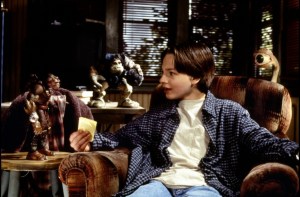
Unfortunately, auteurship isn’t what makes the original better. Both films have auteurs at the helm, Hubert and Donoghue respectively. In the remake’s case the difficulty was in that she was writing an adaptation and transplanting the story from one culture to another. The true auteur of this film is Jean-Loup Hubert who originally wrote this film, spawned from his own imagination. At best Donoghue saw the film and thought it was underappreciated in the States and wanted to bring it to a wider audience. In all likelihood a studio executive bought the rights and hired her to adapt and direct.
    

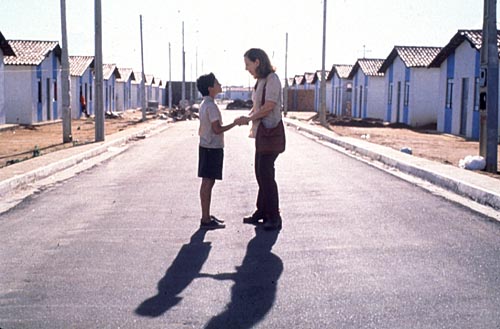
The title of this film has been loosely translated as “The Grand Highway.” While Grand may be kept the same it can also be ‘large’ or ‘great’ but chemin was definitely mistranslated it’s either ‘path’ or ‘track.’ I had learned that chemin was a path but it was clear to me visually that the translation was wrong even if I had no knowledge of French. Hubert frames the street passing under the bus after the driver yells out ‘Le Grand chemin’ obviously making it a metaphor. This is the path that is leading Louis into this couple’s life, a convergence, and it’s also life passing us by. Pello, who was Ben in Paradise, is introduced in much the same way talking bad of the couple and then surprising Louis by being at the house.
 
I take issue with the Billie character in Paradise. In Le Grand chemin she is Martine (Vanessa Guedj) and her character is a lot more rounded and intelligent. She is the grounded realist for having grown up in the country. Martine never doubts that her father walked out on her mother for a younger woman and towards the end of the film her bluntness causes Louis to run away being that he’s a dreamer from the city. While we may even dislike her for some of her actions, like when she shoves civelles down Louis’s shorts as a joke, she is strong and independent and not weak like Billie.
    

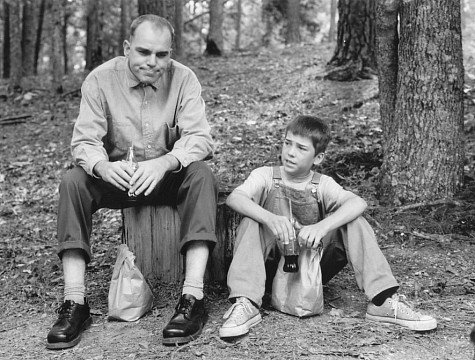
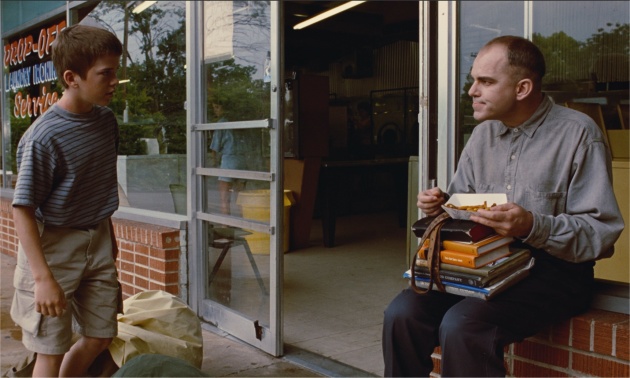
In this film, we see Marcelle knocking a rabbit out cold and skinning it. I’ve already discussed the animal rights concerns this was likely to cause if attempted in the U.S. and the studio was probably unwilling to shoot in another country to do something that may offend the audience. However, there is a purpose to this scene. Louis witnesses it all. This serves to reinforce his bad feeling about the trip which is prevalent at the beginning of this film. While Pello did deceive him, he is the first to earn his trust when Pello winks at him so he’ll pretend it’s their first meeting. In Paradise, Willard was merely afraid to say otherwise and a bond forms later in the film amongst less natural circumstances. 
    

The involvement of the Catholic Church also occurs earlier and more frequently in this film than it does in the American version. Actually, in the classic American tradition of watering everything down the Reeds attend a Protestant church of unknown denomination. In France, there is a greater acceptance of criticism of the Church. In the revolution the Church was under attack and to be abolished, later France was the nexus of the existentialist school of thought in the 20th Century. These interpretations of the Clergy are not necessarily as negative as we may interpret them, but rather an attempt to help humanity cope when they feel religion has failed them. In Le Grand chemin, Hubert frames the priest in a high pulpit above the parishioners. He is speaking of God and the saints and of lofty things and boring everyone to death. Later, when Louis is walking around on the roof and Martine is seeking help he makes jokes about them. All this is saying is that the Church and its clergy have begun to lose touch with the reality of worshippers’ lives. It’s not done in poor taste and it does in the end serve the story. The challenge Martine placed to Louis is that he couldn’t urinate down the gutter which leads out of a gargoyle statue’s mouth. When Louis is missing at the end he is found when a nun gets a “shower.” Now a nun is a human being just like you and me, thus, imperfect and not a religious icon and it escapes the dangerous realm of blasphemy. In Paradise, the preacher is merely a talkative dolt and the challenge is merely a high wire act because I guess Americans don’t urinate until they’re of age. 
 

Another aspect in which the French film excels is in the score. The French score is evocative of childhood whimsy and wonderment as need be. It is touching and extremely moving towards the end and put a great emphasis on the ending. And it highlights the moments of high drama perfectly without overshadowing the action.

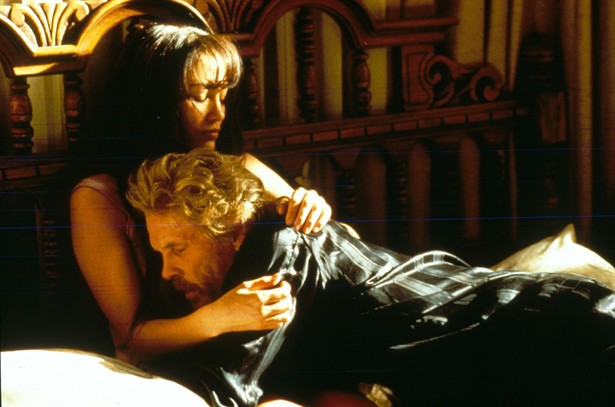
In contrasting the actors ‘The Bedroom Scene’ is where we can most easily draw comparison between how each version of the story was handled. Jean-Loup Hubert frames his actors together with minimal cutting and the tension is so thick it hits home. You hear it almost as if you’re there. Richard Bohringer’s performance as Pello in this scene is absolutely raw, you can see there’s no stopping him, there’s nothing contrived here, no acting – that we can see. Hubert also excels here at writing putting this in a more emotionally vulnerable point in the film.


In Le Grand chemin, we see the following scene unfold: Pello and Louis have just spent a day together. In a very warm and touching shot Louis reaches out and takes Pello’s hand. Shortly after Marcelle arrives worried about whether or not he has eaten. Later she has to go pick Pello up because he’s drunk. Here we see them really butt heads. Because Pello has made a connection with Louis and he’s always been the more forward looking of the two he pushes the issue of Jean-Pierre, their dead child. He misses her as a wife and feels she’s playing the martyr and tries to take her physically. “God won’t help you, let’s do it in the wheelbarrow,” he says. He then chases her into the house and she locks him out of their room. Upon falling to the ground drunk he finds the key to Jean-Pierre’s room. He goes in and starts demolishing it, as he expected Marcelle comes out to stop him and again he attempts to rape her. This is high drama and great conflict. Pello is living in the moment and Marcelle in the past; we see the metaphorical struggle enacted physically. 
    

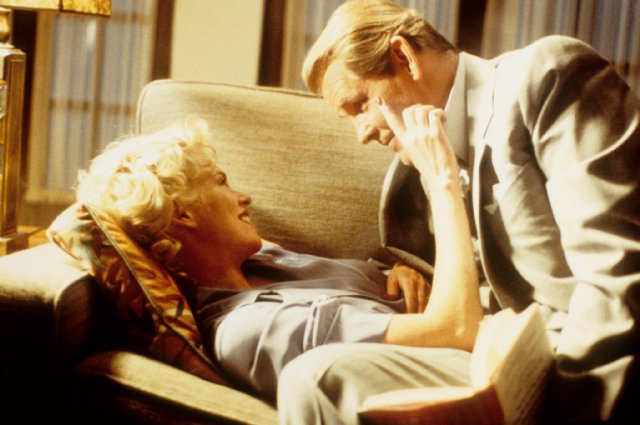
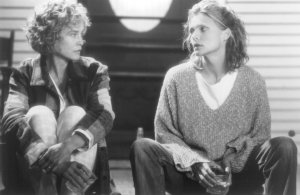
Even if the American film had reached the same amount of drama that the French film was able to they still undercut the tension. In the French film we discovered the room in that scene. In the American we had a sentimental and non-essential wandering into the room by Lily. The woman’s role in this scene is the same in both films; she must be resistant, in fear, fighting back and in hysterical shock at her husband’s actions. Melanie Griffith holds her own but is unable to live up to Anémone’s example. Don Johnson, on the other hand, fails miserably in this scene giving her nothing to work off of. His diction is poor, his tonality is all off and he is scarcely believable. He comes off as a man who may be a jerk but would never be thought of as being that passionate.
 

The French film also makes the connection between Pello and Louis and it’s made in not a more subtle but a better way. In Paradise, all the bonding occurs during a fishing trip both the forming of the friendship and the big question about the dead child. In Le Grand chemin, first Pello shows Louis how to sand by letting him watch how it’s done. Here we also see Pello give Louis a makeshift wagon where he carries around the scrap pieces of wood. This allows a visual representation of the bond they had. When he gets upset near the end we see Louis leave the wagon behind in the shed. Later, we have the fishing trip where they are already friendly and he asks about the baby after a long talk. 
    

What really works well in Le Grand chemin is the story arc. He may not be the most involved character but Louis is the catalyst of this film. In one scene Pello refuses Marcelle’s idea of a bedpan and takes Louis outside to urinate against the wall. He says to him “If you can hit the wall you’re ready for girls,” and in a very humorous turn Louis leans forward trying to hit the wall. The scene begins with Pello arguing with Martine and ends with his getting closer to Louis. He sharpens the conflict between the couple and then ultimately brings them closer together at the end. In the closing scenes, he climbs into bed with them because he had a bad dream and ultimately for the context of the film he sees them as his parents. He also affects Martine while they are quite different as Louis is timid and Martine is outgoing to the point of being brash she is very saddened by his leaving. When Louis is saying his goodbyes she is squeezing grapes and mixing them with rum to drink away her depression. This is another scene American audiences would have trouble with. We’d be willing to accept underage drinking in a movie, but only at a certain age even though much the same thing must happen here. The ultimate visual representation of how he affected everyone was when he was standing atop the church and the whole town is watching him.
    

In what is a very affective sequence, Louis’s character is pushed too harshly to the truth and lashes out. First, he is listening to a letter his father wrote him, a father he always believed was a head waiter in Nice. He asks Marcelle to see the postcard he sent and sees it’s blank. Marcelle was instructed to make up a message for him to hear. He recognizes the postcard from the year before. Marcelle tries to play it cool but Louis isn’t going to believe the story anymore, he calls her a liar and then he gets slapped. He runs off and consequently meets Martine who speculates that he must have met a younger woman. While Louis is ready to accept his father is gone he doesn’t want to hear anything negative either. He calls her a liar as well and then disappears to the church. What I like about this film is that it’s one without a ‘hyperplot’ but it does move and it is very well told. The characters come together bit by bit, and you get to slowly find out what they’re all about. If this film where made in the US it would be independently produced and most likely fall through the cracks, but in France it won many awards.

Of course, the way in which this film handles both sensuality and sexuality, while also dealing with death is very adept. Love and death are dramatic foils that writers have been toying with since time out of mind. In Le Grand chemin, the theme of death is more readily handled. Pello is not only a carpenter but he makes all the caskets in the town and he is best friends with the gravedigger, Hippolyte. Combine this with the fact that they had lost a child some years ago you get quite an odd little circle. It’s psychologically subtle. When you think about it Pello in all likelihood fitted his own son for a casket, he literally buried his own son. While his best friend, who may have been the godfather for all we know, buried him in the ground. So the impact on them must have been twice as hard in this film. As for Marcelle, no one can say how hard it is for a mother to lose a child unless they’ve ever been in that situation. So the film opens with characters that are deeply bruised. The connection between life and death is blood. In Pello’s shop we see Marcelle’s ‘monthly rag’ here blood is signifying the inability to create life. And it also ties in with sex. When dealing with a scene of attempted rape it’s hard to keep sympathy for a character but Pello never really loses our respect because once we realize he’s drunk and not his usual self (not that his usual self has been that nice) we almost understand his actions. We also know that all he wants of his wife is some affection. He feels that she died with their child and he hates it. Between the children the scenes of discovery are obviously better handled than in the American version. The scene where they discuss the clap in the French film isn’t as shy or prudish as the American. Martine is a tomboy and Billie is not. She doesn’t sit like a girl or talk like a girl. She offers Louis a look up her skirt which is something which is only clumsily suggested in the American version; Martine says it with bravado and pride. Billie only wears a dress when looking for her derelict father while Martine flashes a priest. The scene when they spy on Martine’s older sister is also quite differently handled in the American version.
 
   
While the American version starts off imitating the French version with identical framing of the kids on the upper level of the barn how the coital relationship is filmed is quite different. Why it is so I have no idea? In both cases, there are shots where the children would have to be there, unless there was some sort of processing. In the French film, the boyfriend moves up from performing cunnilingus and we see him on top of his girlfriend. In the American version, they are already engaged in intercourse and we see the couple sideways. Even when depicting sexuality we must be the example of prudery and puritanical ethics.
    

Simon, Solange’s (Martine’s sister) boyfriend, is about to go off to Algeria. This was a war that was a backdrop to many French films. It was a war that eventually ended French colonialism in the nation. Many films, including Godard’s Le Petit soldat, have used this war as central themes yet in this film it’s more a background issue but I don’t believe it represents any larger symbol here but is merely a plot element. If the American version had some kind of backdrop it may have been better but it doesn’t; it’s flat and it’s all surface.


Le Grand chemin is triumphant filmmaking in which all the elements work together smoothly. Jean-Loup Hubert gets a wonderful performance out of his son that ranks amongst the great performances by child actors alongside Christian Bale in Empire of the Sun and Haley Joel Osment in The Sixth Sense to name a few. For the adult roles, Hubert had actors who were confident enough to be able to take a scene of such intensity and absolutely live it, the chemistry was there and it was shot to perfection. The story is well-written and simply done. The music and cinematography in Le Grand chemin are far superior. If we learn anything in comparing these two films is that the original work, especially if foreign, loses a lot of it’s spirit in switching countries its culture and in many cases its talent.
 
Le Grand chemin is a beautiful film that should’ve been left alone. Some stories are only meant to be told once. And many must stay where they are born and are never meant to be imitated overseas.  

Works Cited


Chemin Grand, Le. Dir. Jean-Loup Hubert, 1987. Perf. Anemone, Richard Bohringer, Antoine Hubert

Éloge de l’amour Dir. Jean-Luc Godard, 2001. 
Atkins, Beverly T, Alain Duval, Rosemary C. Milne et al.,

Le Robert & Collins Poche Dictionnaire Français-Anglais Anglais-Français. 2nd ed. Dictionnaries Le Robert: Paris, 1996.

Paradise Dir. Mary Agnes Donoghue, 1991. Perf. Melanie Griffith, Don Johnson, Elijah Wood and Thora Birch.