Everybody’s Got Stories: Extremely Loud and Incredibly Close and My 9/11
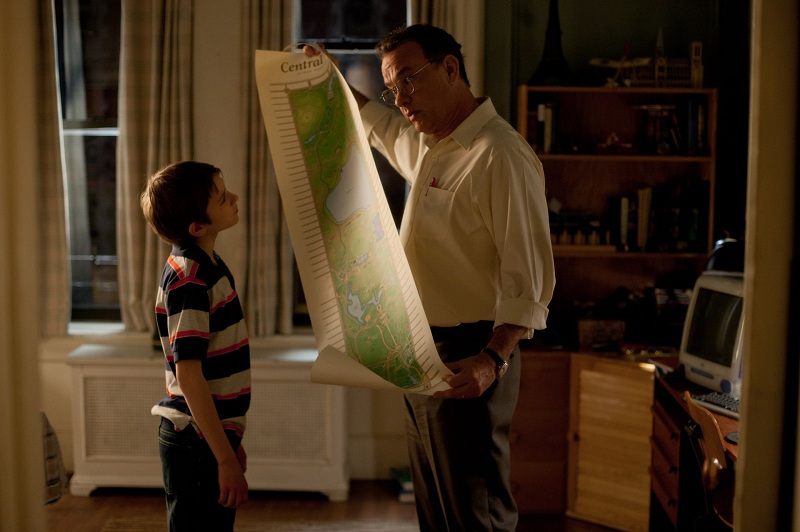
Thomas Horn and Tom Hanks in Extremely Loud and Incredibly Close (Warner Bros.)
I worked in 1 World Trade Center from 1999 to 2001- to September 11th, 2001 to be precise. My story about that day isn’t all that dramatic really. There are details I could divulge but suffice it to say I wasn’t on the schedule for Tuesday mornings that month. So I was not on either the 106th or 107th floor on that day, nowhere close, thank God. I thought about taking that shift when the proposed schedule came out but decided against picking up an occasional AM shift. I was juggling college and the job and Tuesday was an off day from classes and I decided to use that to rest.
Of course, we all know what happened that day and since then I’ve been fairly quiet about a number of topics that pertain to the day itself. I’ve also had varying reactions to works of art which have dealt with the attacks.
I am writing this, of course, because Extremely Loud and Incredibly Close is due out soon and it’s been lambasted by some as exploitative among other things. I have yet to see the film so I cannot defend its artistic merit, however, we should look at other depictions of 9/11. One other caveat: so unimaginable and unpredictable were the attacks to me that while working there I wrote a post-apocalyptic script wherein a family eventually lived in the World Trade Center.
First, there is the tandem of fairly fact-based films World Trade Center and United 93. Neither of these films interest me in the least. I have, more times than I care to, been able to imagine, only imagine but what more can one do, what those floors looked like that day. Having worked there I get a much clearer picture than I care to so I needn’t see any dramatization thereof. The films may be fine and as propaganda-free as possible but I just have no interest. To me those smack more of exploitation for it takes actual people and focuses on the event and tried to feed on rampant patriotism to generate box office. Some see it otherwise and that’s fine but as I said I have no reason to see it.
Remember Me, which I wouldn’t have seen anyway, was your standard father-son drama and decided to use 9/11 as a twist ending rather infamously and in classless fashion.
On the flip-side Stephen King in his collection of short stories Just After Sunset deals with the tragic day in New York in two different ways. In “The Things They Left Behind” he deals with the aftermath and those lost but in “Graduation Afternoon” it comes in at the end, in the distance. It does not inundate all that preceded it and change the entire story and feel like a blatant, in-your-face exploitation. It is there, it is stunning and it affects all, but it does not compromise the tonality of the entire piece.
In Brian K. Vaughn’s brilliant comics series Ex Machina the first issue concludes with a newly-minted superhero’s biggest failure, the fact that he only saved one of the two towers. Considering the tone of the series was serious, political and a very post-9/11 story it all fit.
So the last three I enjoyed so I can take in a tale of fiction which cites something that so closely affected me. Yet it seems this film gets quite a bit of vitriol just in the “How dare you?” realm. The question of “How should art deal with 9/11?” is a valid one but it seems that was never asked for the two that try to most closely replicate it. Bastardized truthiness does not a documentary make and what function is being served there? Those are movies about 9/11 but in a bright piece of marketing Extremely Loud and Incredibly Close is being labeled as being about every day after. In some ways those days were harder.
Furthermore, the word art is formed from the word artifice. It is about subterfuge. Exactitude is what a documentarian strives for but even they know there’s a gray area.
This film reminds me of some of the reading I did about Kapó before I decided to buy it. The film features perhaps the most over-analyzed shot in film history of an inmate dying in a concentration camp. It raised questions of morality in film, however, what should be moral about film? Absolute morality eliminates myriad genres. Horror is where we imagine out nightmares to try an exorcise them and horrid, immoral things are imagined and inflicted upon the people that populate those stories. What need have we of narrative morality?
Not to compare disparate tragedies but surely there was a time when the holocaust was an untouched topic. However, through the years different narrative avenues about events in and around World War II have been found, some not universally embraced, Stephen Daldry’s (the director of this very film) The Reader comes to mind.
The fact of the matter is there are events in world history that defy logical explanation and easy categorization. However, that does not stop us as human beings from exploring them and one of our biggest means of exploring is through the arts. Some say “Why make this film?” I say “Why not?”
 The Movie Rat