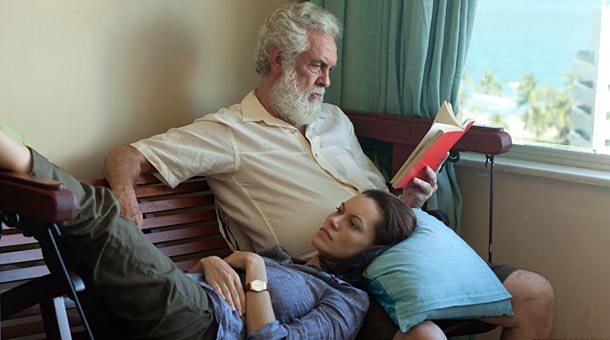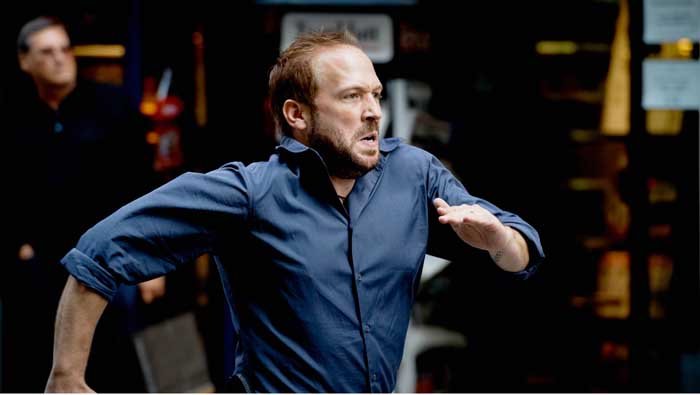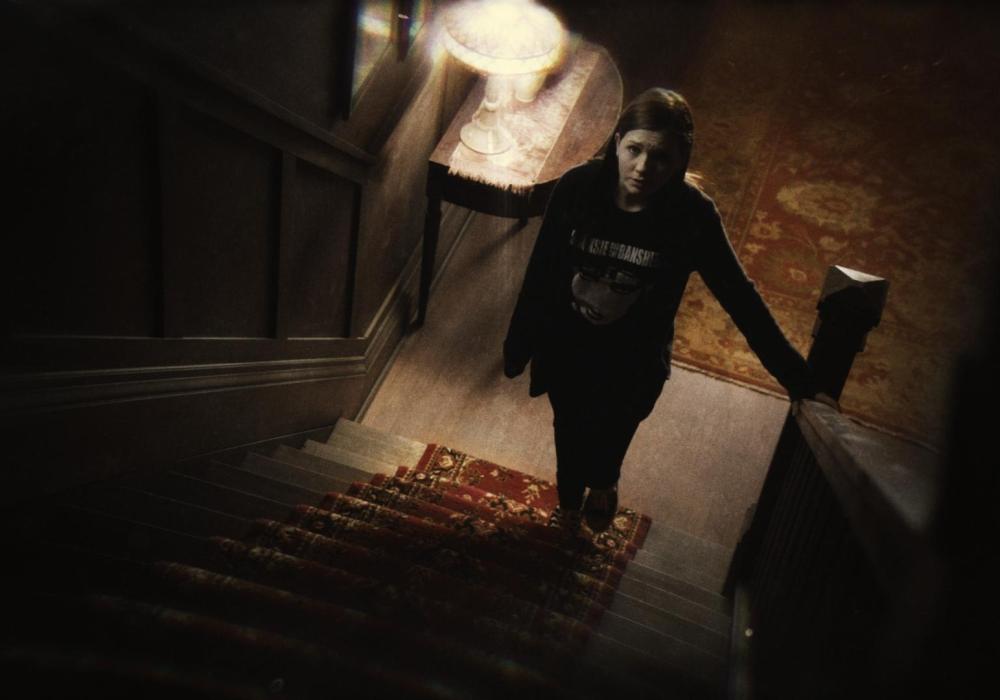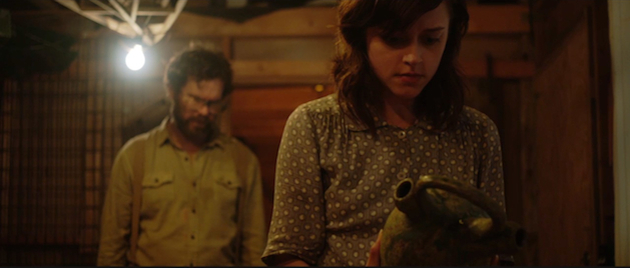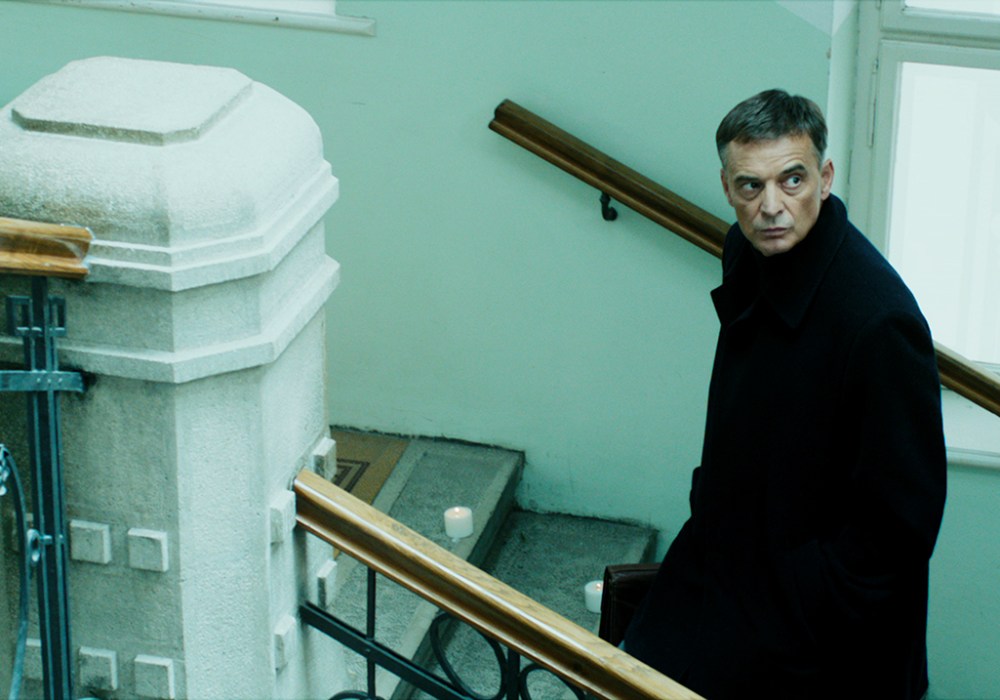
Thankful for World Cinema- Class Enemy (2013)

Introduction

For an introduction to Thankful for World Cinema please go here.

Class Enemy (2013)

Class Enemy, which is Slovenia’s official selection for Best Foreign Language film, tells a tale of a high school class that singles out its new German teacher (Played by Igor Samobor) as the party responsible for their classmate’s suicide (Sabina played by Dasa Cupevski). The film picks up right as their favorite teacher, whom Robert (Samobor) is replacing, is going out on maternity leave and follows the back-and-forth struggle between the three main factions (teacher, students and administration) throughout the school year consistently adding layers to the characters, and conflicts.

On the surface this seems like the kind of concept that might run out steam and run into redundancy, fallacies or tedium but through that consistent layering either of single characters, a faction or the central struggle; the film remains riveting throughout. Furthermore, it achieves that level of tension by refusing to turn a judgmental eye on any particular party and refusing to color its personages in either black or white, but, ultimately shades them all in grays. In the end, not to put too fine a point on it, the “mystery” is left a bit gray also.
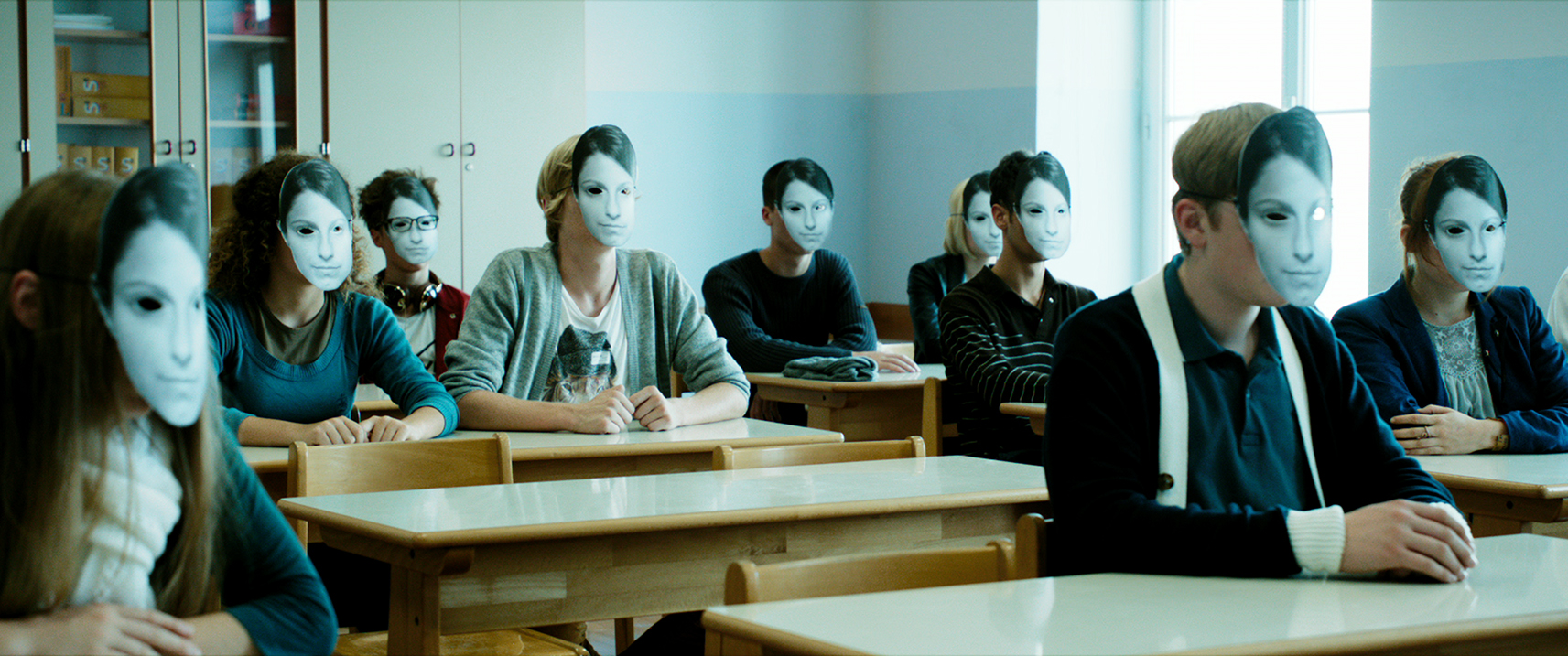
Class Enemy (2012, Courtesy of Triglav Film)

This feat is even more impressive when you consider the fact that when dealing with subject matters such as teenage suicide, student-teacher relations, or any of the myriad ancillary topics this film addresses it can be easy to be callous. However, this film is written and directed with enough finesse such that it conveys the truths as each individual character sees it without disrespecting opposing opinions. Perhaps the best exchanges with regards to this occur with the school’s headmaster. Robert is called in to see her when the conflicts are still relatively tepid and he is befuddled asking something to the effect of “They were offended by that?” To which the headmaster answers: “Welcome, to the 21st Century, Robert.”

That is perhaps the most perfectly crafted line of the film. It’s something that is true regardless of what your vantage point is. It’s not trying to make things like teen suicide or bullying smaller, but merely addressing another truth. The film is similarly adept at having its characters differentiated and not necessarily always holding politically correct opinions. The characters express said opinions earnestly and due to performance and writing the intent is always clear. In a film structured in part as a generational clash there needs to be such understanding and conflicting perspectives for it to work. Even something as youth-centric as The Breakfast Club had good insights into the few authority figures, the adults, and had them not always agree. “The kids haven’t changed, Vern, you have” the Janitor tells the principal there, and while that may usually be true, perhaps this tale stumbled onto a slightly different angle: with the same impetuousness as always the kids here are lead to say something they never vocalized before.

Class Enemy (2013, Triglav Film)

While this is a drama built on a fulcrum which all other events spring off and feed on persistently it does continue and escalate from there. Characters progress and regress; step forward and back, and come to grips with things at different times especially in light of some developments that come to the fore later on.

Perhaps one of the most interesting choices in this film is use of language. Since the German class is the main battleground it allows cultural norms to be more frequently a talking point. Robert is one of those hardline teachers who will not allow the native tongue to be spoken in his class; this was a method that was more often used as a threat in my education and rarely implemented. This fact makes much of the dialogue in the film German, which, of course, puts more of an onus on the performers, but allows for other affectations like repeated, exaggerated use of the term Nazi, and other perceptions; as well as a focus on the works of Thomas Mann.

As may have been intimated earlier, the fact that this is a film ostensibly about teenage high school rebellion does not minimize the drama, or the feat that this film is. I hope the allusion to The Breakfast Club would allude to that too. However, while this may deal with darker, more modern themes with less of a light at the end of the tunnel, less of an end to that tunnel really; it is a similarly insightful piece on themes essentially omnipresent; allowing it an introspection, gravitas and expiation of adolescent and educator frustrations alike.
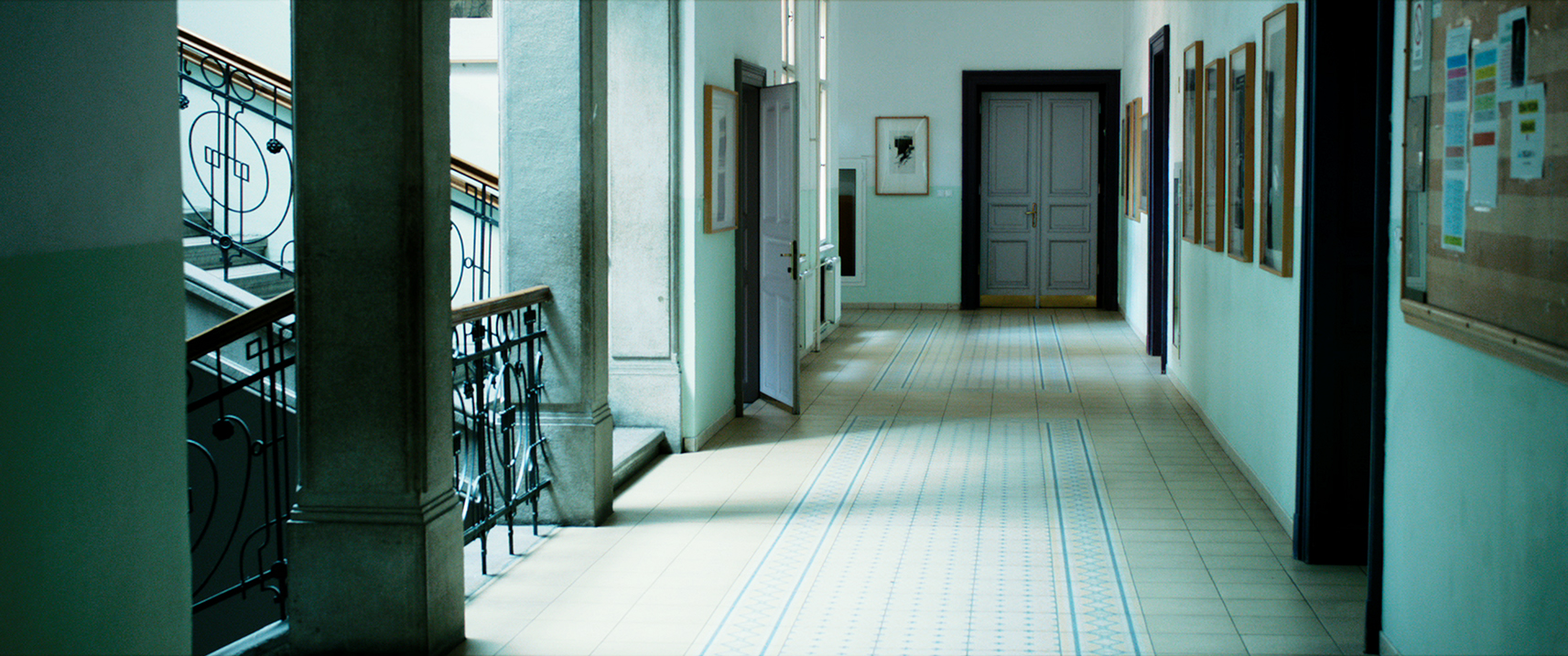
Class Enemy (2013, Courtesy of Triglav Film)

Clearly a tale such as this could not hope to work as well as it would like to without great performances throughout the cast. Clearly, first and foremost would be Igor Samobor as Robert. There is a certain enigmatic magnetism to his performance that allows you wonder as to his character’s precise motivations at times, information that is eventually disseminated; and he plays the villainous-type (to those who still remember their studious days and tendencies well) to a tee. Among the students there are also many great turns: Dasa Cupevski’s screentime is short but memorable; Voranc Boh’s Luka is usually the leader and an effective agitator of the youthful rebellion; perhaps most impressive in his rather divided nature is Jan Zupancic in his portrayal of Tadej. Then there is Doroteja Nadrah who fades in and out of prominence as a character, but is no less impressive.

Class Enemy, when all is said and done, is basically everything you want out of a dramatic piece. It tackles difficult dramatic questions and does not shy away from exploration without concrete answers, but instead knows that better films usually take the journey well; exploring and changing their characters along the way, and more importantly, it understands that the best dramas aren’t about victors or where they audience sides, but how much we enjoy watching them engage in battle.
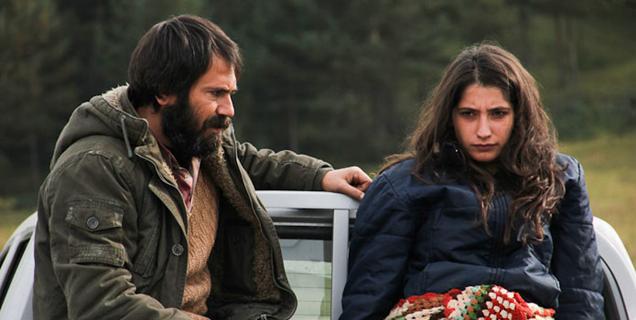
10/10

Thankful for World Cinema – The Notebook (Le Grand Cahier) (2013)

Introduction

For an introduction to the concept of Thankful for World Cinema please go here.

The Notebook (Le Grand Cahier) (2013)

After seeing The Notebook, I went and reread my post on The Witman Boys in part because it was the other Janos Szas I had seen to date. I started on that task merely to remind myself of it a bit more (as writing can help fill in the blanks that memory decides to leave). However, what I found as I looked it over was a film more similar to The Notebook than I’d remembered.

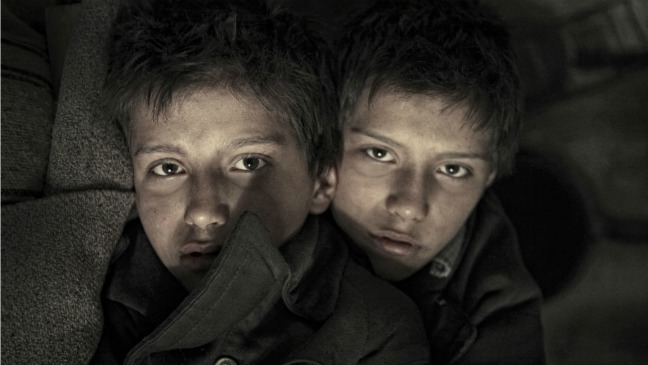
The parallels do go beyond merely a shot of two brothers with their face in close proximity to one another. And this is also not to be implied as a slight on either film; quite the contrary, it makes for a very fascinating look at the auterism behind both and also the refinement and the increased power that the newer film has.

The films both have inciting incidents wherein the boys are changed by something beyond their control. In The Witman Boys its the loss of their father. In The Notebook the second World War is raging on and the boys’ parents worry for them and want them protected. The Witman Boys has similar brothers each with a designated name whereas The Notebook is about twins whom are never referred to by name and are credited as “One” and “The Other.” This is an important fact because the idea is to make the twins inextricable from one another and also to make them symbolic.

For as One and The Other move away from a metropolitan area (presumably Budapest) to the Hungarian countryside, they come closer to the horrors of the war and have to learn to cope with life during wartime in their own unique way.

This is where the tonality of the film comes into play. Children coping with the ravages of war is not a new topic. It’s how the topic is dealt with that dictates the tonality of the film, and in certain regards the success of it. Much liked Szas’ prior film this is not going to be an uplifting tale.

Prior to the boys being taken to live with their estranged grandmother their father gives them a notebook to write down “everything” in. Twins have a tendency to stick close together regardless, but when placed in such isolation the tendency to stick by one another, at least to start, is redoubled; and gives them even more incentive to live a microcosmic existence wherein they seek to define morality, strength and learn how they can best cope in the tumult about them with no outside assistance.

That then lays the groundwork for the film which is told through entries the notebook. Voice-over allows episodes of the story to be tied together . While the wondrous visuals created by Christian Berger, this time exploiting color in a parable. The images are usually gorgeous regardless, but stark when they have to be and edited together precisely to render the progression (or degeneration if you prefer) of the boys from wide-eyed innocents to hardened survivors, who frighteningly at times still have a childlike understanding of things, and at others have a cold and calculated, all-too adult outlook.

Not that those things ever seem wrong for they work in a proper progressive order and lead to a gutting finale whose impact is hammered home when you fully realize how and why things occur the way they do.

One of the fascinating things about this film is not only does it find a way, for the most part, to remove the narrative from the frontline but it still keeps the war close by. It tells a dark, haunting tale in one of the 20th Centuries worst moments that goes above and beyond simplistic moralizing about a specific conflict but makes a more sweeping point. A point uttered through visuals and actions and not directly through dialogue, such that you’re still engaged in watching a story, a disturbing one, but a story nonetheless.

Tying this back into the auteurist aspect, so as not to leave it abandoned as an introductory ploy: many directors have told tales that parallel one another. Hitchcock himself said that “self-plagiarism is style.” With regards to World War II, Steven Spielberg has been there quite a few times in very different ways (1941, Empire of the Sun, Schindler’s List, Saving Private Ryan). It’s not the fact that a director returns to a common ground that matters, but rather what he does when he gets there. What Janos Szas does here is amplify and refine the sensibilities employed in The Witman Boys to this adaptation, sharpening the impact of the story and making it one that can resonate universally. Whereas the prior film was one that could bring one to Hungarian cinema, here he pushes Hungarian cinema out to the world.

9/10

Thankful for World Cinema- Watchtower (2012)

Introduction

For an introduction to the concept of Thankful for World Cinema please go here.

Watchtower (2012)

There are films about situations and there are films driven by their characters. There are not as many that find an interesting situation, and the right characters to place in that situation, as Watchtower does. The characters of interest in the film are Seher (Nilay Erdonmez) and Nihat (Olgun Simsek). Each has a rather different job: Nihat has just started working in a watchtower where basically he’s looking to see if anything out of the ordinary is going on in the surrounding mountains and forests in the Turkish countryside; this usually would have to do with the prevention of rampant wildfires. Nihat, meanwhile, is a hostess on a cross-country bus line. In this way their paths do occasionally intersect.

The film builds well dedicating long portions to telling the story of each of these solitary and willfully ostracized people. It soon becomes clear that each has a secret that is a great burden to them. The secrets, and their situations, will inevitably join their narrative strands. We know this.

The unfurling of the stories spins much like water going down a drain; circling ever closer to the truth of the matter. The performances, especially that of Erdonnez, are wonderful.

This film only faces one true stumbling block, and it is one that holds it back from the greatness it seems destined to achieve for much of its running time. The glimpses of the characters and their plights are riveting for how the film slowly unravels what bothers them about their predicament and why they feel they cannot share it. However, the situation they find themselves in together struggles to find a conclusion and eventually, for all intents and purposes, drops the narrative.

I’ve sat with this ending and thought on it for some time. It’s not the kind of, let’s call it an “open” ending for lack of a more suitable term; that elevates the film. Conversely it is not one that undoes a great deal of the good that was accomplished before it. However, it is still a disappointing and unsatisfactory close to the tale.

There reaches a point in a certain kind of narrative where if you move past the plot point you’re on you’ve stopped telling one tale and moved on to another altogether. Therefore, that ending has to feel like a button, and what occurs afterward can be explored in another film or in the mind of the viewer. I think that Inception would actually be a good, recent, widely-viewed example of that (not that these films bare any similarity). The point being that the last image was meant to be the last image in that film. It had to be. Here it felt a bit like settling and that’s highly unfortunate, but not ruinous to the whole.

Watchtower has characters with baggage who are in binds and meet a crossroads. It is interesting to watch them get there, and see how they interact when their paths cross. I just wanted to go on their journey a little longer, and that can’t be all bad, now can it?

7/10

Thankful for World Cinema: La Playa DC (2012)

Introduction

For an introduction to the concept of Thankful for World Cinema please go here.

La Playa DC (2012)

Here is another film, this one also in this year’s crop of Oscar submitted films, that deals with some compelling cultural dynamics and sociopolitical intrigue. La Playa DC concerns three brothers, mainly Tomas (the middle child). He is an Afro-Colombian teenage whose family has fled their pacific coast home, a war-torn part of the nation.

Due to the bloody history the American institution of slavery, the Civil Rights Movement, and American myopia in general; it can take a moment to allow the fact that racism is an issue in other countries as well, much as immigration is oft debated in many parts of the world. The distinction of the racism faced in this film, which is reflecting Colombian society is that it’s an insidiously quiet one, and not one that’s overt or vocally discouraged. There may not be much frankness in these regards here but it is discussed.

This scarcely touching upon the issue in an open way is one of the film’s better aspects. There are reactions and attitudes that are indicators. One notable instance is the utterance of the phrase “you people” and another would be when Chaco, Tomas’ older brother, in reaction to what just happens says it’s that kind of thing he wanted to move away from.

Chaco has recently returned home after being deported. However, he knows how and where he messed up and hopes to give it another go. This acts as the MacGuffin in story, the goal: heading to North America. The other concern is for their youngest brother who is already drug-addicted and living on the streets. A lot of the action concerns him: finding and/or protecting, but its Tomas we really focus on.

He’s the one who faces the change. Though he does arc well, and is portrayed in an aptly engaging way there are some things that hold this film back despite the fact that we get a full and sensical personal journey of self-discovery. While the film goes to great lengths to have a documentarian aesthetic it also doesn’t try to look too interesting. Too often there are overly-long reverse steadicam shots which give us too long of a view of the back of a head. This is also an editing concern.

While there is some creativity to how certain situations resolve themselves usually those decisions are represented in ways completely lacking drama or any sliver of suspense. This is too low-key a concept to softly deliver some of its few shocking blows. That and the long seeming stretches between these incidents make it a disengaging watch despite all the interesting and relevant things its conveying through its narrative.

5/10

Thankful for World Cinema: Once a Upon a Time Veronica (2012)

Introduction

For an introduction to the concept of Thankful for World Cinema please go here.

Once Upon a Time Veronica (2012)

How does one paint a portrait of a contemporary Brazil? How best does one illuminate the sense of utter helplessness one can feel, when faced on a daily basis with the problems others are facing both at home and in the workplace? How can one find any peace, if not by going from psychiatrist at public hospital and into private practice?

Once Upon a Time Veronica is not the only Brazilian film of recent vintage to tackle some of these questions, at least in part if not in whole. Neighboring Sounds dealt with a species of urban malaise (in the same city) not completely dissimilar from the kind illustrated in this film – and shares a cast member in common with this film (WJ Solha).

This film deals well in dichotomy, if not in an overall portrait. It hinges on the performance of the eponymous Veronica (Hermila Guedes) and does much of its soul-searching as she talks into her tape recorder. As the film ends she makes her last entry into the recorder, not that she as a person is complete, or a finished product (for who ever is?), but she’s ready to let that crutch go and accept herself.

The self-examination is a mean to an end for the character as much as it’s a MacGuffin, but is the search of an interesting person enough to hang a story upon when the narrative framework is uninteresting? It’s not quite. The investigation, even bereft of concrete answers, is usually worth it. Even if a character is deemed merely interesting.

Perhaps a lot of the issue this film faces is that its protagonist is laid bare and not commented upon. Another part of the issue is that there isn’t a great deal of externalization of her conflict, it’s a very internal debate with few decisions made. When a character is treated as such then they are open to interpretation and reactions to said character can be varied.

There are technical aspects, as well as performance aspects of this film that are admirable but it all comes down to the narrative. It’s one I saw as treading far too much water and my view on some of her decisions is colored by sections of the storytelling I found to be lacking. My take on her and the film may have been different if things were presented differently. As it stands, I find this intimate portrait as un-compelling as her conclusion of her introspective thesis.

5/10

Thankful for World Cinema: The Green Wave (2010)

Introduction

For an introduction to Thankful for World Cinema please go here.

The Green Wave (2010)

I have previously written about the events in Iran in 2009 as one documentary I had previously covered very nearly backed into those momentous events by accident. However, here with The Green Wave those events are the focal point and there are very creative things done by the filmmakers to try, as best as they possibly can, to recreate those events.

With any world events that can be described as historic, more so with those that can be considered to be movements, it’s a nearly insurmountable task to attempt to capture the totality of what occurred and how in one film. Yet, even with such a potentially massive scope this film does well in another way: it limits its scope some by mostly focusing on writings posted in blogs and on other forms of social media.

To be able to render what occurred in said writing on film there are some very well done and artistic animated scenes created. Yet there is quite a lot of video, including clips concerning the brutality regular citizens faced at the hands of the military and police. Therefore, some viewer discretion is advised as some of the images are quite disturbing.

There are also interview subjects that fill in the gaps. The time period is also limited some. The narrative of the documentary starts just before the later-contested elections and carry on through the end of the year.

As daunting a task as it is to try and capture all of that information this film does extremely well in disseminating the basics from the political climate in general, to a populous awoken, the voter suppression and fraud, the outcry, the backlash, the final straw and the activation of the nation-at-large.

Yet, perhaps the most valuable piece of the film is that its the first actual testament, which leans heavily on first-hand Internet accounts that shows the power of social media as a keeper of history as events occur. As with anything there many methods of usage that fall short of the “highest and best” use, but here unleashed before all who watch this film is the undeniable proof of one of its most powerful implementations.

The perspective of the film is also one that is very fair. It focuses mainly on the how and why and speaks to only citizens and ex-pats allowing them another outlet to speak about their country and what occurred there. This is a truly moving piece of filmmaking that offers a glimpse into one of the most important sociopolitical movements in the world in recent years. It’s the kind of watchful, necessary eye I’d like to see turned on the protests in Brazil where the internet is also a tool that has chronicle to overreaching abuses, and excessive force used by military police against protesters.

8/10

Thankful for World Cinema: Blind Spot (2012)

Introduction

For an introduction to the concept of Thankful for World Cinema please go here.

Blind Spot

One thing I was reticent of many years ago was using the word “Noir,” or even the more modernist phrase Neo-Noir, in describing a film. My issue was that I was in many ways a purist and believed that to be truly a Noir film it had to be in black-and-white. However, as more time has gone by, and there have been fewer films in my experience that have been able to lay claim to any such adjective; I have a bit more ease with it now. It’s true enough that these phrases deal with presentation, plot construction and building, therefore, the phrase Neo-Noir is far more palatable to me these days than it was.

I say all that by way of introduction to the film Blind Spot. For truly, in the manner its plot is constructed and presented is a kin of Film Noir. Events start to unfold when a cop, the brother of our lead who is also a cop, Oliver Faber (Jules Werner); is murdered. As the investigation progresses and more is learned about the case a complex web is discovered, a manipulative game is played and it is apparent and highly possible that no one is what they seem.

The film really dives in with an in medias res beginning of a fight between two cops. What that fight concerns also builds character and becomes intermingled in the web of mind-play, but it really sets the tone perfectly and sets up a template for the edit which will spin us through this involved storyline quickly, yet also keeps the audience highly engaged.

What also is established early is another Noir staple of the officer (or investigator) who not only has his own demons, but is a bit unorthodox and is going to get very close to quite a few uncomfortable truths.

In this tale, setting also becomes involved in the story as it is a facet of the investigation. Seeing as how a murder investigation, with a complicated forensic profile that has occurred in Luxembourg amidst an undermanned and somewhat inexperienced squad they must await an experts arrival from Germany. There are other examples of current socioeconomic and political realities in Europe making themselves present in this tale, as well as ones specific to Luxembourg proper.

The dangers in many a Noir tale will inevitably be that it will be overly plot-heavy with not enough focus on characters. However, one of the best tricks this film pulls is that it manages to build them as well such that we get a sense for who these people are and in discovering them and their motivations we see that things do connect. It’s a delicate and deftly pulled off balancing act.

Blind Spot is hypnotically watchable and incessantly drives towards its unpredictable and thrilling conclusion. It’s a stylish, character-driven Neo Noir that is brilliantly edited and assuredly directed.

9/10

Thankful for World Cinema: Mother, I Love You (2013)

Introduction

For an introduction to the concept of Thankful for World Cinema please go here.

Mother, I Love You (2013)

Mother, I Love You tells a tale that upon initially glancing at the synopsis may seem like it’s been told a time too often.

Raimonds, a 12 year old boy, falls into a world of petty crime while trying to stay out of trouble with his mother.

However, one thing to admire about the synopsis is that it is not intent on divulging too much of the forthcoming film. A reductive synopsis, for this viewer, is preferable as opposed to an excessive amount of plot detail. This is in essence the plot.

The intriguing thing about this film is that it’s not an overly-stylized treatment. There are no affectations of gangs or syndicates. Not that the stakes aren’t high but the film is concerned first and foremost with it characters, how they react to situations and the consequences of their actions. A simple happenstance of fate, some free time and boredom are what allow Raimonds to travel down the rabbit hole.

However, the domino effect of that one choice comes into play when things start to go wrong for him. Lies are told and further crimes occur. Ultimately, he knows he’s come to a crossroads and must decide whether to head back in the right direction or wander out past the point of no return.

The film also admirably keeps these events grounded closer to what might resemble and actual reality. It still fills the dramatic need of a given conflict or scene but without going overboard with dramatic histrionics that can viewed as compulsory.

There are arcs for the main figures involved that are very believable as well as well-drawn supporting players. The two lead performances, that of Raimonds (Kristofers Konavalovs) and Mamma (Vita Varpina), are captivating and truthful. The chemistry shared and created by them as scene partners allow subtext, lines left unsaid, to speak volumes.

There is a briskness to this film in pace that may feel it feeling rushed if not well-directed and -edited, but that is not the case here. The direction and editing are first-rate. The tone of the film is established immediately, the scenes underscored effectively through wondrous musical choices.

Mother, I Love You aside from an overriding plotline that could be plucked from any corner of the globe does have its cultural specificity to Latvia and effectively opens a window into that microcosm. While doing that though, it does create its characters as individuals rather than types, they are imbued with personality and it’s their home through their eyes we see. This is a compelling, engaging, accessible film that rewards those digging a bit deeper (if they choose to), and it’s a film that should be sought out.

8/10

61 Days of Halloween: Haunter (2013)

Introduction

For the concept of 61 Days of Halloween, as well as a list of previously featured titles, please go here.

Haunter (2013)

The synopsis of Haunter gives you facts that lead you quite a bit of the way into the story:

The ghost of a teenager who died years ago reaches out to the land of the living in order to save someone from suffering her same fate.

Given that as a starting point one would hope that there are layers to this tale, and those who share that hope will not walk away from this film disappointed. For while the comparisons that Haunter has drawn to both The Sixth Sense and Groundhog Day are not unwarranted, there is more at play here and a very intriguing myth being built after all.

The film’s cinematography has great panache and sets the tone throughout, the camera wanders through the world of the story and takes different vantage points on its early-stage déjà vu scenes.

For each of the characters within the story, be they live or be they dead, there is a moment of discovery. Our protagonist Lisa (Extremely well portrayed by Abigail Breslin) is the first to have such a discovery, and, as such, it is through her eyes that we experience this film and start to uncoil the mysteries therein.

One such mystery is what the exact nature of The Pale Man (Chillingly rendered by Stephen McHattie) be he natural or supernatural. As the myth starts to build and the pieces start to fall in place there are surprises in store and there are very intricately transgressed borders between the states of being. The way this handled allows there to continue to be a sense of mystery to the film.

While there is a slight leaden quality to pace towards the tale end of Act II, the conclusion is ultimately quite satisfying as the investment we as an audience have been asked to make in these characters is a fruitful one. Their fates are something that become a concern, and as those who have passed come to the realization that they are past more details fall into place.

Furthermore, the family dynamics, the fulcrum of the dramatic element of the tale changes and we see why. These moderations, these tones and notes would not hit home as well without contributions from the whole cast be it Peter Outerbridge, who has to be a source of empathy and fear, grief-stricken and terrifying; Sarah Manninen whom runs the gamut from TV playing a role to scared victim to knowing realist; or Peter Da Cunha (whose specific echo is one of the key indicators of the film) who plays a soft-spoken, sunny child who is resigned to a cautious fear, and also ultimately terrified.

Despite whatever superficial similarities this film bears to other more famous works, and I thought of a few others myself, the narrative fabric this film weaves is wholly its one and a great one to look at and get lost in. This is a fantastic horror film that melds a few different subgrenre approaches and should be one you look out for whenever you need another horror fix.

8/10

61 Days of Halloween: Jug Face (2013)

Introduction

For the concept of 61 Days of Halloween, as well as a list of previously featured titles, please go here.

Jug Face (2013)

This is one of those titles that jumps out at me as one that deserves at the front of the review a reiteration of the fact that any film is merely just the writer to the best of his or her ability relating his/her experience with a film and why. As to whether it is something that will work for you, that’s something you have to parse for yourself based on what you read here and I stress that prior to discussing this film because it is most definitely one where I can understand how it would engender support.

If there’s one thing I unquestionably enjoy about this film is that it refuses to dumb its narrative down. It concerns a teenage girl who becomes pregnant and for many extenuating circumstances feels the need to flee her backwoods home. One of the extenuating circumstances is a communal, pagan-cult-like existence that mandates basically all the residents’ life decisions. The rural location and isolation create a microcosm separated from reality as we know it. What the rules are about life in this place are made clear throughout the course of the film, as well as what transgressions have occurred against said rules. There is nary a bluntly expository word uttered. Things are learned either visually or indirectly.

Where the film bogs down some are in a few places. One such area is when the minutiae is temporarily unclear. The stakes are quite clear early on, which is great, but the impending doom of the characters (in various ways) is also made apparent early. The lack of clarity does muddle a few relationships, plot points and character assignations but that is a minor concern.

The film ends with some mysteries left unsolved, but some of the answers feel like they should pack more of a wallop than they do. The nature of these deities fascinates but, that is due to the visual conveyance of information.

I am being intentionally guarded in my explanation of of my grievances because to over-discuss them would be to give too much away. It’s better to meet this film knowing just the one line synopsis and no more. It’s the kind of world I would not be averse to seeing revisited and expounded upon. This is the type of first installment that could allow for a shorthand to be in place before it’s followed up, and can create something more akin to a companion piece than a sequel.

The performances in the film, namely by the protagonist Lauren Ashley Carter, are impressive and make the film worth viewing. If you are curious to see the film and form your own opinion it is available to stream on Amazon Instant Video (free to Prime Members).

5/10