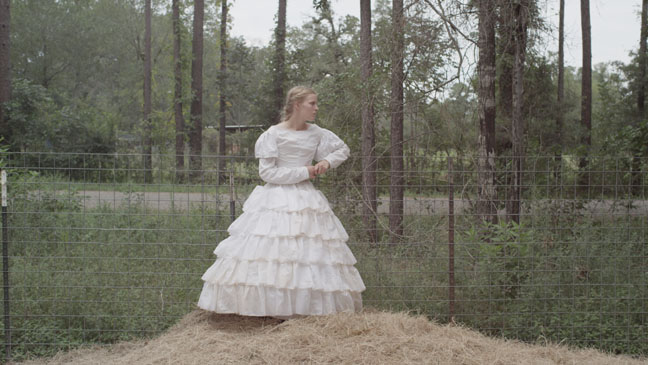
Film Thought: The Tableau Vivant in Halloween (1978)

Each year I will revisit the original, classic Halloween at least once. This year, owing to the new Blu-ray box set I will be revisiting the whole series anew. However, the one I will likely come back to more than once, and always find new things to say about, is the first.

With very good reason there has been much made about the use of Steadicam not only in the film as a whole, but also during the opening sequence (one of the last shots in the can during principal photography) where Michael’s POV is taken as he stalks around the house and kills his sister, Judith (Sandy Johnson). Now in technical, artistic and production terms this shot is quite a feat. In the narrative terms it, of course, begins the film with some mystery, a thrill when the POV is broken and a great reveal. However, over the course of time that has obfuscated something of almost equal intrigue (if not anywhere near as hard to achieve as the prior sequence).

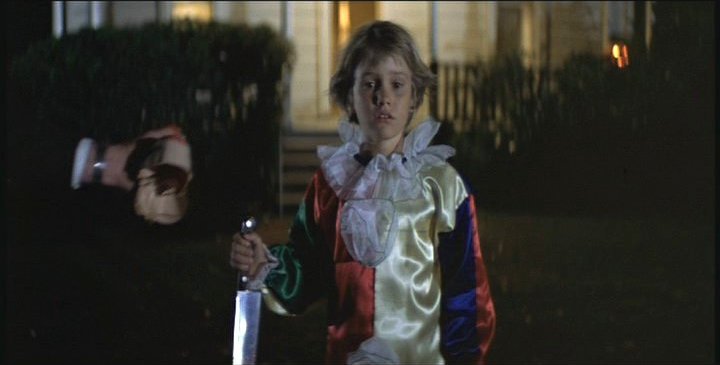
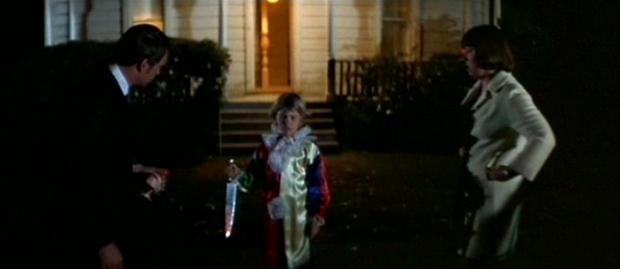
The shot that immediately follows reveals Michael to be a young child of six years of age (Will Sandin). Here again narrative shock may distract you from absorbing what’s happening in its fullest implications. The cut occurs when his mask is removed. We see his face and pull back. As we do, we are introduced visually to Michael’s parents. They look shocked, try to get his attention and the camera continues to methodically crane away. As the camera makes its move there is an unnatural lack of movement in the mise-en-scène, it can be argued, by all parties. Even if you’ll give a pass to the fact that Michael doesn’t move; owing that to some semblance of shock he may be feeling (which would be the last time he really, totally felt any sort of human emotion), then you still have to consider the parents who having found their six-year-old with a bloody butcher knife merely stand there befuddled and scarcely move or comment after having merely called his name a few times, mom crosses her arms and dad takes a step back. That’s it.

Previously, I believe I had dismissed such concerns owing to the fact that the shot needed to happen, and being a director that sufficed. However, the shot can still go on with some more movement by the players as the camera drifts away. So, what was it that was compelling this blocking? It’s a choice so conscious it cannot be dismissed as an oversight and has to be viewed as intentional on the part of the director.

Halloween (1978, Compass International Films)

As I watched it this time it struck me. It was so obvious I can’t believe I hadn’t considered it before. What is being created is a cinematic equivalent of a tableau vivant. This is a technique that is rarely implemented on film, however, it’s one I always felt a powerful to implement on stage, and when one considered some instances in which they are used (such as in fairly tales or religious stories) it starts to make sense.

The tableau vivant is described as:

Tableau vivant (plural: tableaux vivants) means “living picture”. The term, borrowed from the French language, describes a group of suitably costumed actors or artist’s models, carefully posed and often theatrically lit. Throughout the duration of the display, the people shown do not speak or move. The approach thus marries the art forms of the stage with those of painting or photography, and as such it has been of interest to modern photographers.

Usually the only times this has been approximated on film or television that I can recall off the top of my head is is in very obvious circumstances where a character would say “Freeze” or some other directive like it and rather than freeze framing the actors stop moving. One notable example of this was the children’s sitcom Saved by the Bell. Now here you have a far more subtle form and the reason I believe it is: one, is that it is allowing the events to sink in; two, building a legend; three, ending a chapter in the story prior to moving to another one. In the world of this film, in this town, this is the local legend; this is the boogeyman. Now that we the audience know what happened, have ruminated on it for 29 seconds during the shot (Yes, 29 whole seconds this shot runs uninterrupted; quite nearly unconscionable now) here is a story set in the present (1978) about the same town, and what happens when he comes home.

It’s the kind of time-taking and camera move that you wish was easier to get away with in the modern language of cinema. However, it is the way that this shot works, the way it so perfectly caps off the opening salvo of this film that has allowed it to stand the test of time and multiple viewings without even being subject to tremendous amounts of scrutiny. Although, as with most things in Halloween, added scrutiny only enhances the mastery of the work, and doesn’t diminish it in any way, shape or form.

Mini-Review: Shadow People

Introduction

This is a post that is a repurposing of an old-school Mini-Review Round-Up post. As stated here I am essentially done with running multi-film review posts. Each film deserves its own review. Therefore I will repost, and at times add to, old reviews periodically. Enjoy!

Shadow People

I could probably write a much longer piece on this film. One thing it does fairly successfully is mash feature and documentary techniques together. It fully commits to the this “inspired by real events.” The subject matter (Seeing malevolent shadows that would kill you in your sleep if you know they exist) is very strong. This commitment to approach, and the scoring help driving home despite missteps in the approach on occasion and casting issues. A testament to it’s efficacy is that it still was unsettling even in spite of nagging doubts about the quick escalation of the investigation of the phenomena and the fact that much of the second into the third act is spent crystallizing the modus operandi of these beings. Some aspects work brilliantly, for example, it’s a shame I watched it on TV because it was trying deft, slight scares at time that would read better in a theater, some facets of the myth aren’t quite as strong as the others, however, it’s a fascinating one.

Granted the bones of it do have a source in popular culture but its impact on the cinematic realm, as far as I know, is fairly small at current. What one can say is that this film is not unlike The Curse with better production values that’s slightly less clear on its own rules – in short, it excels in spite of itself. Taking that into account, and owing to how it made my skin crawl, I can give it a…

8/10

despite my reservations.

Mini-Review: Stoker

Introduction

This is a post that is a repurposing of an old-school Mini-Review Round-Up post. As stated here I am essentially done with running multi-film review posts. Each film deserves its own review. Therefore I will repost, and at times add to, old reviews periodically. Enjoy!

Stoker

This is one of those films that grabs you from the first frame and scarcely ceases long enough to let go. It’s the kind of film that peels back layers of mystery and intrigue, slowly at first, but, then it escalates them until you find yourself in a delirious whirl of rapt tension and drama. All the while, as it slowly sets the foundation of the most basic facts, it’s setting up reveals of more precisely sinister revelations of motivation and past incidents.

The film is technically constructed to match this narrative drive employing montages, cross-cutting sequences, frames and L-cuts (cuts where audio lingers after a scene, or starts before an accompanying visual) to link what are at first seemingly disconnected events.

Stoker builds mystery regarding enough elements of its story, while keeping things simple, such that it easily achieves misdirection from one unanswered riddle to another. Thus, answers you had half-formed are forgotten briefly as you puzzle something else and when you’re confronted with confirmation of a fact it lands with the desired impact, whether you intuited the information or not.

Practically everything regarding Stoker is precise and stylized to the utmost for impact, yet scarcely ever feels forced when you consider all the pieces in the whole. It’s a mesmerizing portrait that is sure to rank among the best of the year.

10/10

Mini-Review: Imaginaerum

Introduction

This is a post that is a repurposing of an old-school Mini-Review Round-Up post. As stated here I am essentially done with running multi-film review posts. Each film deserves its own review. Therefore I will repost, and at times add to, old reviews periodically. Enjoy!

Imaginaerum

What the Finnish symphonic metal group Nightwish brings with this film is not so much a musical but a film built around music. It’s the visual accompaniment to their concept album that’s the kind of thing that I would’ve liked to have seen from the titans of the music video form at their zenith as well. Having said that there is not much at all un-cinematic about this tale, quite to the contrary.

What Imaginaerum is, is a mind-play and it implements the inner-workings of a man’s psyche and imagination to create a personal and engaging fantasy. Throughout symbols consistently come to the fore and return to create their meaning to tell the tale of a quasi-willful descent into dementia, and what precipitated it all.

The way in which it does all this is a gradual process and the implementation of the music, which is fantastic, is always at the service of the narrative. In other words, it gets the equation right and doesn’t live to support the music but the music serves to buoy the tale.

There is fine editing, cinematography, production design and quite a few good special effects throughout. The film is also aided by very engaging performances by Joanna Noyes and Quinn Lord.

This film is not readily available in the US, but fans of Nightwish and inventive cinema should seek it out.

8/10

Mini-Review: Upstream Color

Introduction

This is a post that is a repurposing of an old-school Mini-Review Round-Up post. As stated here I am essentially done with running multi-film review posts. Each film deserves its own review. Therefore I will repost, and at times add to, old reviews periodically. Enjoy!

Upstream Color

The one thing I can advise potential viewers of this film is: you should not embark on this journey if you’re not ready to be challenged. If you’re looking for escapist hit-me entertainment, this isn’t it.

The film is quietly cacophonous and, on the surface, visually disjointed. This is all by design as, much like characters in the film, we go off in search of as to how and why things occur. The answers to the questions are not disseminated in an overt manner, but most of the ones that truly matter are there. Ones that seemingly aren’t would likely be there upon review, or aren’t as much of a concern.

The heavily visual nature of the film is among its greatest assets, along with its edit. Some of the performances and the sound work, and the plot that is unearthed, are among its more uneven elements. Ultimately, its the craftsmanship and artistry of the film that has it succeed in spite of its missteps.

It welcomes revisiting, debate and discussion but once most of its mystery fades, and its minor ambiguities settle in, there’s not as much impact as it seems to promise early on. It’d make a great double feature with Beyond the Black Rainbow; though I find this to be a better film in a similar vein.

7/10

Mini-Review: 4Some

Introduction

This is a post that is a repurposing of an old-school Mini-Review Round-Up post. As stated here I am essentially done with running multi-film review posts. Each film deserves its own review. Therefore I will repost, and at times add to, old reviews periodically. Enjoy!

4Some

Rather than be a broken record and say yet again, like some truism that must be inherently understood and not questioned, that when I say I dislike comparative analysis in reviews, I say it because it runs the risk of making a review about pitting one film against another. If there’s one thing I believe firmly is that each and every film must be judged solely on its own merits. Meaning it’s judged on how well it creates its world, exercises its dramatic questions, builds its conflicts and so and so forth. Each film, no matter how similar it may be to another, has its own goals and desires.

Having said that we’re all human and recognize patterns and themes, and that can be helpful, useful, educational and fun. So when I started watching 4Some immediately Bob & Carol & Ted & Alice came to mind. The difference of time and place is obvious, but aside from inherent philosophical and aesthetic differences between America of the 70s and the Czech Republic of today there is a lighter approach to this version. I’d say the acting in this film rivals the brilliant foursome of that one, though the prior film treated its subject heavier. Though there are clear implications, conflicts and issues created by the unusual arrangement the couples find, they try to take it in stride and the situations are mostly comical. The marriages deal more in malaise rather than suppressed emotion; so what boils over is more humorous and less combustible. Rather than the dull squalor the couples experienced, their romances come alive.

The largest success of the film is that the couples’ children, themselves paired off (though not openly), also form a quartet that is a refracted image of their parents generation. They give a glimpse of the future, comment on the story in choir-like fashion, but more subtly and provide a good counterpoint subplot.

The only issues the film really has are a bit unfortunate and hold it back from being much better than it is. There are some drowsy, time-filling montages, which are more problematic in a film this short. Then there’s also the rather abrupt, slapped-through-the-end-credits, somewhat half-baked conclusion of the tale. It’s good for a chuckle but a bit odd and opaque such that it tonally didn’t jibe as well. It’s a minor, mostly personal complaint, others may interpreted differently, and its still very enjoyable on the whole.

7/10

O Canada Blogathon: Léolo (Part 8 – Conclusion: The Ashes of Poetry)

Conclusion: The Ashes of Poetry

“Images and words must mix with the ashes of poetry to be born in Man’s imagination” is the Word Tamer’s philosophy and by extension it becomes the philosophy of this film. For within this film we are given images, dialogue and voice over and fragmented poetry, or perhaps better stated as free-flowing open-ended poetry. With this poetic opus burnt asunder it is left to our imagination to be born anew. And with the film being born anew in our imagination it lives on.

Prior to the Age of Video one of the biggest selling points that film had is that you paid the price of admission and all that you had when it was over was a memory. With as much as the world and the industry have changed that is still essentially the truth. Despite the fact that we can ceaselessly loop cinematic moments easily if we wish, the fact remains that it is in the hearts and minds of viewers where film is at its most vital.

With the pastiche of Léolo’s experiences and thoughts on display, with the way the narrative armature structures itself we know that there is more that could be told, but here we have been given the narrative distilled to its quintessence in his eyes. Now that that his ashen poetry has come our way it has room wherein to respawn if we so chose.

Léolo (1992, Fine Line Features)

Perhaps the most apt definition of the term masterpiece I ever saw anywhere was a work of art that had reached perfection in its form. In other words, to convey the thoughts and narrative that the piece was relating through another medium would render it moot, or at the very least not as effectual as its initial instance. It is by that standard that by which I can look at Léolo and state, for the first time, that it is to my mind a masterpiece (as that’s a word I’m leery of bandying about haphazardly). For to leave the beautiful poetry unadorned by images would leave it feeling limp and repetitive, to deprive the images of its dialogue, moreover its music (mostly sourced, but perfectly fitting nonetheless) would border on criminal. To strip the fluidity of time and place that film affords it over the stage would be to handicap it greatly. Perhaps, the only other suitable adaptation of a tale such as this would be a graphic novel – however, even if that could provide the unique layout and the gorgeous images this tale requires it would lack the kinetics and the refined grain of celluloid that gives this motion picture its signature. Staccato cuts could be replicated in drawing or underscored by music, but it’s the seemingly uninterrupted flow of moving visual information that gives this narrative its life, it form and the exactitude it needs to capture and convey the emotions desired.

Léolo (1992, Fine Line Features)

Surely, it takes a bit of magic and good fortune to capture lightning in a bottle the way this film did. However, that can be said of any great work art no matter how individual or collaborative it may be. Much like the missing piece of the Jacques Brel record Léo serendipitously finds in his house, I was not looking for this film when it came before my eyes for the first time – I may well not have known what it was called until I found it a second time. All I do know for certain is that I feel fortunate it found me.

Parce que moi je rêve, moi je ne le suis pas.

This post is part eight in a series. Parts one, two, three, four, five, six and seven can be found here. Stay tuned for the conclusion.

O Canada Blogathon: Léolo (Part 7 – Between Ignorance and Horror)

Between Ignorance and Horror

WARNING: While I will do my best to avoid major spoilers this series of posts is an in depth examination of the film so it will be discussed at length. Reading about the film in distinct sections is not the same as seeing it clearly but forewarned is forearmed.

Much in the same way that this film fearlessly addresses the topics of mental illness, and paints a dysfunctional family portrait; so too does it discuss burgeoning sexual awareness. It explores the topic with poetry and insight, and as with many things in this film it’s not merely superficial. Not to say that a “cigar is just a cigar,” but the film is not just addressing sex with these plot points.

The topic comes up as Léo introduces us to their school’s guide to English; the omnipresent John and Mary. The schooling they were receiving was still very recitative and in this litany of body parts that the francophonic children learned there was a glaring absence: reproductive organs. Yet, Léo, and some of his other classmates had begun to discover these parts of their anatomy had other functions that were heretofore unknown to them.

Léolo (1992, Fine Line Features)

So immediately Léo is complaining about the injustice of forced ignorance. In the guise of sheltering the children and preserving their fleeting innocence they are left to discover sex between “ignorance and horror,” as Léo says. And with no demystification from anyone elder in their life how else can this discovery occur. Surely, for some the repercussions of this will be minimal, but for others who knows how much of a negative impact this had on their development.

Instead Léo is left to his own devices and creates a self-gratification technique that oddly enough parallels his own creation myth. Meanwhile, as he struggles to be his own person, keep his mind in order, and strive to something more through artistry he descends down a rabbit hole. His obsession not being sated he seeks alternate avenues. His greatest, purest, unrequited love – the love that he has for Bianca – becomes tainted in his mind by many factors. Feeling further unworthy of trying to gain her affections he has little hesitation plumbing the depths to fulfill his baser desires.

Much of his realization comes all at once. He goes from reciting a tale about Godin (Éric Cadorette), who has a depraved habit that many other classmates are witness to, he engages in said act as part of a bet (a bet which is a pretext); from that story he tells of how he has found favor with a local girl of ill-repute, Régina (Catherine Lemieux). The close to each story is a fairly similar tragic note: a point-of-no-return reached in each. For Léo it was confirmation of his unworthiness to attain his dream girl. For Godin it’s not only that he didn’t need the excuse to engage in the acts he did, but also that his mother’s largest concern was that he was smoking. He wasn’t. In these two situations you have adolescents entering a realm of adult concerns and desires, while persistently estranging themselves from not only their families but their former selves which makes the journey, the commentary and the pain of this vignette sink further into the stomach and pang deep within the very soul.

This is echoed in Léo’s voyeuristic moments as we see what were once childish pleasures (like a pair of goggles) transformed to new implementations. However, as with most things in this film there is balance. Léo’s fears that his activities would be discovered come to the fore in comedic fashion, along with some commentary. One example of balancing humor with insights and narrative parallels is when Fernand, in a moment of insecurity, goes off on Léo. Fernand accuses Léo of thinking he’s better than everyone in the family. “We both came from the same hole” he states crassly referring to their mother. Another reference to Léo’s conception.

While it’s true Léo discovered sex between ignorance and horror, and the film may leave us a bit drained, sad, but there is no horror at having gone on this poetic, enlightening journey.

This post is part seven in a series. Parts one, two, three and four, five and six can be found here. Stay tuned for the conclusion.

Mini-Review: Space Warriors

Introduction

This is a post that is a repurposing of an old-school Mini-Review Round-Up post. As stated here I am essentially done with running multi-film review posts. Each film deserves its own review. Therefore I will repost, and at times add to, old reviews periodically. Enjoy!

Space Warriors

Director Sean McNamara, despite having mostly TV credits, has successfully brought for cinematic tales before; most recently Soul Surfer. It appears that Space Warriors with a proper theatrical premiere in Alabama and a brief limited run would be closer to film caliber than a made-for-TV project, which Walden Media and the Hallmark Channel recently repackaged it as. Especially when you include cast members such as Thomas Horn of Extremely Loud and Incredibly Close, Ryan Simpkins, Grayson Russell, Dermot Mulrooney, Mira Sorvino and Danny Glover.

Sadly the film goes from the run-of-the-mill half-developed kid-with-a-dream narrative with a standard lie to get what he wants and several conventional plot twists along the way to an absolutely outlandish finale that surely and slowly creeps up on you. That intent, however, is not always apparent and the staging, set-up and writing of that conclusion is lackluster to say the least.

It really is a shame because through all the cheese the premise had promise with more sure-handed writing and directing but the foundation that this story built itself upon was weak so it was sure to implode at some point.

3/10

O Canada Blogathon: Léolo (Part 6 – With His Family in the Common Room)

With his Family in the Common Room

WARNING: While I will do my best to avoid major spoilers this series of posts is an in depth examination of the film so it will be discussed at length. Reading about the film in distinct sections is not the same as seeing it clearly but forewarned is forearmed.

Leading to this point there have been intimations about Léolo’s state of mind and his yearning to individuate from his family. It’s a natural inclination but it is perhaps sparked earlier, and more furiously, in his life than in most. A large reason this is being that nearly all his immediate family receives at least outpatient treatment at a local mental health facility, some are committed. Part of the reason this has been danced about until this section is to be to more closely emulate the structuring of this film.

Léolo weaves this story usually tackling his interaction with each family member and later expanding the circle to see how they interacted with the family as a whole, or with him in a group. The film in some instances uses hospital visits are a trigger to introduce both the character and what placed them in the predicament.

Léolo (1992, Fine Line Features)

The majority of Léo’s time in the film is spent with Fernand (Yves Monmarquette). One of their money-making tasks is to collect news papers, which is how they tend to run across the Word Tamer. They get papers to sell to the local fishmonger to wrap sales in. However, when they are young (here Fernand is portrayed by Alex Nadeau and Léo is played by Francis St-Onge) they run across Fernand’s Enemy (Lorne Brass; his being bilingual adds that aspect to this portrait of Montreal, which some stories do not include) for the first time. It’s an important scene in the film because it is Fernand’s inciting incident, his motivation to bulk up. The Enemy is a local two-bit gangster who intimidates and shakes Fernand down when he sees fit. At the end of this confrontation Young Fernand is left with a bloodied nose and convinced to change something.

This aspect comes full circle the first time they run into one another since he has grown huge. It doesn’t end any differently. The scene, the insight Léolo gains and the performance by Monmarquette makes it one of the signature moments of the film and tremendously moving.

In most cases, as it is with Léolo’s eldest sister, Nanette (Marie-Hélène Montpetit), upon first seeing her we have no idea what landed her there. She pleads to her little brother “They stole my baby, Léo” and have no idea what landed her there. Whether the plea is a literal complaint or one that is more symbolic and symptomatic of her mental illness is not something that’s known right away. As is the case with all the characters we will eventually feel sympathy, and maybe even empathy for her as well. The characters, even in short strokes, round into a more real form. We see their less desirable traits but also get to step in their shoes for a brief moment. Our longest walk is in Léolo’s but nonetheless we get a sense of all their travails.

Léolo (1992, Fine Line Features)

Rita (Geneviève Samson) is the character whose backstory is circled around the most. Léo feels a special bit of kinship to her it would seem because of the little world they shared together. However, we are slow to hear why he calls her Queen Rita and catch glimpses of her not brushing her hair and sing-songing the count. It may well be an act of kindness that Léolo tries for Rita, and his mother’s reaction, that mounts pressure on him. It may not be the straw that breaks the camel’s back, but it’s on the pile for sure.

Léolo (1992, Fine Line Features)

In close competition for dancing around a backstory is Léo’s Grandfather (Julien Guoimar). This is a character that scarcely is seen before his influence on proceedings is discussed. As the problems facing individual family members and the family as a whole have been enumerated. Léo tells us of their history together and how he feels his grandfather is solely responsible for all the problems facing the family. There is a Greek tragic treatment of their tale that for varied reasons involves two scenes of attempted murder, one attempt by each party. That simple rendering of their conflicts may paint a salacious picture but there is a cause-and-effect to each.

Léolo (1992, Fine Line Features)

It is in these hospital scenes that we see that Mama is generally agreed upon as being the strongest in the family in terms of resolve. When Léolo has occasion to talk to the psychiatrist (Julien Guoimar) she agrees with his assessment. There are are group counseling sessions hinted at. However, with this being ‘70s set the state of the mental health profession was still less-than-ideal so it’s unlikely any good was being accomplished in any of these treatments which is what leads Léolo to refer to it as the “cemetery for the living dead.

When I first had this film on VHS I remember that the closing image of the film wherein Léo co-opted the title of this favorite (only) book was subtitled with with the words “Valley of the Vanquished.” In the current region one DVD release that is the name of the chapter but the subtitle it reads: “Valley of the Swallowed.” That title truly is one of the trickier translations and it’s a shame it comes up on so crucial a line. The book when it has been translated has been referred to as “The Swallower Swallowed.” That is a fair treatment in literal terms, but I think that the bit of poetry that the titlers engage in here is justified. It is the sense that the line is driving for and thus well played in English.


This post is part six in a series. Parts one, two, three and four and five can be found here. Stay tuned for more.