The Oscars Should Change Its Best Foreign Language Film Processes

Antonio Banderas and Elena Anaya in The Skin I Live In which is not Spain's entry therefore ineligible for the Oscars (Sony Pictures Classics)
The official submissions for Best Foreign Language Film are now in and the nominees, like those for all other categories, will be announced on January 24th, the shortlist will be announced today. The list of submitted films does immediately indicate some issues with the nomination process in this category that should be addressed.
The Process
This sections facts were clarified with the help of this Hollywood Reporter article.
Here’s how the system works:
Each nation through its national film board creates a list of contenders and then the constituency therein picks one film to submit for Best Foreign Language Film. Each country is allowed one submission, chosen by its film board. Sixty-three films have submitted this year. Some noticeable omissions this year include: Albania’s first pick, Joshua Marston’s Forgiveness, was disqualified because it didn’t have enough Albanians in key behind-the-scenes roles, which Marston calls “ridiculous.” Similar grounds were used to to knock out Angelina Jolie’s debut In the Land of Milk and Honey because it was so international no one country claimed it, however, those sort of casualties occur yearly and are a bit harder to legislate against but I will address them.
The Academy’s foreign-language selection committee, which consists of any Academy member prepared to sit through many a film, are divided into four color-coded groups, and each member must see at least 80% of the pictures in his/her group.
Few active members have the time this requires, which means older and retired members figure heavily among the voters, which can factor into the strategy of selecting a film the avant garde will stand less of a chance. Hence, Greece’s selection of Dogtooth last year and Hungary’s The Turin Horse stand out as bold selections for bravery.
Approximately 300 members vote, grading films on a scale from 7 to 10, and their scores are averaged, meaning if 10 people or 100 see a movie, it’s their average score that counts. There’s no weighting that takes into account that X film got many people to watch it.
The top six point-earners qualify for the shortlist.
The nine-title shortlist includes three additional films chosen by a 20-person Executive Committee led by producer Mark Johnson (The Chronicles of Narnia).
This additional provision was implemented in 2008 after the broader committee failed to select 2007 Cannes Palme d’Or winner 4 Months, 3 Weeks and 2 Days. The super-committee consists of such prominent figures as director Florian Henckel von Donnersmarck, cinematographer Janusz Kaminski and writer Michael Tolkin.
Once the nine films are named, they are screened during one weekend for 20 invited voters in Los Angeles and 10 in New York. Those voters comprise a few random Academy members and others specifically named by Johnson, who attempts to find a distinguished range of Academy veterans across all fields. They decide the five nominees, which are unveiled the same day as the other Oscar nominees, Jan. 24.
After the 5 nominees are named the vote is held as such: Any member can vote on the winner but must give proof that he or she has seen all five nominees, voters can only see the movies in a theater, not on DVD because as Johnson asserts “In a perfect world, nobody should be seeing movies on DVD.”
How it Should Be
The National Film Board Level
Some may look at this process (with one submission a nation) and say “Well, what’s wrong with that?” While it is egalitarian, it is exclusionary to some extent. Countries like France, Italy, Spain and India (and others) with large quantities of film production and a lot of good product to offer have to pick one, and only one film and with that one choice the submission could be more political. It can be based on who the filmmaker is, what the subject matter is, how appealing it might be to the American viewer, instead of what it should be based upon – the quality of the film.
Aside from one film knocking out another contender from its own country like Au revoir les enfants being submitted in 1987 and Le grand chemin being overlooked, not that the former shouldn’t have been nominated but both should have, the problem with the current system is that there is not a true representation of what the Best Foreign Language Film is, it is the best from amongst the submitted films.
How does one go about solving this? There are a few ways. The Academy has juries, viewers and voters for all categories. What should happen is that this group should be expanded so that more films can be submitted.
The Expansion Plan: Submission Quotas
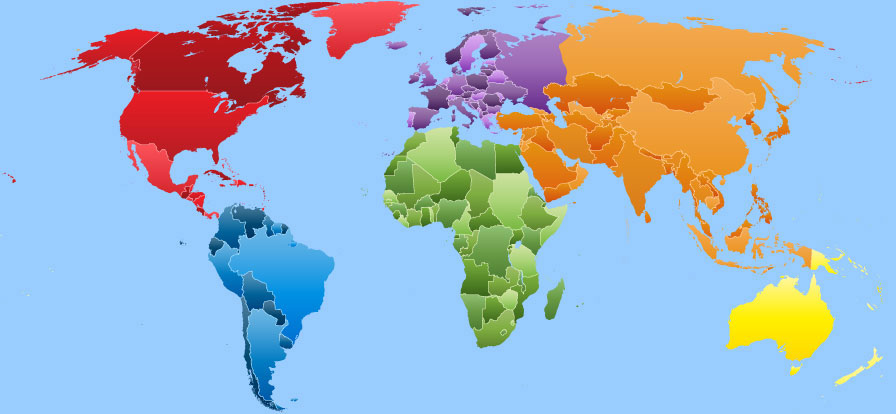
The Division of Continents would be Similar to FIFA's for the World Cup
Now should every film in the world be submitted? Of course not. However, to limit every filmmaking nation in the world to one is crazy. Think of this: Canada gets one submission, which basically means the best Quebecois film goes in because with a majority of Canadian films being shot in English they are ineligible, which is not to knock Quebecois filmmaking. Canada absolutely should get its submission but again you are saying a region of a nation and a prolific nation are on equal footing. They have the same number of submissions that France, the birthplace of cinema gets. So there definitely needs to be more allowable submissions when there are a handful of nations that have a strong field annually.
There are a few ways to go about expanding. Regardless of which plan is enacted the jury needs to be divided and watch the submissions of each continent. The cap of submissions should be five per nation at most. Now if the Academy wanted to control submissions for a while they could allocate submissions to nations based on the “strength” of the nation as a film producer. For example France, Italy, Spain, Sweden, etc., who have been nominated for and won several Academy Awards in this category would receive 5 submissions, and whatever nations were considered the next tier would get four and so on.
Therefore, you’d have a team who have to watch the submissions from each continent. This may seem like a ridiculous idea but one must consider that the deadline to submit your foreign language film consideration is approximately 3 months (late September/early October) ahead of the Oscar nominations. With enough dedicated Academy members all films, even with increased submissions, can be whittled down to a reasonable size (a top 10-20) for larger viewership and voting similar to how its constructed now.
Selection Process

Francesc Colomer in Black Bread (Massa d'Or Produccions) Spain's Official Selection not yet distributed in the US.
So that is how they could expand submissions. Now on to the selection process – firstly, it should expand to between five and ten films and be a preferential ballot like Best Picture (can be) lest the Academy be seen as jingoistic but the selection of nominees should be based on the scores of several viewers. The films receiving a score above a certain threshold (on a scale of 1 to 10 rather than 7 to 10) would move on. Then the remaining films would be seen by all members and the films with the ten, or five, highest scores would be the nominees. It could be similar to the Best Original Song in that way in as much as the films need to be of a certain quality to be considered. What shouldn’t happen is that the Academy feels the need to nominate one film from every continent. This system is meant to find the best films not to represent all regions as if it was the World Cup.
Conclusions

Making some countries pick just one film has always been and will always be wrong based on the quality and quantity they churn out and it should be addressed. Expanding submissions will also open up other categories since at current only submitted foreign films are eligible in other categories and ideally giving some nations multiple submissions would subvert the political machinations that might block a particular film or director from being considered for a nomination. Also, to be considered under a new mode of selection would be at a minimum the removal of the DVD restriction. Anyone with an appreciation for film knows that a theatrical viewing with ideal conditions is preferable, however, it is a bit more time-consuming and restrictive for a voter. I think what should matter is getting all the films in a given phase a viewing regardless of how that occurs.
Implementing any of these changes will be a boon to the Best Foreign Language Film category would be most important. Specifically, expanding the number of nominees many of these films are hardly viewed or get their only boost in the US after a nomination so why not expand?


 The Movie Rat