Mini-Review: Pinocchio’s Christmas

Part of the appeal of this Warner Archive set was that I had never, or thought I had never, seen all the specials on this disc. No other film in this set gave me the feeling of déjà vu as this one. However, I cannot say of that is for real, and even if it is, I cannot guarantee I saw the whole film even if I did see it before. Out of all of these, this is the best example of the Rankin/Bass style the songs and lyrics, and vocal stylings are all top notch. It takes the Pinocchio lore and not only tells a Christmas tale with it but tells only part of the story. It’s an hour-long special that not only fits the allotted running time, but thrives because of it. There is also plenty of humor and wonderful sets. This may not be a household name special but it it on par with the best.

10/10

Review – Home Alone: Holiday Heist

Now, I for one have written on this franchise on this site on a few occasions, once in theory and once when news broke. Similar to the way in which some can engage in auteur criticism, I feel that series and/or franchises can burrow out their own niche and create their own sort of scale. After all, when judging a film for what it’s trying to be the fact that it’s an installment in, or a continuation of, a series factors in.

When I wrote on Home Alone continuing and/or rebooting the idea I was leveraging was the fact that this is now a conceptual series. The series of films is predicated on a kid or kids being caught at home, without their parents, having to defend their house, and ultimately themselves. It almost always had to be that way. Disregarding the fact that in part two Kevin is not home, the fact that he is separated from his family anew is a major challenge to suspension of disbelief. So it was always likely to, and thankfully has, become a series wherein its concept-driven. Thus, whatever the other challenges brought up to each installment how Kevin gets lost again, is no longer a concern. Horror franchises with iconic killers have that issue of trying to bring back their seemingly dead, yet ultimately immortal lead – this is a major encumbrance lifted.

When I wrote about it as a news item it was to confirm that one of my wild postulations was really coming to fruition. I do have a tendency to err on the side of positivity over cynicism more often than not, but I had a few reasons to be optimistic. Based on the casting and story news that came out it seemed like the upcoming film would return closer to the core of what these films are. The series went out on a limb in part three and broke said limb off in part four. This looked like a very promising restart based on early indicators.

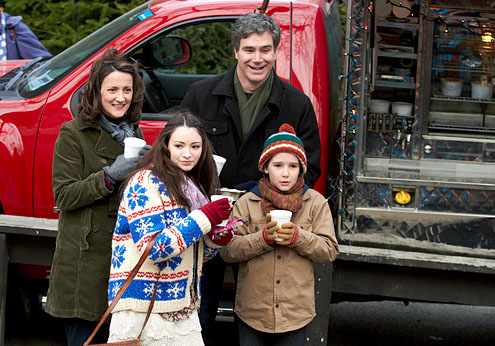
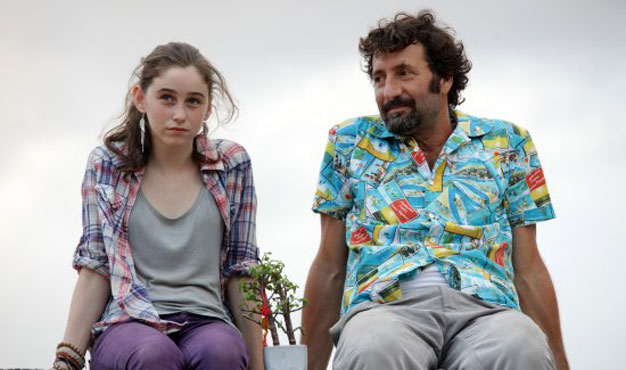
JODELLE FERLAND, CHRISTIAN MARTYN

So? Now, it’s aired, and I’ve seen it, what did I make of it? The short version of it is that there was room for this film to be much more than a decent, enjoyable restart had there been some shifts in focus, both story and production-wise. Having said that after the precipitous slope the franchise was on, this is welcome and refreshing course correction for the most part. It’s just that the potential existed for it to surpass even my modestly lofty expectations.

The best elements of the film are: the booby-trapping motif is introduced prior to the reality of burglary dawning on the characters, the in-jokes regarding the series are plenty good, the performances of Christian Martyn (whose turn in this archetype I’d rank as best barring Culkin) and Jodelle Ferland (whose inclusion and progression adds an interesting dynamic to the film), the dichotomy of Finn’s character and its slight, steady arching; and the presence of the seemingly random neighbor-kid (Peter DaCunha) who does occasionally add humor and plot functionality.

Where the film misses opportunities in narrative is that it tries too hard to shoehorn what it feels are mandatory elements of a Home Alone film such as a misunderstood stranger who befriends the lead and doesn’t have a place to go for Christmas. Yes, there are anticipated elements, but each narrative has its own set of dynamics and fitting molds or formulas at times restricts the tale at hand.

home-alone-5-3

An example of not wanting to fit a mold is giving the crooks a lot more backstory and justification than is really necessary. The emphasis on name recognition for the triad of crooks (Malcolm McDowell, Debi Mazar and Eddie Steeples) I feel is detrimental to the film because they get over-exposed and over-wrought and the parents are under-written and under-represented.

The dialogue misfires quite a few times which is a shame when there are some good situations introduced, but there are the occasional good cinematic touches, which goes beyond the production design, there is the rotoscopic montage of the booby trap prep and some of the set-ups for the crooks are visually intriguing.

I enjoyed this film but what wass perhaps most surprising is that there were opportunities for it to be more than just a pleasant pastime and be a legitimately, unassailably solid upgrade to the sequels that had come to this series that could even serve as a springboard. Shortcomings are almost inevitable in any film, it just seems that they came in unexpected areas here and some harder elements were well-executed and some given less priority. However, it ultimately serves its purpose as a redemptive feature for the series, but could’ve been much more.

6/10

Rewind Review: Coco Chanel and Igor Stravinsky

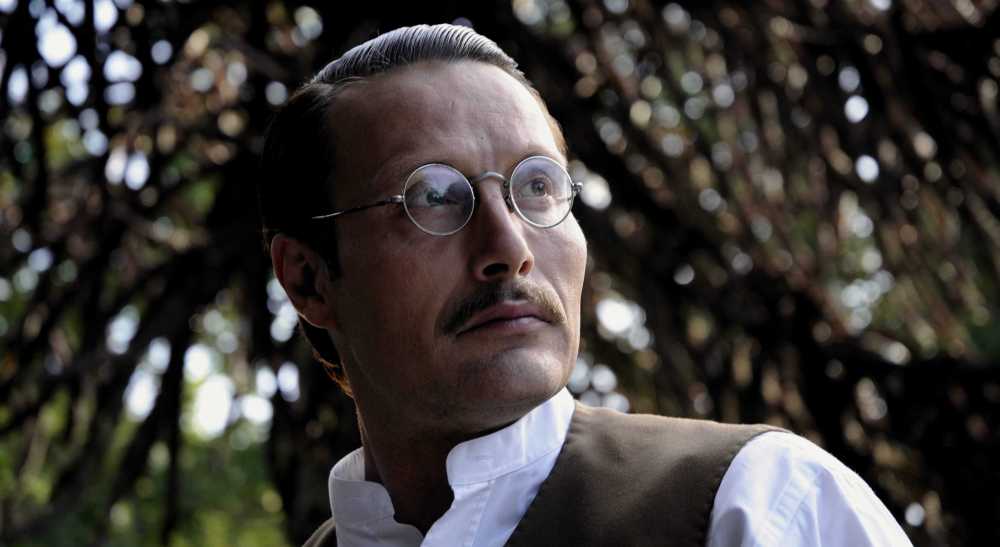
Coco Chanel & Igor Stravinsky is an odd case of a tale, at least as it is recounted in this film, that may have been best left as a historical footnote, or better yet a historical rumor which this is.The set up is certainly one that is loaded with promise. The film begins with the then controversial premiere of Stravinsky’s The Rite of Spring. After which his fame and fortune topple and seven years later he was living hand-to-mouth in a hotel with his wife being seriously ill. Chanel who admires his work offers him and his family residence in her country home. This leads to an affair and that’s about the apex of the film.

The beginning of the film where in we see not only a hint of their attraction between Chanel and Stravinsky but also the fiasco that is the opening of his show in 1913 is nothing short of riveting. However, making a compelling first act is not the difficulty it’s the other two that often present the challenge. This three-pronged beginning is worth noting though. First, there is the pre-show where we see not only him and Chanel but also his pre-show jitters and an intimation of what his family life is like. Second, there is the chronicling of what the show itself was like which is quite something because listening to the music with modern ears it’s difficult to see what is so offensive. The music is wonderful but ahead of its time and thus receives a negative reaction. The last part of the opening is also compelling as you see opposite sides of the then failed symphonic ballet pointing fingers at each other. You have Nijinsky blaming Stavinsky and vice versa with Diaghilev trying to play mediator.

The positive effect that the move to Chanel’s has on Stravinsky’s work is obvious. He is able to compose. The difficulty the film ends up having is in the conveyance of the affair. To be just it doesn’t seem to be unrealistic but that’s where the issues come in. It is possibly too realistic for there to be sustainable drama and conflict that is truly compelling.

JM_MN

The affair begins and they are secretive about it but of course they are discovered, not only do Chanel’s friends suspect, as one scene illustrates, but Stravinsky’s wife and oldest son find out. Not that things need to blow up into melodrama but not enough does happen. Stravinsky’s wife takes it for as long as she can. She confronts both her husband and Chanel but in very subdued ways not making any overt threats or fuss. Again realistic for period but not necessarily making for the best drama.

Also you have an issue in that the two protagonists are quite similar in many ways. They are both driven to succeed in their profession and both consider themselves to be instinctual artists. They are demanding and not very open but physically passionate. When you have two characters who do not wear their hearts on the sleeves you need more incisive, perhaps even intrusive, filmmaking than you get in this film. It is all surface, glimpses beneath are few and far between and the water is murky.

Though you do get interesting time cuts which allow you to see the two in their old age hearkening back to their tryst it doesn’t stir up much emotion because the dénouement in this film seems massive. Chanel and Stravinsky fight, essentially ending their affair but he has work to finish and stays until he does. She attends his opening and applauds as people now appreciate his work. However, their relationship is over and we know it. We also know they will not fight for it. Similarly, Stravinsky’s wife really doesn’t fight for him to come back but hopes that he will.

2009_coco_chanel_and_igor_stravinsky_001

It is unseen but he does go back and there is another failing. You have here a triangle with no real tug and pull. He is never truly torn, we assume he will return to his wife who doesn’t struggle to get him back so aside from seeing the great work both he and Chanel create by the fact that they are mutual muses what else is the tale really telling aside from an interesting footnote?

At one point Stravinsky’s wife cites the effect of the affair on the children but we don’t see it. We take her word for it. On occasion we get a glimpse into how she feels but not enough and the fact of the matter is how she feels isn’t that unique either. She loves him, wants success for him, wants him for only her but knows she can only push him so far.

Whether through adding more points-of-view or perhaps exaggerating historical facts or hearsay something needed to be done to up the ante in this film because all through the film there just wasn’t enough conflict and the outcome of the tale was ultimately a bit too predictable.

6QZY35qqqdhBaMEBfRxGEpergDLzmhqONZzXaPZc9AMYqbRh8OFEbEGYaW8SMWmzY

Some good acting and interesting cinematography is ultimately wasted in service to a script that seems to never want to, and never does, go for the jugular.

5/10

Rewind Review: City Island

Sometimes it seems like fate when you hear about a film. Again this plays a bit into pre-life but this connection is a little more direct as I agree with the sentiments to follow. I had never heard of the film City Island until Jake T. Austin, the actor best known for Wizards of Waverly Place and the upcoming The Perfect Game, tweeted that he had just seen it at last year’s Tribeca Film Festival and said it’s the kind of film he wants to be involved in. Which is high praise from any actor and equivalent to a director saying “I wish I made that movie.”
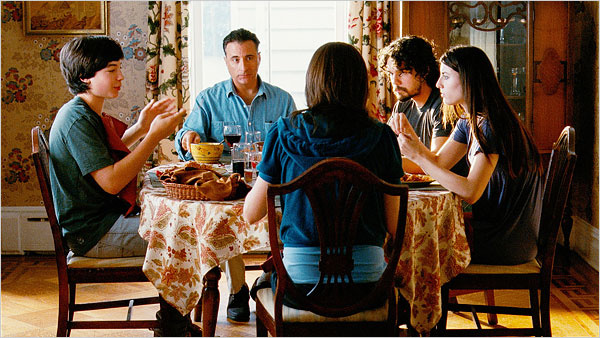
This film concerns itself with the secrets a nuclear family keeps from each other that are unearthed as its patriarch, Andy Garcia, brings home an ex-con who is his son from a pre-marital tryst.This is the best most accurate way to encapsulate the film other cutesy pitch-like attempts give you some but not all of the tale like a partial modern day Greek tragedy with a comedic slant or Secrets & Lies with a sense of humor – both while somewhat true don’t say it all and even the secrets angle borders on hyperbole because what the film is really about is disconnect within a family unit and all members living separately, as if on islands, such that any communication is a task and keeping secrets is easier than saying what’s really going on in their lives.
 
This truly is a cast that is flawless and has absolutely no weak link whatsoever even in the smallest part. First, you have Andy Garcia who narrates the tale and carries us through it we see how he likes to define his existence simply such that anything beyond being a corrections officer threatens his sense of normalcy. There is Julianna Margulies who plays his wife and finally gets a chance to shine on the silver screen in a meaty role after so many successful years on TV.  Emily Mortimer, who even though most of the time she serves to give Vince (Garcia) confidence, has her own baggage and is like those we may meet shortly in life that left something behind for reasons we don’t quite know. Steven Strait as the prodigal son is also an outsider who sees things in this family dynamic so much more clearly than any of them do for he never lived in it. Ezra Miller as Vince, Jr. is the family clown but only because he seeks to break the cycle and not get caught up in the secrets himself and just be himself. There is Alan Arkin’s character whose acting class plays so beautifully into the plot of the film and he even has his own moments of struggle and frustration. There’s also Dominik García-Lorido as their fiery daughter who frequently butts heads with her mom and believe it or not I could go on.
Here is another example of where a film’s setting plays a role as the locale not only serves as a backdrop but it also influences the protagonist’s outlook on life as he defines all people by the local vernacular of Clamdiggers, those born and raised on City Island, and Musselsuckers, those who moved there. It’s more rare for a film to utilize its location to its advantage as a book would as typically you’re trying to disguise one location for another but being the title of the film as well as the location City Island was definitely a strength.

City Island (2009, Anchor Bay)
What does ultimately make this film as successful as it is that it’s a comedy. The drama is there, of course, as it is the foundation upon which all other genres are created but if all these situations are played out and revealed in a straightforward manner it ultimately would lose its effectiveness. It’s because you laugh that it feels more real because some familial situations are so crazy all you can do is laugh.
As demonstrated above where the cast deserves very high praise but note that most of what is mentioned is character related and not performance related. It truly is a character driven piece in which all the people we meet are drawn out and made to seem real. Some scenes are momentarily broken, for example, as Vince is away to build Vince Jr.’s secret/character. It’s the kind of film where one can likely walk away from it identifying with any number of characters. For example, what I found interesting was that to me Vince, Jr. seemed the most well-adjusted or at least the least crippled by his secret. He didn’t panic when Tony (Strait) indicated that he knew his secret and when Vince, Jr. found that the webcam he was watching was across the street he didn’t hesitate to go there. Also, at the end he didn’t hesitate to go outside and see what was happening at his house and interject in the conversation though he was dining with two girls.
This film is truly well-written and directed and is a strong debut that is most deserving of the Audience Award it won at Tribeca last year. Aspiring writers and/or directors should read Raymond De Felitta’s blog on the making of the film on Facebook and Twitter. If you have a chance you should seek this film out. It’s the kind of independent cinema you seek to see more often: truthful and insightful and not different just for the sake of being different- absolutely spot on.
10/10

Review: Off White Lies

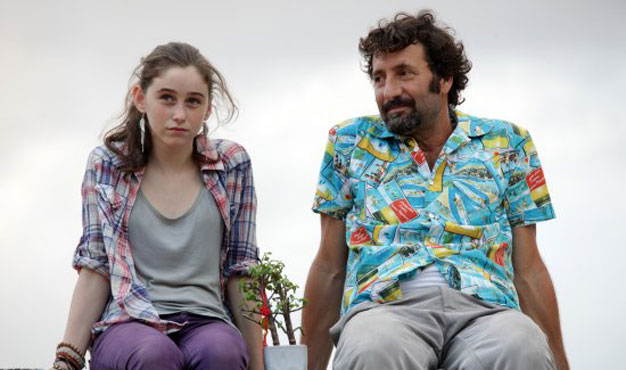
Off White Lies

I find myself commenting on a film’s subtlety quite often. Rather than sounding like a broken record I will expound on that. It’s one think to tell an intricate story without spoon-feeding an audience like say Tinker Tailor Soldier Spy, and another to tell a simple story in a straightforward way. However, to tell a simple story, subtly; jumping in medias res and making revelations indirectly rather than with overt exposition is quite a feat. As is often the case, it’s not necessarily the end destination that matters with a film, it’s the journey. With necessary information being delivered when absolutely necessary and without drawing attention to itself we are allowed instead to focus on the characters and how they interact. This is especially helpful when dealing with a father-daughter dynamic. We see how they interact and the why becomes more and more apparent as we learn more about them.

The story, such as it is, moves rather smoothly ends at an appropriate time and features good performances all around.

8/10

Rewind Review: Despicable Me

Probably the hallmark of Despicable Me is that it has great sight gags and they will hit you very frequently indeed. Whether through dialogue or by visuals this film will have you laughing one way or another and that kind of persistence is something you have to love. It is a surprisingly good film because you may have thought it revealed all the tricks up its sleeve over the year plus Universal has been promoting it but there is more in store believe me.
It is also a film that asks you to take things at face value. It will not bend over backwards to establish this is the universe in which our story exists but instead will show you it. It may be challenging for adults who have to willfully suspend disbelief while children will gladly do so. One thing to keep in mind is that the inciting incident of this film is the discovery that a pyramid has been stolen and been replaced by an inflatable. In a world where such a thing can happen nearly anything can like orphans selling cookies, same-day adoption, shrink rays, etc.

A standout feature of the film was the score and particularly the “Despicable Me” theme song sung by Pharrell Williams. Heitor Pereira has long been making valuable contributions to film scores but his work on this film might be his calling card in the future.

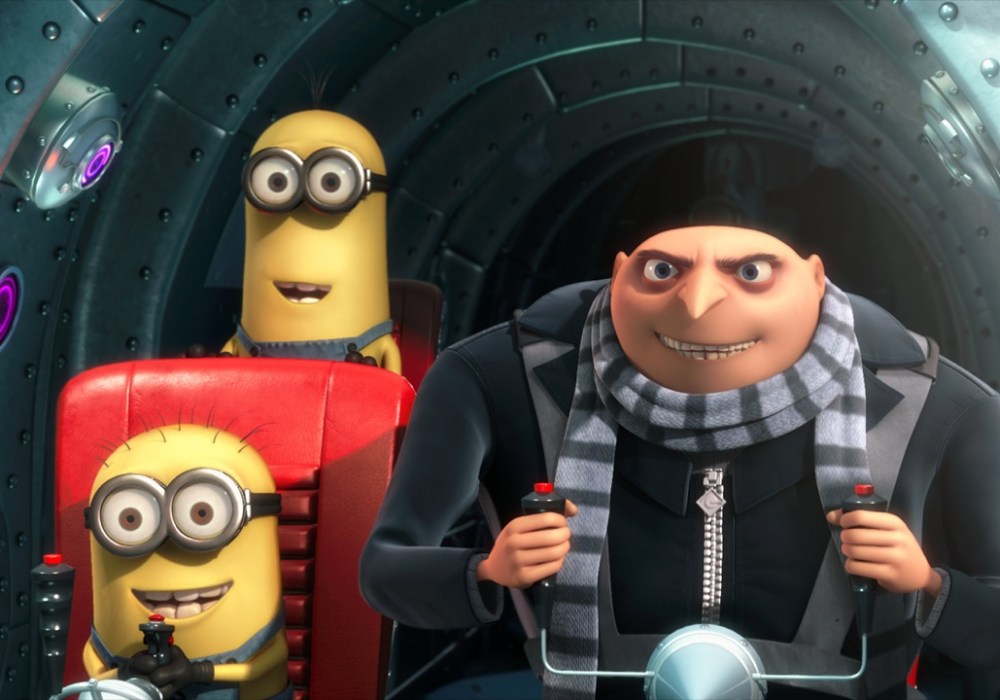
Despicable Me (2010, Universal)

Despite the fact that the names of the actors were heavily advertised as well, the cast does a fantastic job of becoming invisible and blending in to their characters. Examples being Russell Brand who plays the elderly assistant Dr. Nefario. Miranda Cosgrove who plays Margo the oldest girl and you do even stop thinking about Steve Carell as Gru and just see Gru.

This is a film the effectively incorporates flashbacks to illustrate who Gru is on more than one occasion so we can see what his motivation for his lunatic plan is and why he feels he must do it but we also take the journey and start to see his change of heart. It is a film that also finds an extra villain, at least a temporary one, in a somewhat unexpected place.

The film really is ingenious on a number of fronts with its gadgets and gizmos, aforementioned sight gags, with the whole plot about the moon but especially with the creation of the minions. You get here the rare thing created in animation that just you can’t quite classify, you know not what language they speak or where they’re from but they’re just there and it’s great.

Despicable Me (2010, Universal)

The creativity and the quality of this film again illustrates how the animated feature is flourishing. About the only thing you can hold against the film is that Gru doesn’t explain that he didn’t call the orphanage, you understand he is torn at the moment but considering the character he is dealing with she could’ve been even more forceful in taking them back leaving him feeling worse.

Even with that Despicable Me is a joy to watch from start to finish and one of the summer’s most pleasant surprises and was, overall, a more throughly enjoyable experience than Toy Story 3. This film will likely be the most entitled to feel robbed should the Academy’s love affair with Pixar continue.
8/10

Rewind Review: Orphan

Orphan promises, at least conceptually and in the trailer, to be a potential classic of the genre but unfortunately this film was marketed much too well for its own good. However, one would not expect it to be one of the dumbest, lousiest and most asinine films of any kind to be foisted upon the American public this year.

The film starts awkwardly both in acting and dialogue and to top it off in a clumsily handled dream sequence, and at this point it’s hard and uncompelling to start with a dream just for one truly unsettling image of a blood-soaked crying baby. Just because Fellini did and could start a film in a dream sequence doesn’t mean we all should. After all we’re not all Fellini are we?

Okay, perhaps even invoking Fellini’s name in this instance is blasphemous, however, it was to illustrate the apex of what they were trying to accomplish as compared to this lame-brained, stilted mess they presented. Bad is one thing but dumb is another and that comes next. So the dream reveals that the baby is stillborn, a lot of set up for one bit of back-story. Hence, let’s adopt. Their trip to the orphanage starts with Sarsgård delivering two awkwardly written “Snow Orphan” jokes about a snowman. It was just the beginning of a terribly odd, unconvincing, portrayal of this character in writing and performance.
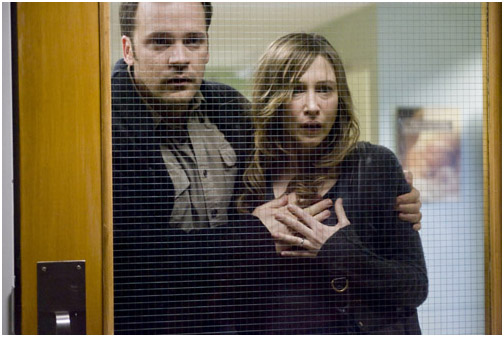
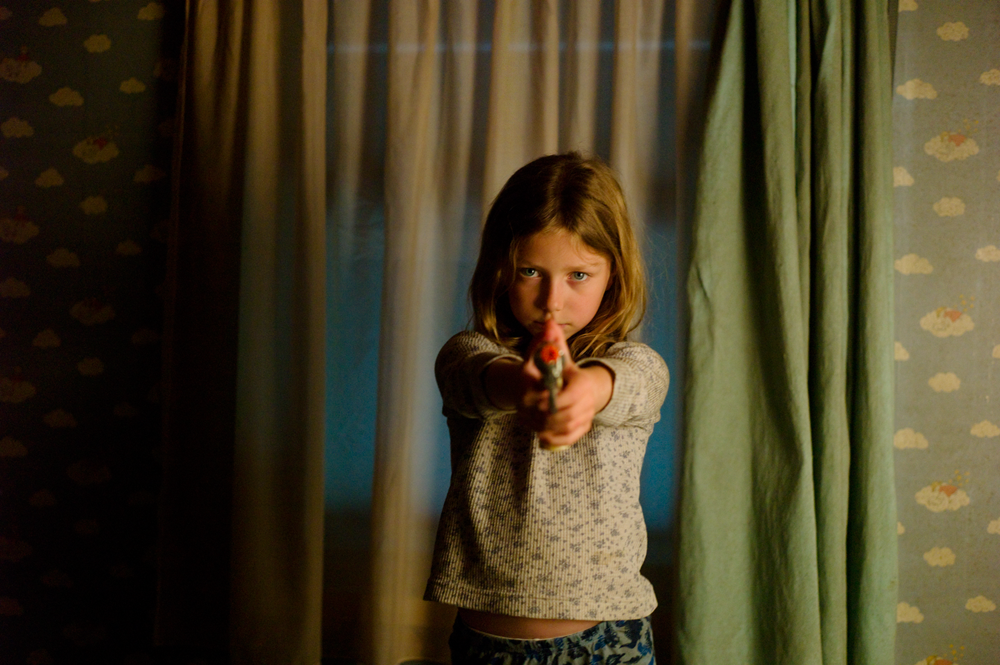
Orphan (2009, Warner Bros.)

The sound mix on scare attempts and screams was just too loud and ineffectual and created near humor. The film also decides to incorporate clichés starting with Esther singing “That’s The Story of Love,” in a droll attempt at irony that only makes the film more annoying not just because the singing is flat but because it is delivered in Esther’s subtle yet annoying Russian accent – it’s also only vaguely Slavic until identified, which is also somewhat inaccurate as Eastern European accents are by no means interchangeable; this is more about writing and directing than acting. Fuhrman was consistent with it at least but the accent was worse than stereotypes because it’s milquetoast.

In bad movies even simple lines go wrong like when the Nun informs the couple Esther’s parents died in a fire, their response “A fire?” Yes, a fire. It happens – you watch the news.

It would be wondrous if horror films didn’t feel the need to include gratuitous sexual content. I emphasize gratuitous. This is not about prudery, but common sense. A couple with three kids all in Elementary school, by my best guess, would not canoodle about their kitchen pornographically so that they could get caught. Yet in the world of this movie they do and were caught. Didn’t see that coming. The conversation about “Mommy-Daddy Time” in the kitchen leads us to our first hint at the twist, unfortunately hindsight doesn’t make that conversation or the coital scene any better or any more logical so these little hints are better referred to as “clues,” in quotes, because they don’t really standout as brilliant touches after the twist.

Orphan (2009, Warner Bros.)

Now we come to the cliché of horror film characters just being too plain dumb to deserve to live and for your edification not enough of the people in this film that should die do. The body count I believe is just three. The parents are a little too slow to catch on. The mother (Vera Farmiga) goes from not suspecting a thing to suddenly having theories as to exactly what Esther’s problem is before taking her to a shrink, the shrink whose character is so dumb and is portrayed so annoyingly we won’t even discuss her except to point out the fact that movie psychologists should not be portrayed as dumb and useless because they’re not necessarily perceived that way and an incredibly brilliant psychologist is a tremendous weapon in a film and has been wielded well by many. The mother’s arc, however, is better than the father’s who is the worst horror cliché there is to the very end: The Doubter.

The Doubter is always the worst character, especially when very involved in the story for this reason: we as an audience are cognizant of the fact we are seeing a horror film so we immediately believe “Something’s wrong with Esther,” or whatever the given doubted fact is, so the slower the characters are to believe it the more annoyed we are apt to become. A great example of an unobtrusive doubter is in Halloween. The Doubter in that film, the Carpenter version, the original, is the Sheriff, Lori never doubts longer than is logical and at one point is lying to Tommy for his own good in her mind as she is doubting her safety. The Sheriff is such a minor character that him trying to thwart Loomis’s efforts at hunting down Myers never gets irritating because Michael and Lori are front and center for a bulk of the film. In Orphan The Doubter was in the family and all too present.

There are also these past incidents that creep up that would make a suspicious mind jump quicker such as some kid she used to go to school with “accidentally stabbed themselves” with a pair of scissors and the house fire that killed her parents was arson. Accidentally stabbing yourself with a pair of scissors, the way that’s phrased, makes it as transparent as saying someone “accidentally” hit themselves in the back of the head with a claw hammer. It’s ludicrous.
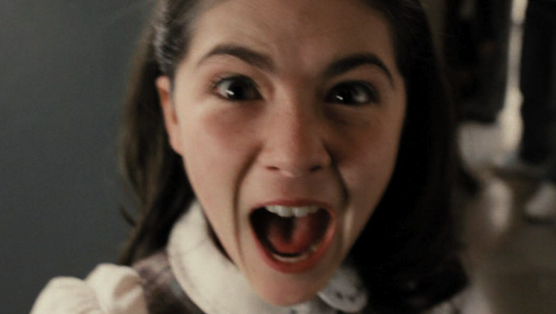
Orphan (2009, Warner Bros.)

One of the few nice touches was that a picture of the orphanage Esther drew glows in the dark to reveal a fire and deaths. This is quickly negated by having her plaster the walls with drawings and making a glow-in-the-dark pornographic mural, which makes it twice as bad as if the execution of the first drawing was off. The only other highlights are also counteracted by the terrible story but are worth mentioning. In horror film standards Vera Farmiga is very good in this for what’s worth. It would’ve been easier to appreciate her if her character wasn’t a dunce, that shackled her and Skarsgard in quite a few ways. On the other hand Jimmy Bennett’s character always hates Esther and about midway through you want him to take a hatchet to the whole family but unfortunately he doesn’t. He survives and the boy better known as the Young James T. Kirk does get more screen time here and thankfully, for his own sake, is hospitalized but alive in the third act.
Another case of dumbness: Esther gets mom really annoyed, mom twists her arm. Later Esther sticks her arm in a vise in order to break it. Dad believes mom did it. Really? Did you watch mom? Is it possible? I guess. Improbable? Yes. Yet the vise would leave some sort of marks, correct?

Another one: It is discovered Esther stayed at some clinic in Estonia. How? Her picture was online. On an asylum’s webpage? “Look at our crazies”? Why would an inmate’s photo be online? These are just some examples of the excessive demands on our suspension of disbelief that we as an audience are asked to accept. When one is not entertained or scared one can’t forgive such obviously flawed logic.
There actually is more, however, let us cut to the chase. The twist. I’ll give it to them for gambling but here are the problems there: first, the movie was already horrible or not in everyone’s mind so the twist either elevates it or makes it much worse. Even looking back at the scenes that did somewhat set the table like Esther trying to seduce her adopted father it didn’t work on any level. That scene was portrayed callously because the director mishandled it and had it played too innocent by Fuhrman and too passively drunk by Skarsgård, who only really told her off on her second or third attempt. The Heart is Deceitful Above All Things had a very similar style of scene but a much different situation and it was handled so much better. It was disturbing, repugnant, powerful and heartbreaking all at the same time and yet you couldn’t not watch it.
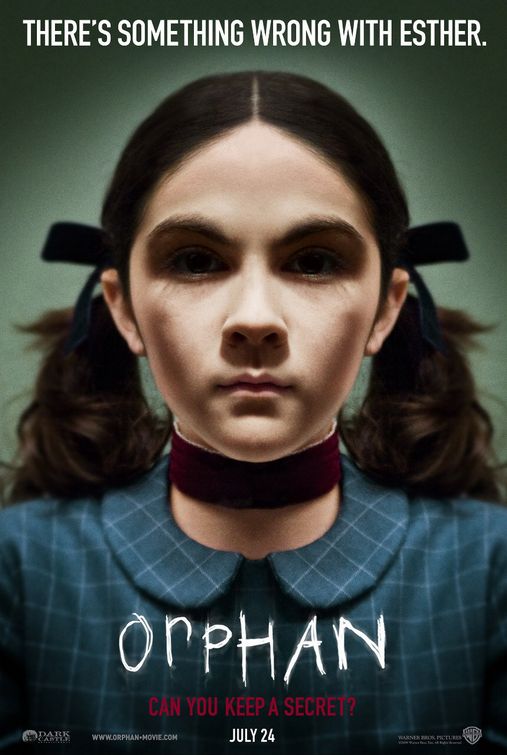
Orphan (2009, Warner Bros.)

Also, the twist is sort of an anti-climax. Is that the kind of modus operandi that makes you say “Brilliant, it practically writes itself?” No, it’s too convoluted. What purpose does that serve really? Is it shocking? Could be. It could also be humorous. As much as it was mocked later for being such a catch phrase no one laughed when they heard “I see dead people.”

A lot of people saw this movie coming out and thought of The Good Son. Well, surprise! It’s not. It’s worse, so much so. If you want The Good Son go rent it, I already have it. Skip this, I wish I did.

1/10
Review: Bloody Knuckles

Bloody Knuckles is the kind of movie where pulling together a coherent review from the seamless insanity it is will prove quite difficult. However, I will do my best to convey to you all just how fantastic this film is.

Firstly, I try to avoid like the plague hyperbolic superlatives upon first viewing a film that I may lament later. Yet there are two such thoughts that came to mind with regards to this one that with further reflection seem to prove to be more and more true. Firstly, it is the best satirical horror/comedy since The Stuff (1985), and in a more unique feat it’s the best film featuring an anthropomorphic severed hand I’ve ever seen.

Bloody Knuckles tells the story of an underground comic book artist, Travis (Adam Boys), who believes no one deserves to be untouched if they’re fit for satirizing. After lampooning a local crime boss, Leonard Fong (Kasey Ryne Mazak). He is then targeted, and has his right hand amputated forcibly. Depressed he thinks he will never draw again until he gets an unexpected visit from his hand!

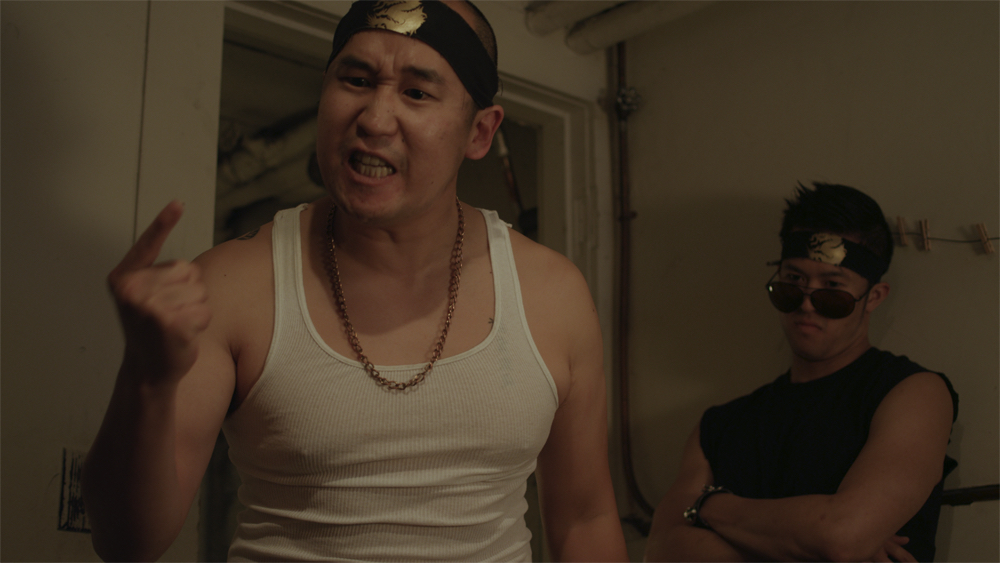
Bloody Knuckles (2014, Artsploitation Films_

The teaser of the film sets it up beautifully and my word the song choice for the opening title sequence is inspired (I will not spoil it). It’s a song that works twice as well if you know it but still fits regardless.

Next there is through the course of this film one friend who cam to mind who I would recommend it to (and did), and one person I would want to screen it for (and I hope to).

In terms of humor it is quite funny. It’s Silly, vulgar, and with a message not unlike Kevin Smith’s films. I nearly laughed through the last scene based on one joke alone.

Bloody Knuckles (2014, Artsploitation Films)

Yet even with all the irreverence to be found in the title it is also a tautly structured gem. The horror and superhero elements on point; circles closing, left, right, and center. Not only that but with silly gags the temptation to go off on a tangent can be huge. This film does not do that instead it features well thought out, useful, illuminating subplots.

Bloody Knuckles has to be considered among the best of the year, and it likely to make quite a bit of noise at the annual BAM Awards. It’s a brisk rollicking good time that doesn’t play it safe and is all the more hilarious, thought-provoking, and intriguing because of it.

10/10

Rewind Review – Resident Evil 3D: Afterlife

Resident Evil 3D: Afterlife is likely to go down as one of, if not the worst film of this year. Whereas I was able to point out in Step Up 3 what could’ve been of more emphasis to make it a better more enjoyable film with this one I am at a loss. For the sake of full disclosure I am not one who unabashedly hates this series. I have seen all the installments and the ones previous while teetering in the land of mediocrity (scoring 5/10, 6/10 and 5/10 respectively) none of them lead me to believe this was in the cards.

As has been typical in the series acting took a holiday, however, given a decent amount of action a coherent plot and a story with a satisfying resolution this would be no issue. However, this film insisted on there being a lot of acting. It was a film where our protagonist Alice (Milla Jovovich) was alone a great deal and talked to herself quite a bit along with doing a bit of voice over. Not only that but there is a great deal of exposition done about the characters she meets each of whom has more annoying traits than the other which are carried out with varying degrees of ineptitude. Even in some very bad films there’s usually an actor you can single out and say about them “So-and-so is better than that.” That’s not the case of this movie no one rises above the material and makes an indelible impression due to the virtuosity of their acting ability.

There is at the beginning very minimal exposition which could leave those not ensconced in the mythos of this series a little loss but things do eventually clear up and you’ll realize there is truly nothing truly significant is going on. It’s almost incomprehensible to imagine how stakes which are so high on paper can be made futile through the execution of the script and the film.

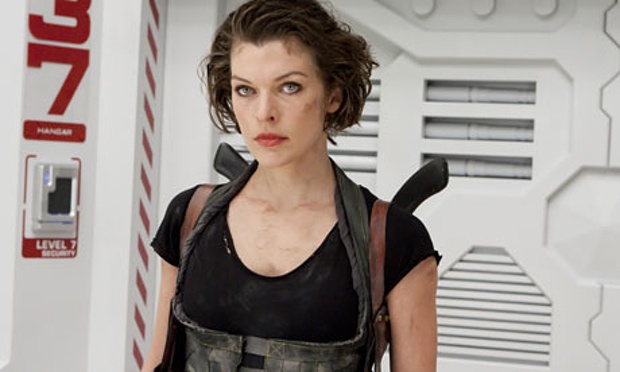
Resident Evil: Afterlife (2010, Screen Gems)

For at least two-thirds of the film they are in a building which is surrounded by countless zombies and never have the undead been more ineffectual. You hardly ever see them except at a distance until they breach the building. They should be omnipresent we should be able to hear them rattling the fence and moaning en masse into the night but instead everyone is so terribly blasé about it you forget they exist. They fear their fellow man much more, which is all well and good in theory but none of them seem to pose a true threat that we the audience see the threats are only perceived by characters.

The characters, for the most part, are short-hand stereotypes of different types of celebrity and occupation and few have any real dimension and based on the display we get it is unlikely any of these players could convey it if they did have depth.

Another trick of the tale that we are forced to sit through which only belies the laziness and lack of imagination trying to mask itself as cleverness is a few cases of amnesia about.

Resident Evil: Afterlife (2010, Screen Gems)

Bad is one thing but bad and predictable is a whole other can of worms. Much of the journey is to try to find this mystical safe haven referred to as Arcadia. At first it is thought to be a town in Alaska then it turns out to be a boat where there is supposedly no infection. It should be rather obvious from Alice’s landing in Alaska that the search for this haven is like Ishmael chasing Moby Dick and sure enough it is.

There is not a redeeming quality to be had in this film at all. The effects are passable and the 3D is fine, however, seeing CG that doesn’t induce laughter and 3D that doesn’t make one’s eyes hurt shouldn’t be a positive it should be a given. This film was shot in 3D so it should look good in 3D. Not an accomplishment, that would be like complimenting a Director of Photography for having proper exposure on all his shots. That’s what’s supposed to happen.

As mentioned before this is one of the worst films of the year and one of the biggest wastes of time to boot.

1/10

Review: Little Glory

Little Glory is a coming of age tale, wherein the two leads are forced to come to grips with their family’s state, and taking on adult responsibilities far too soon for the both of them. What proceeds is part custody battle, part intrafamilial strife.

Little Glory gets a move on quite quickly. The inciting incident wherein Shawn (Cameron Bright) and Julie (Isabella Blake-Thomas) are orphaned comes early and is dramatically portrayed in a highly cinematic way.

The film starts off with a rather overt, in-your-face conflict between drunken father and son, and then proceeds to tell more nuanced ones wherein information is strategically withheld, internal conflicts that are mostly unspoken, and revelatory discussions between brother and sister. The emotion of the piece is easily accessible and highly engaging.

IsabellaBlakeThomas

Much of that is underscored in a not-too-overt scoring by Michelino Bisceglia who lays the groundwork without force-feeding emotion. The reactions expected from the audience will come from the parameters of the narrative and how well we are lead to identify with the plights of the characters.

Cameron Bright, who was BAM Award nominee as a young actor, most recently seen in Twilight series, is perfectly cast in this film as the seemingly gruff slacker whose tough façade belies a sensitive soul underneath.

It’s not too often that a film feels the need to have a special “introducing” title to call attention to a gifted young performer in their first significant film participation. However, Isabella Blake-Thomas definitely earns this distinction.

CameronBright-HannahMurray

What this film ultimately is, is a maturation rather than a traditional coming of age. What I mean by this is that there is a coming to grips, an acceptance of the reality of their situation that must be dealt with rather than a universal platitude, or a commonplace trip through a struggle to newfound peace.

You may be one who thinks a film set in Michigan, shot in Canada, produced by France and Belgium (among other countries) that waited four years to get its North American release on DVD may not have much to offer, but you’d be selling this film short.

Little Glory has the narrative bones of a film in the week that may appear to just be disposable. However, there is an earnestness to be found within, and a universality that allowed this story to be transplanted across the Atlantic from where it was originally set. It is surely a film that’s worth looking out for and giving a shot.