Short Film Saturday- Moonrise Kingdom Animated Shorts

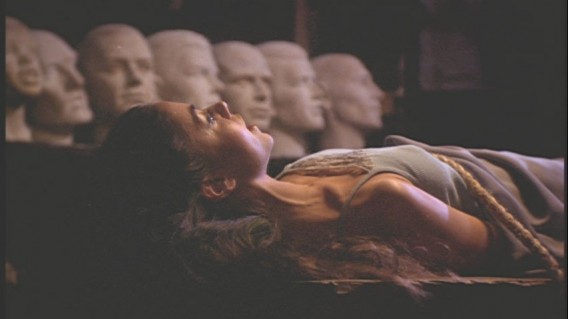
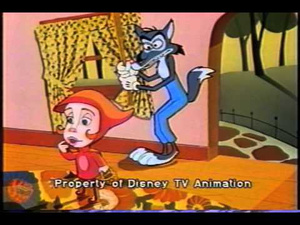
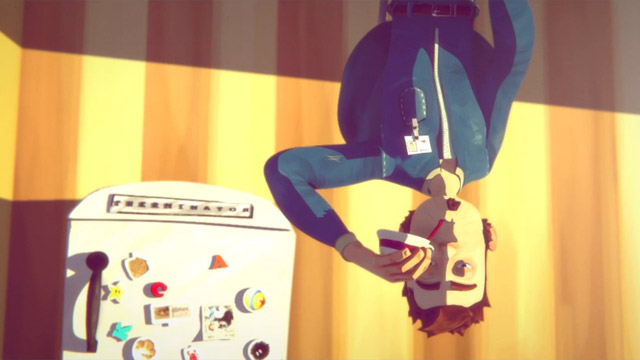
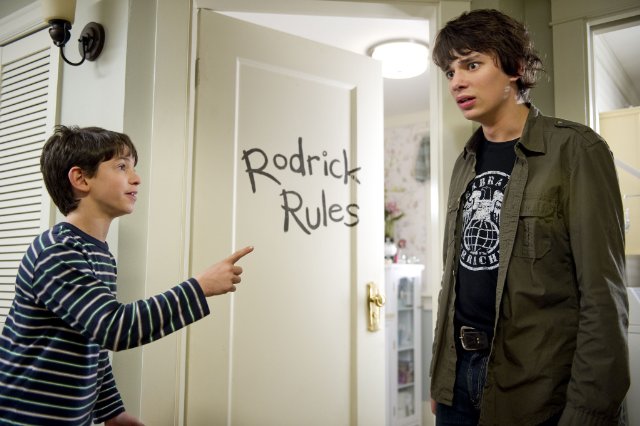
Wes Anderson’s film Moonrise Kingdom, which will be reviewed here shortly (Hint: I liked it), features six fictitious books that are Suzy’s (Kara Hayward) favorites and she reads from constantly. Aside from having a heroine who is an avid reader, thus encouraging reading in general, the film is also very creative in making these tales. Not only does Suzy read aloud from these imagined tomes but different artists were commissioned to create the covers and also animate this short film, which is not only entertaining, but gives you a glimpse into the world of this film without spoiling it.

Enjoy!

Review- Men in Black 3

To be entirely honest, I was not planning on watching it but circumstance conspired such that I did. I, like most people I believe, did enjoy Men in Black when it first rolled around. As this latest installment was coming down the pike I was hearing chatter about it compared to Part II, and count me in the camp of those who have no recollection of Part II whatsoever, and based on what I’ve heard that’s all for the best. This is all a very long way of saying that this film wasn’t playing with house money with my being a fan. Conversely, it was also coming sixteen years after the last Men in Black that I do have some recollection of, so I was pretty much an open book.

The only news items I heard that made up my pre-life with this film were the ridiculously overblown reports of Lady Gaga and Justin Bieber being aliens, which constitutes their likenesses appearing on background monitors in the beginning.

Ah, the beginning, what an ungodly mess it is. Apparently one of the old screenwriting axioms doesn’t really apply here; there’s nothing easy about getting through this first act. It is slow, stilted and uncertain of itself until the mission is embarked upon. What’s perhaps even more perplexing is that the film does get better but the beginning is slow and bad such that it makes recovery difficult. Needless to say that when I discovered, after having seeing it, that principal photography began and the script had not been finalized, I was not surprised in the slightest.

It’s also a bit like that half-baked ethos carried through post-production in regards to the edit. There are two neuralyzer scenes that make little to no sense, add no humor and do not really advance the plot in anyway. In fact, they’re so dubious that even Will Smith seems as if he’s just going through the motions in these sections. Whereas that doesn’t necessarily really ring true for the rest of the film. In a film that has such issues getting off the ground any other extraneous material’s impact is multiplied. Not even to mention the fact that there is a severe shortage of humor in this particular installment, there are chuckles to be had but there’s nowhere near the level of fun that these films are supposed to engender.

The more enjoyable moments in the film are provided by Josh Brolin’s hilariously deadpan take on Tommy Lee Jones and Michael Stuhlbarg’s wonderfully quirky Griffin. Jemaine Clement, who is usually hilarious here is more intent on being creepy as Boris the Animal, and while that succeeds the film could’ve benefitted from a bit more levity, especially given the ending.

When your film already has its issues and is only minimally interesting things like the nearly unavoidable time traveling paradoxes that arise are allowed to occupy more of your attention than they really ought to.

Given the fact that portions of the second and third did work on an intermittent basis, it’s really unfortunate that this film proceeded full speed ahead instead of righting the ship before they got rolling. As it stands, the film is an unfortunate mess that’s a waste of time and talent.

5/10

The 2012 Embarrassed To Say Festival

The 2012 Embarrassed to Say Festival

This is a project I likely should’ve undertaken sooner, but now more than ever it is easier to tackle a lot of the massive films I’ve yet to see. I can likely continue doing it every year and hopefully (eventually) the titles will become more and more arcane to the common filmgoer but no less bothersome for the film buff and/or filmmaker.

However, Edgar Wright the very talented director and great film enthusiast has said something quite true on his Twitter, in response to apologetic fans having seen Scott Pilgrim vs. The World, only on video, “It’s never too late to watch a movie.” That’s the spirit in which I’m undertaking this venture.

In spite of that sentiment there will be films on this list that I have to grin and bear admitting only now having seen so I offer you this explanation in preamble:

My conscious desire to be in film blossomed much later for me than with most, the pure love of it was always there. Therefore, what I want to see has always been a strong impulse as it is with many. However, once one becomes a student of film you quickly learn there are those titles you ought to see and if you haven’t already seen them watching them on your own, later on, can seem like homework. Whereas in school screenings were the best class assignments you were given, homework is a bothersome thing, no one liked homework, not entirely, and the assignation of necessity to something that ought to be a pleasurable and visceral experience alone can make one reticent to watch certain films. In fact, in the schools I attended I saw the disillusion many students felt as they could no longer enjoy films for they analyzed them to much.

I remained steadfast and can control hyper-analysis during viewing and do that legwork after the fact. This is an elongated and roundabout way of saying that some films I have avoided in part because of their stature, for fear that watching them would be more like work than pleasure or conversely for as important as they might be in a historical or technical context I’d not be moved by it in a narrative sense.

Well, the time has come and the access to some is so ready that I’ll bite the bullet on many titles this year (ideally at least 52) and I hope you the reader either get a chuckle of what I’ve deprived myself of thus far or find something new to look for, ideally both. And who knows maybe even undertake this challenge yourself.

Without further ado the films…

1. Apocalypse Now (1979)

Marlon Brando in Apocalypse Now (United Artists)

Reasons I Hadn’t Seen It:

War stories are tough to watch.
Running time.
Rather informed by a making of and needed to distance myself from that viewing.


Expectation Going In:

I had forgotten much I’d learned about the plot so all I really expected were a few scenes I knew of and brilliance.

Reactions:

At times mesmerized, others horrified and befuddled. A film that works brilliantly on an intellectual and visceral plane and as much as I wanted to see the theatrical and “Redux” cuts before they left Netflix I could not deal with seeing it twice in two days.

10/10

It’s been far too long since I updated this post but I figured when I do it had better be a doozie. So how does a Hitchcock film strike you. Now, I did add a new Hitchcock both during 31 Days of Oscar and since, but this one is a big one that is a worthy successor to the aforementioned film.

2. The Birds (1963)

Reason(s) I Hadn’t Seen It:

I have seen bits and pieces of The Birds, and like any Hitchcock film (any good film) it’s not an experience meant to be fragmentary. My avoidance of The Birds always came back to a philosophical quandary: How effective can it be when the film openly acknowledges there’s no real catalyst, at least not one blatantly indicated in the story, as to why the birds are attacking? In a B-Film (This is not one, I’m merely contrasting) that deals with animal attacks there will be the discussion as to why, perhaps too much and perhaps the explanation satisfies and perhaps it doesn’t, but it’s there. I was never sure how well it’d work for me, especially stacked up against other Hitchcock films.


Expectation(s) Going In:

Guarded, to say the least, yet hopeful that it’d be the best rendition of the story at hand, and potentially bulldoze my reservations.

Reactions:

The first thing that really struck me is the importance of the MacGuffin in this film especially. The MacGuffin is really just a device that is used as an excuse to tell the story, but in The Birds, without the flirtation and the new-found connection the two protagonists share, without her coming to Bodega Bay, meeting people; essentially introducing herself into a new family, it’s hardly different than many animals attack movies. However, you do spend that time building characters, relationships and attachments, the story is about them, and the attacks of the birds mount incrementally. They come intermittently and with growing intensity.

The lack of scoring was something I knew about going in but I must say that it really does contribute to making this film as good as it is. It’s not going to work for every film but a certain intimacy and terror are built in just by hearing the flapping of wings.

I am a bird-lover, member of Audubon and all that but I take no issue with this film in that regard particularly because of how Hitchcock executes it cinematically. Birds aren’t usually a feared animal, so to transform the sound of a flock of flapping wings into something fearful is quite a feat.

Hitchcock’s is a filmography with so many greats, and so many personal favorites that many overlook, that it’s hard to gauge this film, even in the context of his canon, but it is undeniably solid and effective.

8/10

Reviews in the Gray Area 2012

Last year I posted an article of this type as well, you can read it here. Essentially what the Gray Area is with reference to this site are films that were out in 2011 that I could’ve gotten to see and just didn’t get around to. They always exist and it’s usually the awards season wherein I will view a vast majority of them, should others come along the way throughout the year I will add them here but this particular post should be active through the first quarter of the year or so and then gradually grow inert. So while I can’t include these films in either last year’s BAM Awards or this year’s and they remain in the gray that does not mean they do not deserve some sort of attention.

For an indication of what the scores mean please refer to my rating scale.

Tinker Tailor Soldier Spy

Gary Oldman in Tinker Tailor Soldier Spy (Focus Features)

Had I not read that Thomas Alfredson (Let the Right One In) directed this film I would’ve figured it out at some point and that’s due to the film’s pace and construction. Tinker Tailor Soldier Spy is not an easy story to convey on the screen. It’s the type of film that has to put forth a very difficultly-attained and nearly intangible fascination that is usually the sole purview of spy capers and whodunits wherein you must be simultaneously enthralled by the intrigue of the narrative and rapt by the film such that you can keep pace with it, on a mental level. I specify that pace because the temporal pace of the film is rather interesting. In a film such as this it’s information that’s flying at you tinged with foreboding and a sense of a gyre closing such that the story cannot speed along at a brisk 90 minutes but must unfurl at a more leisurely 120 yet also still have enough incidents within it to hold that bifurcated attention it’s worked to create. The film manages that easily and keeps the pace rather steady and the facts quick in coming. Even when in flashback sequences, which there are many, though the cuts may be quick the information does not overwhelm. That is not to say that a second viewing wouldn’t make the film more enjoyable or that nothing will be missed, I certainly can’t guarantee that as the film does play things close to the vest often but it does easily connect a lot of seemingly disparate incidents such that a vast majority of facts, and how the conclusion that occurs is reached, becomes clear. In the end whatever vagueness the film may have is not something one can find in anyway distasteful as it recalls to me Bergman’s quote:

I don’t want to produce a work of art that the public can sit and suck aesthetically… I want to give them a blow in the small of the back, to scorch their indifference, to startle them out of their complacency.

I have always taken that to mean that he wanted people to be moved one way or another by his work and if you’re actively trying to piece this film together and succeeding or failing it won’t bore you to the point of indifference I feel and I think it’s riveting.

9/10

Alvin & the Chipmunks: Chipwrecked

Alvin & The Chipmunks: Chipwrecked (20th Century Fox)

Now in the interest of full disclosure, which I believe in, I will say “Yes, I am a Chipmunks fan.” These characters without question are divisive. There is no middle ground it seems you love them or you hate them. Being a fan I was surprised to have liked the first film (just barely) and very sorely disappointed in the second installment. Where I feel things went wrong the second time around wasn’t in the introduction of the Chipettes but in doing so spreading itself too thin amid myriad conventional plot devices. That’s not to say that this installment breaks ground with some unconventional plot machinations, however, it does combine a few old hat techniques creatively and it focuses heavily on the Chipmunks and the Chipettes and on their character. Furthermore, while maybe having fewer musical cues than before it functions more like a musical than the prior two installments seeking emotional veracity in spotting songs rather than literal locales. By having the Chipmunks and Chipettes pushed to extremes and assuming different characteristics than expected this is the first tale of the three that feels fully realized especially since it restrains Dave, who was overly-involved in the first two. It’s also interesting that Cross’ somewhat listless turn is somewhat elevated by his recent ranting.

7/10

Coriolanus

Oh, how I wish I could cite the Titus Conundrum as an exception here, but I cannot. What I mean by that is that I did know of Coriolanus at the end of last year and its having opened at the Ritz theaters in Philadelphia in late 2011 made it eligible for the BAMs last year. To make a long story short, I could’ve seen it but I did not. Therefore, it cannot carry over into 2012 unlike some films, which I had no legitimate chance of seeing last year, like We Need to Talk About Kevin for instance.

There are many facts that this film crystallized in my mind: first, it is much easier for me to watch Shakespeare, even if going in cold, than to read it. Seeing some sort of visual accompaniment provides a context that in a way allows me to focus on the words, the inflections used and in so doing I interpret rather rapidly. Whereas with the text, it’s you and the book and you stare at the words, glance at the footnotes and not having a framework of production there’s a bit more mental legwork to do to break down that barrier, to surpass the wonderful linguistic acrobatics and capture the meaning.

The second fact was a bit more interesting, as I have now for the fourth time seen a cinematic adaptation, which took liberties in updating the visuals of the story, quite a few things became clear simultaneously: While I certainly take no issue with a film that wants to take a literal period approach, I love the creativity that these modernized renditions show. Perhaps the biggest facts they underline is the timelessness of Shakespeare’s themes. In Coriolanus, for example, the names of the characters and the city-states remain the same. If looking at the text I would wonder what on Earth is a Volsci and where is Volscica, not that those questions are invalidated, but with this rendition that portrays Ancient Rome in a modern yet alternate reality, it’s easy enough to understand; Rome is a huge Empire, Volscica lies on the outside, they are an enemy state.

Coriolanus, like many a Shakespearean tragedy I’m sure, excels due to the fact that you not only understand the tragic figure’s flaw, and to an extent identify with it but circumstances constantly conspire to shift characters from one side to another, power play opportunities abound and each and everyone is taken, plots and counter-plots are always afoot.

With the implementation of news television as a major narrative device, combined with televised senatorial debates, even the peculiarities of Roman politics become not only easily accessible almost instantly but the entire story resonates so much more as a modern political allegory than it would be allowed to as a period piece.

The performances are exceptional and what also allows the film to be quite relatable is that the nucleus of dramatis personae is not as large here as in other Shakespearean works, at least in terms of major figures as they are presented here.

Essentially, Coriolanus as envisioned by first-time director and lead Ralph Fiennes and multi-talented screenwriter John Logan is a film that is likely to be an awe-inspiring experience for neophytes and die-hard Shakespeare fans alike. I know hearing from people on either side of that fence made me want to see it and after another invigorating adaptation I am certainly seeking to brush up on my Shakespeare further.

10/10

Review- Peace, Love & Misunderstanding

Peace, Love & Misunderstanding has a simple enough set-up: in the very first scene a husband (Kyle McLaughlin) asks his wife, Diane (Catherine Keener), seemingly out of nowhere for a divorce. The second scene is the dinner party they were planning for and he seems his normal petulant, pedantic, socialite self and she’s affected. While the legalities are being straightened she decides to take her kids; college-aged Zoe (Elizabeth Olsen) and high school student Jake (Nat Wolff) to Woodstock to stay with her long-estranged mother. As they stay their the difficulties of reuniting and illustrations of why Diane left become readily apparent.

So the foil is established early inasmuch as you have in this tale a hippie mother (Jane Fonda), who still very much embodies that lifestyle and a conservative, attorney daughter. The film does well to arc a majority of its characters. This film is a bit like Boy because it’s not so much about all of its characters changing, but more about accepting your family for what it is. Fonda’s character won’t change, as adventurous as Diane gets on the odd occasion she fundamentally will not either, it’s really a progression of learning to accept and live and let live on the other side of the mother-daughter relationship. Zoe is an interestingly drawn character; seeing as how she’s a college student she is open-minded and politically aware, at least in theory, but meets people who challenge her preconceived notions in a very creative way. She is at a crossroads more than once in the film, and must decide if she’ll be more laissez-faire or more rigid, seeing as how she’s torn. Then there’s Jake who is perhaps the most deftly written character because he is awkward around girls he likes, tells mostly inappropriate jokes with his sister and takes his documentarian ethos wherever he goes (and sometimes makes mistakes in that regard). However, it is he that makes the most incisive observations in the film but he doesn’t express them verbally.

He expresses them through his free form poetic short film that debuts at a short film festival in the story. We see the entirety of the film and many of the scenes are spliced back creatively in juxtapositions that seem apropos of nothing when looking at just one pair of joined images, but as a whole the short serves to illustrate that in spite of the lunacy and at times chaos that transpired between the family members during their time away it was evident all the way there was affection amongst all members of the family there was just difficulty in expressing it.

So while having a few characters not fundamentally change, at least not yet, makes the rendering of drama a bit more difficult the relationships do work as a whole. What was not even a family per se before this film started; now is one. While the nuclear family fractures, the extended family starts to re-solidify and working a number of characters together, leaving them at peace with one another is something and quite true: their may be a truce but each individual will still have his or her own baggage.

The progressions aren’t instant, or in a bee-line, a bit like reality it’s two steps forward and one step back. However, there are gaps being bridged throughout the course of the film.

Of course, these relational dynamic would hold no interest, and would not be allowed to build as they do, if it were not for the performers inhabiting the roles. If the actors inhabiting these parts are not sufficiently interesting then the struggles they’re in will not be either, and each player in this film excels in their part. Jane Fonda has been infrequently on the big screen in the past few years, alas this is a role and a narrative truly worthy of her talents and she truly shines in the film. For her part Keener seems a bit too perfectly suited but she does do well and plays brilliantly off of Fonda, which is half the battle. It’s not Elizabeth Olsen’s best role, partially due to her screen time, but there are no small roles and having an actor so gifted in a supporting part is truly a blessing for any film. The male performers in this film for the most part take a backseat to the ladies, which is rare but that is not to say they are insignificant. I discussed Jake’s character above but the interpretation by Nat Wolff is quite natural and adept. Some young actors don’t have the reflexivity to play the inherent awkwardness of certain situations that come with the teen years for whatever reason be it range, their type, direction. Yet, everything he does works whether it be his flippant innuendos, self-deprecating humor, aloof artist mode or being painfully shy around a girl. Jeffrey Dean Morgan has a charm and confidence that is just enough to be very convincing as the free spirit who could get to someone like Diane. Some actors, or some other casting decisions, might place too strong a personality opposite here. He is winning but subtly so, not forcefully persuasive, which makes him harder for Diane to resist. Now, Chace Crawford does have to be an equal to Zoe as Cole, for nothing else would be so disconcerting to Zoe as someone who not only challenges her beliefs, but is as strong a personality as she is; and he succeeds most easily.

Peace, Love and Misunderstanding is most definitely a character study. However, it’s not a talking heads drama. There is visual interest and the short film does add some artistry in the edit. It’s a film that will have you think on it a bit and the kind that got a little better as I wrote this. It’s definitely worth a shot.

7/10

Review- Snow White and the Huntsman

Snow White and the Huntsman is such an odd case. Based on the way it handles the oft told legend it has a lot of promise, however, this film has a weird handling of its two titular characters inasmuch as it seems to run from them both. At the start, yes, it is the hunstman (Chris Hemsworth) who is doing the voice over for the necessary backstory segment that kicks the narrative off, but there are a few unfortunate things about it: first, this is one of the higher points of the film and it’s a brisk, but not rushed beginning portion. Second, after this part the Huntsman is lost for a while until the queen commissions him to retrieve an escaped Snow White. Which brings us to the young princess, her dialogue is sparse throughout, her involvement until her escape is minimal and she drifts into the background more than any would-be protagonist in recent memory.

Is it just sloppy plotting and writing or is the fact that the film wanted Kristen Stewart involved for box office appeal, but didn’t want to hitch their wagon to her alone? She has a moment here and a moment there, but the big military speech falls short of what it should be and her physicality issues persist. No actress on the face of the earth has a mouth so persistently agape for no discernible reason as she does and few emote so little facially, at least in the roles I’ve seen. I’m not going to avoid seeing something merely due to her presence, but I have yet to see this other side of her that her staunch supporters keep citing.

However, as I said, the film is rarely about either of its two named characters, at times this is a good thing and at other moments it’s a failing. Charlize Theron is broad in her role as the evil queen as if she just fell out of an old Hollywood melodrama. I think that’s something most of us can agree on. I, for one, absolutely love her performance and find nary a misstep in it. At the very least someone, is bringing energy and commitment to this film, and more often than not I found her scenes rather chilling.

Much of the conversation has been about the performances thus far because there is little else holding this precarious piece of work up. The pace of the film is decent up until about the midpoint when the dwarfs are introduced and then the film gets a bit unfocused, lost and extraneous. The narrative does pick up again eventually but never recovers from this unfortunate area. This section also introduces the odd production choice of having average size actors be the faces of the dwarfs. I’m really not sure why it’s deemed necessary, and it is a distraction.

The cinematography, scoring and production design of the film were all really quality components that could’ve truly elevated this film to its potential had the narrative it was supporting been up to snuff. The beginning of the tale works best because it’s in storybook mode and frames the queen as much more of a power-hungry madwoman than say, Disney did. The stepmother queen in either tale is motivated, it’s just that this film explains the motivation a bit more. Where it develops her plot and psychology it works, but little else is substantial here at all, which is not the case of the animated version, or even some others for that matter. Where it sets up Snow White’s initial struggle it works, but it loses her along the way, as it not only fills in blanks but colors outside the lines, so to speak, and adds running time and trivially valuable sub-plotting with the love triangle that evolves. The richness it builds is soon watered down by excess.

Snow White and the Huntsman
starts with a few clear objectives but then becomes occluded and can no longer see the forest for the trees and like many travelers in this imaginary world gets lost in a dark forest, and all hopes of its being a quality piece of work perish.

5/10

Comparative Analysis: The Dictator (2012) and The Great Dictator (1940)

I have often said that I do not enjoy indulging in comparative analysis when writing a standard review. Sometimes it does come up by I try not to focus on that aspect. However, there will be the rare occasion where the comparative analysis angle is far more intriguing than a standard review, so I have taken it here. I hope you enjoy it and welcome comments.

After having seen The Dictator a thought occurred to me that would invariably shift the tone and direction of the piece I wrote regarding it and it would thus not be a traditional review. The thought was as follows: The Dictator is like Sacha Baron Cohen’s own take on The Great Dictator. Now before proceeding with this line of reasoning allow me to state unequivocally that I am not for a second equating Cohen to Chaplin. What I am saying is that the parallels that this film shares with the one made 72 years ago are rather hard to ignore.

Frankly, I could also write a little more on this topic and explaining why this film does work to the extent that it does and find that this is a much more interesting dialogue than “How funny is this?” as that’s quite the subjective question, and “How does this rank in Cohen’s canon thus far?,” ibid.

Now, this might seem a rather facile allusion at first but what most intrigued me about this thought was the absolutely refractory nature that this tale has and that it makes The Dictator not only true to its time but as true to the artistic force driving it as The Great Dictator was.

The first confluence that the two films share is that there is a rather overt political message being delivered in the film. Each fits the tone of the actor and the film perfectly aside from being a necessary oration for the political climate in which it was spoken. Chaplin, the silent star, who resisted the advent of sound with fervor eventually, slowly gave in. The Great Dictator was his grudging embrace of the new form. That’s not to say Chaplin didn’t make it a visual venture, as this film features the iconic playing with the globe scene but it does also have the memorable speech, one of the most brilliant pieces of acting ever committed to celluloid. The silent star has a stump speech wherein he not only wears his heart on his sleeve but belies the fact that he is a double for the dictator.

The Dictator does have its own double aspect, however, as the title indicates, it focuses on the dictator rather than the double, and the speech here is given by the dictator not the double. The speech, as opposed to being heartfelt, goes from being tongue-in-cheek to sarcastic to the near equivalent of a bit from The Daily Show or The Colbert Report, the 21st Century replacement of the political cartoon. Chaplin’s speech was made during the darkest moments of the 20th century and was a message of hope, whereas Cohen is speaking in a world that alternates between great apathy and great fervency, where there is much conviction with little to no information despite the ready availability thereof. In the end, his is a rather even slam of both sides showing the warts totalitarianism and capitalism have.

While Cohen’s tale creates a fictitious nation meant to capture the foibles of as many leaders of Aladeen’s ilk as possible, Chaplin’s is clearly a caricature of Adolf Hitler, and has the additional layer of being a personal statement by Chaplin on his own behalf, who had for years been a presumed Communist by Hoover’s FBI.

While the cinematic quality of either is never going to be confused, I will reiterate that each reflects their lead perfectly. Chaplin was every bit the dramatist, the sensitive artist as he was a comedian, he’s cinema’s crying clown, only he’s unlikely to frighten small children. Cohen is broad, crude and if he’s left a member of his audience un-offended he feels he’s failed in his mission. His style is a perfect reflect of the excess and vapidity of the global political scene in this day and age. This is not to say that decisions of today’s world leaders do not carry weight, but while the world is always in the balance we’ve rarely come so close to the brink of global devastation as we did in World War II. Therefore, the tone of events allow for greatly contrasting tones in the films.

Cohen’s film taking place in a world that is not completely and totally at war allows there to be more societal commentary here, namely in the person of Zoey (Anna Faris). It’s not subtle and it doesn’t always work perfectly but she is the personification of what I referenced above: much conviction with not enough information.

The insanity of World War II also lead to the creation of the United Nations, what was essentially supposed to be a more effective solution than the prior League of Nations. In some ways it has been, in others not as much, this is also a notion that this film toys with quite a bit. Whereas The Great Dictator tackles the Nazi notion of Aryan superiority foremost, then the major players of the Nazi party and then the party’s constructs. The tertiary commentaries of The Dictator vary from totalitarian mindset, to post-9/11 paranoia, the year of protest and more.

While very different tonally, in terms of comedic and dramatic effect it would be fascinating to see these two films as a double feature and further compare and contrast them, but there are some of the most apparent parallels that I found upon one viewing of the newer film.

For the record, there is a bit of inconsistency in The Dictator for my liking. The laughs stop long enough so you notice some of the sillier plot points so the most I can give it is a 7/10. Having said that, I clearly found method to Cohen’s madness such that I took up this tangential association as the most interesting way I could find to discuss it. No film is perfect but there are few films in this day and age that even have something to say, and no matter how crass the method of delivery or how silly the context that does mean a great deal, and I definitely appreciated that.

Review- Battlefield: America

The weekend of June 1-3 was one that was rather filled with movies practically no one had heard of until very close to the weekend. This is rather unusual for a summer movie release slate but I suppose part of it had to to do with not over-spending when you’re heading up against Snow White and the Huntsman. That’s where Battlefield: America comes in. All of a sudden, on Thursday I see it plastered all over the IMDb and I had no idea it even existed previously, nor that it was likely playing anywhere near me.

After viewing the trailer it seemed to me to fall into the so bad I had to see it category, however, what was so surprising and disappointing after having seen it is that it’s being bad was really easily avoidable but there were myriad sloppy, lazy mistakes, which mostly had to do with story more so than any production value, that could’ve made it passable.

Many of the issues fall into the logical follow-through category, example: Sean Lewis (Marques Houston) is established in a series of walking shots as a boss so feared that his employees has someone on the street radio that he’s coming up, yet later on everyone’s all chummy with him, giving him love advice, telling him to quit the community center, etc.

The inciting incident here is that he’s ticketed for DUI and has to do community service and mainly that entails coaching a dance battle team (a team that in the opening credits is pretty good then suddenly become the Bad News Bears of dance). Here’s the next failing on a few levels: the film knows we know how this story goes so it gets a little too cocky making Sean a huge jerk, and yet as bad as he is he softens and we’re supposed to buy that completely, and also that the Sarah (Mekia Cox) falls for him, not once but twice and that the kids come to like him, also not once but twice.

As if Sean’s predictable regression to his former self isn’t enough, the film also chooses to shoehorn in additional extraneous conflicts, namely: one of the boys mothers suddenly comes in late and takes issue with him dancing and spouts a lot of circular logic about why her child can’t dance that even she can’t sound completely convinced of in the end. There’s also the obligatory rival dance crew and their leader who is the only person in the film playing it like it’s a parody.

Then you have a couple of issues with the dancing itself, which in a movie essentially about dancing is quite troublesome. They are twofold: First, a lot of the times the handheld cinematography combined with the overly-anxious editing style make it hard to absorb and appreciate the dancing itself. Proof: I went with two other people and we all had different interpretations of how well or poorly the two main squads did in the final. The second issue is that not quite enough is done, either in dancing or cinematically, to fully convince me of who won.

It kind of goes without saying that the acting is inconsistent at best, however, that is far from the biggest issue that faces this. In fact, there are many instances where that’s about all that makes it watchable.

The cardinal sin this film commits really is over-complicating things. It’s a case where simpler would’ve been better. Where smaller would’ve been better two as the two rival dance teams face off in several rounds leading up to a national final, where they’re the two finalists, really? The film runs about one hour and forty-six minutes and I think many of the films sins would’ve been expiated in excising 16 minutes or so and another couple could’ve been dealt with in reshoots. As it stands the film is well-intentioned but messy beyond repair.


4/10

Review- Keyhole

Keyhole is a film by Guy Maddin. If one knows Guy Maddin then one knows precisely what this means. If one is not familiar with him then you will soon find out precisely what this means. To begin to get some sort of grasp of the significance of that statement you can visit either of the aforelinked posts. Now what precisely is Guy Maddin’s latest like?

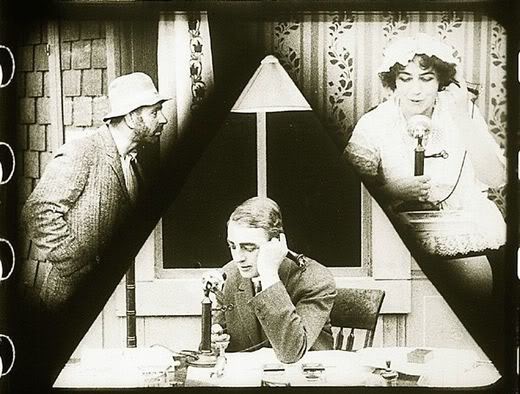
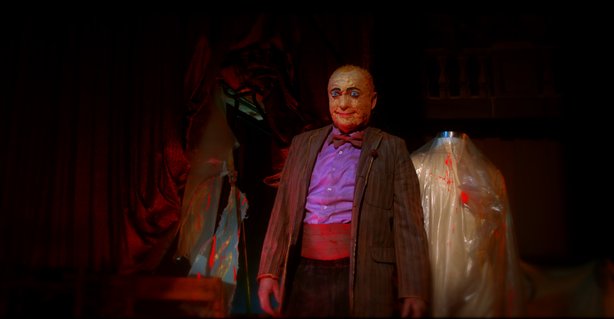
Keyhole is a black & white, horror/comedy melodrama, which is a widening gyre that goes from a very cloistered, guarded tale and unwinds into one that is a rather effective and is nearly pantomime. The loop that the world revolves in and the roles these characters play, the unusual ways the characters behave in soon make themselves evident and as they do a seemingly fragmentary tale begins to tell other tales and history by implications.

With a film such as this, which is so unorthodox, the pacing thereof will be a precarious balancing act and a difficult thing to navigate, however, while not brisk the film does manage to move at a relatively steady pace. The incremental repetition of certain visual motifs and snatches of dialogue don’t bog the story down and serve as markers to an extent. One must also acknowledge that there will be a certain amount of disorientation that will need to be surmounted that also affects the speed of mental processing that this film requires.

Key to establishing the surreal and other-worldly tone that Maddin seeks in this film is the scoring, which is wonderful in this film. The score provides an anchor which keeps the film grounded in some sense of constancy and gravitas as the dialogue, images and scenes get all the more wilder as they are slowly unfurled and deciphered.

Another aspect that gives the film a sense of tempo is the edit. This is a film where you can almost predict the cuts by metronome. Here is where Maddin imbues the film with much of its frenetic energy. Surely, the pace of the cuts frequently belies the flow of the narrative, but it reaches a rather constant speed that pulls the story along with it. While such a discordant bit of technique may seem a distraction it mostly serves the film well as another steadying force.

The guardians of this arcane world that is partially occluded are the actors as they must do something very difficult, which is to play rather broad types but still resonate with the audience as people, transmit that they too are trying to uncover mysteries and/or not seem as they are obviously hiding something. With such affectations in the making of the film and stylizing in the narrative it can be most difficult for an actor to convey true emotions but the cast throughout manages quite well.

I find it important to seek reasons to justify the usage of color, even if the choice between color and black and white is a rather anachronistic one in this day and age, however, I hold the inverse true: if a film is shooting in black & white is it truly exploiting that choice; is it seeing and portraying a world that can only be conveyed monochromatically? Here I say the answer is an emphatic yes. There are tableaus and mise-en-scène designed the way they are because they fit a black & white landscape similarly many of the actors look like they were born to be shot in black & white.

Keyhole is not the most accessible film in the world but it is a nut that can be cracked with patience and focus, whether you know Maddin or not. Clearly, if you are familiar with him you’ll know what to expect better than most and your appreciation of it may be greater.

8/10

Review- Chernobyl Diaries

The nuclear incident in Chernobyl is one of the most unfortunate events in modern human history. It’s effects are far-reaching in terms of both distance and time, as the illnesses caused by radiation spread far and wide. Lest you confuse this with a Wikipedia entry that’s about as much as I need to say up front save that the Chernobyl incident is one I learned a great deal about and have a tremendous amount of sympathy for. Therefore, despite the fact that it’s rare, this was a film I was likely to be sensitive to in the horror genre. However, I went in hopefully, as horror cannot play it safe and I was rather surprised that this angle hadn’t yet been taken.

One of the few things I can happily report is that the film is not overly-exploitative. The deliberate pacing of it, the restraint it shows and the fact that it takes the point of view of a group of American tourists looking for an extreme locale make it much more palatable.

However, that is not to say it works entirely. The film works to about its midway point and then it starts to seriously degenerate into typically silly, dumb tropes that are only half-baked and highly illogical. Granted Hitchcock had a very valid point about feasibility, and it usually doesn’t come into play in horror, but what I mean is it seems the consequences of the exploration could’ve been greater and more logical simultaneously, so why not do that?

The set-up works very well and what’s more the acting is quite good. I speak frequently of acting when it comes to horror films because quite often it is not a prerequisite for this kind of film, or many actually, to have exceptional thespians to work on a narrative and technical level. However, this film has no weak-link that stands out in that regard. Particularly effective is Jesse McCartney, who not only plays the requisite Doubting Thomas but also spends a good deal of time injured. He is a talented actor who should be getting many more chances to show what he can do aside from being my favorite Chipmunk.

The film thankfully doesn’t take the found footage approach but there are a few unusual decisions visually. Some of them work well, some of them not so well. When the tour group is first threatened we watch the first search part go out from afar, see muzzle flashes, hear off screen noises but we eventually lose them. In a vacuum it’s an effective tactic, however, combining it with how minimal the rest of the film is it’s regrettable in hindsight. Towards the end there looks like there’s an incredible fight and struggle. The shame of it is I can’t see it because of the crazy handheld swish-pans and frenetic editing. The handheld camera in modern cinema is perhaps the biggest double-edged sword. Much vitality is added to action shots with the jostling that goes on, with the proximity that we get to the subject, but the pace of the edit needn’t be as frantic as the framing if we need to see something.

The climax of the film and the conclusion is so unsatisfying it nearly taints all that preceded it. Now, it’s is by no means The Devil Inside but perhaps this would’ve been a case where a few more incidents and a little less explanation would’ve made a bigger impact. The film falls close to over-explication than under and perhaps less truly would’ve been more here.

The Chernobyl Diaries
simmers for a while and never really comes to a full boil, which in the end leaves it tepid and a bad taste in your mouth.

4/10