Super Bowl Movie Commercials

While with each year the hype and price surrounding Super Bowl commercials grows one other aspect that becomes increasingly significant is the advertising of films during the game. A Super Bowl ad for a film is the biggest opportunity of the year for simultaneous impressions that a movie has and which films go for it and what impact they make is interesting to consider. Below you will find links to the ads that played during the game this year. They run the gamut from Act of Valor which opens in just a few weeks to two of the movie events of the year The Hunger Games and The Avengers.

Did some of these ads do more harm than good? You are the judge for now. Time and the box office returns will tell the ultimate story but considering the Super Bowl is where I got the first glimpse of the tone and awesomeness of Super 8 the significance of these ads in marketing terms should not be underestimated.

21 Jump Street

http://www.springboardplatform.com/mediaplayer/springboard/video/ci035/39/434487/

Act of Valor

http://www.springboardplatform.com/mediaplayer/springboard/video/ci035/39/434619/

The Avengers

http://www.springboardplatform.com/mediaplayer/springboard/video/ci035/39/434555/

Battleship

http://www.fandango.com/fplayer/player.aspx?mid=130096&mpsguid=2192855347&dm=3&genre=Action/Adventure,&rt=&title=Battleship_-_Super_Bowl_:60_TV_Spot&w=620&h=349&emb=user

G.I. Joe: Retaliation

http://www.springboardplatform.com/mediaplayer/springboard/video/ci035/39/432393/

The Hunger Games

John Carter

http://www.springboardplatform.com/mediaplayer/springboard/video/ci035/39/431121/

Dr. Seuss’ The Lorax

http://www.springboardplatform.com/mediaplayer/springboard/video/ci035/39/434621/

What My Film Reviews Mean

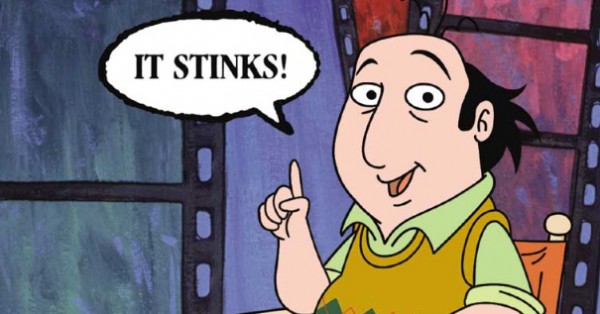
The Critic (Gracie Pictures)

In many ways it’s more important that people read the following than My Rating Scale for it will allow you to understand my philosophy on film criticism:

Anyone who claims they have nothing else to learn is a liar. Part of why I have found my time film writing valuable is because I am constantly learning and re-learning things because you can never really stop. Similarly, I will never disable commenting (no matter how much I may want to at times) because on occasion there will be a thoughtful reader who will engage you in an actual conversation and make you examine your thought process and have you come to realization. It’s not even a question of being right or wrong about something but just understanding how you reach your conclusions or a truth you couldn’t put into words yet, an epiphany if you will. Recently when discussing my piece on Extremely Loud & Incredibly Close I realized my philosophy on film reviews is as follows:

I just try as accurately as I can to convey what my feelings are and why such that the reader can draw his/her own conclusions. I never presume my opinion to be more “right” I just always try to logically explain it.

That’s as simply as I can put it but I’d add the caveats that I’m not a fan of synopses in reviews (they can be found in many places, I’d go to official film-related sources for those), I am also by the above definition not a consumer advocate in strictest terms. Many times when I read a well-written review someone’s reasons for disliking it will compel me to go for I know I may like it for those same reasons. The key to choosing critiques to read is clarity of opinion and not taking the writer’s word for it. There will be no one in the world who shares all the same thoughts on films as you. We all have slightly different perspectives. Therefore you want to find someone who can accurately convey rather specifically why they liked/disliked a film and read them. No one reviewer’s word is gospel.

Lastly, and this is a little similar to the above, while I apologize for this, I also cannot and do not provide parental advice regarding appropriateness of material. There are myriad reasons: first, each parent has his/her standards; two, the MPAA’s standards may not be yours or mine regarding appropriateness (they may either be too strict or too liberal). Third, it’s not something I often consider in terms of a review. If you ask me in a comment I will do my best to address specific concerns of profanity, nudity, etc. However, for better sources the IMDb usually has a parent’s guide for titles with very detailed explications of things that may be objectionable and also there’s Lights Camera Jackson the “kid critic,” who always comments on family friendliness of titles he sees.

I appreciate your readership and welcome intelligent discourse and just wanted it clear that my aim is to state opinion not shape it.

The Oscars Should Change Its Best Foreign Language Film Processes

Antonio Banderas and Elena Anaya in The Skin I Live In which is not Spain's entry therefore ineligible for the Oscars (Sony Pictures Classics)

The official submissions for Best Foreign Language Film are now in and the nominees, like those for all other categories, will be announced on January 24th, the shortlist will be announced today. The list of submitted films does immediately indicate some issues with the nomination process in this category that should be addressed.

The Process

This sections facts were clarified with the help of this Hollywood Reporter article.

Here’s how the system works:

Each nation through its national film board creates a list of contenders and then the constituency therein picks one film to submit for Best Foreign Language Film. Each country is allowed one submission, chosen by its film board. Sixty-three films have submitted this year. Some noticeable omissions this year include: Albania’s first pick, Joshua Marston’s Forgiveness, was disqualified because it didn’t have enough Albanians in key behind-the-scenes roles, which Marston calls “ridiculous.” Similar grounds were used to to knock out Angelina Jolie’s debut In the Land of Milk and Honey because it was so international no one country claimed it, however, those sort of casualties occur yearly and are a bit harder to legislate against but I will address them.

The Academy’s foreign-language selection committee, which consists of any Academy member prepared to sit through many a film, are divided into four color-coded groups, and each member must see at least 80% of the pictures in his/her group.

Few active members have the time this requires, which means older and retired members figure heavily among the voters, which can factor into the strategy of selecting a film the avant garde will stand less of a chance. Hence, Greece’s selection of Dogtooth last year and Hungary’s The Turin Horse stand out as bold selections for bravery.

Approximately 300 members vote, grading films on a scale from 7 to 10, and their scores are averaged, meaning if 10 people or 100 see a movie, it’s their average score that counts. There’s no weighting that takes into account that X film got many people to watch it.

The top six point-earners qualify for the shortlist.

The nine-title shortlist includes three additional films chosen by a 20-person Executive Committee led by producer Mark Johnson (The Chronicles of Narnia).

This additional provision was implemented in 2008 after the broader committee failed to select 2007 Cannes Palme d’Or winner 4 Months, 3 Weeks and 2 Days. The super-committee consists of such prominent figures as director Florian Henckel von Donnersmarck, cinematographer Janusz Kaminski and writer Michael Tolkin.

Once the nine films are named, they are screened during one weekend for 20 invited voters in Los Angeles and 10 in New York. Those voters comprise a few random Academy members and others specifically named by Johnson, who attempts to find a distinguished range of Academy veterans across all fields. They decide the five nominees, which are unveiled the same day as the other Oscar nominees, Jan. 24.

After the 5 nominees are named the vote is held as such: Any member can vote on the winner but must give proof that he or she has seen all five nominees, voters can only see the movies in a theater, not on DVD because as Johnson asserts “In a perfect world, nobody should be seeing movies on DVD.”

How it Should Be

The National Film Board Level

Some may look at this process (with one submission a nation) and say “Well, what’s wrong with that?” While it is egalitarian, it is exclusionary to some extent. Countries like France, Italy, Spain and India (and others) with large quantities of film production and a lot of good product to offer have to pick one, and only one film and with that one choice the submission could be more political. It can be based on who the filmmaker is, what the subject matter is, how appealing it might be to the American viewer, instead of what it should be based upon – the quality of the film.

Aside from one film knocking out another contender from its own country like Au revoir les enfants being submitted in 1987 and Le grand chemin being overlooked, not that the former shouldn’t have been nominated but both should have, the problem with the current system is that there is not a true representation of what the Best Foreign Language Film is, it is the best from amongst the submitted films.

How does one go about solving this? There are a few ways. The Academy has juries, viewers and voters for all categories. What should happen is that this group should be expanded so that more films can be submitted.

The Expansion Plan: Submission Quotas

The Division of Continents would be Similar to FIFA's for the World Cup

Now should every film in the world be submitted? Of course not. However, to limit every filmmaking nation in the world to one is crazy. Think of this: Canada gets one submission, which basically means the best Quebecois film goes in because with a majority of Canadian films being shot in English they are ineligible, which is not to knock Quebecois filmmaking. Canada absolutely should get its submission but again you are saying a region of a nation and a prolific nation are on equal footing. They have the same number of submissions that France, the birthplace of cinema gets. So there definitely needs to be more allowable submissions when there are a handful of nations that have a strong field annually.

There are a few ways to go about expanding. Regardless of which plan is enacted the jury needs to be divided and watch the submissions of each continent. The cap of submissions should be five per nation at most. Now if the Academy wanted to control submissions for a while they could allocate submissions to nations based on the “strength” of the nation as a film producer. For example France, Italy, Spain, Sweden, etc., who have been nominated for and won several Academy Awards in this category would receive 5 submissions, and whatever nations were considered the next tier would get four and so on.

Therefore, you’d have a team who have to watch the submissions from each continent. This may seem like a ridiculous idea but one must consider that the deadline to submit your foreign language film consideration is approximately 3 months (late September/early October) ahead of the Oscar nominations. With enough dedicated Academy members all films, even with increased submissions, can be whittled down to a reasonable size (a top 10-20) for larger viewership and voting similar to how its constructed now.

Selection Process

Francesc Colomer in Black Bread (Massa d'Or Produccions) Spain's Official Selection not yet distributed in the US.

So that is how they could expand submissions. Now on to the selection process – firstly, it should expand to between five and ten films and be a preferential ballot like Best Picture (can be) lest the Academy be seen as jingoistic but the selection of nominees should be based on the scores of several viewers. The films receiving a score above a certain threshold (on a scale of 1 to 10 rather than 7 to 10) would move on. Then the remaining films would be seen by all members and the films with the ten, or five, highest scores would be the nominees. It could be similar to the Best Original Song in that way in as much as the films need to be of a certain quality to be considered. What shouldn’t happen is that the Academy feels the need to nominate one film from every continent. This system is meant to find the best films not to represent all regions as if it was the World Cup.

Conclusions
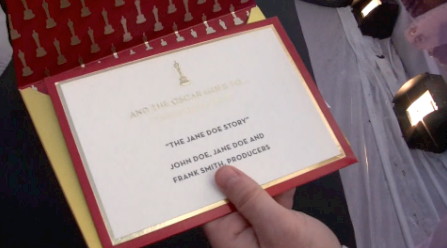
Making some countries pick just one film has always been and will always be wrong based on the quality and quantity they churn out and it should be addressed. Expanding submissions will also open up other categories since at current only submitted foreign films are eligible in other categories and ideally giving some nations multiple submissions would subvert the political machinations that might block a particular film or director from being considered for a nomination. Also, to be considered under a new mode of selection would be at a minimum the removal of the DVD restriction. Anyone with an appreciation for film knows that a theatrical viewing with ideal conditions is preferable, however, it is a bit more time-consuming and restrictive for a voter. I think what should matter is getting all the films in a given phase a viewing regardless of how that occurs.

Implementing any of these changes will be a boon to the Best Foreign Language Film category would be most important. Specifically, expanding the number of nominees many of these films are hardly viewed or get their only boost in the US after a nomination so why not expand?

Hero Whipped: Comics and the Studio System (Part 3)

The previous two entries in this series offered one connected stream of consciousness. You can read them here and here. In this installment I break from that narrative and take a look at how comics could benefit from emulating the better parts of the imperfect and once standard studio system that films employed for many decades.

The Studio/Indie Parallel

Disney and Marvel logos. They merged in 2009.

One way in which you can definitely draw a parallel between comics and movies is that there is a definite distinction between the studio system/The Big Two and indies.

Seeing as how that industrial dynamic is similar between the two of them there are ideas that can be borrowed from the studio era and altered to accommodate comics. Not that in a perfect world I wouldn’t like to see movie studios re-adopt things but comics might be more apt to experiment with ideas such as these to get new readers.

Serials

Buster Crabbe in Flash Gordon (Universal)

I’ve written here on a few occasions about my love of serials. Now part of the cliffhangers design was to get kids into movie theatres on a weekly basis, even if they had no interest in the feature they’d show up to see the continuation of their favorite chapter play. How this could apply to comics is in the form of the five-page story (perhaps perfected by Harvey as their staple). The five-page tale would serve as a means to display another character in a given book and should be advertised. It could be an intermediate step before giving a character a book. All-Star Western, part of DC’s new 52, featured a B-story (maybe it still does I dropped it out of my pull list) and if it’s known about it could be a draw. Every reader of comics has a favorite character who is currently not headlining an ongoing series I think most would agree something is better than nothing and it could provide a boost.

Stars

Avengers Academy #23 (Marvel)

Speaking of headliners the star system is the next thing that can be exploited just a bit more than it is now. It is nice to be surprised by an unexpected appearance, however, if it is not crucial to the plot that the secret be kept guest appearances should be promoted. You may have people try a new title but it could also serve as an introductory issue for new readers.

Loans

Image Comics

In the studio system actors pertained to one studio or another but they would and could be loaned to a rival studio for a given project in exchange for a favor.

This does not mean I think it likely that the aisle would be crossed and Marvel and DC characters would co-exist in a story. However, each does still have imprints of its own and can send its big boys to those tales and vice versa, if necessary and applicable to boost readership and cross-pollinate fanbases. Preferably in standalone narratives that do not adversely affect continuity.

Trailers

Batman: Noël (DC Comics)

Now previews do exist and they can serve their function. However, just as trailers will inundate us there are months when you can’t get away from the same five pages.

A bit more variety might expand fan-bases for more books.

Self-Containment

Batman & Robin (DC Comics)

All above suggestions would imply and perhaps even demand a greater amount self-containment in each series.

One thing I’ve noticed in the New 52 is that, at least in some cases, there is less co-dependence. I started reading Batman and Batman & Robin in their new incarnations and there is little to no leaning on the other series thus far one needn’t read both if they choose not to.

That lack of co-dependence is a lot of what the above is about also. If you have a guest character in a new arc it can easily be its own entity and not need to play into a hierarchy.

Marvel Short Film Rumors

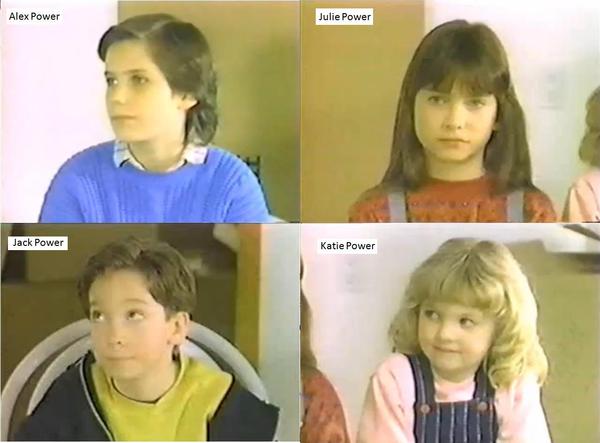
Nathaniel Moreau, Margot Finley, Bradley Machry and Jacelyn Holmes in Power Pack (Marvel/New World)

Pictured above is the cast from a pilot for a Power Pack series that was never picked up but along with Dr. Strange would be an ideal candidate for a short film treatment. There were rumors a while back that Marvel would produce shorts to play prior to its tentpole films. That seems to have died down but it shouldn’t a short film would be a great boon to a lesser character and not the investment or risk that a major summer release for a borderline top tier character would be (top tier in film terms).

Both Marvel and DC have established cinematic properties such that they can try and get lesser properties some limelight too. They are both studios and they should act like it with greater frequency.

Movie Tie-Ins

The Adventures of Tintin: The Secret of the Unicorn (Little, Brown)

In keeping with that any all comic-based feature films need their tie-ins and branded to get their product out there. I purchased The Adventures of Tintin: The Secret of the Unicorn recently with the all too rare “Soon to be a Major Motion Picture” sticker on it but a week or so removed from having seen the film.

However, novelist and comics writer Joe Hill had a great idea on Twitter this summer just before one of the huge superhero movies came out: Why not have comics at the movies when those projects come around? When else would an impulse buy be as strong? “I just saw this movie and liked it, yes I’ll buy a comic; it’s half the price of a soda.”

Conclusion

The studio system was imperfect but so is the current one. The idea of changing a system isn’t replacing everything about it but just what didn’t work. Some of these ideas form a parallel industry can help comics.

By Any Means Necessary

With almost as many release paths as there are films now it’s more important than ever to explore all possible avenues of viewership to see as wide a variety of films as you can. It is this way you will most likely find films you like.

Movie Theatres

Clearly this is the first option, however, I suggest you have a few in your regular rotation. Multiplexes will be more expensive and offer fewer choices than art houses. Having a few theatres to frequent will offer a wider viewing experience.

Netflix

If you can swing both the streaming and disc package it offers you the widest variety and frequently streaming is lackin but use Instant Watcher to keep track of new streaming options.

Other Services

Other services for Discs and/or streaming include: Facets, Vudu, Mubi Fandor and Amazon.

Redbox/Blockbuster

One will charge you less overages but are the best DVD-based option for those who are fans of instant gratification.

VOD

This is a resource you constantly need to check because at times movies will be available pre-release and/or during release only.

DVD of the Month Club

A few independent distributors offer you a selection a month or so for a flat rate, two that I know of are Film Movement and Oscilloscope Labs.

Foreign Regions

Not all DVDs from overseas are off limits. In fact, depending on if you have a region free player or if you want to set a computer to a different region (there are usually a set number of changes) you can watch anything you want.

Retail/Online

Two things need saying here: one, you need to be the kind that might buy something sight unseen to find something new. Second, if you are occassionally you’ll find something unique either in a retail store or online.

Public Library

It may not be the go to place for new releases but my local library does get titles from Film Movement, or they did at a time. Regardless I have found great movies I didn’t know about or classics I had yet to see. And it is free after all.

Keeping Tabs

Lastly, if you read a lot and keep up on films it may be hard to keep track of all the upcoming films where you can see them and when. This year I plan on using Go Watch It this year to track what I want to see. It’s a great one stop queue wherein it’ll tell you where a given film is available to watch.

Everybody’s Got Stories: Extremely Loud and Incredibly Close and My 9/11

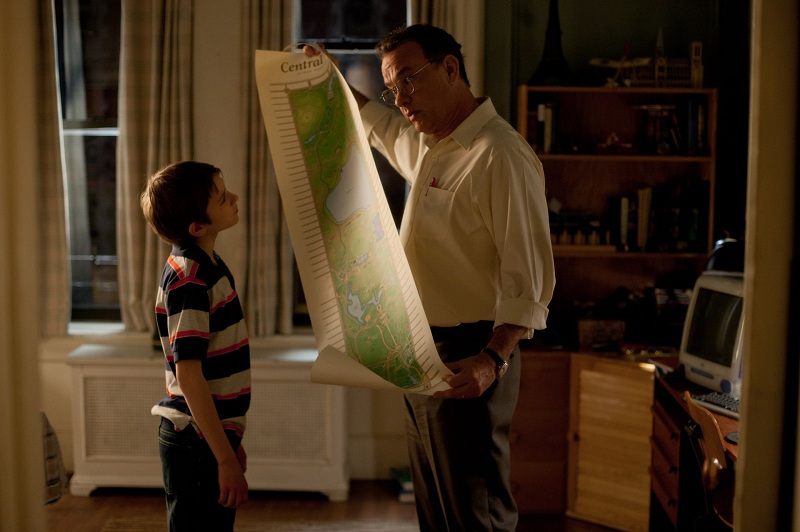
Thomas Horn and Tom Hanks in Extremely Loud and Incredibly Close (Warner Bros.)

I worked in 1 World Trade Center from 1999 to 2001- to September 11th, 2001 to be precise. My story about that day isn’t all that dramatic really. There are details I could divulge but suffice it to say I wasn’t on the schedule for Tuesday mornings that month. So I was not on either the 106th or 107th floor on that day, nowhere close, thank God. I thought about taking that shift when the proposed schedule came out but decided against picking up an occasional AM shift. I was juggling college and the job and Tuesday was an off day from classes and I decided to use that to rest.

Of course, we all know what happened that day and since then I’ve been fairly quiet about a number of topics that pertain to the day itself. I’ve also had varying reactions to works of art which have dealt with the attacks.

I am writing this, of course, because Extremely Loud and Incredibly Close is due out soon and it’s been lambasted by some as exploitative among other things. I have yet to see the film so I cannot defend its artistic merit, however, we should look at other depictions of 9/11. One other caveat: so unimaginable and unpredictable were the attacks to me that while working there I wrote a post-apocalyptic script wherein a family eventually lived in the World Trade Center.

First, there is the tandem of fairly fact-based films World Trade Center and United 93. Neither of these films interest me in the least. I have, more times than I care to, been able to imagine, only imagine but what more can one do, what those floors looked like that day. Having worked there I get a much clearer picture than I care to so I needn’t see any dramatization thereof. The films may be fine and as propaganda-free as possible but I just have no interest. To me those smack more of exploitation for it takes actual people and focuses on the event and tried to feed on rampant patriotism to generate box office. Some see it otherwise and that’s fine but as I said I have no reason to see it.

Remember Me, which I wouldn’t have seen anyway, was your standard father-son drama and decided to use 9/11 as a twist ending rather infamously and in classless fashion.

On the flip-side Stephen King in his collection of short stories Just After Sunset deals with the tragic day in New York in two different ways. In “The Things They Left Behind” he deals with the aftermath and those lost but in “Graduation Afternoon” it comes in at the end, in the distance. It does not inundate all that preceded it and change the entire story and feel like a blatant, in-your-face exploitation. It is there, it is stunning and it affects all, but it does not compromise the tonality of the entire piece.

In Brian K. Vaughn’s brilliant comics series Ex Machina the first issue concludes with a newly-minted superhero’s biggest failure, the fact that he only saved one of the two towers. Considering the tone of the series was serious, political and a very post-9/11 story it all fit.

So the last three I enjoyed so I can take in a tale of fiction which cites something that so closely affected me. Yet it seems this film gets quite a bit of vitriol just in the “How dare you?” realm. The question of “How should art deal with 9/11?” is a valid one but it seems that was never asked for the two that try to most closely replicate it. Bastardized truthiness does not a documentary make and what function is being served there? Those are movies about 9/11 but in a bright piece of marketing Extremely Loud and Incredibly Close is being labeled as being about every day after. In some ways those days were harder.

Furthermore, the word art is formed from the word artifice. It is about subterfuge. Exactitude is what a documentarian strives for but even they know there’s a gray area.

This film reminds me of some of the reading I did about Kapó before I decided to buy it. The film features perhaps the most over-analyzed shot in film history of an inmate dying in a concentration camp. It raised questions of morality in film, however, what should be moral about film? Absolute morality eliminates myriad genres. Horror is where we imagine out nightmares to try an exorcise them and horrid, immoral things are imagined and inflicted upon the people that populate those stories. What need have we of narrative morality?

Not to compare disparate tragedies but surely there was a time when the holocaust was an untouched topic. However, through the years different narrative avenues about events in and around World War II have been found, some not universally embraced, Stephen Daldry’s (the director of this very film) The Reader comes to mind.

The fact of the matter is there are events in world history that defy logical explanation and easy categorization. However, that does not stop us as human beings from exploring them and one of our biggest means of exploring is through the arts. Some say “Why make this film?” I say “Why not?”

Tintin Finds Its Own Path

The Adventures of Tintin (Columbia/Paramount)

As the art of cinema develops alongside technology, so does the business of it. Methods of distribution and viewership are now more varied than ever, however, what some may not fully consider is that aside from method of viewing (streaming, MOD, DVD, etc.) theatrical releases also have found new paths. Now more than ever theatrical releases have tinkered with the formula. It used to be an unwritten rule that the rest of the world would have to wait for Hollywood films until America had seen it first. Now, for many reasons whether it be location or just the international viability of a given project, films are not only premiering overseas with increasing frequency but opening there well ahead of the US also.

Perhaps the best example of this is Steven Spielberg’s The Adventures of Tintin. I for one had always had a vague awareness of Hergé’s well-known creation but didn’t know much about him or the stories in which he lived. However, similar to my affinity to The Little Prince, which crosses not only various media but also three languages, I knew that it was a property more renowned abroad than in the US. Therefore, it’s perfectly logical that not only did Tintin debut overseas first but also opened there well in advance.

Tintin is, in fact, a cinematic rarity in as much as of this writing it already ranks #360 all-time in worldwide box-office with $239.1 Million and opens in the US tomorrow. Considering the fact that it opened in late October overseas and the ubiquity of social media below you will find some of the reactions I’ve gotten from overseas as I anxiously await the US release. The conversation started rather spontaneously when discussing some of my favorites of 2011 after that Twitter discussion I asked around and got more feedback:

Alex Terentjev, Russia

“What bout Tintin? I think this is the best film to share the evening with family…btw (By the way) I didn’t know anything bout Tintin before I’ve watched a movie, but u know this film is amazing…comedy elements mixed with criminal and interesting adventures and motion capture, as well, makes this movie really awesome…I even started to read Tintin comic books cuz of this movie.”

Patrick Gibson, England

Tintin, one of the best animated films I’ve seen in a long time! Such well thought out characters and beautiful animation!

@lucylucesim, Ireland

Tintin was brilliant![…]The 3D was great but could’ve been better utilized.

@everyfilmin2011, England

So, after months of looking forward to a new Spielberg movie, one of my Twitter followers threw cold water on my mood by telling me it was boring. I must admit, I’m glad they did – because watching a movie with low expectation is always best. First off, I can happily report that there was far too much going on for it ever to be condemned as boring but it’s certainly not the standard of an animated Raiders Of The Lost Ark, which I’d originally hoped…

The action, of course, comes thick and fast and computer animation really lets Spielberg’s imagination out of any normal constraints. Jamie Bell is the perfect voice for Tintin but the real revelation is Daniel Craig as the baddie. He hams it up like never before – talk about shaken and stirred! Of course, it goes without saying that Britain’s greatest chameleon actor, Andy Serkis, is unrecognisable and in top form as the captain…

My biggest bugbear is the 3D. It really doesn’t bring anything to the party and, once again, is just a giant rip-off. The sooner this gimmick dies off, the better. So, a Spielberg classic it isn’t but is Tintin worth a family outing. Yes, I should say so. Rating? 7/10

Here’s an excerpt from Screenings a great resource for those of you in the US who want a chance to see movies early and free:

It mainly mixed three of the original comic books: The Crab with the Golden Claws (1941), Red Rackham’s Treasure (1944), and of course, The Secret of the Unicorn (1943). While the precise motion-capture couldn’t compare to Hergé’s original execution of his characters, it delivered a new fascination for the current generation to enjoy. So don’t expect as much nostalgia but do expect a great viewing experience…

The script does a wonderful job introducing the audience to Tintin and the whole premise quickly. Even if you have no idea what the source material is about, you will get it within the first 10 minutes where you see the new animated Tintin get a caricature of himself which shows the original inked boy journalist […] By mixing many different plots in one, the filmmakers were able to explore more of the Tintin universe and splice together various story lines to keep the momentum and the pace quick. However, you never forgot the main story at hand…

The cast was as impressive as the men behind the scenes. The motion capture and voices were provided by the likes of Daniel Craig, Jamie Bell, Simon Pegg, Nick Frost, and motion capture legend/guru Andy Serkis. With every mocap film, Weta Digital somehow tops itself and delivers a more seamless experience letting you forget your even watching an animated feature. It was a weird mix…even though it looked extremely lifelike, The Adventures of Tintin still had it’s [sic] cartoony feel…

The 3D was used well but again, not drastically enough. The best implementations were the particle effects that were unlike any other movie. They added a strong feeling of depth in their scenes that can’t be duplicated using 2D cameras. Even with the fast moving action scenes, the 3D didn’t get too crazy or give headaches so in the end it just made the visuals pop that much more. I would actually recommend watching this one in 3D because animated films do gain the most from the 3D technology…

The biggest win for this production, however, was a chaotic sequence which never seemed to end. It was very reminiscent of the Indiana Jones days where everything fell into place and the characters had to pull off stunts just at the nick of time. Of course, this is a lot easier to accomplish when every movement is animated by a computer rather than a stunt double. In the end though, the action scene came out so well that it makes you want to watch the entire film again just to watch that portion. If it was on DVD or DVR, you would instantly rewind it back to see again. The whole movie is ok up until that point but then Tintin blasts into full force and dazzles you with the unbelievable. It was really fun and that alone made the movie enjoyable for me. If you’re ready for a big dose of action adventure, The Adventures of Tintin is an amusement ride in the form of a movie and you should probably watch it because the sequel is already in the works.

Two other pre-certifications are first that it currently scores a 7.8 on 21,946 votes on the IMDb, it is “Certified Fresh” by Rotten Tomatoes with 82% based on 67 Reviews and is at 67% on 11 reviews at Metacritic.

However, my open inquiries for a reaction from abroad to Tintin also garnered this surprise response from Simon Doyle who runs titinologist.org:

In 1983, when I was much younger, I watched an “interview”, broadcast on Janet Street-Porter’s “yoof TV” show Network7. Boy-reporter Tintin (we, the viewing public, were assured) was orbiting the Earth in Professor Calculus’s rocket, to bring amazing news to the world. Duly excited, I watched a 2D, somehow-electronically-but-rather-simply-animated Tintin inform the interviewer (and us) that none other than Steven Spielberg was in the process of bringing his globetrotting adventures to the screen!

Wow! If he could do for Tintin what he’d done with Indiana Jones–! I sat back, and waited…

…and waited…

…will it ever happen?…

…and waited…

…Great snakes! – A chap could start to lose hope…!

…and then…!

It’s 28-years later, and I am sitting in the viewing-theatre at BAFTA (BAFTA! The glittering heart of British cinema!), courtesy of the good folks at MediCinema, watching Thompson and Thomson introduce Steven Spielberg’s glorious new movie –

The Adventures of Tintin: The Secret of the Unicorn!

– and it proved well worth the wait!

If you want the devil’s advocate take there is a discussion link at the bottom of the review, however, if someone who has been as devoted fan for ages and has waited that long for a film version can come away that impressed it is most definitely worth my time. Moreover, the distribution path decision while might’ve seemed obvious to some has reaped rewards for the film as it opens with a bit more buzz stateside than it might otherwise.

Cinematic Battle of the Nutcrackers

Every year for the past 5 years Ovation TV has a Battle of the Nutcracker’s wherein they play 5 different versions (rotating some out annually) of the ballet based on Tchaikovsky’s most renowned work. While I definitely qualify myself as an enthusiast rather than a savant of dance, this is a piece I know well enough such that I find it interesting to watch the different versions and pick a favorite.

Now within the ballet there are many variations for while Tchaikovsky’s music is the standard each choreographer has their signature while it was Marius Petipa and Lev Ivanov who originally choreographed it, it’s perhaps Balanchine’s that’s most well known.

What’s most interesting to me about this “competition” where the viewers are invited to vote for their favorites is that it gets me thinking about adaptation. One could do quite a lengthy case study on The Nutcracker alone. While there are many either “filmed ballets” or cinematic versions based on Tchaikovsky there are many based on E.T.A. Hoffman’s story The Nutcracker and the Mouse King. Just the fact that you have these two available sources available to freely adapt makes this quite a notable story.

However, a narrative as flexible as this wouldn’t suffice for a post for one could argue that “The Turn of the Screw” by Henry James and “The Colour Out of Space” by H.P. Lovecraft are more malleable pieces of fiction based on the films they’ve spurned. What makes The Nutcracker a unique tale, is not only the fact that I personally would put it on a list of ‘The Great Stories’ meaning classic narratives I could watch re-interpreted any number of ways but also the fact that it does have two potential origins as a source material either in literature or in dance.

In honor of this great story and the novel idea by Ovation I thought it’d be good to have some suggested Nutcracker-related film viewing for the holiday season.

Here are perhaps the three most well-known (the ones I’ve seen) cinematic versions to get you started.

The Nutcracker in 3D (2010)

The Nutcracker in 3D (2009, Freestyle Releasing)

During its all too brief cinematic run it was referred to as The Nutcracker in 3D. Now with 3D being the cinematic boogeyman du jour home video is the way to check this film out. I won’t give too much away but this version is most definitely different and based on the story rather than the ballet. This allows the storytellers to have a lot of latitude and there are few if any safe decisions and this film will likely cause divisive reactions all around. Partially musical and very allegorical it’s a film that refuses to be ignored. It also features Elle Fanning (Super 8, We Bought a Zoo) and Charlie Rowe (Neverland).

Fantasia (1940)

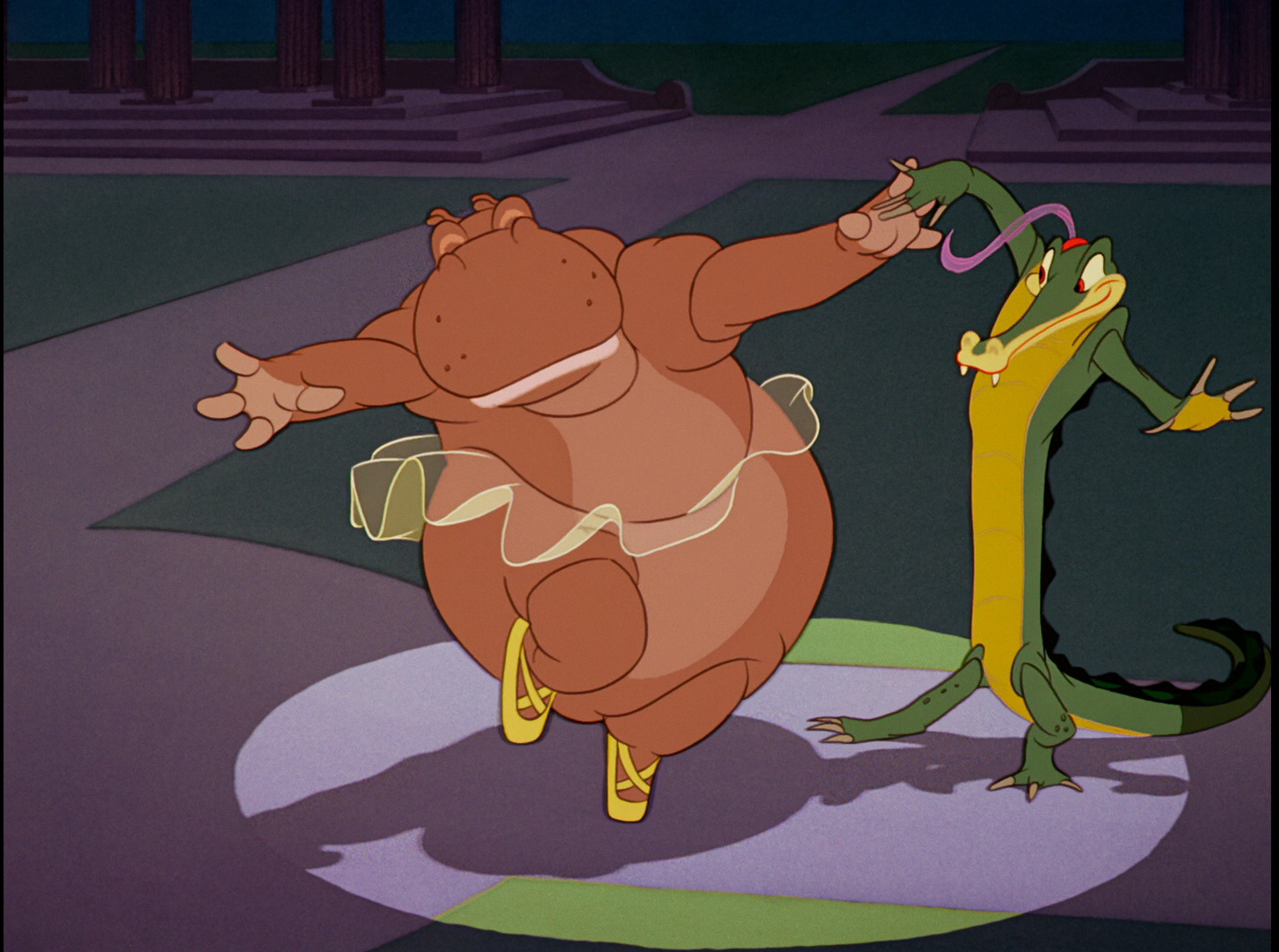
Fantasia (Disney)

If you’re one who prefers your references and adaptations a bit more oblique then you need look no further than Disney’s pet project Fantasia. Along with many numbers from The Nutcracker you will of course see interpretations of may other classical pieces. This film is definitely all about Tchaikovsky’s music rather than the ballet though there is dancing too as you may well know.

George Balanchine’s The Nutcracker (1993)

Macaulay Culkin and Jessica Lynn Cohen in George Balanchine's The Nutcracker (Warner Bros.)

This was the first place I was able to complete viewing the complete story of The Nutcracker ballet. My first attempt to view it live at Lincoln Center was interrupted halfway through. There are a few things that are interesting about this film not the least of which is that you have within it an encapsulation of George Balanchine’s choreography. You also have the fine narration of Kevin Kline. However, of course, what most will note is that it features Macaulay Culkin in the lead. The only major alteration is that the choreography, which for the nephew/nutcracker is rather minimal is diminished further here. While some may not even know this film even exists you might be further surprised to learn that this film is really perhaps the biggest power play Kit Culkin, Macaulay’s father and perhaps the most notorious stage parent in modern times, ever pulled off. Macaulay’s participation in The Nutcracker was really a case of living vicariously through your child. Though he speaks of it earnestly now of his distaste for the project it really doesn’t translate very much on film. Furthermore, Kit tried to influence the final cut of the film removing said narration and when it wouldn’t happen Culkin didn’t publicize the film so it was another Nutcracker box office bomb.

The Ovation block certainly made me want to look for other versions on film and I hope you enjoy these as well as seeking out others.

The Titus Conundrum

Below you will find a paragraph which was prepared for the Best Films of the Decade

Anthony Hopkins in Titus (Fox Searchlight)

list:

9 Titus

This is the over-looked film of Julie Taymor’s cinematic career thus far and it was here debut. It was an emphatic statement of style and vision but it also combined with substance to reinvent Shakespeare’s most violent tale with verve and surrealistic panache. The ensemble, headed by Anthony Hopkins and Jessica Lange, is brilliant and not overly-stagey even dealing with such cumbersome dialogue. The film is visually stunning and engulfing.

All this is true. What’s further true is that Taymor adds a bit of surrealism to the tale not only with the hallucinogenic interludes that appear on occasion, once to try and convince us Titus is mad but also through the opening of the film. An opening which introduces us not only to the character of Lucius, played very aptly by Osheen Jones, but also to the mix of modern technology, furniture and settings that will be mixed into this film. We see a child epitomizing with action figures and ketchup the kind of over-the-top violence that will be the reality of this tale, a reality he is put into. A reality he is a mute witness to for approximately an hour of the nearly three that the film runs.

All that is well and good but some of you may be asking why this film didn’t make the final cut. It was based on a technicality. The technicality is this. Titus was released by Fox in New York and Los Angeles on December 25th, 1999 in order to qualify for that year’s Academy Awards. It was resoundingly ignored. It’s wide release to general consumption and an equally absent public audience was in January of 2000. Upon double-checking the release date on the IMDb app on an iPhone I proceeded to re-screen the film to confirm inclusion on the best of the decade list. It fit. Then before publishing a trip to the IMDb proper showed all release dates.

Based on the wide release date it was the best of the year in 2000 but due to its actual release date not on the best of the decade list. Therein lies the problem. The good films get sat on until the end of the year and those not able to attend special advance screenings are left with many a film in a no man’s land.

Recently, there had been a reticence on my part to allow films from the prior year entry into award consideration, which punished The Reader. While it seems difficult to consider Titus a film of the aughts because that is a much bigger threshold to tread over I will no longer be disqualifying end of year releases from consideration in the next year. It’s only fair. While Titus can be denied a place in this decade passed it will always be a standout of year 2000 to me.

The Perfect Subplot in The Sitter

Attention Dear Reader,

Prior to reading any further I feel it only fair to warn you that a narrative thread in the film The Sitter will be discussed in detail herein and not a portion of it will be left unspoiled. If you have yet to see this film please do so. If you have seen it let us begin…

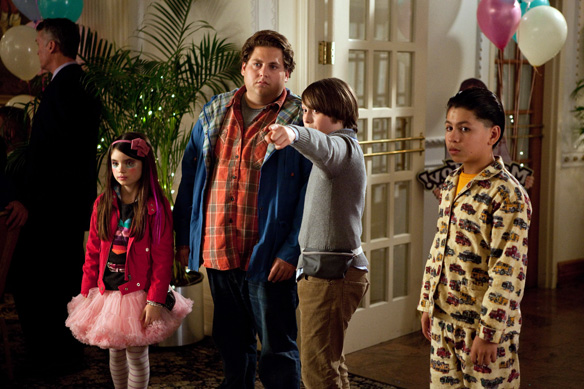
Landry Bender, Jonah Hill, Max Records and Kevin Hernandez in The Sitter (20th Century Fox)

In the critical lambasting this film has received, that I noticed both via its Rotten Tomatoes score and the encapsulated consensus that the site offers, what is missing is an insight. Granted a majority of the issues that critics have with the film are questions of taste. This is true of many comedies. Perhaps nothing is more subjective. However, I will not seek in this space to convince you that the film is funny, though I did find it to be very funny. Some also call out the film for not being very original. I cannot claim that this film re-invents the wheel.

What this film does brilliantly, which I will argue with any and all comers, is fold in a completely unexpected subplot based on the fact that it’s a comedy and the type of comedy it is. The term fold in is picked specifically to borrow the cooking term. In that vernacular it has a much more homogenizing context, somehow, in film it seems like it applies to putting something other where it does not belong.

In The Sitter Noah Griffith (Jonah Hill) is your typical slacker and atypical babysitter making it kind of a typical setup. A ne’er-do-well who in many ways has arrested development will see the truth of these children’s lives and connect with them in ways their parents cannot. Furthermore, these insights he has into their personalities and lives will better him.

The surprise comes in Slater’s subplot, it’s by far the most well-executed and most subtle of them all from start to finish. Slater, played with stunning adroitness by Max Records (whom you may know from his pitch-perfect performance as Max in Where the Wild Things Are) and countered beautifully by Jonah Hill’s usual potty-mouth with a heart of gold, not to sound snide but that’s how many of his characters can be pigeon-holed.

How does this all unfold?

We meet Slater as Noah does. He is arriving at the kids’ house and sees him in the living room lounging watching TV. The programming is a shirtless male gymnast set against a woodlands background. The thought that Slater is gay occurred vaguely to me but I dismissed it simply because the image on screen was so odd and because “that sort of thing just doesn’t happen in films of this kind.”

The second step in the progression of this subplot is the introduction, at the time as a literary ghost, of Slater’s best friend Clayton. He is merely identified as his best friend and someone who Slater is texting incessantly. Again no bells really sound at this revelation because two assumptions are made by me and likely the average audience member: One, kids text a lot and two, he’s getting responses.

The third step is where suspicions start being aroused. Slater isn’t getting responses and he’s distressed by that. However, the filmmakers deflect this for many by having it play into Slater’s myriad partially self-diagnosed manias. So we move on…

The fourth step is where it likely clicks for most audience members. In their wild night about New York Slater runs into Clayton (Alex Wolff) at a Bat Mitzvah. Slater catches him in a lie and with another friend. This creates the need for Clayton, prodded by his friend, to blow Slater off to his face and tell him he’s acting “weird.” Slater, of course, is devastated. Here is where I jumped the gun and finished the equation.

However, many times in a film you’ll know a certain event is going to happen and it’s how it unfolds that really matters. That is evidenced by this film.

What occurs in the 5th and penultimate step (The Sixth being Slater being at peace in the denouement) is just flat out brilliant. In a confrontation with his adopted brother, Rodrigo (Kevin Hernandez), Slater’s meds are thrown out the car window. He freaks out and makes Noah stop the car. He looks for them and shouts that he needs them because he has problems. As is the case with all the “Remedy Scenes” Noah doesn’t act out of character at all but wisely. It’s truly a tribute to Jonah Hill and his abilities that he can play a scene wherein his dialogue is flat-out blunt, button-pushing and confrontational but yet delivered sensitively and is precisely what is needed to get a desired reaction from his scene partner/opposite character.

Slater is told to his face he’s gay and in a film of this nature the magnitude of those two events alone is incredible. Firstly, the fact that another character recognizes it and points it out to him allows for the allusions to the It’s-not-a-choice aspect to be made naturally. Also, it allows the character in question to deny it before confirming it. The singular most moving moment in a film where anyone in their right mind would expect their to be none is when Slater, protesting too much, shrieks “I don’t wanna be a faggot!”

It’s also precisely this kind of scene that proves the point that I’d rather have society police language rather than the movies. The F-word in real life has become intolerable in the 21st century. That does not, however, mean that it’s been eradicated, which is precisely what makes it such a powerful choice here.

Not only that but you have in one short coming out scene, in a movie you’d never expect to see one in, the vocalization of so many truths about homosexuality and being closeted that it’s staggering.

Namely: No one wants to be gay, no one chooses to be gay, when one is closeted you almost want to be called out to relieve yourself of the burden, you and others around you think there’s something wrong with you, it’ll make your life more difficult, you’ll go through very hard times but it gets better and people get over it, coming out to your parents is the hardest thing you’ll ever have to do and so on.

I belabor the point about the kind of film it is because these kind of talking points are typically that they’re reserved for so-called Gay Cinema. The only problem with Gay Cinema is specifically that, it’s too much of a niche. There’s a lot of preaching to the choir. Even a mainstream hit like Brokeback Mountain can’t carry this message as well because first it’s about homosexuality and moreover it’s about repression thereof and the gay characters don’t receive the liberation that Slater does in this film. So many of his fears are allayed that you do hope somewhere a conversation like this is really happening between a parent or guardian and a child.

The sensitivity with which David Gordon Green, Jonah Hill and Max Records convey this scene is to be applauded long and loud. Typically, films branded as important are so because of their overall theme or their impact on cinema as a whole. While I enjoy it, this film may end up on neither end of the spectrum in time but what ought not be overlooked in an age when many with a social conscious are flat out saying that “It’s OK to be gay” and “It gets better” and other well-meaning statements that can be construed as platitudes by some, it is vitally important that the youth of this country are shown clearly and irrevocably that these things are true.

Fiction does not diminish a truth but rather can echo and amplify it more so than anything else. The true importance of The Sitter then cannot be measured in either category listed above but the reason it has importance is that it perfectly, in a social and aesthetic sense, includes a message in a film made for mainstream consumption and for they all need to be congratulated.