Review: No Más

No Más

I am glad I sought other reviews before sitting down to write this one. In doing so I discovered that the director of this film also directed Renee, which could still be the greatest 30 for 30 installment yet. And he has also covered boxing before. That gives me some perspective but still leaves me perplexed and greatly disappointed.

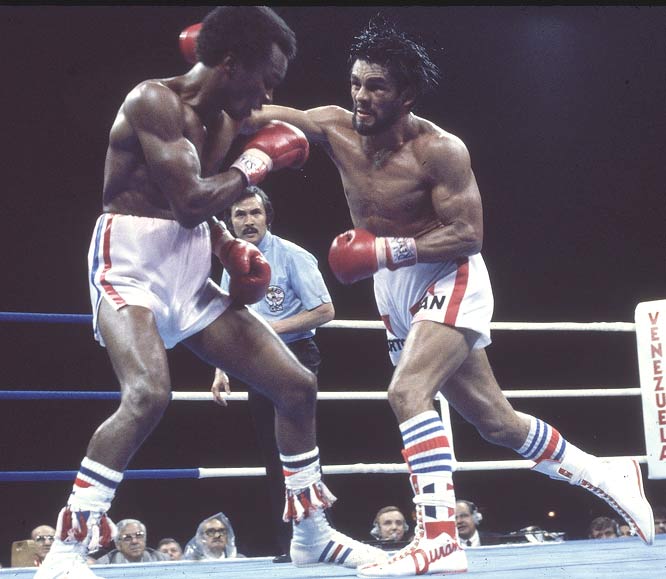
Firstly, there is a question of balance: whereas the most recent installment, which I will discuss below, even-handedly presents interpretations of the career of a controversial figure. This one becomes skewed down the line. Both fighters (Leonard and Duran) are introduced. However, after the infamous incident (wherein Duran quit during the rematch), and many theories are examined to no satisfactory conclusion; the film takes a few odd turns.

In one turn, Leonard (at least based on the way this story I knew the bare minimum about) comes off almost like a sore-winner who never faced any backlash for that fact. Almost like the antithesis of Mary Decker Slaney in terms of public perception.

This shift is a weird occurrence because the film, based on what footage they do have, is seeking a resolution and an answer. Yet, it becomes increasingly apparent that no new or publicly acceptable version of why Duran quit would surface. Despite that there they are face-to-face in a boxing ring in the present day, talking in a highly staged manner, and when Duran is giving at least a more detailed version of his truth than he ever told his audio is drowned out for Sugar Ray’s take on it and how he was able to (eventually) let it go.

I’m not saying I believe Duran’s story or questioning Leonard’s right to a vantage point, but in documentary terms starts to bang its head against the proverbial wall insisting on its interpretation of events being told.

At this point in the series a mediocre doc would be the worst 30 for 30, but this one sadly isn’t even good because of its insistence on seeking an absolute truth and its skewed narrative.


4/10

Review: Gone with the River

Gone with the River (Dauna. que lleva el río) is Venezuela’s submission to the 88th Academy Awards for Best Foreign Language film. It is also a work of indigenous cinema. Indigenous cinema regardless of what aboriginal population it chronicles, in what era, is of significance. Perhaps far more so in the postcolonial/postglobalized world. Therefore, Gone with the River has instant immediacy and significance. In this instance the people are of the Warao tribe and their language is also named as such.

Dauna (Yordana Medrano), the protagonist, is defined by her nonconformity, as she tries to act as a bridge between her culture and the Hispanic one from the world outside the banks of the Orinoco River. She practices her traditions to a point but also seeks education when given the opportunity and wants to write in both her native tongue and Spanish to preserve the culture, pass on traditions, also give those with little insight to their way of life a window in.

The windows used to look into the culture, specifically our protagonist, are ones that travel back and forth through time. Typically speaking, through many experiences, I’ve found that a chronological sequence of events is preferable unless the impact is heightened through the juxtaposition and contrasting of similar instances backward and forward in time. Some examples would be things like The Tree of Life, Last Year at Marienbad or the lesser-known Villa-Lobos: Uma Vida de Paixão thrive because of their playing with the temporal structure of their respective narratives. In this film its dubious as to whether the shifting back and forth through time is the greater impact.

Gone with the River (2015, Alfarería Cinematográfica)

For certainly the symbolic symbiosis; Dauna’s native culture versus her adopted one is mirrored by those scenes where she is free contrasting those where she’s incarcerated for an as-of-yet unknown crime. Surely, there’s some intriguing commentary there but it ends up feeling an insufficient amount of material to stretch the narrative.

The reason for this is that even the central relationship through the years – that of Dauna and Tarcisio. At times even they seem as if they are but placeholders for the central societal conflict but they have scant amounts of personal delineation and impetus for their actions and opinions.

As opposed to a recently BAM-shortlisted Canadian film about First Nation lives on the reservation, Rhymes for Young Ghouls, which felt like it needed more running time because it was covering too much; I wonder if film was even the ideal medium here because it feels that this conflict and relationship – both cultural and personal – could’ve been examined in more detail over all the years this film covers.

Review: Sivas (2015)

When looking for a theme in which to select films from the start of November until Thanksgiving being literal is not the best option. Films centered around Thanksgiving tend to be overly obsessed with dysfunctional families. So in thinking about the nature of the day which was initially a celebration of survival in the New World, I thought why not focus on foreign films.

Sivas

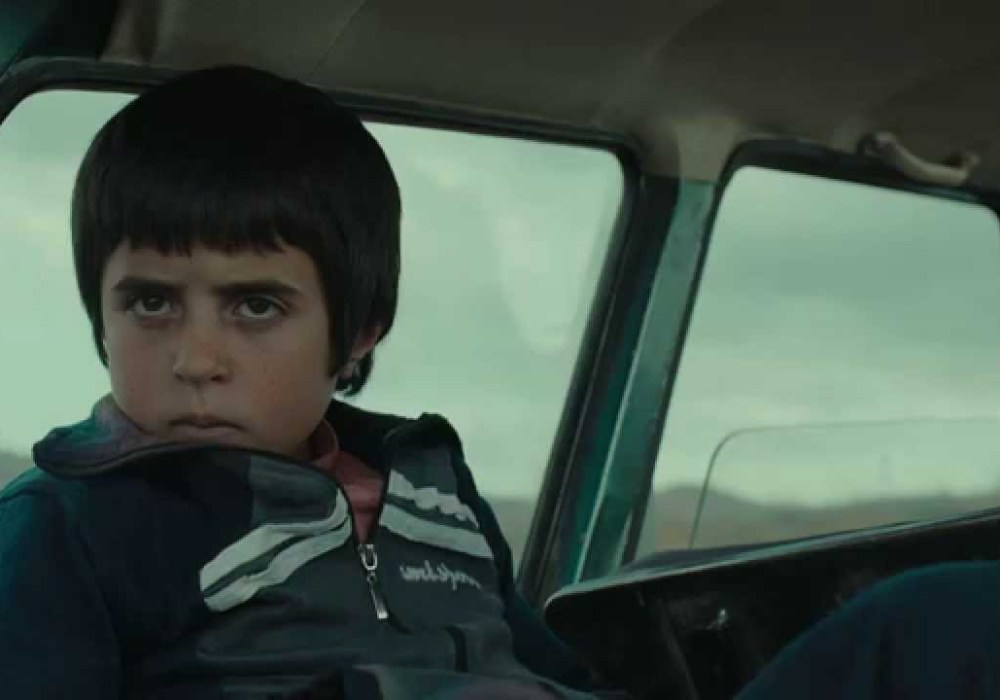
Sivas is the Turkish submission for the Academy Award race, and is a debut feature film from writer/director Kaan Müjdeci. It takes a naturalistic, externalized look at a coming-of-age cum boy-and-his-dog story.

Aslan (Dogan Izci) becomes attached to, and wants to keep a dogfighting sheepdog Sivas after he’s been left for dead following a fight in Aslan’s hometown.

The best way to contextualize this film for western mores would perhaps be bullfighting stories. Even as a child I was never particularly fond of the sport before the notion of animal rights was even a sensical phrase in my brian. However, I have seen titles about bullfighting and bullfighters, such as The Brave One, and been able to connect through it via the guise of the characters’ individual wants and needs.

Sivas (2015, Coloured Giraffes)

The strongest overall sequence in the film is definitely when Aslan and Sivas bond overnight. The dog is severly wounded, handshy, and skittish. Aslan insists on staying with him overnight when his older brother, Şahin (Ozan Çelik), insists that he leave Sivas behind and Aslan refuses.

Through the same guise of character wants/needs the decision Aslan first makes as a dogowner, as he is given sole responsibility for the dog when everyone, his Father (Hazan Yazilitas) included, believes that the dog will serve them no purpose; the provocation of his rival Hasan (Hasan Ozdemir) makes it an obvious choice, and one where it is easy to grin-and-bear it hoping for the desired result.

Dogan Izci is particularly strong as the young lead in one scene when his rage gets the better of him and he makes his biggest, and arguably last, stand in defense of his dog’s rights and insistence on being included in decisions having to do with his well-being and living conditions. The raw emotion tapped by Izci and captured by Müjdeci are breathtaking and are the height of the film unquestionably.

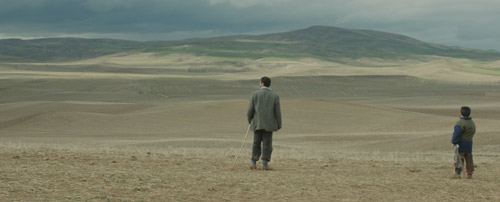
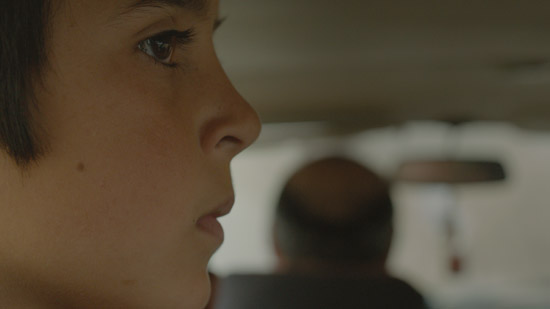
Sivas (2015, Coloured Giraffes)

Unfortunately, the concluding third, barring one standard sequence of suspense as their carload of passenger and the dog seek to escape notice of the authorities is a bit nebulous, and left wanting. Aslan’s emotional state at the end is one of steadfast resoluteness in no longer subjecting his dog to the rigors and cruelties he’s already allowed, but any indication of whether or not his request is heeded is left to our imagination. All certainty is expunged for us, all we know for sure is that we watched him grow, and in some respects have seen him come full circle in an unusual way: he reached a new sense of maturity and responsibility when he bonded to and felt protective of Sivas. Yet that was him looking before he leapt, and he had to fight to be able to get back there again.

More so than the usual the dog in question is more a framing mechanism for the tale than the central focal point of the plot. The film may be called Sivas but it’s Aslan’s strength and maturation, and his ability (or inability) to live up to the meaning of his name (“lion”) that is meant to keep us engaged.

Rewind Review: Machete

Introduction

As those who know me, and if such a person exists, cyberstalk me, know I created this blog after writing on another site, which shall remain nameless, for a while. The point is, I have material sitting around waiting to be re-used on occasion I will re-post them here. Some of those articles or reviews may have been extemporaneous at the time but are slightly random now, hence the new title and little intro, regardless enjoy!

Machete (2010)

Machete is the kind of movie that will leave you smiling ear to ear from beginning to end. The film is absolutely non-stop entertainment, laughs and action and one of the more enjoyable movie experiences you’re likely to have this year. Robert Rodriguez is a director who has two very disparate personas there is his action side and his kid’s film side. It’s kind of hard to compare the two but in terms of straight-up action this is likely his best offering since the cinematic miracle that put him on the map, El Mariachi.

One thing you need to know is that this movie is a grindhouse film from start to finish. There are intentional and digitally rendered scratches on the film in the opening portion, there are outlandish situations, gratuitous nudity and some over-the-top performances all done with a tongue-in-cheek spin to make it all spot on.
This is a film that owes its genesis to Rodriguez’s 2007 collaboration with Quentin Tarantino on the Grindhouse double-feature. In which we first saw a glimpse of Machete in a spoof trailer. Leave it to Robert Rodriguez to have the guts to like his idea enough to bring it to the big screen as a feature and it has been worth the wait.

What helps drive this film along is perhaps the best scoring in a film by Robert Rodriguez since Spy Kids. Robert does not take the task alone this time but has a band assembled referred to as Chingon and the sum is definitely greater than the whole of its parts. It is the toe-tapping overdrive that is needed for such a story.

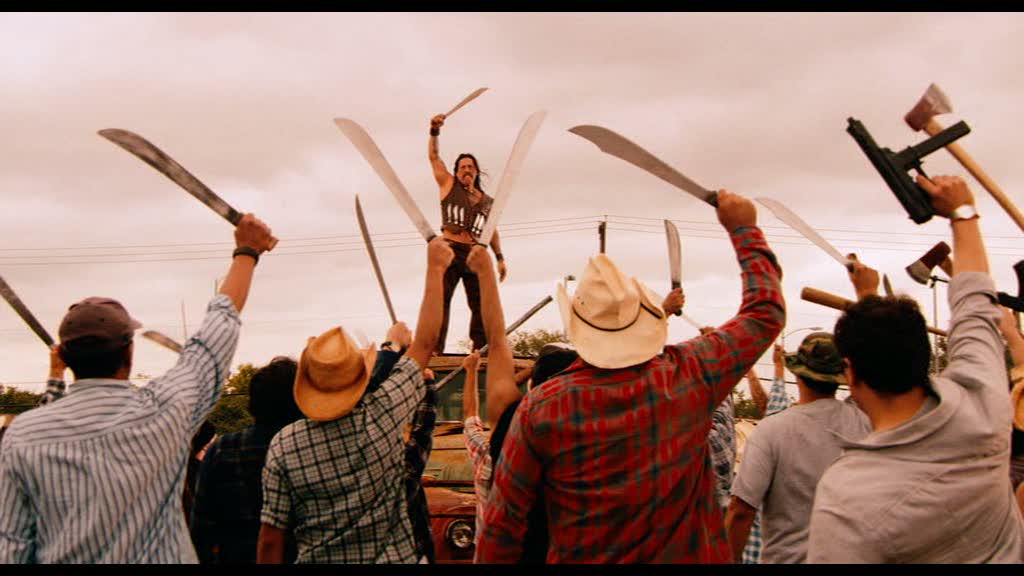
Machete (2010, Troublemaker Studios)

Not only does this film remain in the grindhouse style from start to finish but it is so through to its bones meaning there will be no attempt at subtlety in conveying its message about immigration policies in this country. It occasionally comes right out and hits you over the head with them, typically in a very funny way but it all fits and makes sense. It is also commendable that as silly and fun as it is most of the time it still manages to be about something and is not just pure escapism.

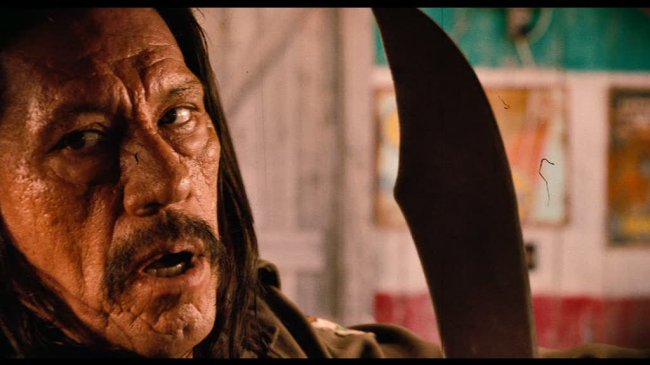
Robert Rodriguez’s films are always notable for their casting. He typically gets commitments from bigger names by having them take smaller parts they like and working them only a few days but at the same time, like many established directors, he has his stable of favorites. Here he might just have done his best balancing act of his career. Of course, you have Danny Trejo as the titular character who is convincing every step of the way through and though he is age-wise in the ballpark of many of the stars of The Expendables it never crosses your mind (and odds are he can take a few). There’s Cheech Marin, who here he plays a priest in a much more convincing and Cheech-like way than he did in The Perfect Game because the circumstances are vastly different and you have Daryl Sabara, formerly the younger half of the Spy Kids tandem, as a member of “The Network” in a hysterical turn.

On the flip-side you have Robert De Niro as two-faced Texas State Senator, Don Johnson as a man hunting border-jumpers, Jeff Fahey as a duplicitous campaign manager and Jessica Alba, fittingly placed as an agent who has turned her back on her heritage and arrests illegal immigrants. Not to mention Lindsay Lohan in a part where few will reasonably think she’s acting and, of course, Steven Seagal who…well you just have to see it as it’s indescribably funny. It’s the perfect balance.

Machete (2010, Troublemaker Studios)

This film is downright hysterical from start to finish and is without question one of the best films of the year and will be hard to top as the most enjoyable time I had watching a movie. The end teases sequels and hopefully there are, and if there are Rodriguez certainly traded up dumping Sin City for this. This is an absolute triumph for Robert Rodriguez.

10/10

Rewind Review – Bad Lieutenant: Port of Call New Orleans

Introduction

As those who know me, and if such a person exists, cyberstalk me, know I created this blog after writing on another site, which shall remain nameless, for a while. The point is, I have material sitting around waiting to be re-used on occasion I will re-post them here. Some of those articles or reviews may have been extemporaneous at the time but are slightly random now, hence the new title and little intro, regardless enjoy!

Bad Lieutenant: Port of Call New Orleans

This is quite an unusual Werner Herzog film. Of course, one must realize that the statement is quite nearly oxymoronic in as much as there is no standard or quintessential Herzog film. It just never really seems to have his stamp on it until we start seeing Terence’s hallucinations through our eyes rather than his; or rather in perspective rather than POV.

It is interesting to note Herzog insisted he wasn’t doing a remake but producers added the insinuation with the title, for marketing purposes and in crediting the original writer, for fear of law suit. What is most intriguing and at the same time most vexing about this film is that it is a tale which has a lot of circles, and they all close such that the film is nearly a Spirograph and the beauty of such a thing is in the eye of the beholder. The only reason it is vexing is because all these separate subplots are fine except a majority of them resolve themselves within two minutes of each other to very comedic effect, whether intentional or not.

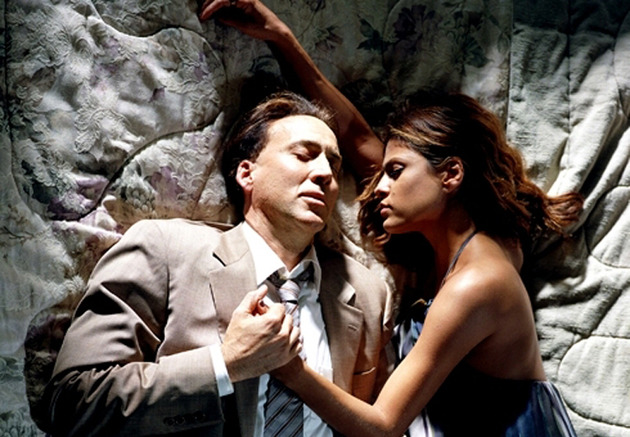
Nicolas Cage is getting very good reviews for this film and they are deserved, the only minor caveat I will add is that saying this is him at his best may be a little inaccurate. Perhaps this is him in his type. As I scan his filmography I see where I have liked him previously and he was depressed, frantic or addicted to something. Where he’s been most effective has been in The Weather Man, Adaptation and Matchstick Men to mention more previous work, where he usually gets hammered, looks uncomfortable and falters greatly is in action parts like Knowing. No speculation as to why that is but the Nicolas Cage seen in this film is scarcely the same man as he was in Knowing and thank goodness for that because he has to carry the film.

Bad Lieutenant: Port of Call New Orleans (2009,  First Look Studios)

In the end it is definitely an interesting film and not your usual fare. It leaves you torn between the comedy and the sad absurdity of the situation. At some point it does almost become a bit too much but all that is alleviated by a brilliantly directed and acted closing scene. A scene which frames the starting point of the troubles in the tale and while substance abuse seems to be over you’re left to wonder about the rest.

What Herzog does in this film can be best described as flirting with film noir. Flirting is as far as it ever goes because Herzog will never tie himself down to the conventions of genre but the seedy underworld elements are there as well as the lack of a moral compass, yet with so many frames thrown into the mix and some of the camera-work it could never be considered as such – barring the obvious fact that it is in color. It also resembles the progeny of those who loved noir, the New Wave, with some standard technique thrown in for good measure.

Herzog really works brilliantly with this cast which is part of what brings such a strange story home in the end. So well does he work with them that two actors in particular were nearly unrecognizable because of how they acted in their roles: one being Xzibit as Big Fate, the drug dealer who is the target of an investigation McDonagh (Cage) is heading the other being Fairuza Balk as a Highway Patrol Officer.

Bad Lieutenant: Port of Call New Orleans (2009, First Look Studios)

What is also interesting is that the story followed in the film for a significant portion of it is the execution of an immigrant family in the slums of New Orleans. That investigation vanishes after a while like a red herring but then works its way back in very interestingly.

What Herzog creates here is as always an interesting cinematic experience but also a transparent and approachable story line that perhaps will get people interested in his work. This may be about as close to convention as he ever is but you do get a taste for his style.

7/10

Review: Stranger (Zhat)

Yermek Tursunov’s previous film, that I was able to see, was The Old Man (Shal), and it was Kazakhstan’s official submission to the Academy Awards and was nominated for quite a few BAM Awards including Best Picture and won Best Cinematography. The Old Man was part of a trilogy. This one is not part of that multigenerational tale of familial legacy but Stranger very much feels of Tursunov’s milieu; exploring the world of Kazakh nomads.

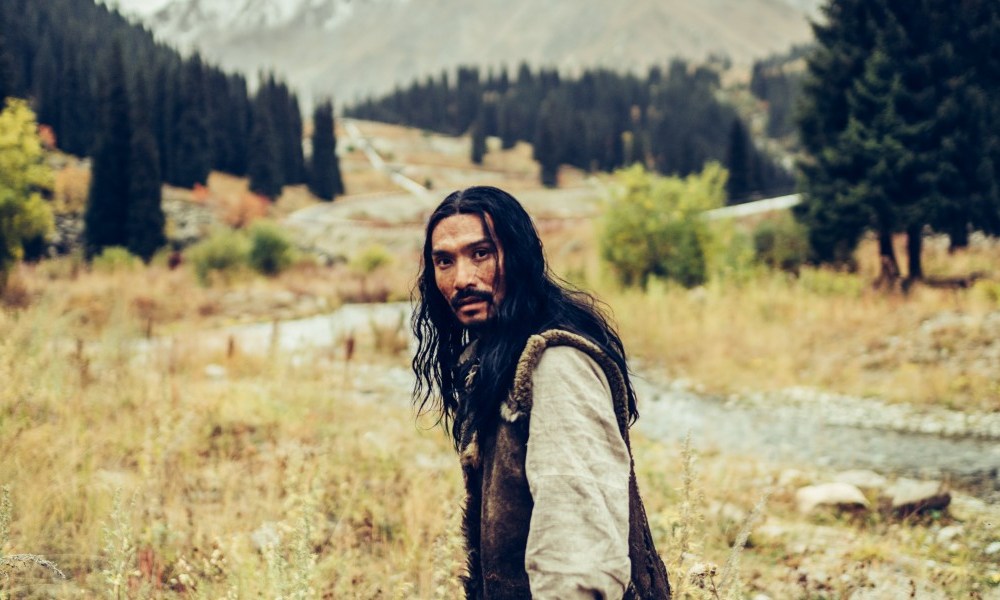
In this case a tumultuous period of the 20th century in this then Soviet-state. Events are realized, and come home visually without too much assistance from the dialogue. However, it allows us to more quickly bring ourselves into the film and experience it not as outsiders, insistent on knowing precise causes and affects, but rather much as our protagonist Ilyas does. He doesn’t quite understand what’s going on and why his parents and friends are disappearing as enemies of the state, and he doesn’t care what the reasoning is. He just feels it’s not right, refuses to “get with the program,” and runs off. Not only living the only way he’s known how, but adopting and even closer-to-the-earth more insular existence than he heretofore had.

Music is perhaps more crucial to Stranger than it was to the old man because the narrative is not one compressed in the dramatic unities of time and space in cinematic terms but rather a sweeping epic than spans decades and goes from the protagonist’s childhood to his death. The timelessness and majesty of the music are another tool used to draw us in. For truly music, perhaps even more so than cinema, can have the evocative quality needed to truly transport a person to a time and place they’ve never been and identify as if they have.

Stranger (2015, Tursunov Film)
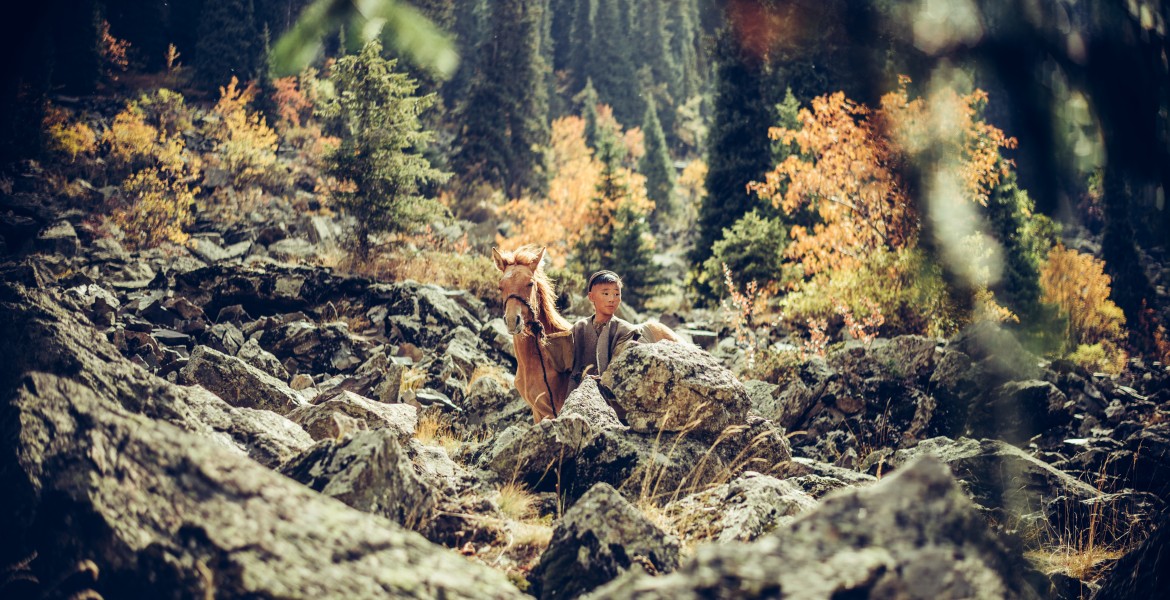
With a tale that concerns a reclusive nomad and the small village he leaves behind and can only occasionally return to for short times. The cinematography by Murat Aliyev lovingly captures the steppes in their beauty and brutality but is also the key to creating the marvelous mise-en-scène this film has. The framing, quality of light, and the fact that this film speaks far more in images than in dialogue makes it even more crucial that it is this good and it is.

Stranger also hearkened me back the to the Norwegian film Pathfinder (Ofelas), but with a more allegorical than traditional epic slant. Most of that has to do with the magnetic performance of Erzhan Nurymbet not just the fact that he’s frequently isolated. Perhaps the rarest feat this film can claim is the equilibrium in quality of performance between two actors playing versions of the same character at different ages. Typically aging of a character from childhood into adulthood is only used to create an inciting incident, or illustrate a trauma; usually the appearance is all that remains the same. However, with Stranger there is shown, simply, in a gorgeous montage, Ilyas’ transformation from wide-eyed innocent fleeing into uncertainty to a fully red-blooded nomad more adept at living in the woodlands of the steppes than what passes for society in collectivized village. This is a testament to Erzhan Nurymbet, Nurgali Nugman, and the edit of the film.

An edit which frequently is deftly artful to convey the passage of time visually without having to resort to titles. In fact, only at the beginning do we outsiders get some necessary background information. What proceeds after that is a story embodying many aspects of that title card in one character’s life.

Stranger (2015, Tursunov Film)

Even though the film may not be traditionally uplifting its a wonder to see the world through Tursunov’s eyes anew. I’m sure that some will experience these same joys for the first time. For beautifully made films about difficult subjects that deal in the highest of artistry and a minimum of didacticism are far too rare, even rarer still is the hypnotic ambience of these Kazakh film worlds.

9/10

Blu-ray Review: Children of the Night

Children of the Night (Limbo, 2013)

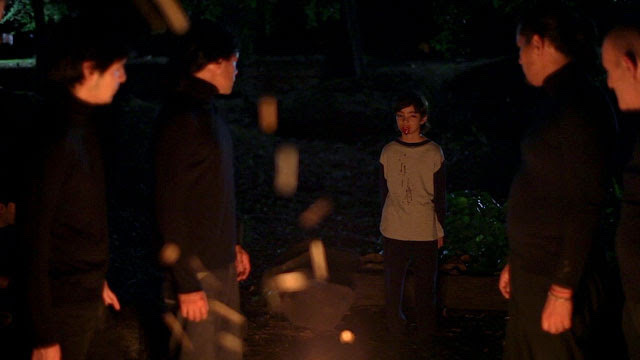
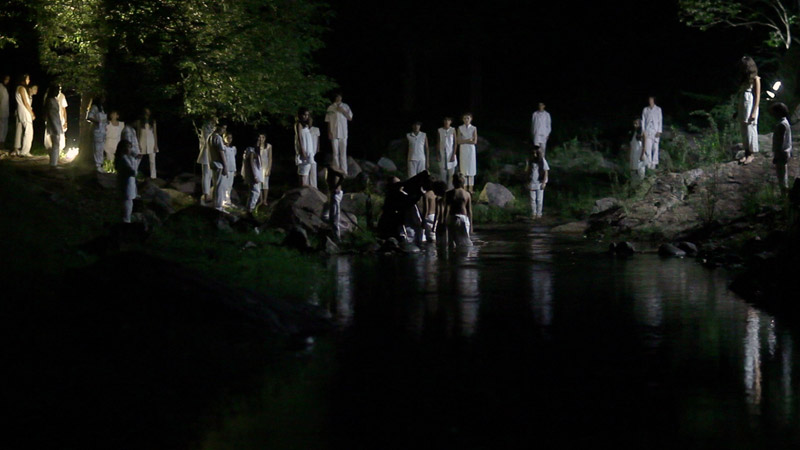
Children of the Night is a film that offers a fairly different take on the vampire lore, and seems just as interested in using the guise of the vampire tale to make societal commentaries as it is in twisting the tropes of the genre.

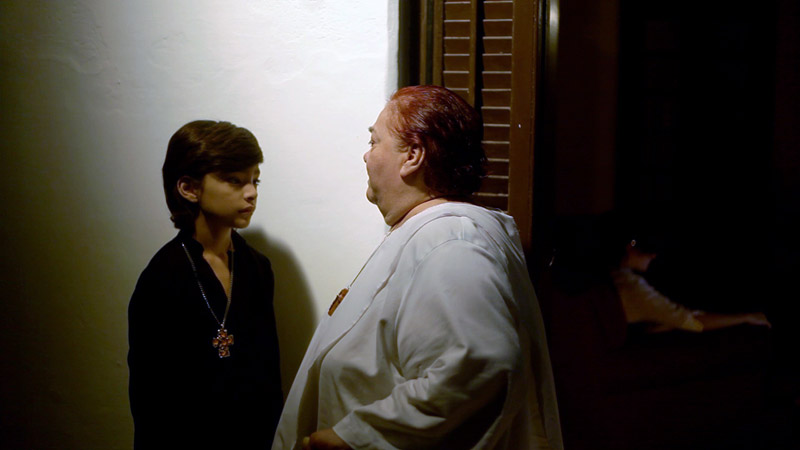
It kicks off with Alicia (Sabrina Ramos) being contacted at her newspaper about doing a profile on Limbo, which claims it is a group home for children with a rare disease. As Alicia arrives and starts talking to Erda (Ana Maria Giunta) the true vampiric nature of these inhabitants starts to make itself known, as well as why she was really asked to come.

The English title play off a famous quote from Dracula, and it’s not entirely unfitting. It allows the audience to some extent understand what the film will be about as well as disambiguating it from other films also entitled Limbo.There are also allusions to Dracula herein so that makes it even less of a stretch.

Children of the Night (2013, Artsploitation Films)

It’s nearly inevitable now that when you hear of a tale of vampires who are children you will invariably think of Let the Right One In, or the Amerian remake Let Me In. This film is neither of those films and it’s not really trying to be. Aside from the mystery portion of the tale, which is not that long, it’s not playing things entirely straight. There is much dark humor to be found and it’s much appreciated.

Also allowing the film stand out is that it combines story elements interestingly. There is a compulsory vampire hunter angle thrown into the mix, which allows some of the expected viscera and action sequences. However, much of the intrigue in this film are about interpersonal relationships, and the suspense elements are from learning new bits of information.

If you’re one who’s over-concerned with budget allow me to assuage your fears: yes, this is quite a microbudget film. However, the film nevr puts itself in situations where that becomes apparent or a detriment. in fact, there are instances where its refreshing to see something actually being done, instead of virtually occurring with the aid of CG. The film gets quite ingenius about it as well.

Children of the Night (2013, Artsploitation Films)

The locations, the way its shot, and the uniquely indigenuous and entrancing score crafted by writer/director Iván Noel help to create a very unique atmosphere. The two leads newcomer Ramos and renowned veteran Giunta are positively captivating in their scenes in tandem. They are buoyed by two fairly strong debut turns among the young cast by Lauro Veron and Toto Muñoz. The latter especially as he is our introduction to this world, and has some of the longest, soul-searching scenes within.

Children of the Night is not a run-of-the-mill vampire tale. However, with the most recent surge in popularity of the vampire over (due mostly to an over-abundance of cynical, subpar, dime-a-dozen, mass-produced junk) the thoughtful well-rendered tale with laughs and gore within should still find an audience.

Bonus Features

Making-Of Featurette

Children of the Night (2013, Artsploitation Films)

It’s always interesting to see making-of featurettes. In this case it is especially intriguign to see some of the restraints they faced. You also see some footage from preproduction through to the making of the film, along with theatre games to get the kids warmed up. There are some English titles to give one a sense of information though I will warn viewers: my Spanish is pretty good so I got everything I could out of the featurette. Some may not.

Commentary

Children of the Night (2013, Artsploitation Films)

If some parts of the feturette leave you wanting the director’s commentary will help. Noel discusses the makign of throughout, all in perfectly enunciated English, and gives you soem great insights. While on occasion there’s some overload for those not as interested in the technical or textual aspects, he does counterbalance that by not talking the entire time and letting some scenes play out.

Children of the Night is available today on digital platforms, DVD, and Blu-ray.

It runs 105 minutes, with dialogue in Spanish subtitled in English.

Review: Birds of Passage

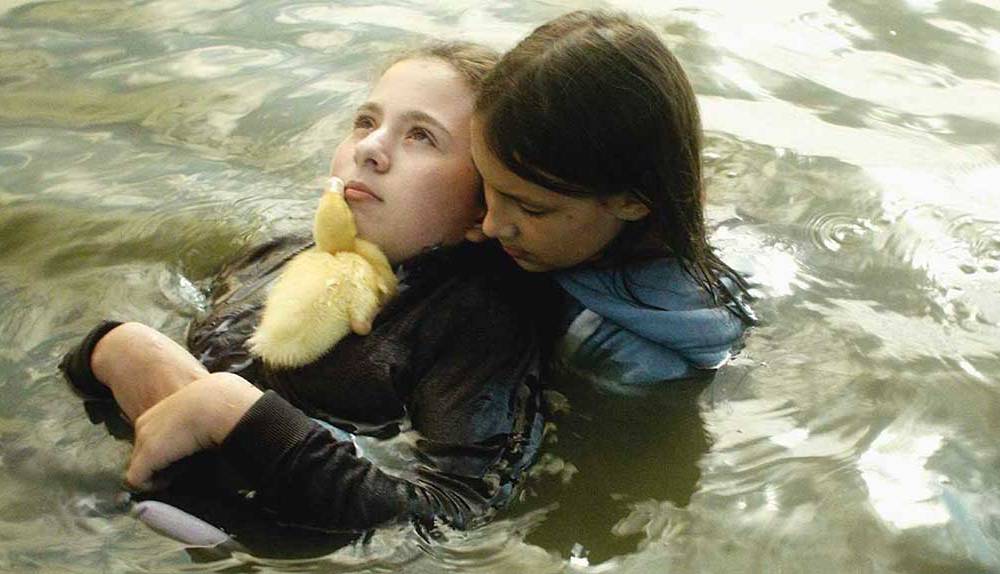
Birds of Passage tells a story that in synopsis, and in the trailer appears to be quite charming. The set-up is a simple one: Cathy (Clarisse Djuroski) receives a duck egg from her father (Alain Eloy) for her tenth birthday. The duckling imprints on her friend Margaux (Léa Warny) as its mother. Margaux is disabled, and wheelchair-bound so her parents do not think she can keep the duckling. Cathy and Margaux are then determined to find a way for her to care for the duckling at all costs.

This is a very simple, and straight forward story, which is always very refreshing. However, in a tale with so few sections where a single decision by a character can send it off the rails, it almost always veers off course, at least for the time being, and the total effect is irreparable to the end product.

In key moments there is a certain obtuseness to some of the characters that is hard to abide. This is not to say that characters, especially children, cannot make mistakes, it’s the how and when, combined with the predictably of the mistake or odd decision that ultimately makes this one hard to latch on to.

6106_piepkuikens

On positive notes: this film is a prime example of the importance of the first image we see, this one being a static shot of swans on a pond as the credits roll over it. There is a symmetry here, and a visual coming-of-age that is apparent and easy to admire. There is also throughout a reconciliation without speaking that is refreshing.

However, this brings us to yet another difficulty. In this film there are four parents, only one of whom is tolerable, in fact, he’s my favorite character. In coming-of-age tales individuation and parents being seen as a barrier is a natural state of affairs, but something’s off when the thought occurs to you “With parents like this who needs enemies?”

The young leads perform admirably, and the very close of the film, and occasional comic relief are nice but ultimately do not salvage the film. This is a film that should be a slam dunk: kids, one disabled, taking a road trip to not just save their duck from becoming pâté but so that it surrogate mother can usher it to its own independence (and their own), yet the whole thing becomes an example of how to take easily identifiable and watchable characters and situations utterly intolerable.

5/10

Review: Alfie the Werewolf (Dolfje Weerwolfje) (2011)

Introduction

A brief editorial note. Somewhere along the way laziness officially took over and I stopped citing both the original title and the English translation in reviews of foreign films. This is now a thing of the past. Enjoy!

Alfie the Werewolf (Dolfje Weerwolfje) (2011)

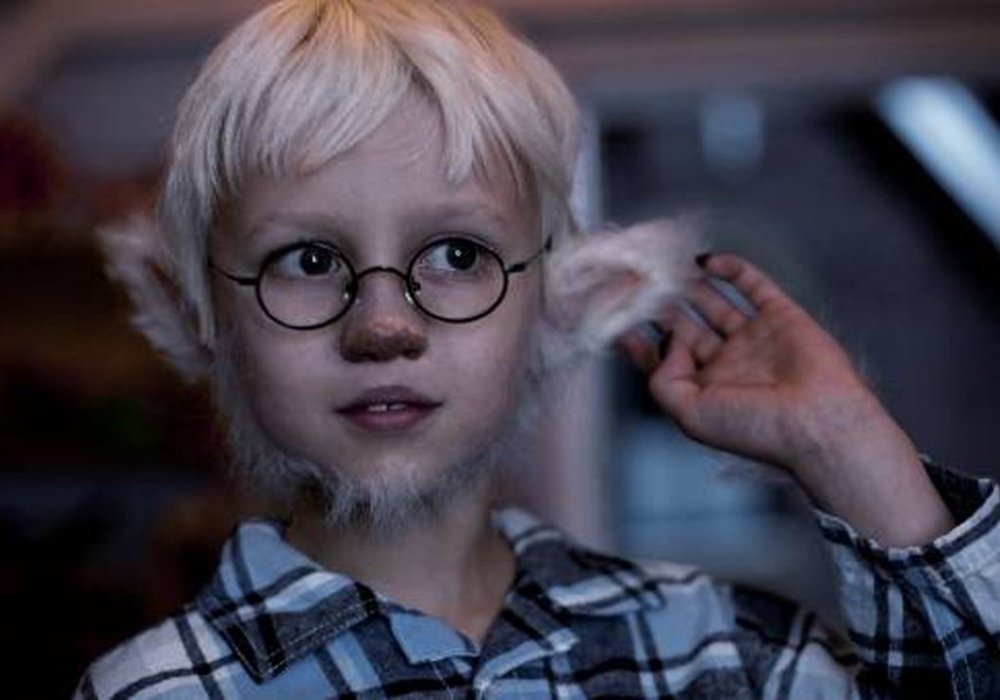
Alfie the Werewolf  is the tale of a foundling boy (Ole Kroes) who is staring to feel ostracized because he is treated differently than his brother (Maas Bronkhuyzen) at school. When the full moon comes he starts to discover just how different he may be. The title gives away just what tha difference is.

The treatment of the concept is most definitely one geared towards humor and a youthful audience, as opposed to one that lends an excessive amount of gravitas to it. The seriousness, the dramatic undertone, is left to the handling of the character’s wants and needs rather than any preternatural elements within the narrative.

If you’re looking for an analogous American film The Little Vampire comes to mind, even though I think that one plays into the darker side of the vampire lore albeit in an infantile fashion. In this film the werewolf is given the treatment of a kind of species rather than a curse or burden. This may be an expected approach when you consider this film is aimed at children. In certain ways, this also allows the condition to act as a metaphor, much as it always does.

Alfie the Werewolf (2011, Attraction Distribution)

While this is certainly not the film nor the score that Finn possesses Fons Merkies’ music is quite a standout in this film. It’s still fully orchestral but frequently has a melodic, lighter, jazzy feel that allows some of the common tropes of the subgenre to relax a bit.

Yet again this is an adaptation of a Dutch children’s novel. This series of books has been translated into English but their availability in the US in physical editions is scarce. They are easier to find as eBooks. Due to this fact its good that the film has been brought to North America through Attraction Distribution so that kids may be able to discover the story.

Perhaps what’s most refreshing about this film, from a production value and aesthetic standpoint, is the fact despite being a 2011 domestic release in the Netherlands it does not shy away from practical effects work. Yes, CGI is use where it’s truly beneficial like making the lycan child run about, but for more settled scenes he’s in a suit and make up. It is very well-done indeed.

Alfie the Werewolf is an enjoyable film for all members of the family, and perhaps most intriguing for parents is that it is a fairly benign way to reach a compromise with your kids on viewing material. It could satisfy the desire to see a werewolf movie but would not be potentially emotionally scarring in the process.

6/10

Review: The Magicians (2010)

The Magicians is a family film that works on a few levels in terms of the stories it tells and also in terms of the tones it is setting.

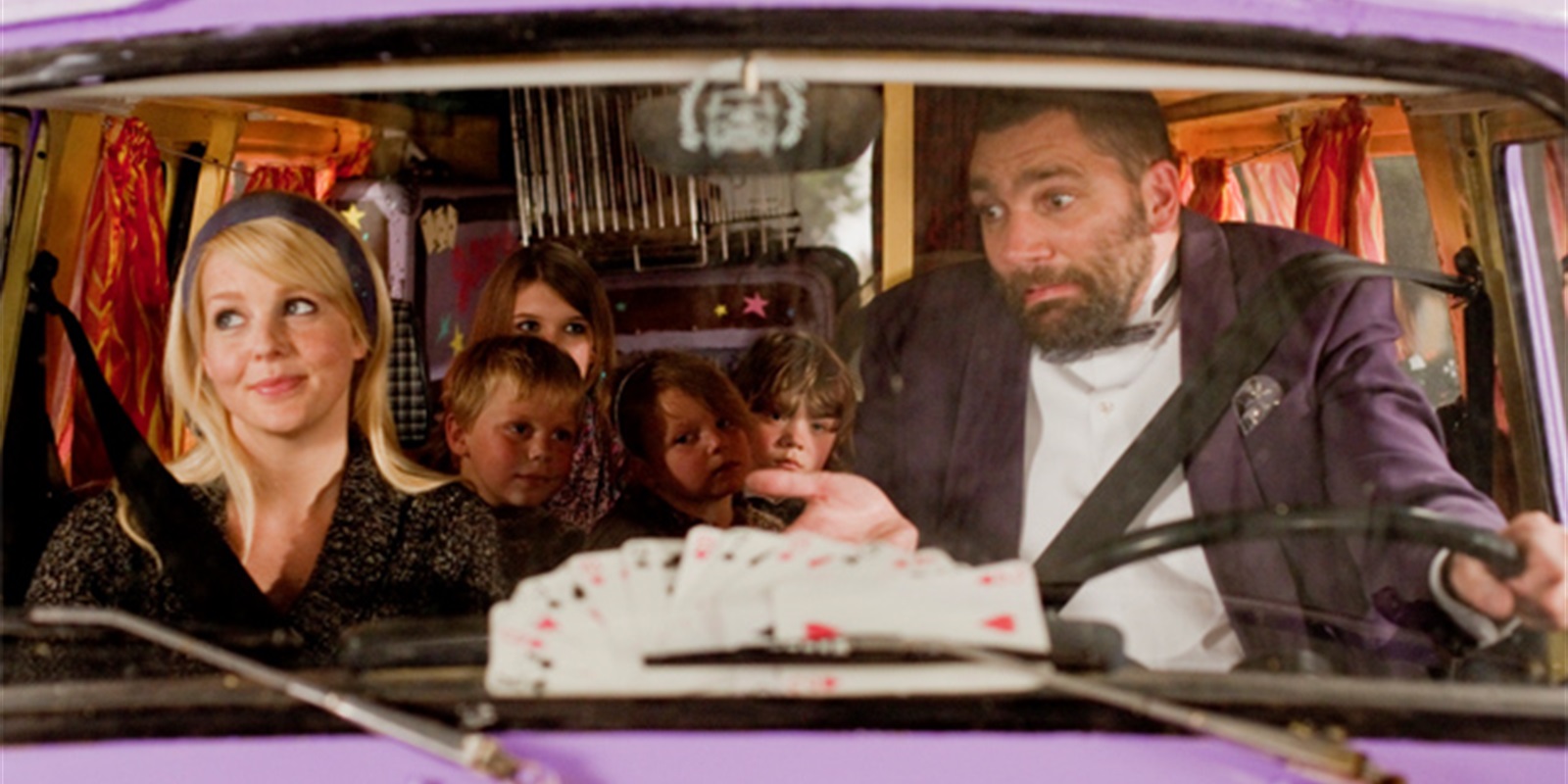
The Magicians concerns itself with a boy Ben (Thor Braun) who sees a magic show by the famous Hans Smid (Daan Schuurmans) and wants to learn magic. Seeing it as a good opportunity to bond with his son, Ben’s father, Koos (Theo Massen) agrees to learn with him and they form a team. His friend Sylvie (Java Siegertsz) acts as their lovely assistant. Everything changes for all involved when in the debut of their new disappearing trick, she really disappears.

One common pitfall of the family film this title manages to escape is that it manages to have humor and drama working in symmetry most of the time keeping the mood fairly light without diminishing the stakes. It doesn’t veer too far off course into overriding emotion or the another and doesn’t bludgeon you over the head with its messages them but rather incorporates them nicely into the action. The film also has a logical but unexpected turn of events that leads it towards its climactic sequence enjoyably.

The Magicians (2010, Attraction Distribution)

Another common pitfall of the family film is the buffoonish father trope, which can at times be too cartoony. The performance by Maasen in tandem with the writing make Koos and endearing and lovable sort despite his very apparent and numerous quirks. Also noteworthy here is the seemingly one-note, prototype of the too-cool older sister (Chantal Janzen) does have some unexpected and well-delivered variation in her arc also. Rounding out the cast are the winning Thor Braun equal parts convincingly awkward and convincing screen presence, and Schuurmans with a deliciously hammy supporting turn.

Most family films would only be tasked with resolving the concerns of one family unit. The Magicians decides to take the task of trying to sort out two family situations. There is also the ongoing struggle Sylvie faces in her house with her father living overseas and her mother being detached leaving her mostly to the care of an Au Pair. This dual purpose is most refreshing and combine that with the unusual-though-not-unprecedented disappearing foible it keeps you engaged.

The Magicians is well-edited and paced. It tells its story briskly, in a manner lacking pretension but conversely it’s not devoid of content. The whole family can enjoy, laugh, and learn from this film.

7/10