Mini-Review: Cody the Robosapien

Introduction

This is a post that is a repurposing of an old-school Mini-Review Round-Up post. As stated here I am essentially done with running multi-film review posts. Each film deserves its own review. Therefore I will repost, and at times add to, old reviews periodically. Enjoy!

Cody the Robosapien

MV5BOTAzNjMzMDUyNl5BMl5BanBnXkFtZTcwNTE2NzM2OQ@@._V1._SX640_SY360_

I previously had occasion to discuss the odd resume of Sean McNamara when Space Warriors was released earlier this year [At the time of this writing]. This the same guy who directed Soul Surfer and that is good, while Space Warriors most certainly is not. Some of it could have to do with the production gathered around the film. Some also invariably has to do with the story being told. I would peg Cody the Robosapien as being somewhere in between the two.

I knew that this was a pre-existing property but it was one I was merely aware of and not one I knew well. Regardless at one point this film was referred to as Robosapien: Rebooted and acts like an origin story so there’s no issue of pre-existing information we don’t have access to.

As a narrative this film is quite the weird one, it barely gets by (if you suspend much disbelief) when looking at the first and third acts in isolation. It’s in act two when the robosapien becomes more Jar Jar Binks-like than the affable, smart-kid prototype he was that issues come in, especially when trying to make it a whole. Yes, there is also filler and lapses, but it’s really the sideshow nature of the comedy, the seemingly unquestioned acceptance of the robot’s existence at school that start the downhill slide and introduces other issues.

As per usual, Bobby Coleman, as the young lead, is fantastic and a standout in this cast. He buoys the title much more than most would deem possible, and more than most actors his age could possibly hope to.

Considering how long this one sat around in the can I don’t know if there’s a future for this property anymore. However, it seems like if the vaudevillian aspect of Cody’s persona was reprogrammed it is a concept that could work.


5/10

Mini-Review: Aliyah

Introduction

This is a post that is a repurposing of an old-school Mini-Review Round-Up post. As stated here I am essentially done with running multi-film review posts. Each film deserves its own review. Therefore I will repost, and at times add to, old reviews periodically. Enjoy!

Aliyah

This film has a very interesting premise: a Parisian man dissatisfied with his life of dealing drugs and bailing his brother out of trouble seeks Aliyah, emigration to Israel, though he’s never been that in touch with his roots; he just seeks a new start. However, what occurs is a fairly bland, opaque character study of a many scarcely changing and hardly facing obstacles to reach what he thinks will be his change. There’s a rather New Wave ethos of seeing scene X then Z, such that you know Y occurred, so why bother watching it? However, that works better when impact is heightened. Here it is lessened. Furthermore, there is a late-film scene where if you haven’t followed the character’s plot his would-be girlfriend literally plots it out in a very thinly-veiled parable trying to keep him in Paris. Worse yet it changes nothing and her sudden head-over-heels passion for him never makes sense. This is a film that keeps one more disengaged than its lead seeks to be and fails because of it.

5/10

Updates 5/4/2015: Here, There, and Everywhere

Introduction

One thing I was aiming to avoid when starting my own page was being a slave to the cinematic news cycle. Not that there’s anything wrong with following industry headlines, and I usually comment on things I find compelling on Twitter. However, yesterday and today there has been a synergistic confluence of fantastic news, in my estimation. Therefore, when the bad news occurring in threes trend is reversed, I feel it should be fodder for my first update post in quite some time. So it’s what’s new on the site and the four bits of film news.

Blog News

MovieRatLogo2_1200x600

Yesterday I posted a new blogathon contribution.

The recent BAM Awards Considerations post was more appropriately populated.

Music Video Monday and Free Movie Friday will return soon.

Follow my Letterboxd as I may add the My Radar post there as a list. Also, other themes where I plan on doing year-round viewing will be viewable there too.

Also check out out all four of the new About pages if you’re so inclined.

Star Wars

VisionOntv-StarWarsTheEnvironmentalistsVersion608.mp4

Yes, it was just May the fourth and the forthcoming Episode VII played into it big time by releasing new images and information here.

Also recently it was announced that the Anthology films will be Rogue One, directed by Gareth Edwards. Rogue One centers on the Rebel plot to steal plans for the Death Star.

Star Wars: Episode II - Attack of the Clones (2002, 20th Century Fox)

It was also confirmed that the second anthology film, which Josh Trank just departed as director, will be about Boba Fett.

Pennywise cast for new adaptation of Stephen King’s It

Will Poulter (2013, Interview Magazine)

I don’t usually like to get into a casting decision that may still be in negotiations, but the idea of Will Poulter (Multiple BAM Award Winner) as Pennywise in the forthcoming two-part It film from New Line and director Cary Joji Fukunaga is so brilliant I have to applaud it repeatedly.

Recent Birthday Celebrants Making News

Ender's Game (2013, LionsGate)

Asa Butterfield (April 1st), BAM Award Winner for Ender’s Game, has been cited on the leaked shortlist of candidates to be the next Spider-Man. A few publications cite him as the favorite. If this does come to fruition, it’s awesome news.

Bobby Coleman (May 5th) appears to have a new title Momo announced per his IMDb page. Considering some of the notices I’ve given Coleman (which you can see below) it’s a wonder this is his first credit since 2013, and that title was long-in-the-can.

In The Haunting Hour:

What buoys this episode is the prosthetic work, the voice over of the creature, its conclusion and most importantly Bobby Coleman‘s performance, which may be the finest of the series to date.

In Cody the Robosapien:

As per usual, Bobby Coleman, as the young lead, is fantastic and a standout in this cast. He buoys the title much more than most would deem possible, and more than most actors his age could possibly hope to.

In The Last Song:

Most impressive in the film is Bobby Coleman, best known to some as the title character in The Martian Child, who plays the younger brother in this film and delivers a very compelling performance. Towards the end he does quite a bit of crying and considering this is his second tear-jerker style movie it can now be said with no exaggeration that his abilities as a crier now rank amongst the all-time greats, rivaling even Bobs Watson.

Conclusion

It’s been too long since I posted an update, I will try to do this more regularly in a free-flowing manner.

Short Film Saturday: Rooty Toot Toot (1951)

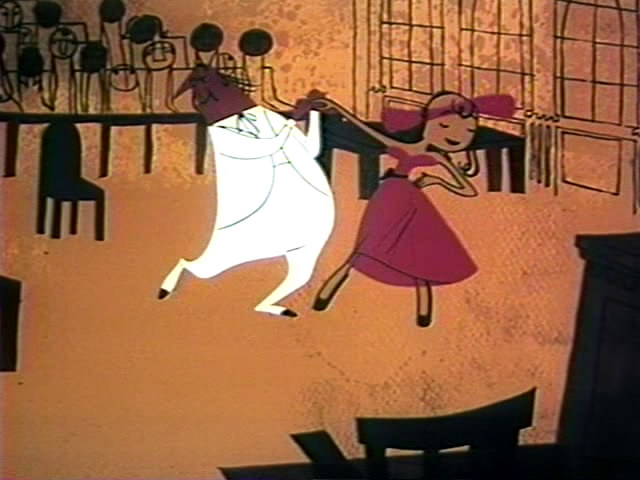
If you ever needed proof that even at the Academy Award-nominated level, even when the official category was called cartoons; that animation isn’t just for kids’ stories. This is proof. Sure, it was unlikely to be selected over The Two Mouseketeers (Tom & Jerry) and Lambert the Sheepish Lion (Disney), but its nomination is noteworthy. As is the musical treatment and minimalist animation style, and usage of color.

2015 BAM Award Considerations – April

I know that awards season on this blog just ended,  however, assembling those nominees is a year-long process. So the cycle begins anew with posts at the end of the month and master lists offline in preparation for the big dates of the award’s calendar year. Enjoy the scant January offerings. All titles viewed, new and old, can be seen on my Letterboxd.

Eligible Titles

Monkey Kingdom
Child 44
The Nun
God’s Slave
Wiplala
Seeds of Yesterday
Living is Easy with Eyes Closed
Woman in Gold
Get Hard
Tom Sawyer & Huckleberry Finn
If There Be Thorns
Furious 7
I Hate Christian Laettner
It Follows
Little Boy
Ex Machina
The Dead Lands
My Mistress

Best Picture

It Follows

Best Foreign Film

The Nun
God’s Slave
Wiplala
Living is Easy with Eyes Closed
The Dead Lands

Best Documentary

Monkey Kingdom
I Hate Christian Laettner

Most Overlooked Picture

As intimated in my Most Underrated announcement this year, I’ve decided to make a change here. Rather than get caught up in me vs. the world nonsense and what a film’s rating is on an aggregate site, the IMDb or anywhere else, I want to champion smaller, lesser-known films. In 2011 with the selection of Toast this move was really in the offing. The nominees from this past year echo that fact. So here, regardless of how well-received something is by those who’ve seen it, I’ll be championing indies and foreign films, and the occasional financial flop from a bigger entity.

The Nun
God’s Slave
Wiplala
The Dead Lands

Best Director

It Follows

Best Actress

Pauline Etienne The Nun
Helen Mirren Woman in Gold
Maika Monroe It Follows
Alicia Vikander Ex Machina
Emmanuelle Béart My Mistress

Best Actor

Tom Hardy Child 44
Will Ferrell Get Hard
Domhnall Gleeson Ex Machina
James Rolleston The Dead Lands
Harrison Gilbertson My Mistress

Best Supporting Actress

Noomi Rapace Child 44
Louise Bourgoin The Nun
Isabelle Huppert The Nun
Natalia de Molina Living is Easy with Eyes Closed
Emily Watson Little Boy

Best Supporting Actor

Gary Oldman Child 44
Geza Weisz Wiplala
Paul Kooij Wiplala
Kevin Hart Get Hard
Cary-Hiroyuki Tagawa Little Boy
Oscar Isaac Ex Machina

Best Performance by a Young Actress in a Leading Role

Best Performance by a Young Actor in a Leading Role

Sasha Mylanus Wiplala
Francesc Colomer Living is Easy with Eyes Closed
Joel Courtney Tom Sawyer & Huckleberry Finn
Mason Cook If There Be Thorns
Jakob Salvati Little Boy

Best Performance by a Young Actress in a Supporting Role

Kee Ketelaar Wiplala
Kat McNamara Tom Sawyer & Huckleberry Finn

Best Performance by a Young Actor in a Supporting Role

Jake T. Austin Tom Sawyer & Huckleberry Finn

Best Cast

The Nun
God’s Slave
Wiplala
It Follows
Little Boy
Ex Machina

Best Youth Ensemble

Child 44
Wiplala
Tom Sawyer & Huckleberry Finn
Little Boy

Best Original Screenplay

God’s Slave
It Follows
Little Boy
Ex Machina
The Dead Lands

Best Adapted Screenplay

Child 44
Wiplala
If There Be Thorns

Best Score

Child 44
The Nun
Wiplala
It Follows
Little Boy

Best Editing

Monkey Kingdom
God’s Slave
Wiplala
It Follows
Little Boy

Best Sound Editing/Mixing

God’s Slave
Wiplala
Furious 7
It Follows
Little Boy
The Dead Lands

Best Cinematography

Monkey Kingdom
The Nun
It Follows
Little Boy
Ex Machina
The Dead Lands

Best Art Direction

Child 44
The Nun
Wiplala
It Follows
Little Boy
Ex Machina
The Dead Lands

Best Costume Design

Child 44
The Nun
Tom Sawyer & Huckleberry Finn
It Follows
Little Boy
The Dead Lands
My Mistress

Best Makeup

Child 44
The Nun
It Follows
Little Boy
The Dead Lands
My Mistress

Best Visual Effects

Wiplala
Ex Machina

Best (Original) Song

Wiplala
Furious 7

I commented last year that there was a film that had me reconsidering the soundtrack as a potential category. It’s happened again so I will be tracking it and seeing if it’s worth re-including this year.

Best Soundtrack

Monkey Kingdom
Wiplala
Living is Easy with Eyes Closed
Furious 7

Review – My Mistress

My Mistress will be released on DVD on May 5th and is the first title I’ve been able to sample from Film Movement’s newest imprint Omnibus Entertainment. Having just recently rolled out Ram Releasing one might wonder what the focus of Omnibus is:

Omnibus Entertainment brings compelling motion picture features, acclaimed television programming and insightful documentaries from around the world to North American audiences. Dedicated to providing quality content “for all,” Omnibus Entertainment includes a growing catalog of carefully curated titles with appeal that extends beyond the dedicated art house and film festival enthusiast.

So the line of delineation seems to be Film Movement is arthouse, RAM is genre titles fro adults (note their horror offerings like App, Moebius and A Life in Dirty Movies); while the first offering from Omnibus is an erotic drama looking at their site certainly indicated they will bring in varied film styles befitting their name. It’s another exciting development from Film Movement who will also introduce a restoration and repertory imprint called Film Movement Classics; adding to to the legion dedicated to preservation and rereleases.

As for My Mistress, the synopsis is as follows:

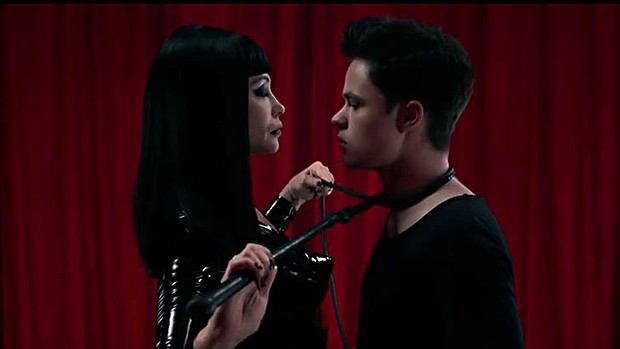
It’s a long hot summer for sixteen-year-old Charlie Boyd. He just found out his mother is having an affair with his father’s best friend, but is distracted from his problems by the mysterious woman down the street who has visitors day and night. After a sudden family tragedy Charlie is overwrought with pain. At first feeling hopeless, Charlie soon finds solace in Maggie, the beautiful French stranger, a dominatrix who teaches him the seductively beautiful side of pain, and how it can heal his emotional wounds. What starts as a perverse game quickly turns into a taboo love affair. And as Charlie learns to control his pain he turns that control back onto his mistress.

What occurs in My Mistress is that the tale is mostly segregated telling of the personal dramas of interconnected characters who too rarely consult one another about their issues. While they do spend a good amount of time with one another they are usually struggling with their own baggage and rarely let the other person in. Usually these struggles become a bit redundant until either party lets the other in, which usually takes a bit too long to happen.

Aside from that we are frequently left holding the bag inasmuch as Maggie’s (Emmanuelle Béart) story is more muddled than Charlie’s (Harrison Gilbertson). Charlie deals with an almost instant shock that sends him into a spiral looking for answers, closure and to vent. We know Maggie has a child, she no longer has custody and her struggle is being exploited, but the motivations of the blackmailer are vague.

These subtleties are usually a boon to a film, when more complex emotions or situations are being conveyed. That’s not really the case here. Most of the narrative is pretty transparent and close to the surface such that any obfuscation seems like unnecessary coyness on the part of the film. It doesn’t develop intrigue but encourages detachment. This doesn’t make the film a total failure just one that falls well short of its potential.

Those who would be tuning in for the more lascivious aspects of the narrative also shouldn’t get their hopes up. For a film that ostensibly deals with BDSM it most of the time acts more like a metaphor than a gratuitous selling-point. The scenes where it is featured are tame; the tapping into the emotional pains that draw these characters to such activities is where most of the intrigue lies actually. The subjugation of sexuality to character and conflict are not an issue overall, it only becomes so when the portrait is hazy, and you’re left wanting more out of these two that’s when it becomes problematic.

For their efforts Emmanuelle Béart and Harrison Gilbertson should be commended. They play characters at opposite ends of the spectrum convincingly and seem to share a genuine connection within this film. Their pencil-sketch characterizations are about as fleshed out as the script allows them. Their engaging presence is much of what makes this film as watchable as it ends up being.

My Mistress unfortunately skims the surface and doesn’t have an abundance of complications. One wonders if a tightened edit would’ve benefited this film a bit. Instead of being a middle-of-the-road tale, a bit more risk, detail and definitive resolution may have alienated more, but yielded greater aesthetic results. Instead it serves the function of letting us know Béart is still here and Gilbertson has a promising future and not much else.

5/10

Review – The Nun

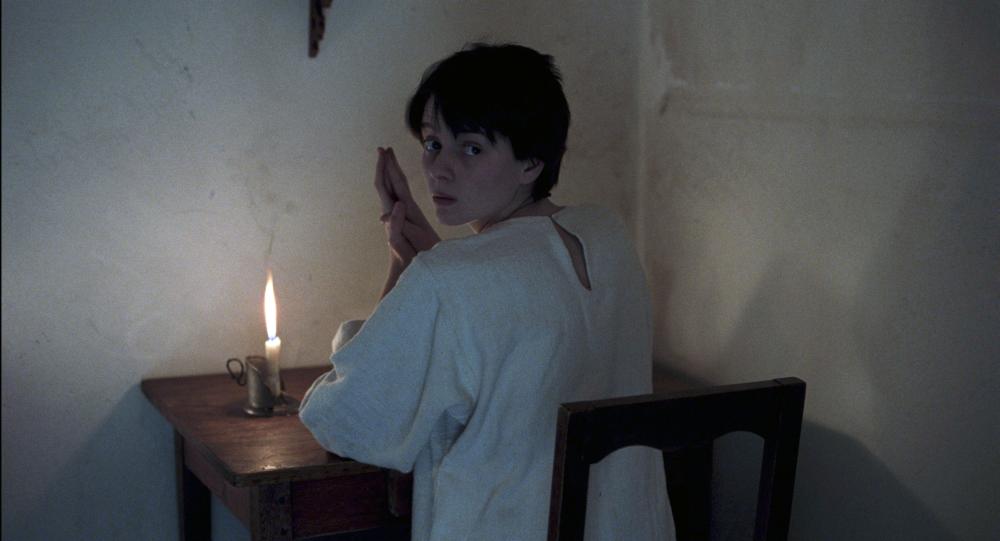
The Nun is based upon a classic French novel by Diderot, which has also inspired a classic film by Jacques Rivette. Having not been familiar with either rendition of the tale prior I cannot comment on its faithfulness of it or its lack thereof, but I was fairly riveted throughout much of this film. Its a tale where fate and circumstance take our protagonist and put her through the wringer and it seems there will be no end to her downward spiral. This is fairly standard of the fiction of the time. It is the rumination on convents, social mores, religion and the performances that give this film the variety it needs to work.

As stated by Film Movement the synopsis is:

Born to a bourgeois family in 1760s France, Suzanne is a beautiful young girl with a natural talent for music. Inexplicably, her parents abruptly decide to send young Suzanne off to a convent, where she resists structure at every turn until she discovers that she is an illegitimate child. Left with no other option, she pronounces her vows and suffers the consequences of her mother’s sin. Still uncertain of her path and wishing to revoke her vows, Suzanne’s only ally, the Mother Superior, dies and is succeeded by Sister Christine, a sadistic and cruel woman who inflicts the worst forms of humiliation imaginable upon the young nun. Suzanne is finally transferred to another convent, only to discover another kind of Mother Superior, a woman who develops an inappropriately affectionate bond with her new charge. Ultimately, The Nun, based on the classic French novel by Diderot, is the story of a woman trying to resist imposed religious values and the dehumanizing effect of cloistered life.

What can plague a film of this kind, where there is virtually no escape throughout a vast majority of it, is the structure. Thankfully, there are changes in routine, locale and escalations in treatment, which invariably lead to different editing patterns that help spice up the flow. The film’s cut-points flowing one scene into another, cinematography and the sparing use of the mellifluous score also aid in varying what may seem like redundancy if one was merely looking at a beat-sheet.

Another interesting amalgamation of this tale is that there is an element of bildungsroman to this teardown of a religious convention and social mores. Suzanne’s virtual incarceration is incited by a trumped-up interpretation of her affection for a young man. Madame Simonin (Martina Gedeck) fearing that her daughter will make similar mistakes to those she made she is shipped to a nunnery. The over-punishment of children for the sins of parents are one thing, but the deeper commentary in this film is how a seemingly more religious society lead to the ruination of lives and the self-imposed strictures of religion lead to the corrosion of institutions like convents.

It seems as if its increasingly difficult to find films with a strong female presence these days. Never mind being progressive or passing the Bechdel Test, just having films fronted by female personages seems a rarer occurrence lately. Therefore, even though this is a eighteenth century tale about one woman needing to rebel simply to not be a victim of fate and circumstance it does remain significant and relevant. Having three very strong female performances at the forefront Suzanne (Pauline Etienne) and the Mother Superiors (Louise Bourgoin and Isabelle Huppert) is noteworthy indeed.

Most impressive about Etienne is that not only are there many notes to her performance, even many notes to her agonizing; never does her would-be martyrdom become trite or un-engaging. She remains magnetic and effective throughout and runs the gamut from ingenue to glassy-eyed mort vivant and everywhere in between. Isabelle Huppert’s desires fester and manifest themselves with equal parts awkwardness and oppression which create a perfect atmosphere of discomfort. The trap for Bourgoin’s character is being seemingly too one-dimensional. However, he cruelty is so perfectly-rendered it terrifies persistently without becoming cartoonish or boring.

The Nun lands a bit softer in the end than I anticipated perhaps because of the fact that it stuck too closely too the book, though I cannot say for certain. Regardless, the journey is well worth it. On the religious end it would be likely to draw skeptics and free-thinking believers alike. From the cinematic spectrum fans of dramas and French cinema should be on the look-out for this film.

7/10

Poverty Row April: Hearts of Humanity (1932)

Introduction

This is a post that is a repurposing of an old Poverty Row April post. As stated here I am essentially done with running multi-film review posts. Each film deserves its own review. Therefore I will repost, and at times add to, old reviews periodically depending on the theme. Enjoy!

Hearts of Humanity (1932)

They don’t make melodramas like they used to. To be a little less trite, because they make nothing like they used to, what made melodramas in the Pre-Code and Golden Age era work was the unrelenting wave of unabashed emotion, the incredible circumstance, be it hardship or triumph, the near-cloying tugging at heart strings in a tale with a more straight-forward narrative style made for a less cynical world. Yes, these date them, but any film from any period can be perceived as dated. What these films don’t fear is trying too hard for the emotional response.

In this film there’s an example of much of what I was talking about as a boy is orphaned one day through two unrelated acts. Both his parents die on the same day. His father has just learned of his mother’s demise when he meets his unfortunate fate. The plot that follows his less high-stakes to an extent, but it is moving. Jean Hersholt is endearing in the lead and Jackie Searl showed his ability to play endearing characters as well as conniving ones, though his Irish accent isn’t that great. It’s a simple film, but a truly enjoyable one in the style that only this era could produce.

8/10

Poverty Row April: The Night Rider (1932)

Introduction

This is a post that is a repurposing of an old Poverty Row April post. As stated here I am essentially done with running multi-film review posts. Each film deserves its own review. Therefore I will repost, and at times add to, old reviews periodically depending on the theme. Enjoy!

The Night Rider (1932)

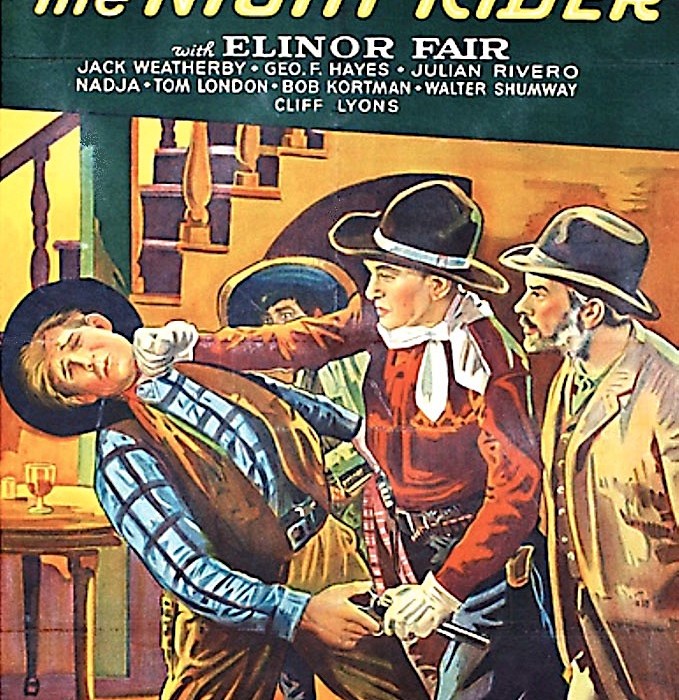
Here again we have another western tale with a mysterious desperado whose identity is withheld throughout. The issue that films of this kind have faced thus far is that they are so preoccupied with the opacity of the villain’s identity that little else, if anything, gets developed. There are many attempts at humor, which mostly fail; the identity is well-guarded, but the reveal is poorly staged, and lastly, the story just flatlines once it takes its sweet time establishing all its players. It does that clearly enough, but little of what follows is compelling.

3/10